Articles & BlogBy Trapper W. Brown12 min readBoth sides
Editing the genes of an embryo means changing the DNA of a fertilized egg in its first days, when it is a handful of cells in a lab dish. Because every cell of the future person descends from those few cells, the change is copied into all of them, including the eggs or sperm that person will one day make. The change can then pass to their children, and to theirs. Scientists call this heritable human genome editing. A genome is the full set of DNA instructions in a cell.
Why should you care? Because the tools have improved quickly, companies have formed to pursue it, and the argument is no longer about science fiction. One side sees a way to stop a deadly inherited disease before it starts. The other sees an experiment on people who cannot consent, with effects that run down a family line. This guide lays out both cases and does not pick one.
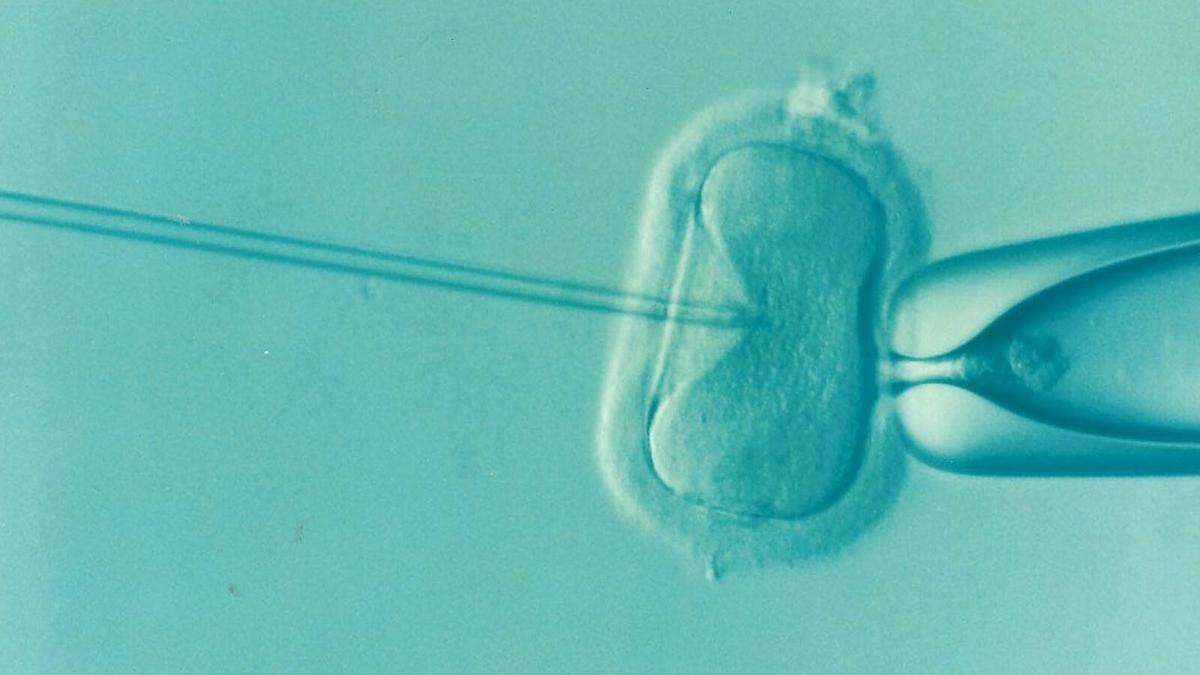 A glass needle enters a human egg during a fertility lab procedure; embryo editing would use the same kind of bench, dish and needle. Photo by Dr Elena Kontogianni, CC0, via Wikimedia Commons.
What is the difference between editing a patient and editing an embryo?
There are two kinds of gene editing in people, and the debate is about only one of them.
Somatic editing changes cells in the body of a living patient: blood cells, liver cells. The change stays in that person and ends with them. This kind is already medicine. On 8 December 2023 the U.S. Food and Drug Administration (FDA) approved Casgevy for sickle cell disease and called it the first approved treatment to use a genome editing technology. In 2025 the New England Journal of Medicine reported a baby with a severe metabolic disorder who received a gene editing treatment built for that one child, with no serious adverse events in the first seven weeks.
Heritable editing changes an embryo, an egg or a sperm, so the edit is in every cell and can be inherited. No country has approved it.
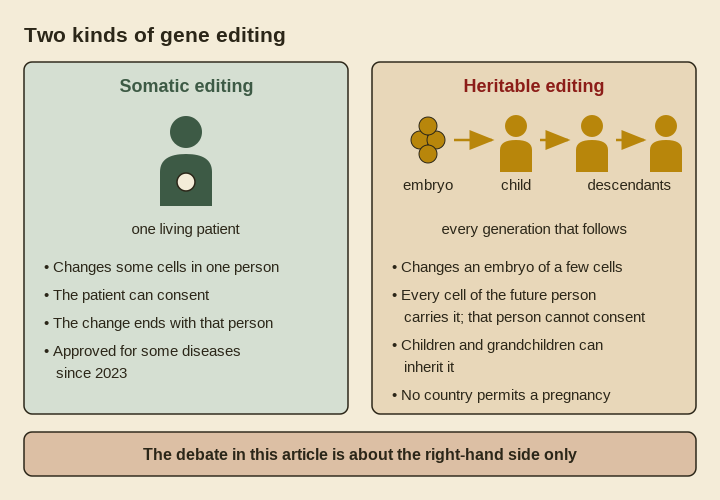 Somatic editing stops with the patient; heritable editing is copied into every cell and can pass to later generations.
What has actually been done?
Three children. On 30 December 2019 China's state news agency, Xinhua, reported that a court in Shenzhen had sentenced the researcher He Jiankui to three years in prison and a fine of 3 million yuan for illegal medical practice. The court said he had carried out embryo gene editing intended for reproduction and that three genetically edited babies were born. Those are the only births a court or government has confirmed.
Lab studies that found damage. The first widely used tool, CRISPR-Cas9, cuts both strands of the DNA and lets the cell repair the break. In embryos the repair often goes wrong. A 2020 paper in Cell found that about half of the breaks stayed unrepaired, and that cells then lost one or both arms of the chromosome. A 2021 paper in PNAS found unintended changes at the target site in about 16% of the embryo cells it analyzed. A 2017 paper in Nature had reported correcting a heart disease mutation with no off-target changes, and said much remained to be considered before any clinical use. The 2020 study showed that a broken chromosome can leave the mutated copy undetectable, which on a simple test can look like a repair.
Newer tools. Base editors change one DNA letter without cutting both strands. In October 2026 Nature published two studies that used them in human embryos for research. One reported editing every copy of a cholesterol gene called PCSK9 with no small insertions or deletions. It also reported rare chromosome breaks and uneven editing at other sites, and its authors wrote that these problems are "currently precluding the clinical use of base editing in reproduction."
A legal cousin. Britain allows mitochondrial donation, which swaps the small set of DNA in a cell's power plants without rewriting any gene. Parliament approved it in 2015, and a 2025 report in the New England Journal of Medicine counted 8 babies born this way at the one licensed clinic, in Newcastle.
What does the law say in November 2026?
| Place | The rule | Source |
|---|---|---|
| United States | The FDA may not spend money to acknowledge an application for research in which an embryo is "intentionally created or modified to include a heritable genetic modification." A separate rule bars federal health research funds from work that creates or destroys embryos. | Section 734 of Public Law 119-37 (12 November 2025); NIH notice of 18 March 2026 |
| United Kingdom | Only a "permitted embryo" may be placed in a woman, and that means one whose DNA has not been altered. The single exception is for mitochondrial disease. | Human Fertilisation and Embryology Act 1990, section 3ZA |
| Council of Europe treaty | A change to the human genome is allowed only if its aim is not to alter the genome of descendants. | Oviedo Convention, Article 13 |
| Worldwide | Of 96 countries with relevant policies, 75 prohibit starting a pregnancy with an edited embryo, and none explicitly permits it. | Policy survey in The CRISPR Journal, 2020 |
The U.S. rule lives in a yearly spending law, so it must be renewed each year. It limits what the FDA can review. Privately funded lab work on embryos that are never used for a pregnancy continues, as the 2026 studies and the report below show.
The expert bodies have been cautious and have not said "never." An international commission of the U.S. National Academies and Britain's Royal Society said in September 2020 that edited embryos should not be used for a pregnancy until precise changes can be made reliably, a standard it said no technology had met. If a country did allow it, the commission said, first uses should be limited to serious single-gene diseases in couples with no option or very poor options for an unaffected child. The organizers of the Third International Summit on Human Genome Editing wrote in March 2023 that heritable editing "remains unacceptable at this time." In May 2025 three gene and cell therapy societies called for a ten-year global moratorium. The Nuffield Council on Bioethics, a British ethics body, concluded in July 2018 that heritable editing "could be morally permissible" if it serves the welfare of the future person and does not increase disadvantage or division in society.
In September 2026 NPR reported from a New York startup that is testing gene editors on cells from donated embryos and whose founder says it may be time to reconsider the ban. The same report quoted scientists who said the company is moving too fast.
What is the strongest case for allowing it?
It prevents suffering at the root. A somatic treatment has to be given to each sick person in each generation. An edit made once in an embryo would remove the mutation from that child and from every descendant. For families who have watched a disease such as Huntington's or Tay-Sachs move through generations, that is the whole point.
Some couples have no other route to a healthy child of their own. Screening embryos works only when some embryos are unaffected. The next section shows the cases where none are.
The safety objection is about today's tools. The 2020 and 2021 damage studies used Cas9 cutting. The 2026 base editing papers show the error rate falling. Supporters argue that a ban written around one generation of tools should not outlive it, and they note that the 2020 commission laid out a path to the clinic and did not rule one out.
Parents already make choices for future children. People choose partners, use donor eggs and sperm, and screen embryos. No child consents to being conceived. On this view editing out a lethal mutation is a medical choice of the same kind, and refusing it is also a choice made on the child's behalf.
A ban moves the work; it does not end it. The 2018 births happened even though, as the court later found, the work was illegal. Supporters argue that a regulated path with public data is safer than leaving the field to whoever is willing to work out of sight.
What is the strongest case against?
The person most affected cannot consent, and neither can their descendants. A patient who accepts a risky treatment speaks for themselves. An edited embryo becomes a person who carries the result for life and passes it on. A mistake cannot be recalled.
The safety evidence is not there. Even the best 2026 result reported rare chromosome breaks, and its authors said clinical use is precluded for now. An embryo also cannot be fully checked: testing every cell would destroy it, so a doctor would be inferring from a sample.
The medical need is small. The head of one of the societies behind the 2025 moratorium call said there is "no compelling medical need." Embryo screening already lets most at-risk couples have an unaffected child, and somatic treatments are arriving for people who are sick.
The line between treatment and enhancement will not hold. NPR's 2026 report noted that other companies already screen embryos for traits such as height. They argue that once editing for disease is allowed, pressure will build to edit for height or intelligence, and that the result is a market in children's traits open mainly to the wealthy. Some add that it sends a message about whose lives are wanted.
Trust in the rest of gene medicine is at stake. The moratorium statement warns that moving early could damage the standing of somatic gene therapy, which is helping patients now.
Could embryo screening do the job instead?
Both sides lean on the same arithmetic. Screening, called preimplantation genetic testing, means making several embryos by in vitro fertilization (IVF), testing a few cells from each, and transferring one without the mutation. Here are three couples, each with 6 embryos to test.
| Couple | Chance each embryo is affected | Chance all 6 are affected |
|---|---|---|
| Both parents carry one copy of a recessive mutation | 1 in 4 | 1 in 4,096 |
| One parent has one copy of a dominant mutation | 1 in 2 | 1 in 64 |
| Both parents have the same recessive disease | 4 in 4 | Certain |
A recessive disease needs two bad copies, one from each parent; a dominant disease needs only one. For the first two couples, screening will almost always find an embryo to transfer. For the third, it never will. A parent who carries two copies of a dominant mutation is in the same position.
Opponents read the table as proof that editing is needed by very few families, who have other ways to become parents, such as donor eggs or sperm or adoption. Supporters read it as proof that some families are left with no way to have a healthy child who is genetically theirs, and note that the middle row gets less comfortable with fewer embryos: with 3, the chance that all are affected is 1 in 8. The 2020 commission described exactly this group as the only one it would consider first.
What is known, what is disputed, and what can facts not settle?
Known. Cas9 cutting damages chromosomes in a share of embryos. Base editing does less damage and still makes errors. Three edited children were born in China and a court punished the researcher. No country permits it. Somatic editing works for some diseases.
Disputed. Whether any tool can become safe enough, and how anyone would prove that without trying it in a pregnancy. How many families truly have no alternative. Whether a legal line between disease and enhancement can be enforced. Whether a moratorium slows unsafe work or just pushes it offshore.
Value judgments. How much risk it is fair to place on a person who cannot agree to it. Whether a genetic tie to one's child is a need medicine should serve. Whether the human gene pool is something each generation holds in trust or something parents may change. Whether preventing a disease also says something about the people who live with it.
The public is split in the same way. A Pew Research Center survey published in March 2022 found that 30% of U.S. adults thought widespread use of gene editing to greatly reduce a baby's risk of serious disease would be a good idea for society, 30% a bad idea, and 39% were not sure.
What to remember
- Both sides agree that somatic editing, which stops with the patient, is real medicine, and that today's tools are not safe enough to start a pregnancy with an edited embryo.
- Both sides agree that the 2018 births in China were wrong as carried out and that no country now permits the practice.
- Both sides agree that embryo screening already serves most at-risk couples.
- They divide on whether the remaining families are reason enough to build a path to the clinic.
- They divide on whether a line between preventing disease and choosing traits can hold once editing is legal anywhere.
- They divide on consent: whether deciding for a future person is ordinary parenthood or a step too far.
The U.S. limit comes up for renewal with each year's spending law, and the labs will keep publishing. Reading the next headline is easier with the two questions kept apart: can it be done safely, which experiments can answer, and should it be done, which they cannot.
Sources (21)
- FDA, "FDA Approves First Gene Therapies to Treat Patients with Sickle Cell Disease", 8 December 2023
- Musunuru and others, "Patient-Specific In Vivo Gene Editing to Treat a Rare Genetic Disease", New England Journal of Medicine, 12 June 2025
- Xinhua, "Three jailed in China's 'gene-edited babies' trial", 30 December 2019
- Zuccaro and others, "Allele-Specific Chromosome Removal after Cas9 Cleavage in Human Embryos", Cell, 10 December 2020
- Alanis-Lobato and others, PNAS, 1 June 2021
- Ma and others, "Correction of a pathogenic gene mutation in human embryos", Nature, 24 August 2017
- Jerabek and others, "Highly efficient base editing at PCSK9 and normal human embryo development", Nature, October 2026
- Bower and others, "Base editing reveals an essential role for NANOG in human embryogenesis", Nature, October 2026
- Human Fertilisation and Embryology Authority, "Mitochondrial donation treatment"
- Hyslop and others, "Mitochondrial Donation and Preimplantation Genetic Testing for mtDNA Disease", New England Journal of Medicine, 31 July 2025
- Public Law 119-37, Division B, section 734, 12 November 2025
- NIH, Notice NOT-OD-26-060, "Notice of Legislative Mandates in Effect for FY 2026", 18 March 2026
- UK Human Fertilisation and Embryology Act 1990, section 3ZA
- Council of Europe, Oviedo Convention, Article 13
- Baylis and others, The CRISPR Journal, October 2020
- National Academies, news release on the International Commission on the Clinical Use of Human Germline Genome Editing, 3 September 2020
- Organising Committee of the Third International Summit on Human Genome Editing, statement, March 2023
- ARM, ISCT and ASGCT, press release calling for a ten-year moratorium on heritable human genome editing, 27 May 2025
- Nuffield Council on Bioethics, "Heritable genome editing: action needed to secure responsible way forward", 17 July 2018
- NPR, Rob Stein, read on OPB, 29 September 2026
- Pew Research Center, "Americans are closely divided over editing a baby's genes to reduce serious health risk", 17 March 2022