Articles & BlogBy Trapper W. Brown9 min readCurrent to 13 November 2026Facts only
As of 13 November 2026, the federal rule on airline refunds is 14 CFR Part 260, "Refunds for Airline Fare and Ancillary Service Fees." It says when an airline flying to, from or within the United States must give your money back. The government's electronic copy of the rule shows no change to its text since 12 August 2024.
This follows the site's article "FAA Nationwide Ground Stop on November 13, 2026: What We Know." That piece covers what happened. This one covers the rule, using its own words and the Department of Transportation (DOT) pages that explain it. It is general information and not legal advice. Your airline and DOT are the authorities on your ticket, and the rule and DOT's pages can change, so check the official versions linked under Sources.
 A gate area at Long Island MacArthur Airport in February 2023. Photo by AITFFan1, CC0, via Wikimedia Commons.
Does the cause of the cancellation matter?
Not for the refund. The rule requires a refund "for any cancelled flight or significantly delayed or changed flight" when the conditions below are met. It lists no exception for weather, air traffic control or anything else. DOT's refunds page says the same: "A consumer is entitled to a refund if the airline cancelled a flight, regardless of the reason, and the consumer chooses not to travel or accept travel credits, vouchers, or other forms of compensation offered by the airline."
The federal statute behind the rule, 49 U.S.C. 42305, uses the same phrase, "any cancelled flight."
When is a refund owed?
Section 260.6 has two parts that must both be true.
First, the airline cancelled the flight or significantly delayed or changed it.
Second, you chose not to take what the airline offered instead. The rule says the refund is owed where the consumer chooses not to "fly on the significantly delayed or changed flight or accept rebooking on an alternative flight," or not to "accept any voucher, credit, or other form of compensation offered."
The refund is "a full and prompt refund of the airfare, including any taxes and ancillary fees," and the rule says it applies to "a nonrefundable ticket."
The rule also describes refunds that are due without your asking. A refund is due when:
- "A flight is canceled and a consumer is not offered an alternative flight or any voucher, credit, or other form of compensation";
- you reject the changed flight, the rebooking or the credit; or
- you do not respond to an offer and the flight leaves without you.
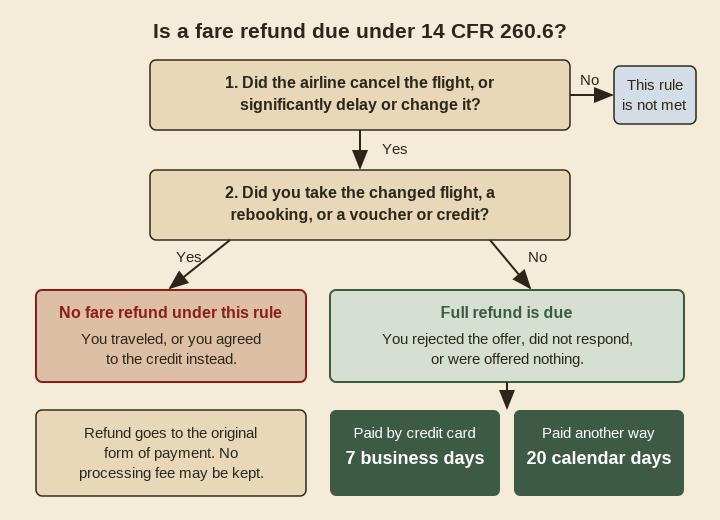 The two questions in 14 CFR 260.6, and the deadlines in the rule's definition of a prompt refund.
What counts as "cancelled" or "significantly" changed?
The rule defines both terms in section 260.2.
A cancelled flight is a flight "with a specific flight number scheduled to be operated between a specific origin-destination city pair that was published in the carrier's Computer Reservation System at the time of the ticket sale but not operated by the carrier."
A significantly delayed or changed flight is one where, because of the airline's delay or change, any of these is true:
| Change | Domestic trip | International trip |
|---|---|---|
| You leave earlier than first scheduled | 3 hours or more | 6 hours or more |
| You arrive later than first scheduled | 3 hours or more | 6 hours or more |
| Different departure or arrival airport | Counts | Counts |
| More connections than the original trip | Counts | Counts |
| Downgrade "to a lower class of service" | Counts | Counts |
Two more items apply to a traveler with a disability: being routed through different connecting airports, or being moved to a substitute aircraft where "one or more accessibility features needed by the customer are unavailable."
Notice what the delay test measures. It compares your new scheduled arrival with the original one. A flight that leaves two hours late and lands two hours late does not meet the three-hour line for a domestic trip.
One narrow pause in enforcement. DOT says that under this definition a flight given a different flight number than it had when the ticket was bought counts as cancelled. On 5 December 2025 DOT announced it would not enforce the refund requirements in that one case, and on 7 July 2026 it extended the pause to 7 July 2027. The notice says the pause "applies solely to situations where a flight is given a different flight number but the passenger is successfully rebooked on the new flight without experiencing a 'significant change or delay.'" It adds that if a number change comes with such a delay or disruption, "standard consumer refund mandates remain fully enforceable."
How fast, and in what form?
The rule defines a "prompt refund" by how you paid:
- Credit card: "within 7 business days after the earliest date the refund was requested."
- Cash, check, debit card or other payment: "within 20 calendar days."
"Business days" means "Monday through Friday, excluding Federal holidays in the United States." Seven business days is nine calendar days at the least, and more when a holiday falls inside the span. That arithmetic is mine.
DOT's refunds page does not match itself on the second deadline. One passage says "20 calendar days for other payments (e.g., cash or check)." Another says "20 business days (for cash purchases)." The rule text says 20 calendar days.
The money goes back the way it came. The rule says the refund "must be issued promptly in the original form of payment," and it gives the examples "a check, credit card, debit card, cash, or airline miles." A different form is allowed only if "the consumer agrees" and it is a cash equivalent. And: "Carriers may not retain a processing fee for issuing refunds that are due."
Vouchers and credits. An airline may offer one "as an explicit alternative" to a refund. The rule attaches conditions:
- the offer must include "a clear and conspicuous notice" of its terms and of "the consumer's right to a full refund";
- the credit must stay valid "for a period of at least five years"; and
- the airline "must not deem a consumer to have accepted" a credit "unless the consumer affirmatively agrees."
What about bag fees, extras and tickets bought through an agent?
Extras. The rule calls seat selection, Wi-Fi and similar paid add-ons "ancillary services." A fee is refundable "if the service was not provided through no fault of the consumer," and the rule's examples include a flight cancellation.
Checked bags. A bag fee is refundable if the bag is lost or "significantly delayed." For a domestic trip that means not delivered "within 12 hours of the last flight segment's arrival." For international trips the limits are 15 hours or 30 hours, depending on whether the nonstop flight to or from the United States is 12 hours or less, or longer. The airline has no duty to refund "unless a passenger files a Mishandled Baggage Report."
Travel agents and booking sites. Who refunds you depends on the "merchant of record," which the rule defines as the entity responsible for processing the payment "as shown in the consumer's financial charge statements." DOT's page says: "Merchants of record are responsible for issuing refunds when they are due."
What does the rule not give you?
DOT's refunds page lists the cases where no fare refund is owed.
- You flew. "If you chose to take a significantly delayed/changed flight or an alternative flight offered by the airline, you are not entitled to a refund under DOT rules."
- The flight ran on schedule and you did not go. People with nonrefundable tickets who "decide not to travel or arrive to the airport late are not entitled to a refund when the flight operates as scheduled."
Part 260 is a refund rule. It does not set a payment for the delay itself, a hotel room or a meal. DOT's page says a traveler who takes a delayed flight "may be entitled to compensation for certain expenses and/or amenities if the delay was due to something in the airline's control," and points to each airline's customer service plan and to DOT's dashboard of airline commitments. That dashboard describes services airlines provide "when the cause of a cancellation or delay was due to circumstances within the airline's control."
Rebooking is also outside the rule. DOT's page says alternative flights are offered "although not required by DOT," and that an airline "can set a deadline for you to accept the offer."
What I could not confirm. The DOT pages I read do not say how a nationwide FAA ground stop is classified for the purposes of airline commitments. The July 2026 notice says DOT has a pending rulemaking on the definition of a cancelled flight and that the pause "does not prejudge the outcome." I read the Federal Register's listing for Part 260 on 13 November 2026, and it showed no proposed rule amending it.
What to do
These steps are DOT's, from its refunds and complaint pages.
- Watch your messages. DOT says to "pay close attention to emails, text messages, or mobile app notifications" so you know what the airline is offering and your refund rights.
- Decide before you accept. Taking the changed flight, a rebooking or a credit ends the fare refund under the rule. If you do want to travel, DOT says to tell the airline you accept "as soon as you can or before the response deadline set by the airline."
- Find the merchant of record. Look at your card statement. DOT says "it is important to find out which entity, the airline or the ticket agent, is the merchant of record."
- Start with the airline. DOT's complaint page says: "Before you contact DOT for help with an air travel problem, you should give the airline a chance to resolve it." It says airlines must acknowledge a complaint within 30 days and answer in writing within 60.
- Then DOT. If the airline does not resolve it, the page says "you may want to file a complaint with DOT."
For a question about your own ticket or a dispute over money, the airline, DOT and, if you choose, a lawyer are the ones to ask.
What to remember
- The rule covers "any cancelled flight." DOT says the refund is owed "regardless of the reason."
- Two conditions: the airline cancelled or significantly changed the flight, and you did not take the new flight, a rebooking or a credit.
- "Significant" has set lines: 3 hours domestic and 6 hours international on departure or arrival, a changed airport, added connections, or a downgrade.
- Deadlines: 7 business days for a credit card purchase, 20 calendar days for other payment, to the original form of payment, with no processing fee.
- A voucher or credit is optional. It must last at least five years and you must affirmatively agree to it.
- The rule refunds money you paid. It does not set compensation for a delay.
This article describes the rule as its text stood on 13 November 2026. The regulation and DOT's refunds page, both linked below, are the versions that count.
Sources (7)
- Electronic Code of Federal Regulations, "14 CFR Part 260: Refunds for Airline Fare and Ancillary Service Fees", read 13 November 2026
- U.S. Department of Transportation, "Refunds", last updated 7 November 2025
- U.S. Government Publishing Office, "49 U.S.C. 42305: Refunds for cancelled or significantly delayed or changed flights" (United States Code, 2024 edition), read 13 November 2026
- Federal Register, "Airline Refunds and Other Consumer Protections" (notification of enforcement discretion), 7 July 2026
- Federal Register, "Airline Refunds and Other Consumer Protections" (notification of enforcement discretion), 5 December 2025
- U.S. Department of Transportation, "File a Consumer Complaint", last updated 1 August 2025
- U.S. Department of Transportation, "Airline Cancellation and Delay Dashboard", read 13 November 2026