Articles & BlogBy Trapper W. Brown10 min read
For anyone who has looked at the animal asleep on the sofa and wondered how a wolf ended up there. By the end you will know what the science has settled, what it is still arguing about, and why no other animal's story matches this one.
The dog is a domesticated wolf. That much nobody disputes. Almost everything else about the event, including when it happened, where, how many times and who started it, is still being worked out from old bones and older DNA.
It is worth knowing the real state of the evidence, because the popular versions run ahead of it. Some of what is said about dogs is solid. Some is one small study repeated until it sounds like a fact. This guide tries to keep the two apart.
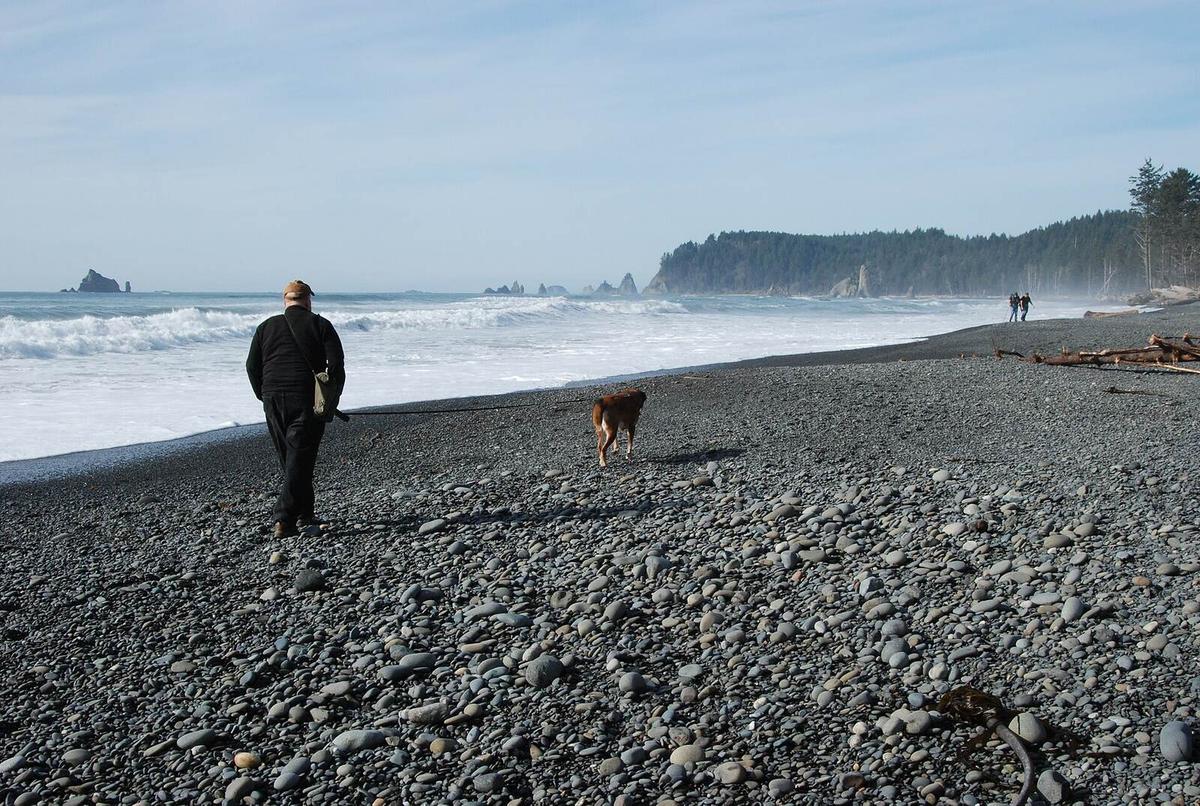 A walker and a dog on Rialto Beach in Olympic National Park, March 2015. The leash is the newest thing in this picture. National Park Service photo, public domain, via Wikimedia Commons.
Where did dogs come from?
From gray wolves, but not from any wolf alive today. That is the first surprise in the genetics.
In 2020 a team led by Anders Bergström sequenced 27 ancient dog genomes and reported in Science that all dogs share a common ancestry distinct from present-day wolves. Since domestication, they found, few wolf genes have flowed into dogs, though plenty of dog genes have flowed into wolves. An earlier study by Freedman and colleagues, in PLOS Genetics in 2014, compared living wolves from three regions once proposed as the dog's birthplace and found that none was more closely related to dogs than the others.
Put together, the usual reading is that dogs descend from a wolf population that no longer exists. Modern wolves are the dog's cousins.
The same 2020 paper opens with a plain statement: "Dogs were the first domestic animal." By 11,000 years ago, it found, dogs had already split into at least five major lineages. A species does not diversify like that overnight, so the origin must lie well before.
When and where did it happen?
Here the agreement ends. The proposals differ by more than ten thousand years.
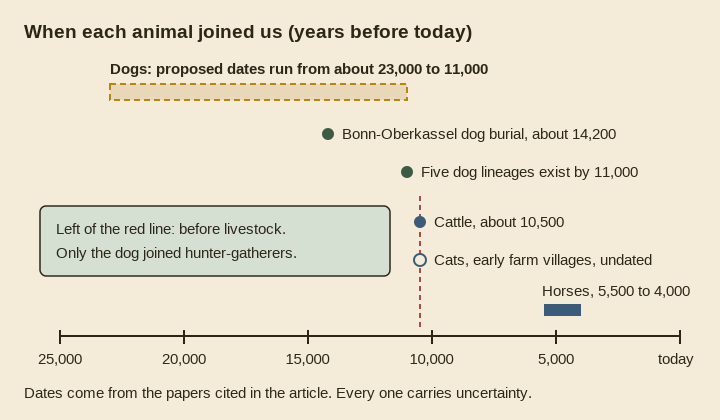 Every proposed date for the dog falls before the first livestock.
- Siberia, by about 23,000 years ago. Angela Perri and colleagues argued this in the Proceedings of the National Academy of Sciences in 2021. They compared the family trees of ancient people and ancient dogs across Siberia and the Americas and found that the branches split in step. Their suggestion is that people and wolves were shut in together during the coldest part of the last Ice Age, and that dogs then walked into the Americas with the first people, from about 15,000 years ago. The authors say the evidence "suggests" this. It is an inference from matching family trees.
- Somewhere in eastern Eurasia, or twice. In 2022 Bergström's group analyzed 72 ancient wolf genomes spanning 100,000 years, in Nature. Dogs turned out to be more closely related to ancient wolves from eastern Eurasia than from the west. But dogs of the Near East and Africa carry up to half their ancestry from a second wolf population. That could mean a second, independent domestication, or early dogs breeding with local wolves. The paper cannot tell which, and it adds that none of the wolves analyzed is a direct match for either ancestry. The source population is still missing.
- Between 11,000 and 16,000 years ago. This was the range Freedman's 2014 study drew from the genomes of living animals.
The safest summary is a window. Dogs existed well before 11,000 years ago, a dog was buried with people about 14,200 years ago, and one serious proposal reaches back to 23,000. The place was probably in Eurasia, and the number of times is open.
How does a wolf become a dog?
Wolves and Ice Age people were rivals. Both hunted large animals in groups, and each could kill the other. Three explanations are on offer for how that turned into partnership, and they are not exclusive.
Self-domestication around camps. The boldest wolves hung around human sites for scraps. Animals that tolerated people ate better and bred more, and tameness spread without anyone planning it. One piece of evidence once offered for this is in the next section, a starch gene, and it has not aged well.
Shared meat. Lahtinen and colleagues proposed in Scientific Reports in 2021 that Ice Age hunters had protein to spare. People cannot live on lean meat alone, because the liver can only process so much protein, while wolves can thrive on it for months. In harsh winters, the authors calculate, hunters would have had leftover lean meat to give away. They point out that every Ice Age site with early dog remains lay in a cold, subarctic kind of environment. The case rests on a calculation and a pattern across sites.
Hunting partners. In this view people and wolves hunted the same prey and learned to do it together, perhaps starting with pups raised in camp. It is plausible, and dogs clearly became hunting companions later. Direct evidence that hunting came first is thin.
All three share one point that the dates support. The people involved were hunter-gatherers. Lahtinen's paper puts it flatly: dogs are "the only ones domesticated by mobile hunter-gatherers." Every other domestic animal came after farming.
What do the oldest burials tell us?
Bones can show something DNA cannot: how people treated the animal.
The best known case is Bonn-Oberkassel in Germany, a grave found by workers in 1914. It held a man, a woman and the remains of two dogs, and it is about 14,200 years old. In 2018 a team led by Luc Janssens, a veterinarian and Leiden University researcher, re-examined the younger dog's teeth for the Journal of Archaeological Science. The dog died at about 27 or 28 weeks. Its teeth carry marks of repeated serious illness, which the team read as probable canine distemper caught at three or four months.
The authors argue that a puppy could not survive weeks of that illness alone. Someone must have looked after it, though it was no use to anyone in that state. Leiden's own summary adds the needed caution: a firm diagnosis is not possible, because none of the virus's genetic material survives. So the claim is care, inferred from teeth. It is a careful inference, and it is still an inference.
What changed inside the dog?
Three changes get the most attention. They do not rest on equally strong ground.
Reading people. In 2002 Hare and colleagues reported in Science that dogs are more skillful than great apes at using human signals, such as a pointing hand, to find hidden food. Wolves raised by humans did not show the same skill. Puppies a few weeks old did, even those with little human contact. In 2021 Hare's group compared 44 dog puppies with 37 wolf puppies in Current Biology. The dog puppies were more drawn to people, read gestures better and made more eye contact, while the two species scored alike on memory tests that involved no people. The reading is that domestication changed something social and left general problem solving alone.
Not everyone accepts that. In 2010 Udell, Dorey and Wynne argued in Biological Reviews that the skill can be explained more simply: an animal first has to accept humans as companions, and then learns that human hands lead to food. On their account, upbringing does much of the work that Hare assigns to genes.
Digesting starch. In 2013 Erik Axelsson and colleagues compared dog and wolf genomes in Nature and found 36 regions that looked shaped by selection. Nineteen held genes important in brain function. Ten genes had roles in digesting starch and fat, among them AMY2B, which makes an enzyme that breaks down starch. Dogs carry extra copies. The authors suggested this was a key early step: wolves that could live on human leftovers.
Later work moved the date. A 2016 study in Heredity counted AMY2B copies in dogs worldwide and found that dogs from the Arctic and Australia have few. It concluded that the change probably followed the spread of farming and was not part of the first domestication. A study of ancient dog bones the same year, in Royal Society Open Science, found the extra copies appearing in southeastern Europe about 7,000 years ago. So the starch gene is real, but it is a story about dogs adapting to farmers, thousands of years after dogs began.
The gaze and the hormone. In 2015 Nagasawa and colleagues reported in Science that when dogs gazed at their owners, the owners' levels of oxytocin rose, as measured in urine. Oxytocin is a hormone involved in bonding between mothers and infants. Dogs given oxytocin by nose gazed more. Wolves raised by people showed no such effect. The authors proposed a loop between the two species, borrowed from the one between parent and child.
It is a lovely idea and it may be right. The evidence is slim. A 2016 commentary in Frontiers in Neuroscience, by Kekecs and colleagues, noted that the key experiment had 28 dogs and only 11 wolves, that 82% of the dog owners were women against 55% of the wolf owners, and that the owner's sex had a larger effect on the hormone change than the species did. They estimated that 44 animals of each kind would be needed for a reliable test, and concluded that the limits "prevent us from concluding that this loop was acquired during domestication of the dog."
Why is this different from cats, horses and cattle?
| Dogs | Cats | Cattle | Horses | |
|---|---|---|---|---|
| When | Before 11,000 years ago, perhaps 23,000 | With early farming villages | About 10,500 years ago | About 5,500 to 4,000 years ago |
| By whom | Hunter-gatherers | Farmers | Farmers | Herders of the steppe |
| From | An extinct wolf population | Near Eastern wildcat | Wild ox (aurochs) | Wild horses |
| First use | Unsettled: companion, hunter, guard | Usually said to be pest control | Usually said to be meat and milk | Milking and bridling, later riding and chariots |
The sources: a 2007 genetic study in Science of 979 cats placed cat domestication in the Near East, probably alongside the first farming villages. A 2012 study in Molecular Biology and Evolution put cattle in the Near East about 10,500 years ago, from perhaps 80 wild females. A 2021 study in Nature of 273 ancient horse genomes found signs of early horse keeping at Botai in Central Asia around 3500 BC, and traced modern horses to the steppes near the Volga and Don rivers, from where they spread from about 2000 BC.
Four differences stand out, and the last two are my own reading of the evidence.
- Timing. The dog came first, by thousands of years, and before any farm.
- Purpose. Cattle and horses are usually thought to have been taken on for a product or a job. Nobody can name the dog's first job, and the oldest good evidence, a nursed puppy in a grave, is about care.
- Range of work. A cow gives milk, meat and muscle. Dogs hunt, herd, guard, haul sleds, find people by scent and guide the blind. No other species has been fitted to so many tasks that depend on understanding a person.
- Where they live. Dogs share the house, and only cats join them there. But the cat's skills are its own. The dog's, on Hare's evidence, are aimed at us.
And from a tamed wild animal?
Taming changes one animal in its lifetime. Domestication changes a population's genes over many generations. A hand-raised wolf is tame. Its pups are born wild.
Hare's 2002 result is the cleanest illustration. Wolves raised by people did not follow a pointing hand the way dogs do, while puppies that had barely met a person did. Whatever the dog has, a good part of it arrives with the puppy. A tamed animal has learned to put up with people. A dog is born expecting them.
What to remember
- Dogs descend from a wolf population that is now extinct. Living wolves are cousins.
- The dog was the first domestic animal and the only one domesticated by hunter-gatherers, before farming.
- When and where are unsettled. Proposals run from about 23,000 to 11,000 years ago, in Eurasia, possibly more than once.
- Dogs read human gestures unusually well from puppyhood. How much of that is inherited is still argued.
- The starch gene came with farming, later. The oxytocin gaze loop rests on one small study that has been criticized.
- Cats, cattle and horses joined farmers for a purpose. The dog joined hunters, and its first purpose is unknown.
The source population of wolves has not been found. When an ancient genome turns up that matches, several lines in this guide will need rewriting, which is how it should be.