Articles & BlogBy Trapper W. Brown8 min readCurrent to 13 November 2026Facts only
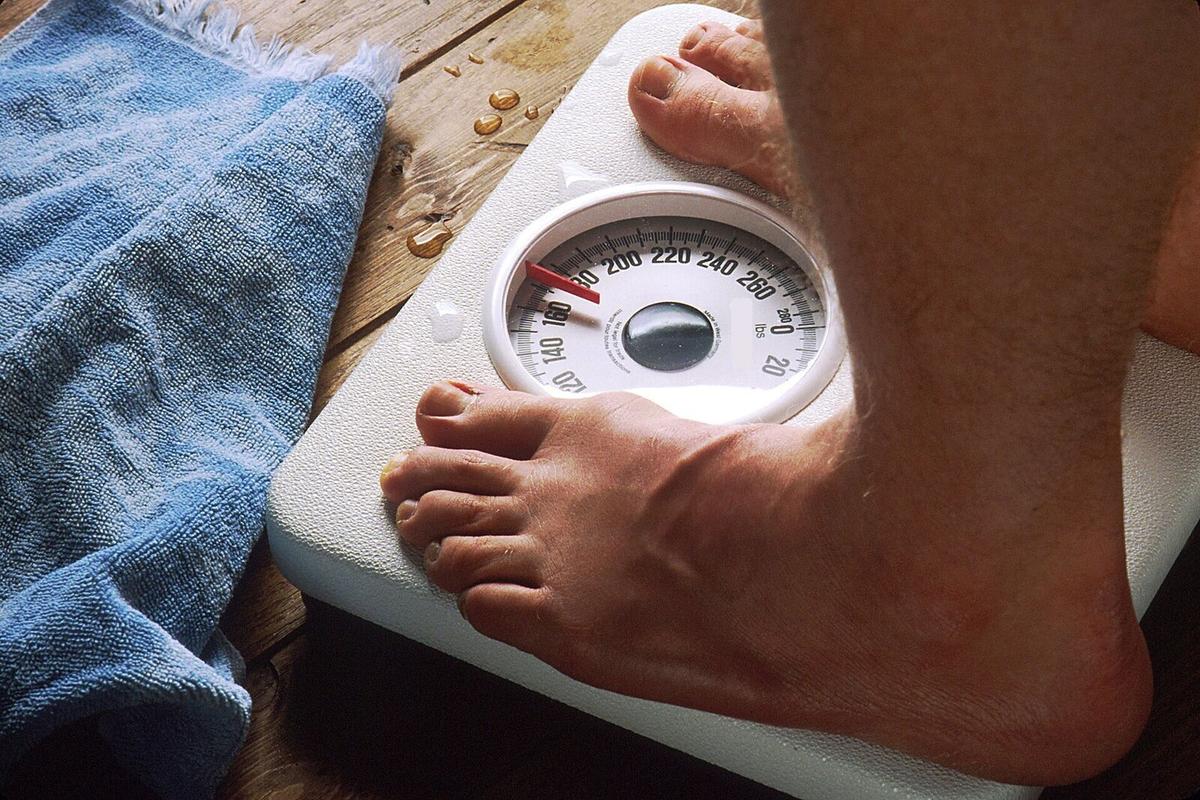 The CDC survey found reported GLP-1 use rose with body mass index, a number worked out from height and weight. Photo by Bill Branson, National Cancer Institute, public domain, via Wikimedia Commons.
As of 13 November 2026, the newest federal estimate of how many Americans take a GLP-1 medication is one day old. On 12 November 2026 the Centers for Disease Control and Prevention (CDC) published a survey report in its weekly journal, the Morbidity and Mortality Weekly Report (MMWR). Its headline finding, from answers collected in July and August 2025: "approximately one in 10 U.S. adults reported taking a GLP-1 medication during the past year."
Two other findings sit further down the report. About one in five users said they took a compounded version, and about two in five said they had changed how they took the drug "from the way it was prescribed." This article reports what the survey found and what it cannot tell you. It is not medical advice. Talk to your own clinician before you change anything about a medicine you take.
What is a GLP-1 medication?
The report describes them this way: "Glucagon-like peptide-1 (GLP-1) receptor agonists are medications that help regulate appetite, lower blood glucose levels, and promote weight loss." Blood glucose is blood sugar. The report says the Food and Drug Administration (FDA) has approved these drugs "for type 2 diabetes treatment, chronic weight management, and treatment of certain other health conditions."
The survey question named ten brands: Ozempic, Rybelsus, Wegovy, Mounjaro, Zepbound, Saxenda, Victoza, Trulicity, Byetta and Bydureon BCise. It told respondents these "might contain semaglutide, tirzepatide, liraglutide, dulaglutide, or exenatide," which are the names of the active ingredients.
The same class of drugs is the subject of a new FDA label warning, covered in the site's article "The FDA's New Eye Warning on GLP-1 Drugs." I will not repeat it here.
How was the survey done?
The data come from the CDC's Rapid Surveys System, Round 7. The report says the system is "based on two commercially available, online survey panels," one run by NORC at the University of Chicago and one by Ipsos. A panel is a standing group of people who have agreed to answer surveys. The report says these panels "are based on probability samples of U.S. households," meaning households were chosen by a random method and did not volunteer themselves.
The survey collected answers in July and August 2025 and totaled 8,118 completed surveys. Everyone was asked one question: "In the past 12 months, have you taken an oral or injectable medication for diabetes or weight loss," followed by the brand list above. The 976 adults who said yes got follow-up questions.
The percentages in the report are weighted. Weighting means each answer counts a little more or a little less so that the whole group matches the U.S. adult population on known measures. Each estimate comes with a 95% confidence interval (CI), a range that expresses the uncertainty that comes from surveying a sample and not everyone.
Who reported taking one?
Overall, 9.8% of adults (95% CI 9.0 to 10.7) reported taking a GLP-1 medication in the past year. Use differed by group:
| Group | Reported use in past year | 95% CI |
|---|---|---|
| All adults | 9.8% | 9.0 to 10.7 |
| Females | 11.9% | 10.7 to 13.3 |
| Males | 7.6% | 6.7 to 8.7 |
| Ages 18 to 39 | 4.8% | 3.8 to 5.9 |
| Ages 40 to 64 | 13.7% | 12.3 to 15.2 |
| Ages 65 and older | 11.1% | 9.2 to 13.3 |
| Ever told they had diabetes | 47.4% | 42.8 to 52.0 |
| Never told they had diabetes | 5.7% | 5.1 to 6.4 |
| Uninsured | 2.7% | 1.7 to 4.1 |
Use rose with body mass index (BMI), a number worked out from height and weight. The report gives 8.1% for adults with overweight, 15.6% for adults with class 1 to 2 obesity, and 24.1% for adults with severe (class 3) obesity. Height and weight were self-reported.
Use was also more common among adults who reported sleep apnea (23.3% against 8.1% for those without) or cardiovascular disease (21.4% against 9.0%).
What is a compounded version, and how many took one?
The survey explained the term to respondents like this: "Compounded medications include the same active ingredients as popular brand name drugs but are not FDA-approved. They are made by specialized pharmacies and are often used as an alternative when a medication is in short supply."
Among GLP-1 users, 22.6% (95% CI 18.9 to 26.8) reported taking a compounded version. Another 8.8% did not know whether theirs was compounded. Reported compounded use was higher among females (27.3%) than males (14.8%), and higher among users with private health insurance (25.9%) than users with public health insurance (12.5%).
The report gives the regulatory background in a footnote. The tirzepatide shortage "was declared resolved on December 19, 2024," and the semaglutide shortage "on February 21, 2025." It adds: "After medication shortages are resolved, bulk compounding of these medications is no longer permitted by FDA." The survey ran after both dates, and its 12-month question reaches back before them, so the answers cover time on both sides.
The report states that compounded GLP-1 medications "are not reviewed by FDA for safety, effectiveness, or quality before they are marketed." The FDA's own page on the subject, current as of 1 October 2026, says a compounded drug "might be appropriate if a patient's medical need cannot be met by an FDA-approved drug, or the FDA-approved drug is not commercially available."
How many people changed how they took it?
The report says "approximately two in five GLP-1 medication users (44%) reported modifying their GLP-1 medication use from the way it was prescribed; skipping doses (28%) was the most common modification."
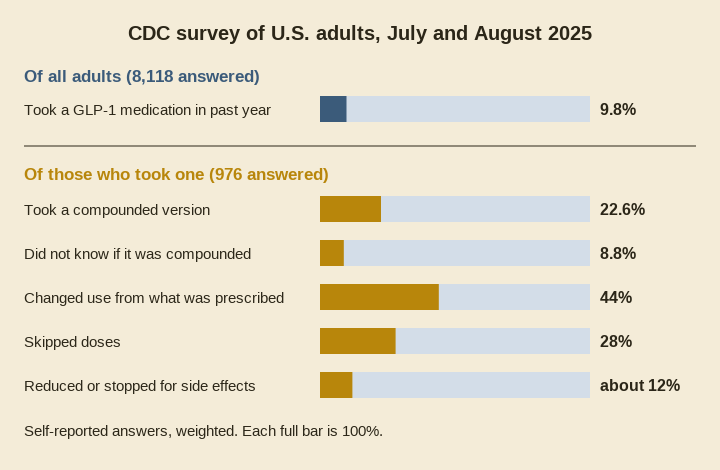 The survey's main estimates. Data: CDC, MMWR volume 75, number 44, 12 November 2026. Diagram by Warhawk Division.
Three comparisons stand out in the report's text:
- By age. 54% of users aged 18 to 39 reported a modification, against 30% of users aged 65 and older. Younger users "more often delayed prescription fills (37% versus 6%)."
- By compounded use. 62% of adults taking compounded versions reported a modification, against 36% of those not taking compounded versions.
- By reason. Among users who modified their use, "38% cited cost and 36% availability as reasons." Cost was cited by 58% of those aged 18 to 39 and 20% of those 65 and older.
Separately, the report says "approximately 12% of GLP-1 medication users reported reducing or stopping taking their medication due to side effects or symptoms."
The authors draw a careful conclusion from this. They write that the modifications "reflect, in part, responses to cost- and access-related challenges," and that better understanding of real-world use "is important because it might have implications for safety and effectiveness." The word is "might." The survey did not measure whether anyone was helped or harmed by a change.
What are the survey's limits?
The report says its findings "are subject to at least three limitations." In its words:
- First, "online panel surveys have low cumulative response rates, which could affect generalizability." The cumulative response rates were 13.3% for one panel and 3.8% for the other. Generalizability is how safely a result from the sample can be applied to everyone. The report says the CDC adjusts for nonresponse by weighting.
- Second, "online panel surveys might be less accessible to persons without reliable internet or computer access." The report notes that one panel offered telephone interviews.
- Finally, "measurement error from response or recall biases was possible." Recall bias means people misremember. Every number here is what people said about themselves over the past 12 months. Nothing was checked against pharmacy or medical records.
A few more limits follow from what the report does and does not contain. These are my reading of it, not statements the authors make:
- The question asked about medication "for diabetes or weight loss" as one item. The report gives no split between the two uses.
- The report does not say whether a clinician advised any of the reported changes.
- The modification and reason percentages appear in the text as whole numbers without confidence intervals. For the modification figures, the intervals are drawn as error bars on the report's Figure 1.
- On reasons, the authors themselves write that "there might be others that were not captured."
- Among users, 8.8% did not know whether their drug was compounded, so the 22.6% figure rests on what users knew about their own prescription.
What to do
The CDC report gives no instructions to patients. The steps below come from the FDA's page on unapproved GLP-1 drugs, current as of 1 October 2026. They are the agency's words, not my advice.
- The FDA says: "Patients should obtain a prescription from their doctor and fill the prescription at a state-licensed pharmacy."
- For compounded drugs sold in multi-dose vials, the FDA says: "Discard the vial within 28 days after the first use, even if medication remains in the vial."
- The FDA says: "Always use a new, sterile needle and syringe for each dose."
- The agency "recommends patients not use any injectable GLP-1 drug that arrives warm or with insufficient refrigeration."
- The FDA "encourages patients to talk with their health care provider or compounder about how to measure and administer the intended dose of compounded semaglutide or tirzepatide."
- If cost, supply or side effects are pushing you to skip, stretch or stop doses, that is a conversation for your own clinician or pharmacist before you change anything.
What to remember
- About one in ten U.S. adults (9.8%) reported taking a GLP-1 medication in the past year, in a CDC survey run in July and August 2025.
- Among adults who had ever been told they had diabetes, the figure was 47.4%.
- About one in five users (22.6%) reported a compounded version, and 8.8% did not know.
- About two in five users (44%) reported changing how they took the drug. Cost and availability were the most cited reasons.
- The survey is self-reported, has low response rates, and did not measure health outcomes.
The full report, its table and its figures are free to read on the CDC site. The questionnaire wording is in the report's table footnotes, which is the place to look before leaning on any one number.
Sources (3)
- Centers for Disease Control and Prevention, "Use of Glucagon-Like Peptide-1 Medications and Modified Medication Use Among Adults, United States, 2025", MMWR 75(44):645-651, 12 November 2026
- Centers for Disease Control and Prevention, the same report as a PDF, 12 November 2026
- U.S. Food and Drug Administration, "FDA's Concerns with Unapproved GLP-1 Drugs Used for Weight Loss", content current as of 1 October 2026