Articles & BlogBy Trapper W. Brown10 min readCurrent to 12 November 2026
An artificial reef is something people put on the seabed so that sea life will move in. The National Oceanic and Atmospheric Administration (NOAA) defines it as "a manmade structure that may mimic some of the characteristics of a natural reef." It can be a pile of limestone boulders, a set of concrete blocks, or an aircraft carrier.
Sinking a ship on purpose sounds like the opposite of protecting the ocean, and done badly it is. Done carefully, a retired ship becomes a home for fish, a destination for divers and anglers, and a way to dispose of a hull that would otherwise rust at a pier. This guide covers how it is supposed to work, what the evidence says, and where it has gone wrong.
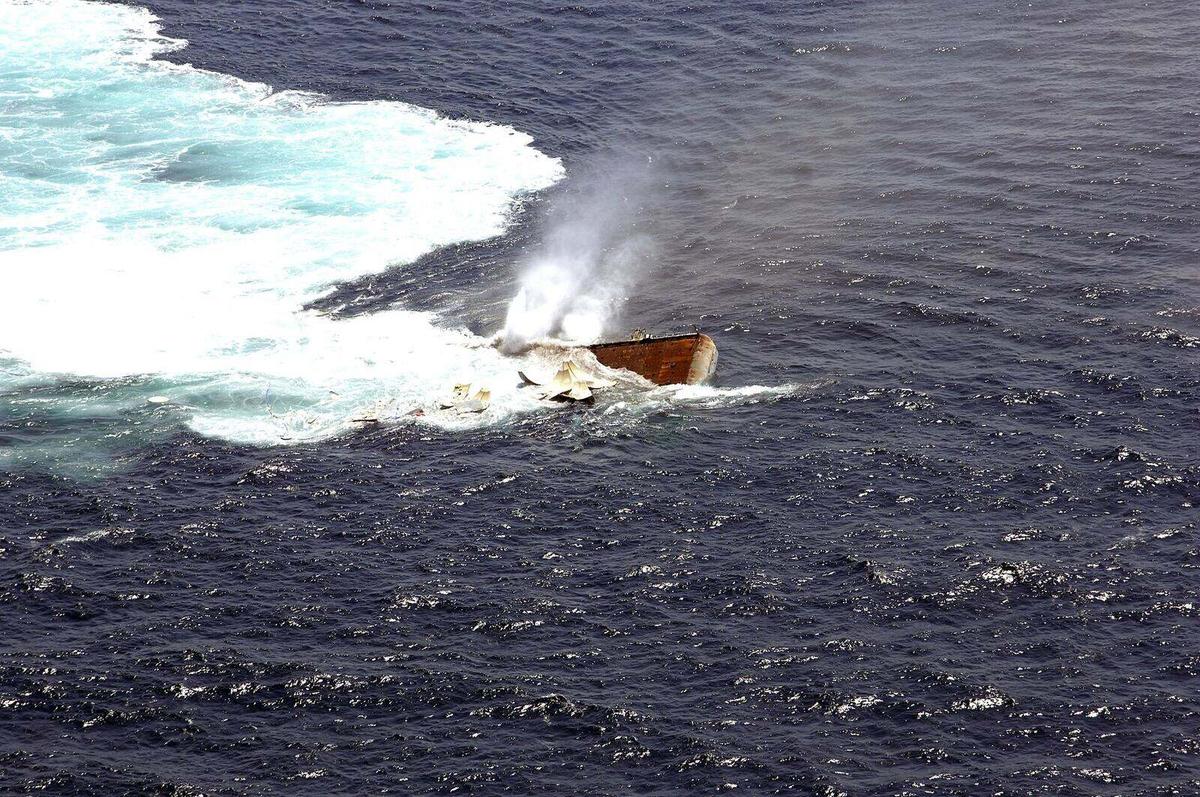 The final seconds of the aircraft carrier Oriskany on 17 May 2006, off Pensacola, Florida. The Navy's caption says the ship took about 37 minutes to go under. US Navy photo by Photographer's Mate 2nd Class Jeffrey P. Kraus, public domain, via Wikimedia Commons.
What is an artificial reef, and why use a ship?
Reefs of this kind are usually placed where the sea floor is flat and featureless: sand or mud. Many fish and nearly all corals, sponges and barnacles need something hard to attach to or hide in. The US Maritime Administration (MARAD), which manages the government's fleet of retired ships, describes the idea plainly: a reef provides hard surfaces where algae and invertebrates such as barnacles, corals and oysters attach, and it gives structure and food to groups of fish.
A ship does this job well for three reasons.
- It is big and tall. A hull rises far off the bottom, so it offers habitat at many depths at once.
- It is full of holes. Decks, passages and compartments are shelter.
- It is available. An owner with a ship too old to sail has to do something with it. The other options are scrapping it or paying to keep it afloat.
MARAD's reef program dates to 1972, when Congress allowed obsolete Liberty ships from the reserve fleet to be transferred to states that applied. Later laws widened the program to other retired government ships.
What has to come off before a ship goes down?
Almost everything that is not steel. An old ship is a floating collection of things that do not belong in the sea: fuel, lubricating oil, asbestos insulation, old wiring, flaking paint.
The governing document is the "National Guidance: Best Management Practices for Preparing Vessels Intended to Create Artificial Reefs," published jointly by the Environmental Protection Agency (EPA) and MARAD in May 2006. Congress ordered it written. It sets a cleanup goal for each of six kinds of material.
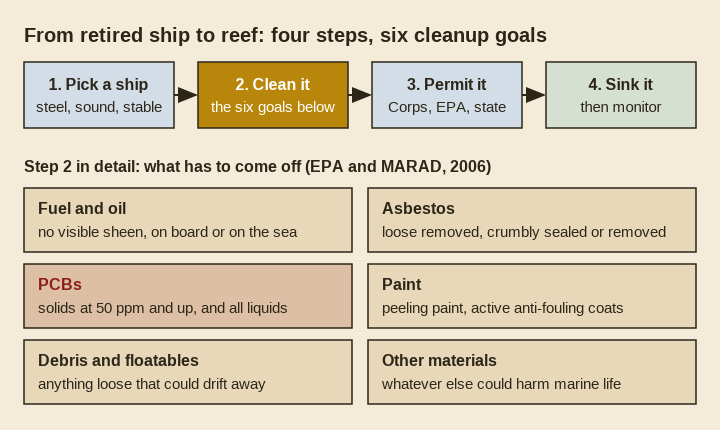 Cleaning is the long step. The sinking itself is over in a day.
Three of the goals deserve a closer look.
Fuel and oil. The guidance says to remove liquid fuels, oils and greases until no visible sheen remains on tank surfaces, and so that no sheen appears on the water when the ship sinks.
Asbestos. Loose asbestos comes out, along with any that could shake loose during the sinking. Accessible asbestos that crumbles is removed or sealed.
PCBs. Polychlorinated biphenyls are man-made chemicals that were used in electrical equipment, paints, plastics and rubber until their manufacture was banned in 1979. The guidance calls them persistent, and says they build up in the fatty tissue of fish and in the people who eat those fish. The guidance says to remove all manufactured products containing 50 parts per million or more of solid PCBs, and all liquid PCBs at any concentration. The legal rules sit in federal regulations at 40 CFR Part 761. If something at or above 50 parts per million cannot be taken out, the project needs a special risk-based approval from EPA.
The guidance is careful about its own limits. It says it "does not substitute for any statute or regulation," and that it neither endorses sinking ships nor compares it with the alternatives.
The engineering matters as much as the cleaning. Crews cut openings so water floods evenly, so the ship lands upright, and so divers and fish can get in and out. The guidance warns that ignoring stability during this work could lead to a premature and uncontrolled capsizing.
Four ships worth knowing
| Ship | Sunk | Where | Why it matters |
|---|---|---|---|
| Spiegel Grove, retired Navy ship | 2002 | Off Key Largo, Florida | NOAA says it was then the largest vessel ever deliberately sunk as a reef |
| Oriskany, Navy aircraft carrier | 17 May 2006 | About 22.5 nautical miles southeast of Pensacola Pass, Florida | Sunk under a one-ship PCB approval from EPA |
| Vandenberg, retired government ship | 27 May 2009 | Off Key West, Florida | Studied for its effect on nearby natural reefs |
| SS United States, ocean liner | 11 November 2026 | About 22 nautical miles southwest of Destin-Fort Walton Beach, Florida | Billed as the world's largest artificial reef |
The Oriskany is the test case for the PCB rules. Florida's Fish and Wildlife Conservation Commission gives the ship's length as 911 feet and says it rests in 212 feet of water. On 15 February 2006, EPA approved leaving PCBs aboard in solid materials such as cable insulation, gaskets and paint, about 700 pounds in all. EPA said it had reviewed leaching studies and risk models with its Science Advisory Board and concluded the sinking "will not pose an unreasonable risk to human health or the environment." The approval applied to that one ship, and it required Florida to monitor fish caught at the site to confirm they stay safe to eat.
The SS United States is the newest and the largest. The county notes that the 990-foot liner still holds the record for the fastest ocean liner, set in 1952. Okaloosa County, Florida, bought the ship from the SS United States Conservancy, and county commissioners set aside $13 million for the purchase, the cleanup in Mobile, Alabama, the tow and a museum on land. The county's page says the stacks and mast were kept for that museum.
Its status, as of 12 November 2026: the ship is on the bottom. A county release dated 26 October scheduled the sinking for 12 November, weather permitting, about 22 nautical miles southwest of Destin-Fort Walton Beach. The Woods Hole Oceanographic Institution, whose scientists are studying the wreck, announced that the ship was scuttled on 11 November 2026. Local news outlets reported that the county moved the date up a day because of forecast winds. The county's own question-and-answer page had not yet been updated when I read it on 12 November. It gives the planned depth as 180 feet to the bottom and about 55 feet to the upper deck.
Does a sunken ship make more fish, or just gather them?
This argument has a name: attraction versus production.
Fish show up at a new reef quickly, and anglers catch plenty. Does that mean the reef created new fish? Or did it only pull in fish that already lived nearby and concentrate them where they are easier to catch?
The scientist J. Bohnsack framed the question in the Bulletin of Marine Science in 1989. Reviewing the studies then available, he found that evidence for increased production was mostly anecdotal. He predicted the answer would depend on the place and the species. A reef is most likely to add fish where natural reef is scarce and for species that need hard bottom and stay put. It is most likely to only gather them where natural reef is plentiful, fishing is heavy and the fish roam widely. His last line is the caution managers still quote: artificial reefs are unlikely to help heavily fished populations without other management actions.
Later evidence is more encouraging about the habitat itself. A 2020 analysis in Frontiers in Marine Science by Avery Paxton and colleagues pooled 39 studies. It found that artificial reefs support fish density, biomass, species richness and diversity comparable to natural reefs. It also found that results varied with location and material, and it concluded that artificial reefs "are not one-size-fits-all tools."
The human side has been measured too. NOAA's Office of National Marine Sanctuaries studied both Florida Keys ships before and after they went down. Its summary says the Spiegel Grove benefited both the local economy and the local ecology. The Vandenberg gave the dive business a major boost at a time when general sales in the local economy fell almost 12 percent. But unlike the Spiegel Grove, the Vandenberg did not take pressure off the surrounding natural reefs. So many new divers came that use went up on the natural reefs as well.
A reef ship can succeed as a business and still not deliver one of the conservation benefits hoped for.
When reefs go wrong
The standard warning is a pile of tires off Fort Lauderdale. Florida's Department of Environmental Protection says that in the 1970s between 1 million and 2 million tires were put in the ocean off Broward County to create fish habitat. Over the years, tropical storms and hurricanes moved many of them, and the moving tires damaged nearby natural coral reefs. The state runs a project to haul them back out, and its newest removal contract was signed in September 2025.
Florida's current rules ban tires, fiberglass boats, plastic, automobiles and appliances as reef material. They allow concrete, limestone boulders and heavy-gauge steel.
Ships carry their own risks. Pollutants are the first, which is why the cleanup list exists and why the Oriskany came with a fish monitoring order. Staying put is the second: the federal guidance says conditions at the site can critically affect whether reef material stays stable over the long term. The third is the one Bohnsack raised. A reef that makes fish easy to find can increase the catch without increasing the fish.
What else gets sunk?
Ships get the headlines. Most reefs are humbler.
- Concrete and rock. Purpose-built concrete modules, including the hollow domes with holes often called reef balls, are the workhorses, along with clean concrete rubble and limestone.
- Subway cars. Delaware's Redbird Reef holds more than 700 retired New York City subway cars, according to the state's environment department, which also counts 86 tanks and armored personnel carriers and 32 retired vessels across its reef sites. The state estimates reef fishing adds $7 million a year to its coastal economy.
- Oil and gas platforms. Under Rigs-to-Reefs, an operator can leave the steel frame of a retired platform in the water as a reef if a state reef program takes it on. The Bureau of Safety and Environmental Enforcement says more than 600 platforms have been reefed in the Gulf. The frame is towed to a reef site, toppled in place, or cut so the top section rests beside the base.
Who gives permission, and how can you see one?
Nobody may sink a ship as a reef on their own say-so. The National Fishing Enhancement Act of 1984 set national standards and a permit system. The US Army Corps of Engineers issues the permits, under the Clean Water Act and the Rivers and Harbors Act. EPA handles the PCB rules, and the Coast Guard, NOAA and the state take part as well. In practice the applicant is a state or county reef program. Florida's wildlife agency notes that the Corps does not issue reef permits directly to the general public.
- Dive it. The Florida Keys National Marine Sanctuary's Shipwreck Trail includes reef ships at very different depths: the Amesbury in less than 30 feet of water, the Eagle in 110 feet and the Thunderbolt in 120 feet. The Oriskany rests in 212 feet of water, so ask a dive shop what training a site requires before booking.
- Fish it. State agencies publish reef coordinates. Florida lists more than 4,500 public artificial reefs.
- Stay dry. Okaloosa County has published a 3D model of the SS United States online.
What to remember
- An artificial reef is hard structure placed on a bare seabed. A cleaned ship is one kind. Concrete, rock and old oil platforms are others.
- Before sinking, fuel, oil, loose asbestos, PCBs at 50 parts per million and up, peeling paint and loose debris must come out.
- The Oriskany (2006) was sunk under a one-ship PCB approval with fish monitoring attached.
- The SS United States went down off the Florida Panhandle on 11 November 2026, according to the scientists studying it.
- Reefs gather fish quickly. Whether they add fish depends on the place and the species.
- The tire reef off Fort Lauderdale is the reminder that the wrong material does lasting damage.
For a next step, look up your own state's artificial reef program. Most publish a map, and the list of what is down there is usually stranger than you would guess.