Articles & BlogBy Trapper W. Brown6 min read
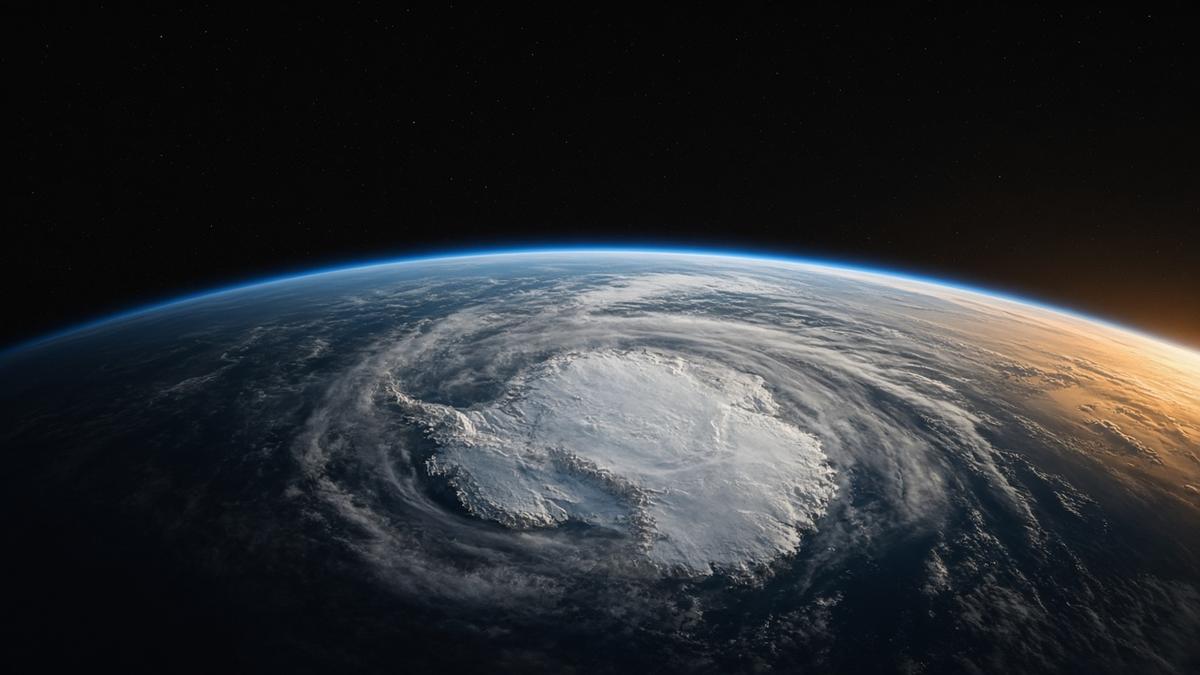 Illustration generated for Warhawk Division.
On 4 November 2026, NOAA and NASA reported that this year's Antarctic ozone hole was the seventh-largest in 48 years of monitoring. They blamed an unusually strong polar vortex. They also said the hole would have been larger without the cuts in ozone-destroying chemicals, and that the ozone layer is still on track to recover. Here is what the measurements show, and what they do not.
What did NOAA and NASA report?
The joint release is headlined "NOAA, NASA release measurements of 2026 ozone hole." Its subhead is the short version: "While weather caused a greater loss of ozone this year, long-term recovery still on track."
The agencies measure the hole's size during the peak depletion season, which ran from 7 September to 13 October this year. Over that window, they say, the hole averaged "about 9.6 million square miles (25 million square kilometers)." They note that is "more than twice the area of the United States."
The single biggest day came on 18 September, at 10.5 million square miles (27.1 million square kilometers). The release says that is "about 90% as large as the largest ozone hole ever observed, which occurred on September 9, 2000."
What is the ozone hole, and why does it matter?
Ozone is a molecule made of three oxygen atoms. The EPA says most of it sits in the stratosphere, "about 9 to 18 miles (15 to 30 km) above the Earth's surface." The stratosphere is the layer of the atmosphere above the one where our weather happens.
NOAA calls this ozone Earth's "sunscreen," because it absorbs harmful ultraviolet (UV) light from the sun. The release makes a point worth repeating: this is "distinct from ground level ozone, which is an air pollutant." The ozone in a summer smog alert is a different problem.
The EPA explains the stakes. Losing ozone-layer protection "will, over time, damage crops and lead to higher skin cancer and cataract rates." The "hole" is not an empty patch. It is an area over Antarctica where ozone drops sharply every southern spring.
Why was this year's hole so large?
The answer is weather, specifically the polar vortex. NOAA describes it as "a seasonal stream of wind encircling Antarctica." The vortex traps very cold air. That cold air forms polar stratospheric clouds, and those clouds help chlorine and bromine destroy ozone.
Amy Butler, a research scientist at the NOAA Chemical Sciences Laboratory, explained this year's version. She said the vortex "was unusually large this year in part because planetary-scale weather systems that typically well up from the lower atmosphere and break up the vortex were especially weak in August and September." That kept the strongest winds farther from the South Pole, "creating a larger area for conditions ideal for ozone depletion to occur."
Paul Newman, a senior scientist at the University of Maryland and longtime leader of NASA's ozone research team, put it this way: "an unusually powerful polar vortex has extended ozone depletion in the Antarctic this season, allowing the hole to grow to proportions we haven't seen in a decade."
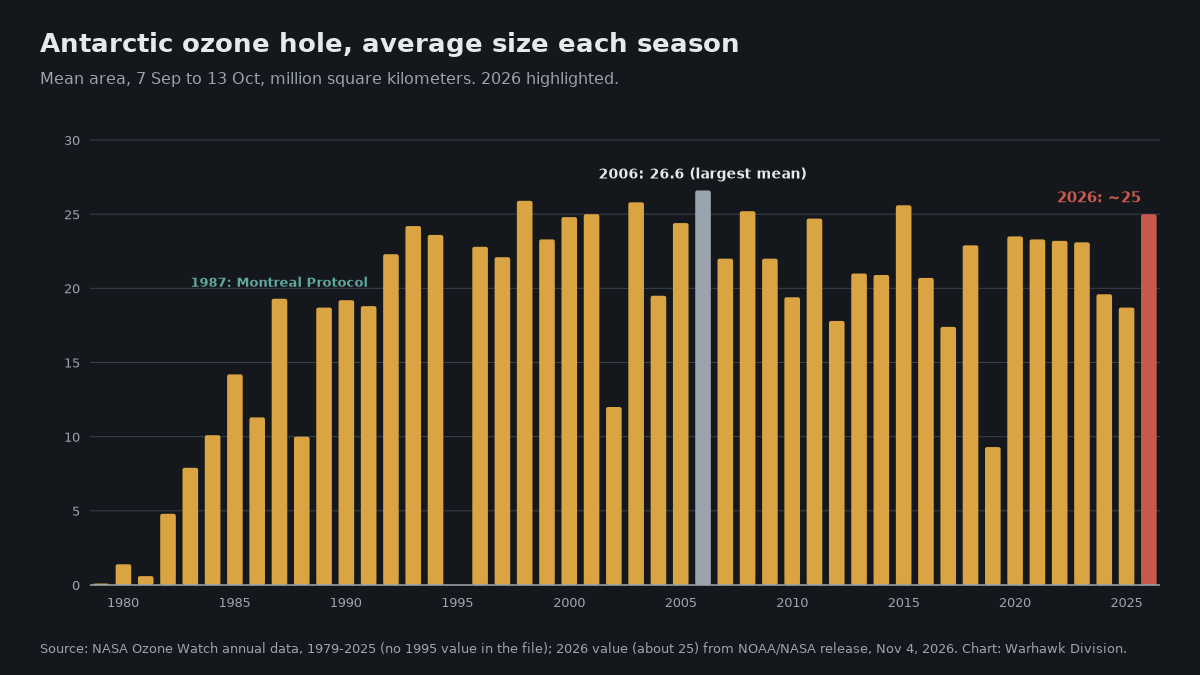 Source: NASA Ozone Watch annual data, seasonal mean area 7 September to 13 October, 1979 to 2025 (the file has no 1995 value). The 2026 value of about 25 million km² is from the NOAA/NASA release of 4 November 2026. Chart by Warhawk Division.
If the hole was this big, how is the ozone layer "recovering"?
Size is only one measure. Depth is another. The release says "the depletion of ozone within the hole was not as severe as record-breaking holes that occurred 10 or 20 years ago."
NOAA measures depth with balloon-borne instruments called ozonesondes, launched from the South Pole, and with a ground instrument called the Dobson Ozone Spectrophotometer. The unit is the Dobson unit. The release says 100 Dobson units would make a layer "1 millimeter deep - about as thick as a dime" if all the ozone overhead were squeezed down to sea-level conditions.
This year, ozone directly over the South Pole bottomed out at 105 Dobson units on 17 October. The lowest ever recorded there was 92 Dobson units in October 2006.
Newman also pointed to timing: "The annual ozone hole has been forming later in the season in recent years, which tells us the ozone layer is healing."
He also estimated what the chemical cuts are worth. The 2026 hole "could have been 1 to 2 million square miles (3.5 million square kilometers) larger if ozone-depleting substances were as prevalent in the atmosphere today as they were at their year 2000 peak."
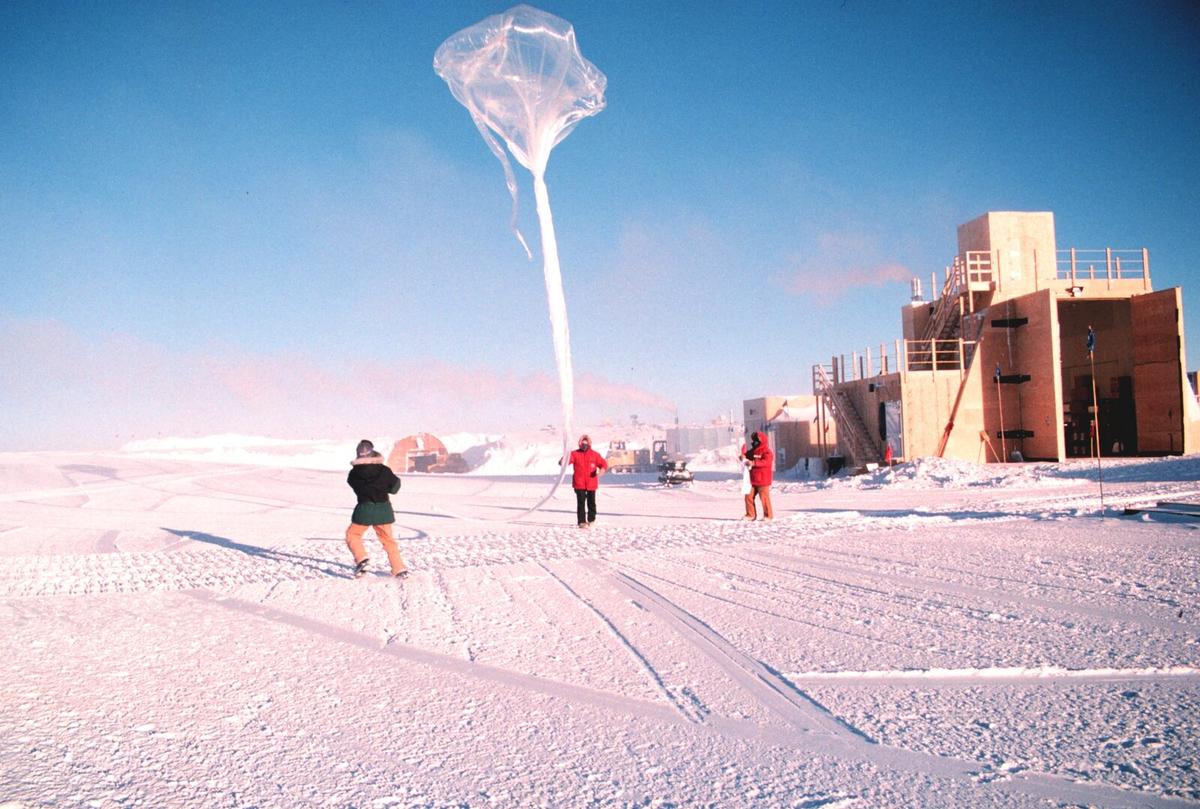 Photo by NOAA Photo Library, public domain, via Wikimedia Commons.
What actually brought the chemicals down?
The answer is the Montreal Protocol, the 1987 international agreement to phase out ozone-depleting substances. The release says monitoring "shows that controls established by the Montreal Protocol in 1987 continue to drive long-term recovery of stratospheric ozone."
The main culprits were chlorofluorocarbons (CFCs). These chemicals were once common in refrigerators, air conditioners and building insulation. Stephen Montzka, a senior scientist at NOAA's Global Monitoring Laboratory, said chlorine levels in the Antarctic stratosphere from these substances "have declined by about a third relative to levels reached in the 1980s."
The chemicals do not vanish quickly. NOAA says they "can linger in the atmosphere or leach out of old products and landfills for many decades." As they break down, "scientists estimate that the ozone hole will recover by the 2070s." Long-lived pollution is a theme on this site; "The Microplastics Problem" covers another version of it.
What the chart shows, and what it does not
- The chart shows the seasonal average area from NASA's published annual data, plus NOAA's 2026 figure.
- Six earlier years in the NASA file average larger than 25 million km². That fits the release's "seventh-largest."
- Year-to-year swings are large. 2002 and 2019, for example, were far smaller than the years around them. The agencies tie this year's size to weather, and one big year does not reverse a trend.
- The chart does not show depth or the date the hole forms. Those are the measures the agencies point to as signs of healing.
What to do
- Check the UV Index, not ozone headlines. The Antarctic hole is not over the United States. Your daily UV exposure is forecast by the EPA's UV Index, which "predicts the UV radiation levels on a 1 - 11+ scale."
- Dispose of old fridges, freezers and window air conditioners properly. The EPA requires that refrigerant be recovered before final disposal of these appliances. The EPA says "the final person in the disposal chain" is responsible for making sure that happens. Use your utility's or city's appliance pickup, or a scrap recycler that recovers refrigerant.
- Do not vent refrigerant from a car or home system. Use a technician or equipment that meets the EPA's recovery standards.
- Read ozone news for the trend, not the single year. The agencies themselves say one strong vortex does not change the long-term path.
Where I land
- The 2026 Antarctic ozone hole was the seventh-largest by seasonal average in 48 years, according to NOAA and NASA.
- The cause was weather: an unusually strong and wide polar vortex.
- The hole was not as deep as the record holes, and NOAA and NASA say it would have been larger without the Montreal Protocol.
- Recovery is still expected by the 2070s. The lesson is that a treaty that cut the right chemicals is still working, slowly, even in a bad year.
Sources (7)
- NOAA, "NOAA, NASA release measurements of 2026 ozone hole," 4 November 2026: https://www.noaa.gov/news-release/noaa-nasa-release-measurements-of-2026-ozone-hole
- NASA Ozone Watch, annual ozone hole data (table): https://ozonewatch.gsfc.nasa.gov/statistics/annual_data.html
- NASA Ozone Watch, annual ozone hole data (text file used for the chart): https://ozonewatch.gsfc.nasa.gov/statistics/annual_data.txt
- EPA, "Basic Ozone Layer Science": https://www.epa.gov/ozone-layer-protection/basic-ozone-layer-science
- EPA, "The UV Index": https://www.epa.gov/sunsafety/uv-index-1
- EPA, "Stationary Refrigeration Safe Disposal Requirements": https://www.epa.gov/section608/stationary-refrigeration-safe-disposal-requirements
- Photo file page, Wikimedia Commons: https://commons.wikimedia.org/wiki/File:Corp2767_-_Flickr_-_NOAA_Photo_Library.jpg