Articles & BlogBy Trapper W. Brown11 min readCurrent to 12 November 2026Both sides
A social media minimum age is a law that tells platforms not to give accounts to anyone below a set birthday, usually 16. It sounds like a rule about children. In practice it is a rule about everyone, because a website cannot keep out the 15 year olds without some way of telling who is 15, and that means checking the age of the adults too.
That is why this argument matters to people with no children at all. One question is whether keeping young teenagers off these services protects them. The other is what every user gives up to prove an age to a website. As of 12 November 2026, one country has nearly a year of experience with such a law, another has announced one, and American courts are still deciding how far a state may go. This guide lays out what each side argues and what the record shows, and takes no side.
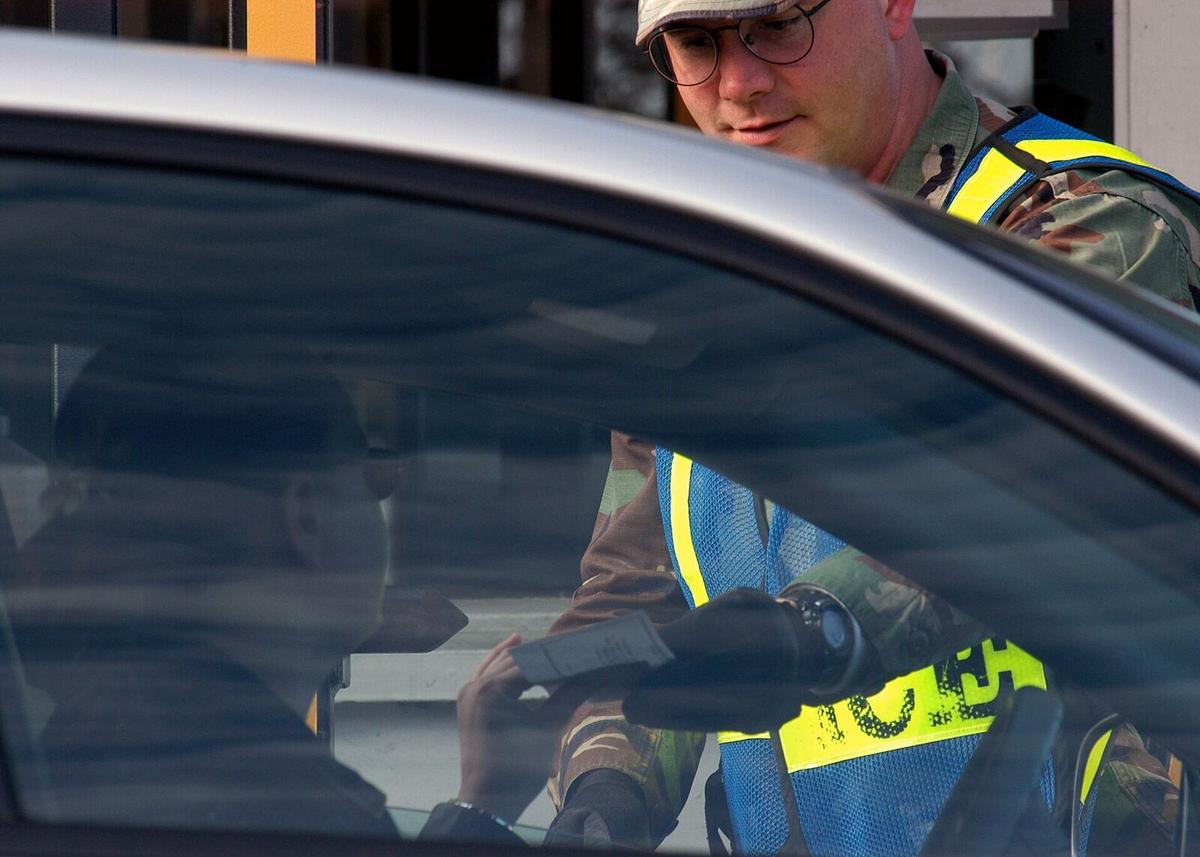 Showing a card at a gate is the oldest kind of access check, and it is what an age law asks a website to rebuild. Photo by Photographer's Mate 2nd Class Michael Larson, U.S. Navy, public domain, via Wikimedia Commons.
What do the laws say today?
Australia went first. Since 10 December 2025, platforms that the law calls age-restricted must take reasonable steps to stop Australians under 16 from creating or keeping an account. The eSafety Commissioner, the national online safety regulator, lists Facebook, Instagram, Snapchat, Threads, TikTok, Twitch, X, YouTube, Kick and Reddit among them. Online games and standalone messaging apps are excluded. The duty sits on the companies: eSafety states that there are no penalties for under-16s who get onto a platform, or for their parents. A court can fine a company up to 300,000 penalty units, which eSafety puts at 109.2 million Australian dollars today.
The United Kingdom announced on 15 June 2026 that it will bar under-16s from social media platforms on the Australian model, with messaging services left out. The government said it expects to bring the plan to Parliament before Christmas 2026 and for it to take effect in spring 2027.
The United States has no national minimum above the one set by a children's privacy law. The Children's Online Privacy Protection Act (COPPA) covers children under 13. It makes sites get a parent's verifiable consent before collecting a child's personal information, and the Federal Trade Commission's guidance says the rule "does not require operators to ask the age of visitors." A bill called the KIDS Act, which would require parental tools and default limits for minors on social media, passed the House on 29 June 2026 and has sat in a Senate committee since 13 July.
The courts have drawn two lines so far. In Free Speech Coalition v. Paxton, decided 27 June 2025, the Supreme Court upheld a Texas law that makes websites with sexually explicit content verify that visitors are 18 or older. Laws about social media raise a different question, since they reach far more than material that is obscene for minors. On 14 August 2025 the Court let a Mississippi law on minors and social media stay in force while a challenge continues, but Justice Kavanaugh wrote that under the Court's current case law the law "is likely unconstitutional," and noted that the district court in that case and seven others had blocked laws of this kind.
| Place | Minimum age | Status on 12 November 2026 | Who is penalized |
|---|---|---|---|
| Australia | 16 | In force since 10 December 2025 | Platforms only |
| United Kingdom | 16 | Announced 15 June 2026, expected spring 2027 | Platforms, under the regulator Ofcom |
| United States (federal) | 13, for data collection without a parent's consent | COPPA in force. KIDS Act passed the House only | Site operators |
How does a website check an age?
There are four broad ways, and each asks something different of you.
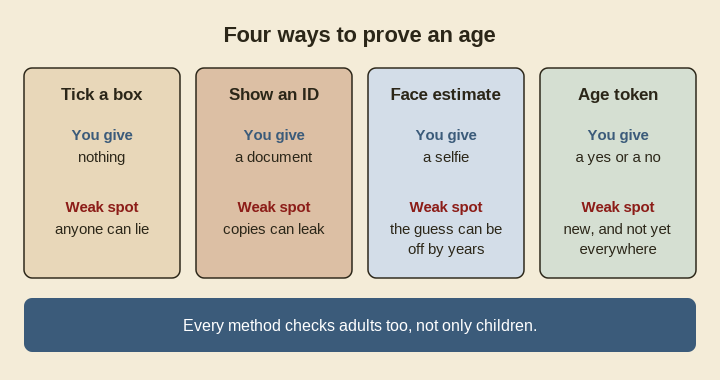 Each method trades a different mix of accuracy, effort and personal data.
Tick a box. You type a birthday. It reveals nothing, and a ten year old can do the arithmetic.
Show an ID. You upload a driver's license or passport, or let a payment record vouch for you. The Texas law in the Paxton case allows government-issued identification or transactional data. This is accurate, and it creates a pile of identity documents somewhere. In October 2025 the chat service Discord said that an attacker had broken into an outside customer service provider and that about 70,000 users may have had photos of government IDs exposed. The vendor held those photos to review appeals from users who had been locked out over their age.
Estimate from a face. Software looks at a selfie and guesses. In May 2024 the National Institute of Standards and Technology (NIST), a U.S. government lab, tested six such programs on about 11.5 million photos. On one set of visa photos the average miss was 3.1 years, down from 4.3 years in 2014. Error rates were almost always higher for female faces, and NIST found "no single standout algorithm."
Carry a proof of age token. An app on your phone, set up once from an ID, answers a site's question with a yes or a no and nothing else. The European Commission says its version, declared feature ready on 15 April 2026, lets users "prove they are over 18 without sharing any other personal information."
Here is a worked example of why the face method needs a margin. Suppose a tool's typical miss near the cutoff is 3 years, which is an assumption for the sake of arithmetic. A platform that lets in anyone the tool reads as 16 or older will wave through many 14 year olds. So it sets a buffer and challenges anyone who reads as younger than 19 for a second proof. Now a real 17 year old, and plenty of 20 year olds, are asked for an ID. Moving the line changes which group is inconvenienced, but some group always is.
The same choice looks different from each side of the screen. For a family, it is whether a parent hands a passport photo to a service to keep a 16 year old's account open. For a company with millions of users, it is whether to hold those photos at all, knowing that whatever it stores can be stolen.
What is the case for a minimum age?
Supporters start from harm. The U.S. Surgeon General's 2023 advisory reports that up to 95 percent of Americans aged 13 to 17 use social media, that teenagers average 3.5 hours a day on it, and that young people who spend more than 3 hours a day face double the risk of symptoms of depression and anxiety. In a survey it cites, 46 percent of adolescents said social media makes them feel worse about their bodies. The advisory's conclusion is that we "cannot conclude it is sufficiently safe for children and adolescents."
Teenagers themselves report unease. In a Pew Research Center survey of 1,391 U.S. teens in autumn 2024, 48 percent said social media has a mostly negative effect on people their age, and 45 percent said they spend too much time on it.
The second argument is about who can act. A single family that holds out leaves its child as the only one in the class without an account. A law changes the norm for everyone at once, which no household can do alone. Britain's government says 9 in 10 parents who answered its consultation supported a ban. Australia's regulator found that after three months, fewer children felt they were missing out by not having social media: 36.3 percent, down from 43.3 percent.
The third is precedent. Societies already set ages for driving, drinking and gambling, and nobody considers a bartender's glance at a license a threat to liberty.
What is the case against?
Opponents start from the evidence too. A consensus committee of the National Academies of Sciences, Engineering, and Medicine reviewed the research and wrote that it "did not support the conclusion that social media causes changes in adolescent health at the population level." The same summary calls broad restrictions on young people's online access "neither practical nor desirable." On this reading the 3 hour finding shows that heavy use and distress travel together, and does not show which causes which.
Teenagers also report benefits. In the same Pew survey, 74 percent said social media makes them feel more connected to friends and 63 percent said it gives them a place to be creative. Only 14 percent said it mostly harms them personally. UNICEF, the United Nations children's agency, warned on 10 December 2025 that bans "come with their own risks, and they may even backfire," and that for children who are isolated or marginalized social media "is a lifeline."
The second argument is that the cost lands on everyone. Every adult must prove an age, and the proof is either a document that can leak, as the 70,000 ID photos show, or a face scan that is less accurate for some groups. A bartender does not keep a photocopy of your license, and a website's vendor may.
The third is that it may not work, and may hide the problem. Children borrow accounts, lie, or move to services the law does not reach. Australia's regulator reported that parents' awareness of what their children do on social media fell in some groups after the law began, particularly for girls and for children aged 10 to 12. Opponents would rather regulate how the products are designed for everyone, and leave the age of entry to families.
What happened in Australia?
Both sides quote the same report. On 31 July 2026 eSafety published the first results from a two-year study following more than 4,000 children and families.
| Before the law | 52.4% |
|---|---|
| Three months after | 42.1% |
Source: eSafety Commissioner, Early days, early insights, 31 July 2026
Platforms removed access to 4.7 million accounts by mid-December 2025. Three months in, the share of under-16s holding an account had fallen from 52.4 percent to 42.1 percent, which eSafety calls a modest but statistically significant decline. The share using a platform at all, with or without an account, went from 85.9 percent to 81.5 percent. Most under-16s who had accounts before the start had kept them or made new ones, and eSafety named weak age checks by the platforms as the main reason. A small share of children said it was harder to keep in touch, and others reported better relationships and less pressure.
Supporters read this as a norm starting to shift and a case for stronger enforcement. Australia's Parliament passed a bill on 10 September 2026 that widens the regulator's powers and raises the maximum penalties. Opponents read it as four in ten children still holding accounts three months into a national effort. The regulator itself says it is "too early to meaningfully assess" whether the policy is achieving what it set out to do.
What is known, what is disputed, and what facts cannot settle?
Known. Nearly all teenagers use social media. Heavy use and poor mental health show up together in studies. No method of checking age is free of error or of privacy cost. In Australia, accounts fell and many remained.
Disputed. Whether social media causes the harm or attracts young people who are already struggling. Whether a ban lowers harm or relocates it. Whether privacy-preserving age tokens will work at scale and be widely adopted. Whether laws of this kind can survive in American courts when applied to social media.
Value judgments. How much adult privacy is worth trading for a given amount of protection for children. Whether the state or the parent should set the age. Whether a 15 year old has a right to speak and listen online that the law should respect. Evidence can inform these, and it cannot decide them.
For what a household can do under any law, see "Kids Online: Settings and Conversations That Work." For an argued view on monitoring, see "Kids Need a Conversation More Than a Monitoring App."
What to remember
- Both sides agree that young people face real risks online, that platforms bear responsibility for how their products are designed, and that typing in a birthday checks nothing.
- Both sides agree that an age rule for children means an age check for adults.
- They divide on cause: is social media driving teenage distress, or sitting beside it?
- They divide on cost: is proving your age a small price, like showing a license, or a new store of sensitive data waiting to leak?
- They divide on who decides: the law, the platform or the parent.
- Australia's first numbers show a real drop in accounts and a large share remaining. Each side cites them.
The next evidence due is eSafety's second compliance update and the later waves of its two-year study, followed by the British regulations. As a rule of thumb, when a new figure appears, ask which of the three dividing questions it bears on.
Sources (14)
- eSafety Commissioner (Australia), "Social media age restrictions"
- UK Government, "Social media to be banned for under-16s", 15 June 2026
- Federal Trade Commission, "Complying with COPPA: Frequently Asked Questions"
- H.R. 7757, KIDS Act, 119th Congress
- Supreme Court of the United States, Free Speech Coalition, Inc. v. Paxton, 27 June 2025
- Supreme Court of the United States, NetChoice, LLC v. Fitch, 14 August 2025
- Discord, "Update on a Security Incident Involving Third-Party Customer Service", 3 October 2025
- NIST, news release on NIST IR 8525, "Face Analysis Technology Evaluation: Age Estimation and Verification", 30 May 2024
- European Commission, "EU age verification"
- U.S. Surgeon General, "Social Media and Youth Mental Health" page
- Pew Research Center, "Teens, Social Media and Mental Health", 22 April 2025
- National Academies of Sciences, Engineering, and Medicine, "Social Media and Adolescent Health", 2024
- UNICEF, "Age restrictions alone won't keep children safe online", 10 December 2025
- eSafety Commissioner (Australia), "Early insights from eSafety's comprehensive evaluation project", 31 July 2026