Articles & BlogBy Trapper W. Brown10 min read
"Bug in" is slang for staying home through an emergency. "Bug out" means leaving. The films prefer the second one: a loaded car, an empty highway, a cabin in the hills. Real emergencies mostly reward the first. For an ice storm, a long power outage, a boil-water notice or a week when the roads are closed, the safest place for most households is the one they are already in.
Staying is not always right, though, and a guide that only praised staying would be dangerous. Some situations mean you leave now, with no debate. This guide covers both: why home is usually the stronger position, the clear cases where it is not, what a home needs to carry you for two weeks, and how to notice the moment the answer changes.
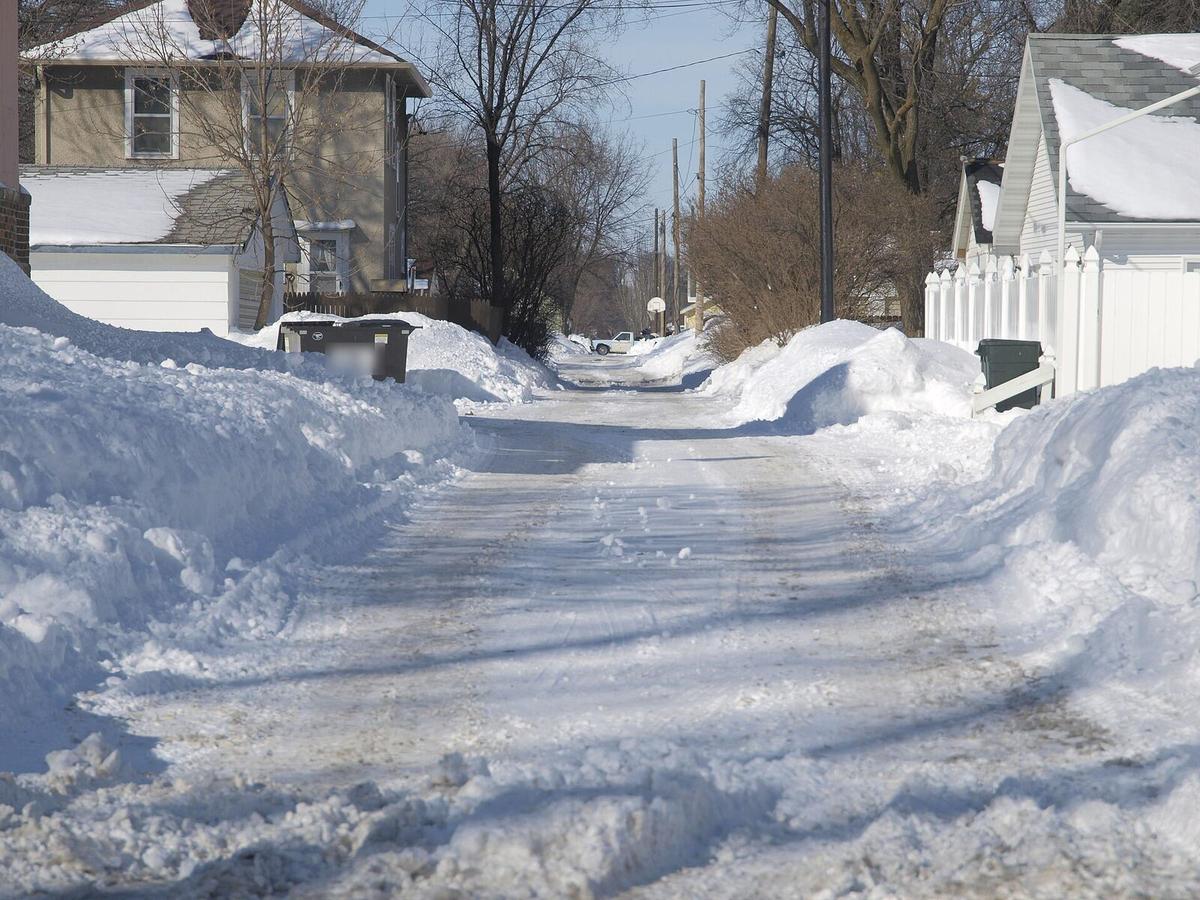 Fargo, North Dakota, in March 2009: in a week like this, the safest plan for most households is the one that involves no driving. Photo by Michael Rieger, FEMA, public domain, via Wikimedia Commons.
Why is staying often the better choice?
Count what is at home. Your food is there, and your water, your medicines, your bed, your tools and your spare blankets. You know which window sticks and where the flashlight lives. You know the people next door. Every one of those is something you would have to carry, replace or do without on the road.
Leaving has costs of its own. Ready.gov, the federal preparedness site, advises evacuating households to take one car "to reduce congestion and delay," and warns that gas stations "may be closed during emergencies and unable to pump gas during power outages." Roads fill at exactly the moment everyone decides to use them. A public shelter is safe, but Ready.gov describes it honestly: "living with many people in a confined space, which can be difficult and unpleasant."
Official guidance often points the same way. Ready.gov's shelter page says there are situations "when it's best to stay where you are and avoid any uncertainty outside." Staying home is not hiding. It is a choice to sit out a problem in the place where you have the most supplies and the most knowledge.
When must you leave?
There are clear cases, and none of them is a judgment call.
| Situation | Decision | Why |
|---|---|---|
| Officials order an evacuation | Go | They can see the river gauge, the fire line and the forecast. You cannot. |
| Fire in or near the building | Go now | Smoke and flames move faster than people expect |
| Rising water, or a storm surge warning for your zone | Go early | Ready.gov warns that a foot of water will float many cars |
| The building is damaged: cracks, a gas smell, a fallen tree through the roof | Go | A damaged structure can fail later |
| A chemical release nearby | Do what officials say | Sometimes that is leave at once, sometimes seal a room and stay |
| Power is out, home is intact, weather is mild | Stay | Nothing outside is better than what you have |
| Roads closed by snow or ice, home is warm enough | Stay | Travel is the hazard |
| A boil-water notice | Stay | An inconvenience, covered in the water guide in this series |
The chemical row deserves a note, because it is the one case where the right move can go either way. Ready.gov's page on hazardous materials says "it may be safer to shelter inside your home, other times it may be safer to evacuate." If you are told to leave, leave immediately. If you are told to stay, bring everyone inside, shut windows and vents, turn off fans and air conditioning, and go to an interior room. If you are caught outside, move away in a direction upwind of the source.
Storm surge is the water a hurricane pushes ashore, and it is the reason coastal evacuation orders exist. Find out now whether you live in an evacuation zone. Many states and cities publish maps. New York City, for example, numbers its hurricane zones 1 through 6 and lets residents look up an address. The city adds a point worth knowing anywhere: federal flood insurance maps are not evacuation maps, and the two should not be confused.
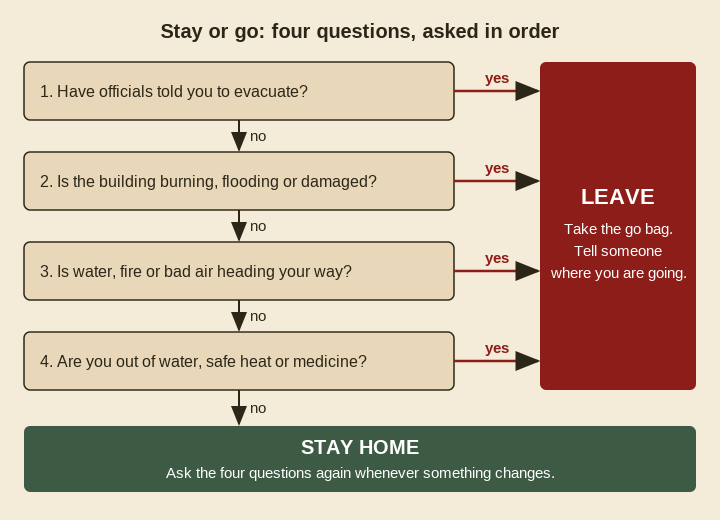 Any single yes means leave. Four no answers mean stay, for now.
Know your routes even if you fully intend to stay. Pick two ways out of your neighborhood and a place to go in each direction. Ready.gov suggests keeping at least half a tank of gas at all times for this reason. A packed go bag, the subject of its own guide in this series, is what makes a late change of plan possible.
What does a home need for two weeks?
Two weeks is the American Red Cross figure: a three-day supply for leaving and a two-week supply for home. Ready.gov says "several days," and New York City says up to seven. Two weeks is the generous end of official advice, and you can build toward it a shopping trip at a time.
| Need | Rule of thumb | Family of four, 14 days |
|---|---|---|
| Water | One gallon per person per day (Ready.gov) | 56 gallons |
| Food | Shelf-stable, needs little or no cooking | 168 simple meals |
| Light | A flashlight for every person, spare batteries | 4 flashlights |
| Medicines | A buffer of each daily prescription | Ask the pharmacist |
| Sanitation | Garbage bags, ties, wipes, soap | A large box of bags |
| Information | Battery or hand-crank radio | 1 radio |
Water. Fifty-six gallons sounds enormous. It is about eleven five-gallon jugs, or a stack of store-bought cases along one closet wall. Ready.gov notes that a normally active person drinks about three quarters of a gallon a day, and that the need can double in very hot weather. One person living alone needs 14 gallons. At 8.33 pounds a gallon, the US Geological Survey's figure, that is about 117 pounds, which is why you store it before the emergency and not during. How to store and treat water is covered in the water guide in this series.
Food. Ready.gov's list is ordinary groceries: canned meat, fruit and vegetables, peanut butter, dry cereal, protein bars, dried fruit, and a manual can opener. Buy what you already eat and rotate it through the kitchen. During an outage, a refrigerator keeps food cold for about four hours and a full freezer holds its temperature for about 48 hours if the doors stay shut. Eat from the fridge first, then the freezer, then the shelf. The food storage guide in this series goes deeper.
Light. Use flashlights and battery lanterns. New York City's guidance is three words long on the alternative: "Do not use candles."
Sanitation. If the water is off, flushing stops. Ready.gov's kit list includes garbage bags, plastic ties and moist towelettes for exactly this. Bag waste, tie it and store it outside the living space, and do not let garbage pile up indoors.
Medicines. Ask your pharmacist how far ahead you can refill. Ready.gov says that after more than a day without power, refrigerated medicine should be thrown out unless the label says otherwise, and that you should call your doctor or pharmacist for a new supply.
How do you stay warm, or cool, without power?
This is where staying home goes wrong most often, and nearly always in the same way.
Carbon monoxide, or CO, is a gas made by burning fuel. You cannot see it or smell it. The Consumer Product Safety Commission (CPSC) says more than 200 people in the United States die every year from accidental CO poisoning linked to consumer products, and that more than 100 of those deaths are linked to portable generators. The commission notes that one portable generator can put out as much CO as hundreds of cars.
The rules are short.
- Generators run outside only, at least 20 feet from the house, with the exhaust pointing away. Never in a home or a garage, "even if doors and windows are open," in CPSC's words.
- Charcoal grills and camp stoves are for outdoors. Ready.gov says the same of both.
- Never heat a home with a gas oven or stovetop.
- Put CO alarms on every level of the home and outside sleeping areas, with batteries or battery backup, and test them.
- Know the signs: headache, dizziness, weakness, nausea, vomiting, sleepiness and confusion. If you suspect CO, get everyone into fresh air first, then call 911.
For cold, the safe method is boring. Choose one room, close the doors to the rest of the house, hang blankets over the windows, and put everyone in layers and under covers. Ready.gov lists a body temperature below 95 degrees as an emergency. If the house cannot be kept warm enough, that is a reason to move to a warming center or to a friend whose heat works.
For heat, the tools are shade, water, cool showers and time spent somewhere air-conditioned. The Centers for Disease Control and Prevention (CDC) warns that a fan stops helping in high heat: "In temperatures above 90°F, a fan can increase body temperature." The city guide in this series covers heat waves in detail.
Locks, lights and the people next door
Security during a long outage means the same plain things it means on any other night. Lock the doors and windows. Keep a light on a battery near the entrance. Know who lives around you.
The neighbors are the real asset. A street where people have each other's phone numbers notices the open garage, the elderly resident who has not been seen today and the unfamiliar van. New York City's outage guidance says simply: "Check in on your neighbors." Do it on the first day, and trade what you have. One house has a camp stove for the porch, another has a nurse, another has a chainsaw.
Our guides Home Security on a Budget: Doors, Lights, Cameras and Habits and Deter, Detect, Delay, Respond: Security in Layers cover the hardware and the habits. Nothing in an ordinary emergency calls for more than that.
What about apartments and medical equipment?
Honesty matters here, because two groups have a narrower margin.
Apartments. There is less room to store water, no yard for a generator, and often no way to cook without power. In a tall building an outage stops the elevators and, where a building relies on electric pumps, the water as well. An apartment household can still stay home, but for a shorter time, and it should decide in advance what its limit is. For example: "If the power is still out on day three in summer, we go to my sister's." The city guide in this series covers high-rise living in detail.
Powered medical equipment. If someone at home depends on an oxygen concentrator, a ventilator, home dialysis or a powered wheelchair, a long outage is a medical event. Ready.gov's advice: talk to your doctor about a plan to keep the equipment running, ask your power company about priority restoration, keep charged spare batteries, and, for dialysis, know more than one facility that can treat you. Some utilities keep a register of customers with life-sustaining equipment, and New York City's emergency office tells residents to sign up with theirs. For these households the honest plan is often to leave early for a place with reliable power.
When do you change your mind?
Staying is a decision you keep making. Run the four questions in the diagram again whenever something changes: a new alert, a new smell, a falling thermometer, a shrinking supply.
Set your tripwires while you are calm. Write down the conditions that mean you go, such as an evacuation order, water in the street, an indoor temperature you cannot hold, three days of water left, or a medicine that runs out on a known date. A rule written in advance is easier to follow than one invented at two in the morning. If you do leave, tell someone outside the area where you are going. The family communications plan guide in this series explains how to set that up.
What to remember
- Home is usually the stronger position: your supplies, shelter and neighbors are already there.
- Leave without argument for an evacuation order, fire, rising water, a storm surge warning or a damaged building.
- For two weeks at home, the Red Cross figure, a family of four needs about 56 gallons of water.
- Generators stay outside and at least 20 feet from the house. CPSC links more than 100 deaths a year to portable generators.
- Know your evacuation zone and two routes out, even if you plan to stay.
- Apartments and homes with powered medical equipment have less margin. Decide the limit in advance.
Look up your evacuation zone today, then count the gallons of water in the house and compare the number with the table.