Articles & BlogBy Trapper W. Brown11 min readCurrent to 15 November 2026
As of 15 November 2026, this is what the federal safety agencies, the National Fire Protection Association and the American Red Cross publish about getting through a power outage in cold weather. Every distance, hour and temperature below is the official page's own figure, read on that date. Agencies update these pages, so check the links before you rely on them.
A winter outage is different from a summer one. The house gets cold, so people reach for generators, space heaters, fireplaces and sometimes the kitchen oven. Any of those can start a fire, and the ones that burn fuel can fill a home with carbon monoxide, a gas you cannot see or smell. Meanwhile the refrigerator warms up and the pipes cool down. This guide takes those four problems in order, then medical devices that need electricity.
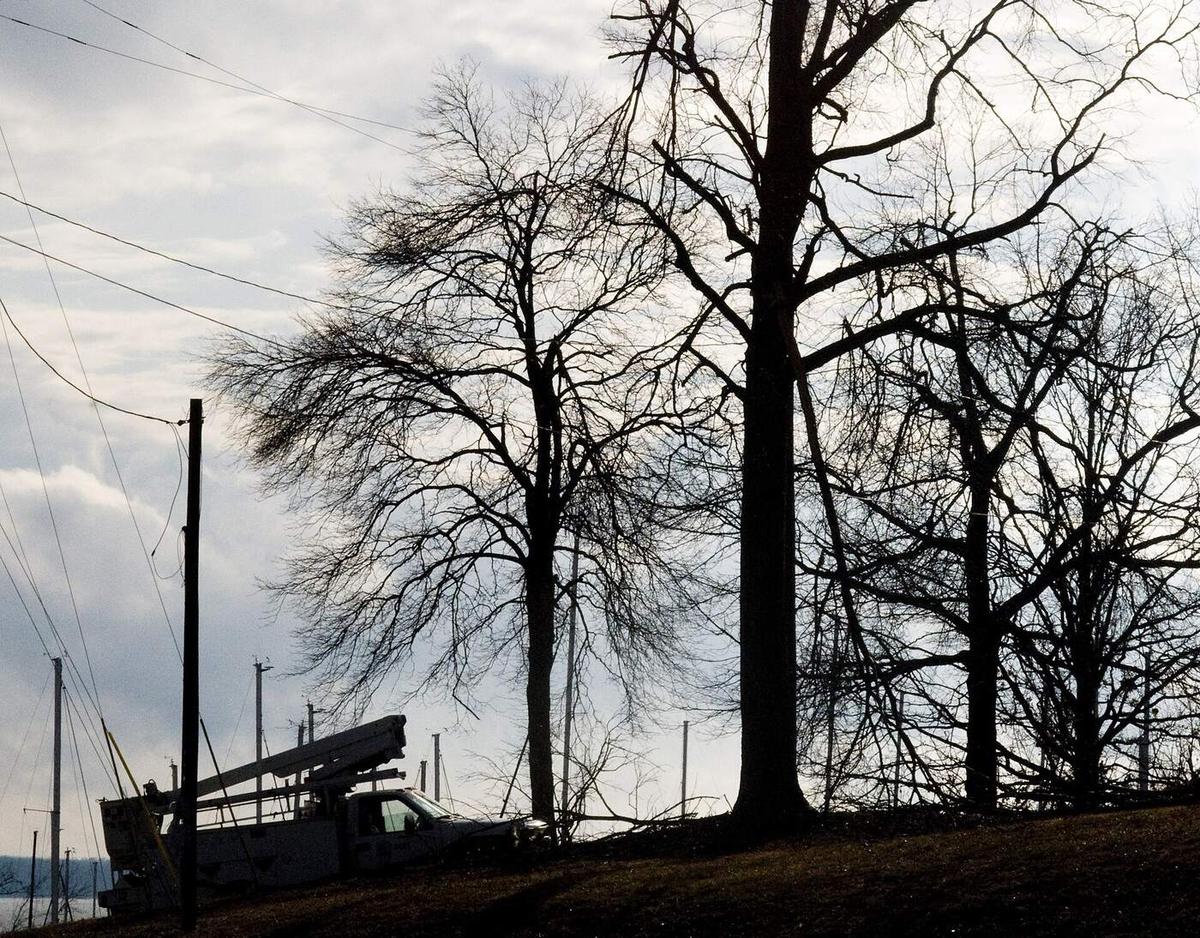 A line crew restoring service in Grand Rivers, Kentucky, on 21 February 2009, after an ice storm on 27 January cut power and phone service. Photo by Liz Roll, FEMA, public domain, via Wikimedia Commons.
Why is a winter outage dangerous?
The first danger is carbon monoxide, or CO. The Centers for Disease Control and Prevention (CDC) describes it as "an odorless, colorless gas that kills without warning." It is in the fumes of anything that burns fuel: generators, furnaces, stoves, grills, fireplaces and car engines.
CDC's figures, on a page it updated on 26 October 2026: "Each year, more than 400 Americans die from unintentional CO poisoning not linked to fires, more than 100,000 visit an emergency department, and more than 14,000 are hospitalized."
Portable generators are a large share of that. The Consumer Product Safety Commission (CPSC), in a release dated 16 March 2026, said "an average of nearly 100 people die in the U.S. each year from CO poisoning caused by portable generators." In a release dated 23 January 2026 it estimated that "from 2012-2022, about 750 people died from CO poisoning associated with generators alone."
The second danger is fire. The National Fire Protection Association (NFPA) says fire departments responded to an estimated average of 37,365 home fires involving heating equipment per year from 2020 to 2024, with an estimated 417 civilian deaths a year. Space heaters and heating stoves accounted for "nearly a third (30%) of the fires, but over seven out of ten deaths (73%)."
Where does a portable generator go?
Outside, and far from the house. The three federal sources agree on the number and differ slightly on what to measure from, so here is each one's wording.
| Source | Its words |
|---|---|
| CPSC | "Operate portable generators outside only, at least 20 feet away from the house." |
| CDC | "Only use generators outside, more than 20 feet away from any windows, doors, and vents." |
| Ready.gov | "Generators and fuel should always be used outdoors and at least 20 feet away from windows, doors and attached garages." |
CPSC is specific about the places people try instead. Its release says: "NEVER operate a portable generator inside a home, garage, basement, crawlspace, shed or other enclosed spaces. Opening doors or windows will not provide enough ventilation to prevent the buildup of lethal levels of CO." It goes on: "Don't operate a generator on a porch or in a carport. It's too close to the home and puts your family at risk of CO poisoning."
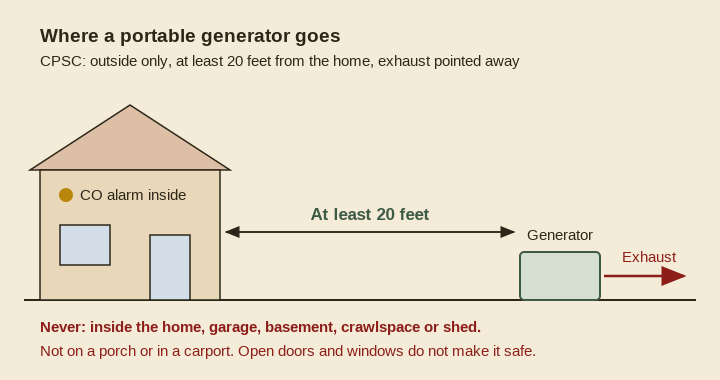 CPSC's placement rule for a portable generator: outside, at least 20 feet from the home, with the exhaust pointed away.
The same release says to point the exhaust "away from your home and other buildings' entrances" and to look for a generator with "a CO shut-off safety feature." The January release adds: "Never refuel a generator while it is running."
On alarms, CPSC says to install battery-operated CO alarms, or alarms with battery backup, "on each level of the home and outside separate sleeping areas," and to test them monthly.
CPSC lists the symptoms of CO poisoning as "headache, dizziness, weakness, nausea, vomiting, sleepiness, and confusion." CDC notes they are "often described as 'flu-like,'" and warns that people who are asleep can die "before they have symptoms." CPSC's instruction for an alarm is short: "Never ignore an alarm when it sounds. Get outside immediately and call 911."
Generators are not the only source. CPSC says: "Never use charcoal indoors," and adds that a charcoal grill should not be used in a garage even with the door open. CDC says: "Never heat your house with a gas oven" and "Never use a portable gas camp stove indoors." CPSC also asks people to clear snow from the outside vents of furnaces and other fuel-burning appliances so CO does not build up indoors.
How do you use a space heater without starting a fire?
The rule nearly every source repeats is three feet. NFPA's tip sheet says to keep a portable heater "at least 3 feet (1 metre) away from anything that can burn, including people," and to keep a three-foot "kid-free zone" around open fires and space heaters. CPSC's version: "Keep all sides of the portable heater at least three feet from beds, clothes, curtains, papers, sofas and other items that can catch fire."
The rest of the official list is just as plain:
- Plug it into the wall. CPSC: "ALWAYS use a wall outlet; NEVER a power strip and NEVER run the heater's cord under rugs or carpeting." NFPA: "Never use an extension cord."
- Turn it off when you leave or sleep. NFPA says space heaters "should be turned off and unplugged when you leave the room or go to bed."
- Fuel-burning heaters need care with fuel. CPSC: "never refuel when in use. Turn the heater off and let it cool before refueling." NFPA says to use only the fuel the maker specifies.
- The oven is not a heater. NFPA: "Never use your oven to heat your home."
CPSC estimates that portable heaters, electric ones included, are involved in an average of 1,600 fires a year, with an average of 70 deaths and 150 injuries annually from 2020 to 2022.
How long is the food safe?
The numbers here are the same on the pages of the U.S. Department of Agriculture (USDA), the Food and Drug Administration (FDA) and CDC, and they all assume one thing: the doors stay shut.
- Refrigerator: USDA says it "will keep food safe for up to 4 hours."
- Full freezer: it "will hold the temperature for approximately 48 hours (24 hours if it is half full)."
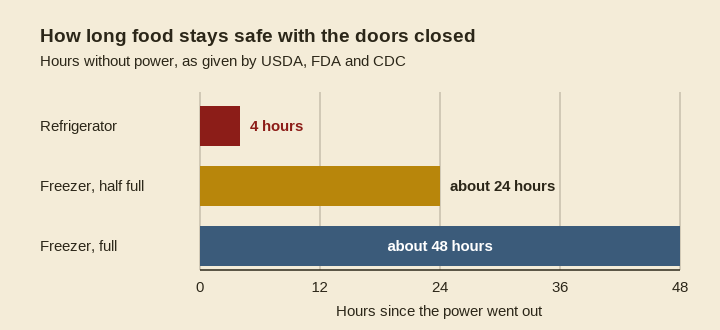 A refrigerator holds for about 4 hours and a full freezer for about 48, if the doors stay closed.
The temperature that matters is 40 degrees Fahrenheit. All three agencies say to keep an appliance thermometer in the refrigerator and the freezer, with the refrigerator at 40 degrees or below and the freezer at 0 degrees or below. After the outage:
- FDA says to discard refrigerated perishable food, "such as meat, poultry, seafood, milk, eggs, or leftovers," that has been above 40 degrees "for 4 hours or more."
- FDA says that if thawed food "still contains ice crystals or is 40° F or below, it is safe to refreeze or cook." USDA lists the same two cases as safe.
- USDA: "Never taste food to determine its safety. When In Doubt, Throw It Out!"
One official page is stricter. Ready.gov says to throw away food "exposed to temperatures 40 degrees or higher for two hours or more." The pages disagree on two hours against four. Both are given here as written.
Winter invites one shortcut that USDA rules out: "During a snowstorm, do not place perishable food out in the snow. Outside temperatures can vary and food can be exposed to unsanitary conditions and animals." Its alternative is to fill buckets or empty milk containers with water, leave them outside to freeze, and use that ice in the refrigerator, freezer or a cooler. Stocking food that needs no refrigeration at all is covered in "Building a Two Week Food Supply Without Wasting Money".
How do you keep pipes from freezing?
Water expands as it freezes. The American Red Cross puts it this way: "No matter the strength of a container, expanding water can cause pipes to break." The pipes at risk are the ones in unheated places: basements, crawl spaces, attics, garages, kitchen cabinets and outside walls.
The Red Cross steps for a cold snap:
- "Keep garage doors closed if there are water supply lines in the garage."
- "Open kitchen and bathroom cabinet doors to allow warmer air to circulate around the plumbing."
- "Let the cold water drip from the faucet served by exposed pipes." Running water, "even at a trickle," helps keep the pipe from freezing.
- If you leave, keep the heat on, "set to a temperature no lower than 55° F."
Those steps assume the furnace is running. The Red Cross page does not say how long a house without heat takes to reach freezing, and I could not confirm an official figure, so none is given here.
If a faucet gives only a trickle, the Red Cross says to suspect a frozen pipe. Keep the faucet open and warm the pipe with "an electric heating pad wrapped around the pipe, an electric hair dryer, a portable space heater (kept away from flammable materials), or by wrapping pipes with towels soaked in hot water." Its warning: "Do not use a blowtorch, kerosene or propane heater, charcoal stove, or other open flame device." If you cannot find or reach the frozen section, it says to call a licensed plumber.
What if someone at home depends on a powered medical device?
This is the part to settle before the storm. The Department of Health and Human Services (HHS) says millions of Medicare beneficiaries rely on "electricity-dependent durable medical and assistive equipment and devices," and that emergencies with prolonged power outages "can be life-threatening for these individuals."
FDA's page on medical devices and natural disasters tells users to:
- "Notify your electric company and fire department to let them know you have a medical device that needs power (e.g., ventilator, apnea monitor)."
- Read the instructions or call the distributor or maker "to find out if your device can be used with batteries or a generator."
- Check the settings when power returns, because devices often "reset to a default mode when power is interrupted."
FDA's most direct line: "If you depend on your device to keep you alive, seek emergency services immediately."
Ready.gov adds a step for medicines: "Talk to your medical provider about a power outage plan for medical devices powered by electricity and refrigerated medicines." It also says that if the power is out for more than a day, refrigerated medication should be discarded "unless the drug's label says otherwise," and that you should consult your doctor or pharmacist immediately for a new supply. This is general information, not medical advice. The plan for a particular device or medicine belongs to the person's own clinician and the device maker.
What to do
Built only from the instructions above:
- Before winter, put a CO alarm with battery backup on every level of the home and outside sleeping areas, and test it.
- If you own a generator, pick its spot now: outside, at least 20 feet from the house, exhaust pointing away.
- If anyone uses a powered medical device, call the electric company, the fire department and the device maker, and ask the clinician for an outage plan.
- When the power goes out, keep the refrigerator and freezer closed and note the time.
- Keep heaters three feet from anything that can burn, plugged into the wall, and off when you sleep.
- If a CO alarm sounds or you suspect CO poisoning, get outside to fresh air, then call 911.
The seasonal forecast behind this winter is in "A Very Strong El Niño Is Shaping This Winter. Here Is How to Prepare." The wider question of staying or going is in "Bugging In: When Staying Home Beats Leaving".
What to remember
- A generator runs outside, at least 20 feet from the home, with its exhaust pointed away. Never in a garage, basement, shed, porch or carport.
- CO alarms go on every level and outside sleeping areas. If one sounds, get outside and call 911.
- Space heaters need three feet of clear space and a wall outlet, and they go off when you leave or sleep.
- With the doors closed, a refrigerator holds for about 4 hours, a half-full freezer about 24 and a full freezer about 48. Above 40 degrees Fahrenheit, perishable food is on the clock.
- Do not store food in the snow, and do not thaw a pipe with an open flame.
- A powered medical device needs a plan made in advance with the clinician, the utility and the maker.
Print the official pages in the list below while the power is on. A phone with a low battery is a poor place to look up how many hours the freezer has left.
Sources (14)
- CPSC, "CPSC Issues Winter Weather Safety Tips to Prevent Fires and Carbon Monoxide Poisoning", 16 March 2026
- CPSC, "Keep Warm and Safe This Winter: Tips for Using Generators, Furnaces and Space Heaters", 23 January 2026
- CPSC, "Carbon Monoxide" information center
- CDC, "Carbon Monoxide (CO) Poisoning Basics", updated 26 October 2026
- Ready.gov, "Power Outages", last updated 4 June 2026
- NFPA, "Safety with heating equipment"
- NFPA, "Electric Portable Space Heater Safety" tip sheet, 2018
- NFPA, "Heating Safety" tip sheet, 2017
- USDA Food Safety and Inspection Service, "Keep Your Food Safe During Emergencies: Power Outages, Floods & Fires"
- FDA, "Food and Water Safety During Power Outages and Floods", content current as of 5 March 2024
- CDC, "Keep Food Safe After a Disaster or Emergency"
- American Red Cross, "Preventing & Thawing Frozen Pipes"
- FDA, "FDA Offers Tips about Medical Devices and Natural Disasters", content current as of 16 April 2024
- HHS, "About the HHS emPOWER Map"