Articles & BlogBy Trapper W. Brown10 min read
For anyone who knows creatine as a gym supplement and has heard it now does something for the brain. By the end you will know which claims rest on trials, how big those trials were, and which large ones came back empty.
Creatine is a compound your body makes and also gets from meat and fish. It is best known for helping muscles produce short bursts of power, and it is one of the most studied sports supplements there is. In the last few years it has picked up a second reputation: a pill for tired brains, for memory, and for the day after a bad night.
There is real science behind the interest and a good deal of overreach on top of it. A handful of small studies suggest creatine can take some of the edge off the mental cost of lost sleep. None of them shows that it replaces sleep. The largest brain trials ever run on creatine, in people with serious neurological disease, found no benefit at all.
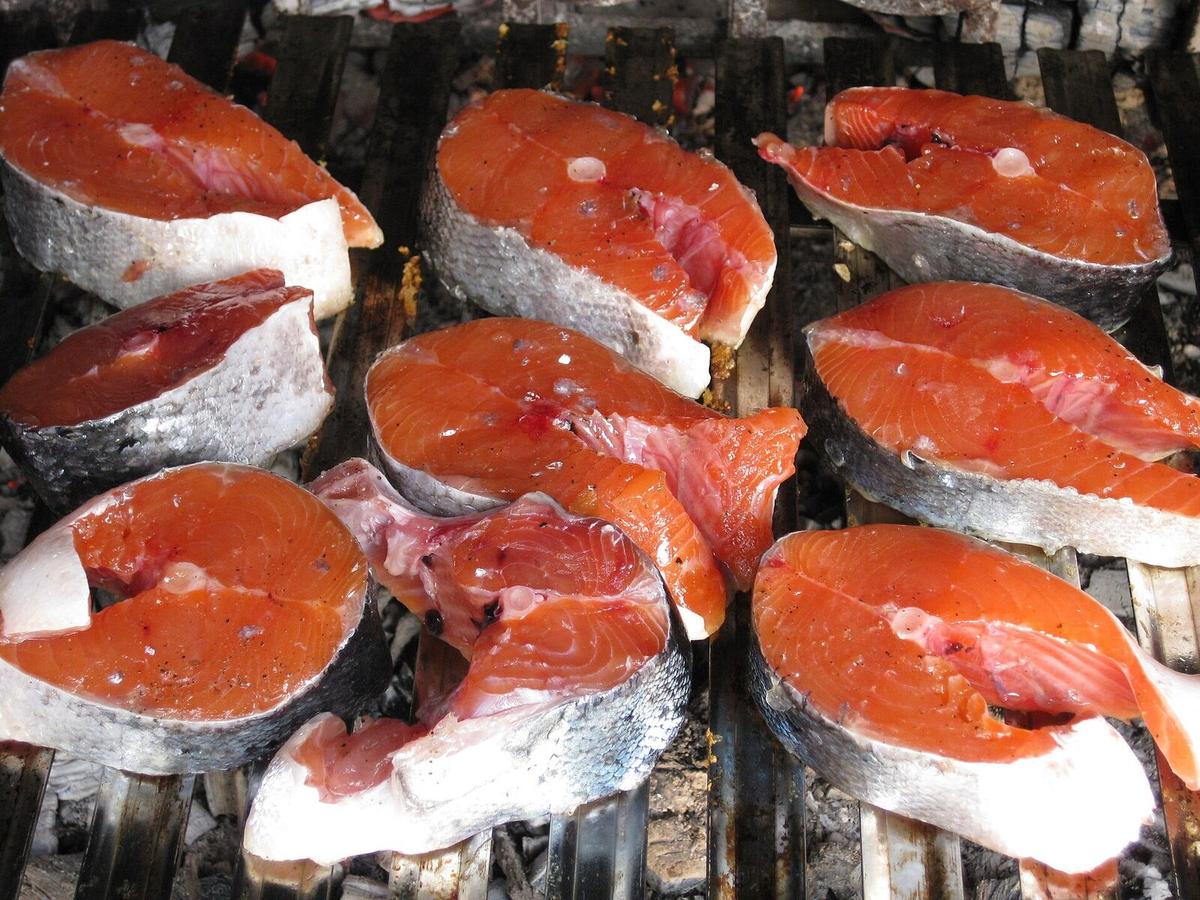 Fish and meat are the main food sources of creatine, which is why vegetarians tend to carry less of it. Photo by FULVIO_TOGNON, CC0, via Wikimedia Commons.
What is creatine, and what does it do?
Every cell runs on a molecule called ATP, which works like a tiny rechargeable battery. When a cell does work, ATP gives up a phosphate group and becomes ADP, the spent form. Creatine's job is to help recharge it. A cell stores creatine with a phosphate attached, as phosphocreatine. When ATP runs down, phosphocreatine hands its phosphate over and the battery is charged again almost at once.
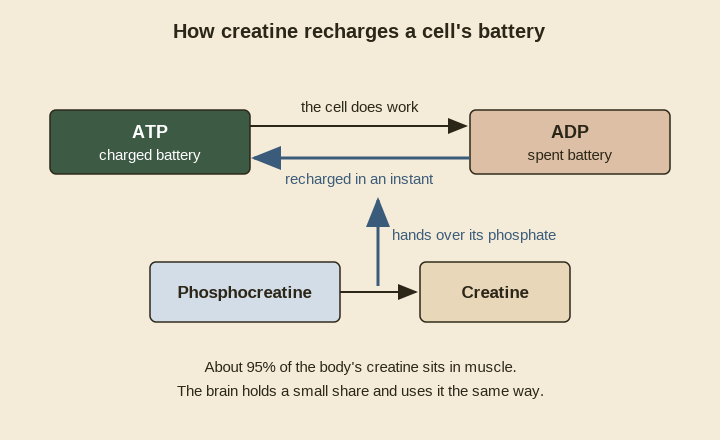 Phosphocreatine is a fast reserve. It refills the cell's energy supply before slower systems catch up.
The International Society of Sports Nutrition (ISSN) reviewed the research in a 2017 position stand. It reports that about 95% of the body's creatine is in skeletal muscle, with the rest in the brain and other tissues. Roughly 1% to 2% of the muscle store breaks down each day into a waste product called creatinine, so the body has to replace about 1 to 3 grams daily. About half of that comes from food and the rest is made by the body, mainly in the liver and kidneys.
That is where the brain idea comes from. The brain is an energy-hungry organ and it uses the same recharging system. If extra creatine tops up the brain's reserve, thinking might hold up better when energy is short. One snag, noted in the same position stand: supplements raise brain creatine by only about 5% to 15%, a good deal less than they raise muscle levels.
What happens to thinking after lost sleep?
Four small human studies have tested creatine against sleep loss. Here they are side by side.
| Study | Who and how | What it found |
|---|---|---|
| McMorris and colleagues, 2006 | 19 people, double-blind. 10 took 20 g a day for 7 days, 9 took placebo. Then 24 hours awake with mild exercise | The creatine group declined less on a hard mental task, on reaction time, on balance and on mood |
| McMorris and colleagues, 2007 | Same dosing, two groups, 36 hours awake with moderate exercise | Creatine helped on one complex planning task, and only at 36 hours. No difference on memory, reaction time, balance or mood |
| Cook and colleagues, 2011 | 10 elite rugby players, each tested after 3 to 5 hours of sleep. One dose of 50 or 100 mg per kg, or caffeine, or placebo | Passing accuracy fell after short sleep on placebo. It did not fall with creatine, or with caffeine |
| Gordji-Nejad and colleagues, 2024 | 15 adults aged 20 to 28, double-blind crossover. One dose of 0.35 g per kg during 21 hours awake, with brain scans | Faster processing on language, logic and number tasks than on placebo, and changes in brain energy markers |
The 2024 study, published in Scientific Reports, got the most attention because it used a single dose. The older view was that creatine needs weeks to reach the brain. The German team reasoned that a sleep-deprived brain, short on energy, might take it up faster, and their scans supported that.
Look hard at the numbers before drawing conclusions. The dose was 0.35 grams per kilogram of body weight. For a person who weighs 70 kg (154 pounds) that is 24.5 grams at once, several times the 3 to 5 grams a day that the ISSN describes for keeping stores topped up. It was given to 15 young, healthy people in a laboratory. The authors themselves say the sample was small and that the right dose and timing still have to be worked out. It is a description of an experiment and should not be read as a recipe.
Notice also what was measured. Every study compared creatine with placebo in people who were already sleep deprived. None compared a sleep-deprived person on creatine with a rested person on nothing and found them equal. The second McMorris study found help on one task out of many. Creatine may blunt part of the damage. It does not undo it, and no trial has tested what happens when someone leans on it night after night.
Does it help memory in rested people?
Here the results are mixed, and the best single trial is the least exciting.
In 2003, researchers at the University of Sydney gave 45 young vegetarians 5 grams a day for six weeks in a double-blind crossover trial. Scores on a memory test and a reasoning test improved clearly. In 2023, a team in Germany repeated the design with 123 people, about half of them vegetarian, and called it the largest study of its kind to date. They found a small effect on the memory test that fell just short of the usual statistical bar, no effect on reasoning, and no gain on eight other tests. Side effects were reported about four times as often on creatine as on placebo.
Pooled analyses lean positive, with caveats attached. A 2023 meta-analysis (a study that combines other studies) of 8 trials found a small overall benefit for memory, driven almost entirely by adults aged 66 to 76. In people aged 11 to 31 the effect was close to zero. A published letter argued that the analysis counted some data twice. A 2024 meta-analysis of 16 trials with 492 participants found a small benefit for memory and none for overall cognition or for planning and self-control. The authors rated most of their own evidence as low certainty, and the paper has since drawn a correction and a published commentary.
Do older adults and vegetarians get more from it?
Older adults: possibly, on thin evidence. One 2007 study gave 15 older people 20 grams a day for a week and compared them with 17 on placebo. The creatine group improved on most memory tasks. That study carries much of the weight in the pooled result above. It was short and small, and nobody has run a large, long trial in healthy older people.
Vegetarians are the natural test case because creatine in food comes from meat and fish, and the ISSN reports lower muscle stores in people who eat neither. Picture two people. One eats meat or fish most days. The other has been vegetarian for years and starts with a lower reserve. If creatine helps anyone, it should help the second person more.
The trials disagree. A 2011 study of 128 young women found better memory after creatine in the vegetarians and not in the meat eaters. The larger 2023 trial found that vegetarians "did not benefit more" than omnivores. I would call that an open question.
What about depression, concussion and brain disease?
This is where a reader most needs the full picture, because the hopeful studies are small and the large ones are negative.
- Depression. A 2012 trial added 5 grams a day or placebo to an antidepressant in 52 women for eight weeks, and the creatine group improved faster. A 2025 trial in India added creatine or placebo to talk therapy in 100 people, with a similar result. The authors of the second call it a pilot and say it only generates a hypothesis.
- Concussion and brain injury. The human evidence is one 2006 pilot study from Greece in 39 children and adolescents with traumatic brain injury. It was open label, meaning everyone knew who got creatine. The rest is animal work.
- Parkinson's disease. A US and Canadian trial enrolled 1,741 people and gave 10 grams a day or placebo for at least five years. It was stopped early for futility. The authors wrote that the findings "do not support the use of creatine monohydrate in patients with Parkinson disease."
- Huntington's disease. A trial of 553 people at up to 40 grams a day was also halted for futility.
- ALS. A Cochrane review pooled three trials with 386 people and found no effect on survival or on how fast the disease progressed.
- Alzheimer's disease. A 2025 pilot gave 20 grams a day to 20 patients for eight weeks. Brain creatine rose and some test scores improved, but the study had no control group, so it cannot show that creatine caused the change.
Nothing here supports taking creatine to treat or head off any of these conditions.
Is it safe, and what about kidneys and water weight?
For healthy adults, the safety record is better than for most supplements. The NIH Office of Dietary Supplements says creatine is considered safe for short-term use by healthy adults and that evidence shows use for several years is safe. The ISSN goes further and states that there is no compelling evidence that short-term or long-term use harms healthy people.
A fair reader should know two things about that second source. The position stand is a review written by sports scientists, and its authors disclose financial ties to companies that make or sell creatine. That does not make it wrong, and the NIH summary broadly agrees, but it is worth knowing.
| Common belief | What the reviews say |
|---|---|
| It damages the kidneys | The ISSN finds no compelling evidence of harm to kidney function. Creatine raises blood creatinine, a marker doctors use to check kidneys, which can look like a problem when it is not |
| It is all water weight | Weight gain is the one consistent side effect. The NIH cites gains of 1 to 2 kg in a month. A 2021 review in the society's journal says water retention is a short-term effect |
| It causes hair loss | The idea comes from a single study of a hormone that has not been repeated. The 2021 review says no study has reported hair loss |
| It is a steroid | It is not. Its chemical structure is entirely different |
Who should be careful? The ISSN notes the advice that people with existing kidney disease consult their physician. If you have a kidney condition, or take medicines that affect the kidneys, that advice applies to you, and you should tell whoever orders your blood tests that you take creatine. The NIH lists nausea, diarrhea and muscle cramps among reported reactions. I found no sleep or memory trial in pregnant women. Talk to your own clinician before starting creatine or any supplement.
Watch out
Creatine does not replace sleep. In the studies it reduced part of the decline on some tasks for a few hours. Reaction time, judgment and mood still suffer, and none of the trials tested driving or operating machinery.
What to remember
- Creatine helps cells recharge their energy supply. About 95% of it is in muscle, and the brain uses the same system.
- Four small studies, with 10 to 19 people each where the size is reported, found less mental decline after lost sleep with creatine than with placebo.
- The single-dose study used about 24.5 grams for a 70 kg person, in 15 volunteers. It was an experiment, not advice.
- Memory benefits in rested people are small and uncertain. They look larger in adults over 65, on little data.
- Large trials in Parkinson's disease, Huntington's disease and ALS found no benefit.
- Weight gain is the one consistent side effect. People with kidney disease should ask their doctor first.
Creatine has earned its place in sports nutrition, and the brain research is worth following as bigger trials report. For a tired mind, the studies so far support a modest, short-lived buffer and nothing more.