Articles & BlogBy Trapper W. Brown12 min read
For anyone with a Social Security number. By the end you will be able to freeze your credit at all three bureaus, lift it when you need a loan, protect a child's file, and know where to start if someone uses your identity.
Identity theft, in the Federal Trade Commission's words, "is when someone uses your personal or financial information without your permission." A common version is new credit: a card, a loan or a phone contract opened in your name by a stranger, who then does not pay. The bills and the collection calls come to you.
A credit freeze is the tool built for that problem. It is free, it is your right under federal law, and the FTC's plain view is that "A credit freeze is always a good idea." This guide covers how a freeze works and how to place one, then the two other things worth doing: a tax PIN from the IRS, and the government's recovery site for when prevention fails. The article "Your Account Was in a Breach: What to Do Next" covers the first hours after a breach notice. This one is the longer job.
 Clerks at the Social Security Board Records Office in Baltimore punch a master card for each new Social Security number in 1937. Photo by Harris and Ewing, Library of Congress, public domain, via Wikimedia Commons.
What does a freeze actually do?
Three companies keep the files that lenders check before they grant credit: Equifax, Experian and TransUnion. They are called credit bureaus, or credit reporting companies. A lender deciding on an application asks one or more of them for your credit report.
A freeze tells a bureau to refuse those requests. The Consumer Financial Protection Bureau (CFPB) defines it in one line: "A credit or security freeze prevents prospective creditors from accessing your credit file." A lender that cannot see the file will usually not open the account, so the thief's application fails. So will yours, which is why you lift the freeze before you borrow. In the FTC's words, "nobody can open a new credit account in your name, including you."
The rest is good news. According to the FTC, a freeze costs nothing to place or lift, "doesn't affect your credit score," lasts "until you lift it," and is open to anyone: "You don't have to wait for your Social Security number or other information to be exposed in a data breach."
What still gets through?
A freeze is narrower than its name suggests. The CFPB lists who can still see a frozen file: creditors of accounts you already hold, certain government bodies such as child support agencies, and companies you have hired to monitor your credit. You can still see your own file. Experian's own list adds landlords screening a new tenant, employers you have authorized to run a background check, debt collectors and card issuers that have prescreened you for offers.
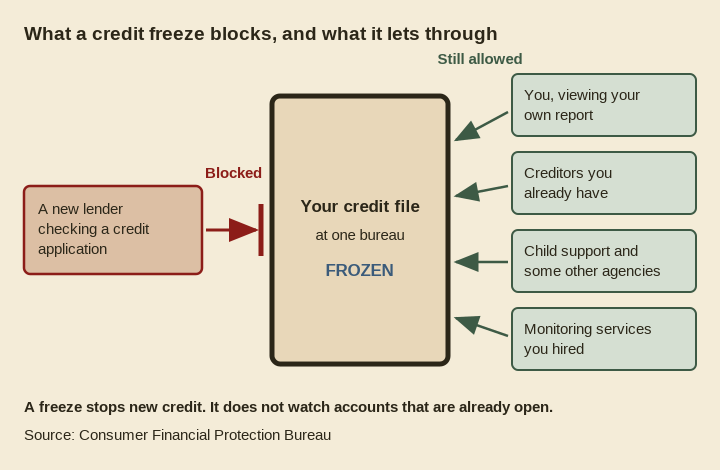 A freeze stops a new lender from reading the file. People and companies you already deal with still can, according to the CFPB.
Two limits follow from that.
First, a freeze does nothing about accounts that are already open. A stolen card number is a job for the card issuer, not the bureaus.
Second, new credit is only one kind of identity theft. The FTC's list of what a thief can do with your details includes "steal your tax refund," "get a job" and "get medical care." None of those runs through a credit check. The tax one has its own lock, covered below.
Watch out
The official pages do not fully agree on jobs, rentals and insurance. The FTC says that to "apply for new credit or a job, rent an apartment, or buy insurance, you can temporarily lift the freeze." The CFPB says the federal free-freeze law "does not apply to someone who requests your credit report for employment, tenant-screening, or insurance purposes." If you are about to apply for any of these, ask the company whether your freeze will get in the way.
Freeze, fraud alert or lock: which is which?
Three products sound alike. Only two are set out in federal law.
| Credit freeze | Fraud alert | Credit lock | |
|---|---|---|---|
| What it does | Blocks new lenders from the file | Tells lenders to verify it is you first | Blocks new lenders from the file |
| Who provides it | Each bureau, by law | Each bureau, by law | A bureau or monitoring service, as a product |
| Cost | Free | Free | May carry a fee or come inside a paid plan |
| Where you set it | At all three bureaus, one by one | At one bureau, which must tell the other two | With each company that sells it |
| How long | Until you lift it | One year, or seven for an extended alert | As long as you keep the service |
The fraud alert is the lighter touch. The FTC explains that it "doesn't prevent businesses from seeing your credit report." It asks them to check with you first. An initial alert is for anyone "who is or suspects they may be affected by identity theft." An extended alert lasts seven years and requires an FTC identity theft report or a police report. Active duty servicemembers have a one-year version of their own. You can have a freeze and an alert at the same time.
The lock is the one to read carefully. The CFPB's view is blunt: "Credit locks are no more effective than security freezes, which are free and which you have a right to by law." It notes that locks are offered "for a fee, often bundled with other services you must pay for." TransUnion's own page puts the difference this way: "Credit freezes are always free and provided by credit reporting agencies. Credit lock can come as a feature of credit monitoring services." A lock's selling point is convenience. Whether that is worth paying for is the reader's call, but it buys no extra protection.
How do you freeze at each bureau?
You do it three times, because a freeze at one bureau is not passed to the others. Each bureau lets you do it online with a free account, by phone or by mail. The details below are from each bureau's own page, read on 15 November 2026.
| Bureau | Online | Phone | Notes from its page |
|---|---|---|---|
| Equifax | A myEquifax account | (888) 298-0045 | You must be 18 to create an account |
| Experian | A free Experian account | 1-888-397-3742 | No PIN is needed any more to manage a freeze |
| TransUnion | A TransUnion Service Center account | 800-916-8800 | A temporary lift can be scheduled up to 15 days ahead |
Type the address yourself. Go to each bureau's site directly. A link in an email about "your credit freeze" is what a phishing message looks like.
Expect an upsell. Each bureau also sells monitoring and lock products, and the free freeze sits beside them. The page you want uses the words "security freeze" or "credit freeze" and says it is free.
Keep the logins. You will need all three on the day you apply for a loan.
Mail works too. Experian's page asks a mailed request to include your full name, Social Security number, addresses for the past two years, date of birth, a copy of a government ID and a copy of a utility bill or bank statement. The other two list their own requirements.
How fast it takes effect. Federal law sets deadlines for the bureaus, which the CFPB summarizes.
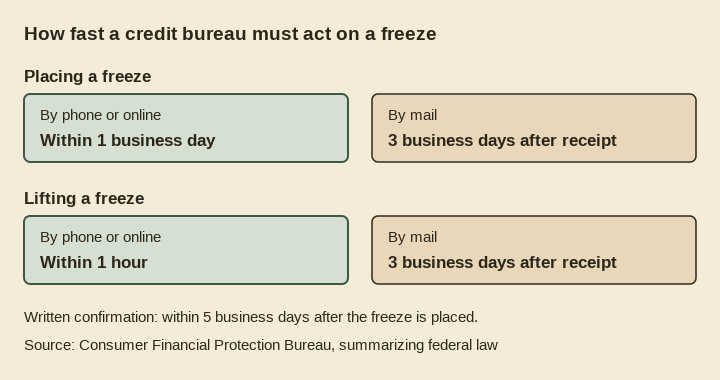 The deadlines the CFPB gives for a bureau to place or lift a freeze.
In practice the online route is quicker than the law requires. Experian says its online freeze and unfreeze happen "in real time." TransUnion says a freeze added online or by phone "typically takes effect almost immediately."
Say you are buying a car on a Saturday. Ask the dealer or lender which bureau it uses. The FTC's suggestion is to "just lift the freeze at that one bureau, and then put the freeze back in place once the need for a credit check passes." Experian and TransUnion both describe a temporary lift with a start and an end date, so the freeze comes back on its own. Equifax also offers a temporary lift. The other two files stay shut the whole time.
How do you freeze a child's file?
Misuse of a child's Social Security number can go unnoticed for a long time, because nobody is checking. The FTC says a child under 18 generally will not have a credit report at all, so finding one can itself be a warning sign.
The rules, from the FTC:
- Under 16: a parent or guardian requests the freeze. "The freeze stays in place until you tell the credit bureaus to remove it."
- 16 or 17: minors "may request and remove a security freeze themselves."
The CFPB explains what happens when there is no file to freeze: the bureau "will create a record in order to freeze it." That record cannot be used for credit.
The process is paper. Experian and TransUnion take a minor's freeze by mail, and Equifax uses a Minor Freeze Request form. Each wants proof of who you are, who the child is and your authority to act. The FTC lists what you may be asked for: your government-issued ID, proof of your address, the child's birth certificate and the child's Social Security card. TransUnion states that it cannot take these requests by phone or online "due to the documentation requirements." Equifax and TransUnion describe the same kind of freeze for an incapacitated adult, placed by someone who can prove they are that person's authorized representative.
For a household of two adults, a 17-year-old and a 9-year-old, the count is this. Six online freezes for the adults, three each. The 17-year-old can request their own. The 9-year-old needs three envelopes, one to each bureau, with copies of the documents above.
What is the IRS Identity Protection PIN?
It is a freeze for your tax return. The IRS describes the Identity Protection PIN, or IP PIN, as "a six-digit number that prevents someone else from filing a tax return using your Social Security number (SSN) or individual taxpayer identification number (ITIN)."
What the IRS page says, as reviewed on 10 November 2026:
- Who can get one: anyone with an SSN or ITIN who can verify their identity. Parents and guardians can request one for a dependent.
- How: the fastest way is through the IRS app or your IRS online account. Anyone under 18 must use one of the other routes.
- If you cannot get an online account: Form 15227, for people whose adjusted gross income on their last return was below $84,000, or $168,000 for a married couple filing jointly, or an in-person appointment at a Taxpayer Assistance Center.
- How long it lasts: "An IP PIN is valid for one calendar year," and a new one is generated each year.
- What happens without it: "An incorrect or missing IP PIN will result in the rejection of your e-filed return or a delay of your paper return until it can be verified."
Tip
Timing matters this month. The IRS page carries a notice that the online IP PIN system "will be offline for maintenance effective Monday, Nov. 16, 2026, until mid-January 2027." If you want a PIN for the coming filing season, put a reminder in your calendar for late January.
One rule from the IRS is worth memorizing: "The IRS will never ask for your IP PIN. Phone calls, emails or texts asking for your IP PIN are scams." This is general information, not tax advice. A tax professional can answer questions about your own return.
What if your identity has already been used?
Go to IdentityTheft.gov, the FTC's recovery site. You answer questions about what happened and it builds what the site calls "a personal recovery plan," with letters and forms filled in for you. Its checklist begins with three steps under the heading "What To Do Right Away":
- "Call the companies where you know fraud occurred."
- "Place a fraud alert and get your credit reports."
- "Report identity theft to the FTC."
The site adds that you may choose to file a police report as well. The steps after that are to close accounts opened in your name, remove charges that are not yours, correct your credit report, and consider an extended fraud alert or a freeze. The site has separate checklists for tax, medical and child identity theft.
For step 2, your credit reports are free. The FTC says the three bureaus "have permanently extended a program that lets you check your credit report from each once a week for free at AnnualCreditReport.com." It is the only site authorized for this, and the phone number is 1-877-322-8228.
What to remember
- A freeze blocks new lenders from your credit file. It is free, it does not touch your score, and it lasts until you lift it.
- Place it three times: Equifax, Experian and TransUnion. A fraud alert, by contrast, needs only one call.
- A paid lock adds convenience, not protection. The CFPB says locks are "no more effective" than freezes.
- A parent can freeze the file of a child under 16 by mail. At 16 a minor can do it personally.
- A freeze does not cover tax fraud. The IRS IP PIN does, and the online system reopens in mid-January 2027.
- If your identity is used, start at IdentityTheft.gov and pull your free reports at AnnualCreditReport.com.
Open three browser tabs by typing the addresses yourself and place the three freezes. Then do the same for the other adults in the house, and put the children's envelopes in the mail.
Sources (11)
- Federal Trade Commission, "Credit Freezes and Fraud Alerts", August 2025
- Consumer Financial Protection Bureau, "What is a credit freeze or security freeze on my credit report?", last reviewed 5 September 2025
- Equifax, "Security Freeze"
- Experian, "Freeze or Unfreeze Your Credit File for Free"
- TransUnion, "Credit Freeze"
- Federal Trade Commission, "How To Protect Your Child From Identity Theft", October 2024
- Internal Revenue Service, "Get an identity protection PIN", reviewed 10 November 2026
- Federal Trade Commission, "IdentityTheft.gov"
- Federal Trade Commission, "IdentityTheft.gov: Recovery Steps"
- Federal Trade Commission, "What To Know About Identity Theft", September 2024
- Federal Trade Commission, "Free Credit Reports", June 2026