Articles & BlogBy Trapper W. Brown7 min read
Security+ SY0-701, Objective 3.3: Compare the ways data is sorted, labeled and protected
What would you protect first if you could only protect one thing? Most people name a system: the server, the firewall, the email. The better answer is a kind of data. A server can be replaced in a week. The patient records, the payroll file and the pricing sheet are what a thief actually wants, and you cannot buy those back.
Objective 3.3 of the Security+ exam is built on that idea. You sort data by what it is, label it by how much damage a leak would do, and then pick a protection that fits. Skip the first two steps and you end up encrypting the lunch menu while the billing export sits on a shared drive that the whole office can open.
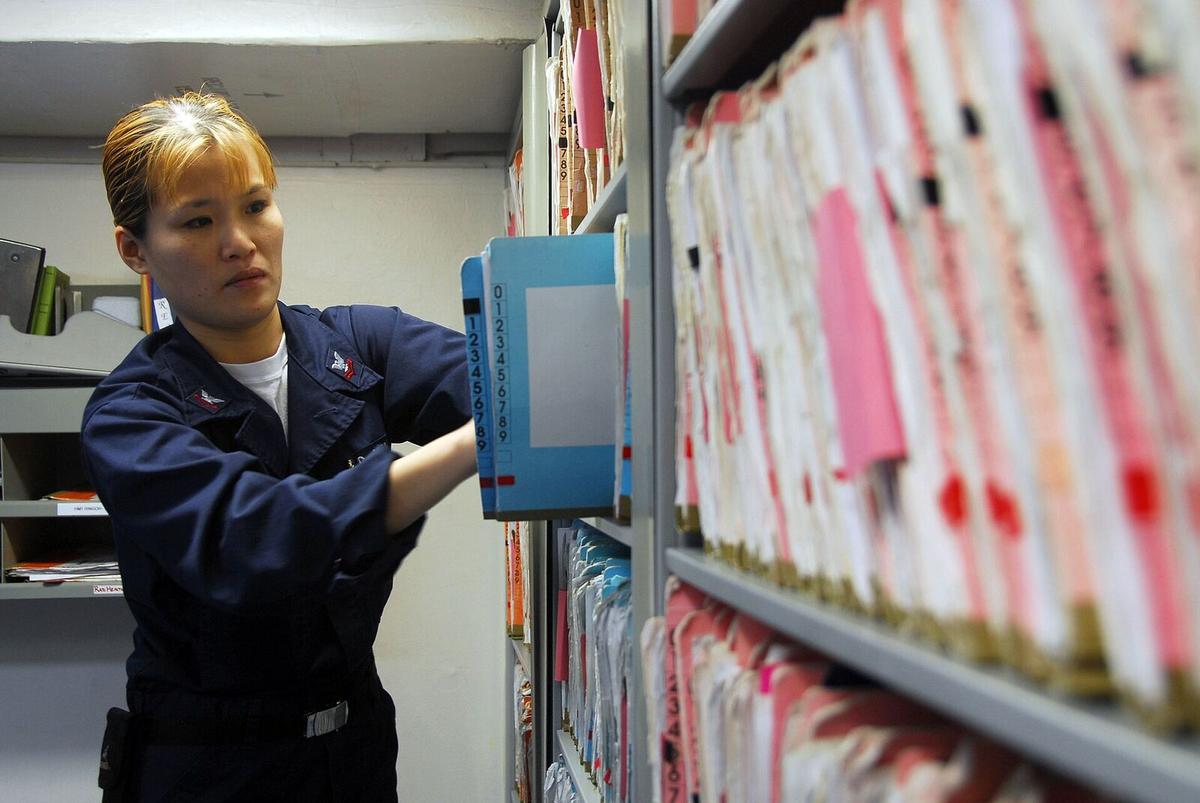 Medical records are regulated data whether they sit on a shelf or in a database. Photo by Mass Communication Specialist 3rd Class Eduardo Zaragoza, U.S. Navy, public domain, via Wikimedia Commons.
What kind of data is it?
Start by asking what you are holding. The exam lists five types.
| Data type | What it is | Example |
|---|---|---|
| Regulated | Data that a law or a contract tells you how to handle | Patient records under HIPAA, card numbers under PCI DSS |
| Trade secret | Something that gives you an edge only while it stays secret | A formula, a pricing model, a supplier list |
| Intellectual property | Creations the law lets you own | Patents, copyrights, trademarks, source code |
| Legal information | Records tied to legal matters | Contracts, court filings, letters from an attorney |
| Financial information | Records of money | Bank details, payroll, tax filings, invoices |
One file can be more than one type. A hospital's contract with an insurer is legal information, and the rates inside it may also be a trade secret.
The exam also splits data into two forms. Human-readable data is anything a person can read as it is: a spreadsheet, a PDF, a printed chart. Non-human-readable data needs a machine to make sense of it: a database file, a barcode, a binary log. Do not assume the second form is safe because you cannot read it. Anyone with the right program can.
Regulated data is the type that comes with reporting duties when it leaks. In its 2024 Report to Congress on breach notification, the HHS Office for Civil Rights counted 663 breaches of health information that each affected 500 or more people in 2024. Together those breaches involved about 192 million people.
| 2020 | 656 |
|---|---|
| 2021 | 609 |
| 2022 | 626 |
| 2023 | 732 |
| 2024 | 663 |
Source: HHS Office for Civil Rights, 2024 Report to Congress on breach notification
Put a label on it
How do you tell a busy employee which files need care? You classify them. A classification is a label that says how much harm exposure or loss would cause, and so how the data must be handled. The exam names six.
| Classification | What the label tells you | Example |
|---|---|---|
| Public | Anyone may see it, and release does no harm | A brochure, a published price list |
| Private | It is about one person and belongs to that person | An employee's home address |
| Sensitive | Exposure would hurt a person or the organization | Health details, salary bands, internal emails |
| Confidential | Only people with a business need may see it | Contracts, unreleased financial results |
| Restricted | Only a short list of named people may see it | Encryption keys, merger plans |
| Critical | The organization cannot run without it | The scheduling and records database |
Every organization orders these a little differently, so the exam tests the idea more than one fixed ranking. Notice that critical is the odd one out. The other five are about who may see the data. Critical is about what happens when the data is gone or wrong, which makes it an availability and integrity label.
A small clinic can get by with three labels: public, confidential, and restricted. A large hospital system may need all six, plus rules for research data. What matters is that each label changes what people do. If confidential and sensitive files are stored, shared and deleted in exactly the same way, you have one label with two names.
Tip
On the exam, read the scenario for what the label drives. If the business stops without the data, think critical. If it is about a named individual, think private. If a law sets the handling rules, the data type is regulated.
Three states, three chances to lose it
Where is the data right now? It is always in one of three states, and each one needs its own protection.
| State | Where the data is | Typical protection |
|---|---|---|
| At rest | Stored on a disk, a phone, a backup tape or a cloud bucket | Disk or database encryption, file permissions |
| In transit | Moving across a network | TLS, a VPN |
| In use | Loaded in memory, being read or changed by a person or a program | Access controls, screen locks, masking, protected memory |
Data in use is the hardest of the three. To work on a record, a program has to decrypt it first, so for that moment it sits in memory in the clear. That is why attackers go after memory, and why a logged-in workstation left unlocked is such a gift.
Watch out
A common mistake is to treat an encrypted disk as the end of the problem. Disk encryption protects a laptop that is stolen while powered off. Once the user logs in, the data is readable by anything running as that user, including malware.
Where the data lives matters
Two general considerations on the exam are about place.
Data sovereignty means data is subject to the laws of the country where it is stored. Say a hospital system keeps its records in a cloud region at home, but its backup service quietly copies them to a data center abroad. Those copies now answer to a second country's privacy and disclosure laws, and the hospital may have broken its own rules without anyone making a decision.
Geolocation is knowing the physical location of data, or of the person asking for it. You use it to enforce the rules above. If your clinic has no staff outside one state, a login from another continent deserves at least a second look.
Eight ways to protect it
The last part of the objective is a list of methods. Each solves a different problem, and the exam likes to ask which one fits.
Geographic restrictions limit where data may be stored or where it may be reached from. They are how you act on sovereignty and geolocation.
Encryption scrambles data with a key so that only someone holding the right key can read it. It is reversible on purpose, and it is your main tool for confidentiality in all three states.
Hashing turns data into a fixed-length fingerprint that cannot be turned back. You use it to prove a file has not changed and to store passwords without storing the passwords themselves.
Masking hides part of a value when it is shown, such as a card number displayed as XXXX XXXX XXXX 1234. The full value still exists underneath. Masking protects it from the person looking at the screen.
Tokenization swaps a sensitive value for a random stand-in, and keeps the real value in a separate, guarded vault. The token has no mathematical link to the original, so stealing it gets the thief nothing.
Obfuscation is the broad term for making data hard to understand. Masking and tokenization are both forms of it, and so is scrambling real names in a test database. On its own it slows a reader down. It does not stop a determined one.
Segmentation keeps sensitive data on its own part of the network, so a break-in somewhere else does not lead straight to it.
Permission restrictions limit who can read, change or delete a file. Give each person the least access the job needs.
Here is how the two organizations might combine them. The clinic encrypts every laptop, puts the patient database on its own network segment, masks Social Security numbers at the front desk, and sets file permissions by job role. The hospital system does all of that, then adds tokenization so that card numbers never reach its own servers, restricts cloud storage to regions inside the country, and hashes its archived records so it can prove later that none were altered.
I think the pairing people most often get wrong is encryption, hashing and tokenization. Encryption can be reversed with a key. Hashing cannot be reversed at all. Tokenization can only be reversed by asking the vault.
What to remember
- Five data types: regulated, trade secret, intellectual property, legal, financial. Two forms: human-readable and non-human-readable.
- Six labels: public, private, sensitive, confidential, restricted, critical. Critical is about the business running.
- Three states: at rest, in transit, in use. Each needs its own protection.
- Data sovereignty ties data to the law of the place it is stored.
- Encryption is reversible with a key, hashing is one-way, tokenization keeps the real value in a vault.
- Masking hides data on display. Segmentation and permissions limit who can reach it at all.
None of the eight methods works well on data you have not sorted. Do the inventory first, label what you find, and the choice of protection gets much easier, because you finally know what each file is worth.