Articles & BlogBy Trapper W. Brown6 min read
Security+ SY0-701, Objective 5.2: Explain elements of the risk management process
Is every risk worth fixing? No. And if you try, you will run out of money long before you run out of risks.
That is the whole reason risk management exists. It is not paperwork for auditors. It is how you decide what to fix first, what to fix later, and what to leave alone on purpose. The Security+ exam tests it in Domain 5, and it is one of the few exam topics you will keep using long after the test.
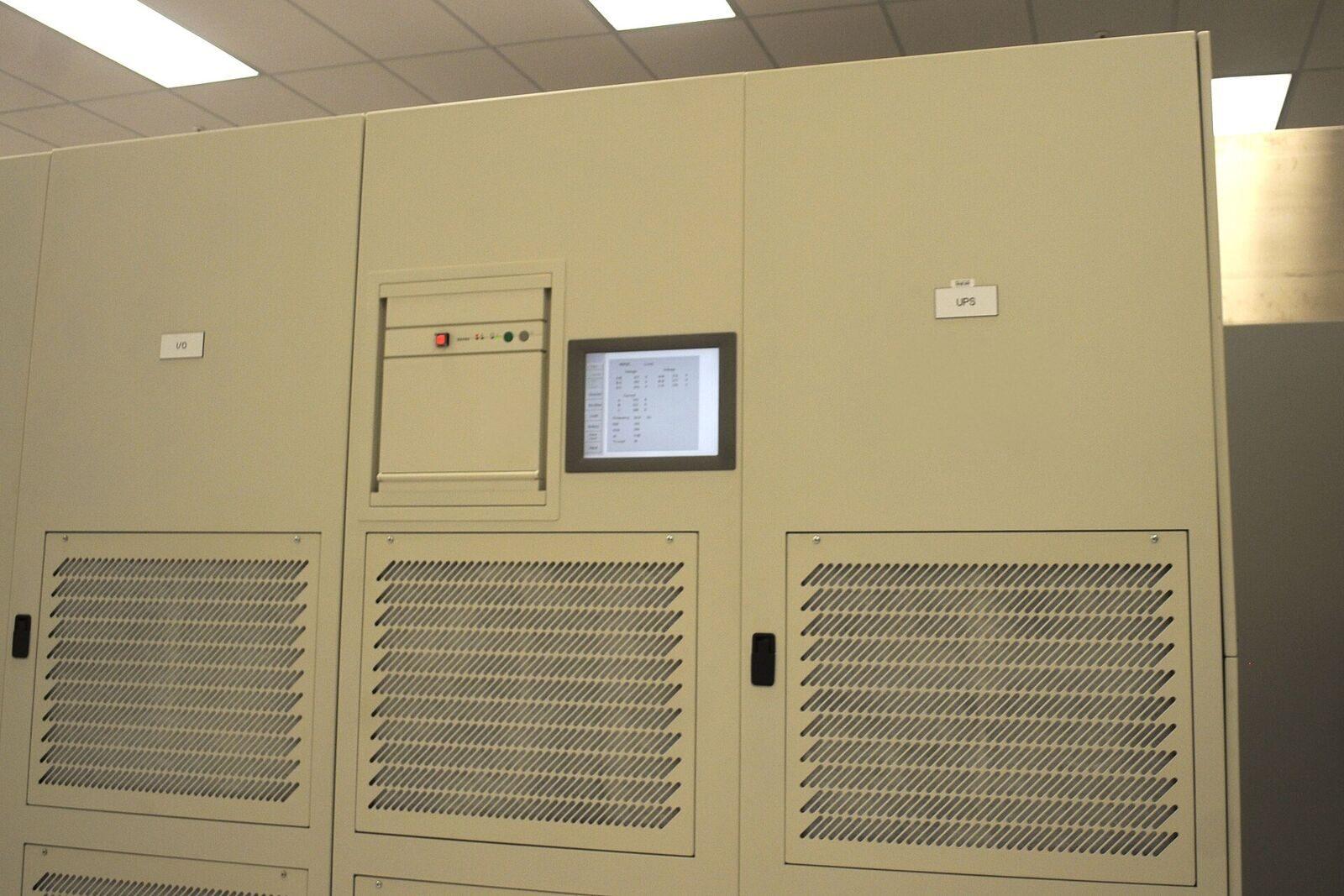
 Every security decision is a bet on likelihood and cost. Photo by freeGraphicToday, CC0 public domain dedication, via Wikimedia Commons.
I have sat through more than one review where the risk register ran to a few hundred lines and nearly every one was marked high. Nobody in the room could say which three to fix that quarter. When everything is urgent, nothing is, and the budget ends up going to whoever argues loudest.
Start with two numbers
A risk has two parts: how likely it is to happen, and how bad it is if it does. That's it. Everything else is a way of measuring those two things.
The quick way is qualitative analysis. You score likelihood from 1 to 5 and impact from 1 to 5, then multiply. A risk that is unlikely (2) but painful (4) scores an 8. A risk that is almost certain (5) and severe (5) scores a 25. Nobody pretends these numbers are exact. Their job is to put your risks in order.
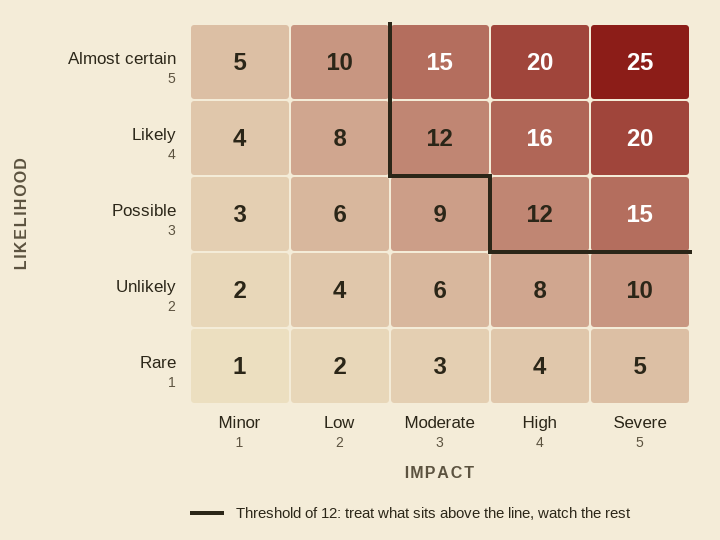 Likelihood times impact on a 1 to 25 scale, with a threshold drawn at 12.
The slower way is quantitative analysis, which uses dollars. This is where the exam formulas come in.
The formulas, with a real example
Say a small clinic has a file server that holds its patient records. Between the hardware, the data, and what it would cost to be down, the clinic values it at $200,000. That is the asset value (AV).
A ransomware attack would not destroy all of that value. The clinic figures it would lose about 40 percent between recovery costs and lost appointments. That 40 percent is the exposure factor (EF).
Now, how often? The clinic estimates an attack like this would land about once every four years. That gives an annualized rate of occurrence (ARO) of 0.25.
| Term | What it means | The clinic's number |
|---|---|---|
| Asset value (AV) | What the thing is worth to you | $200,000 |
| Exposure factor (EF) | The share of that value one incident destroys | 40 percent |
| Single loss expectancy (SLE) | AV x EF: the cost of one bad day | $80,000 |
| Annualized rate of occurrence (ARO) | How many times a year you expect it | 0.25 |
| Annualized loss expectancy (ALE) | SLE x ARO: the cost per year, on average | $20,000 |
That last number is the one that matters. It tells you what this risk costs you per year on average, and so it tells you what a fix is worth.
Suppose better backups and endpoint protection cost $8,000 a year and cut the odds to once in twenty years (ARO 0.05). The new ALE is $80,000 x 0.05 = $4,000.
| Expected loss today | $20,000 |
|---|---|
| Expected loss with the fix | $4,000 |
| What the fix costs | $8,000 |
Source: Worked example in this article
You spent $8,000 to save $16,000. Do it.
Now suppose the only fix on offer costs $30,000 a year. You would be paying $30,000 to avoid $16,000 in losses. That is a bad trade, and the math just told you so before a salesperson could tell you otherwise.
Tip
For the exam, memorize two lines: SLE = AV x EF, and ALE = SLE x ARO. Most risk math questions are one of those with the numbers moved around.
Where is your line?
Once your risks are scored, you need a line. Risks above it get treated. Risks below it get written down and watched.
Two exam terms live here, and people mix them up:
- Risk appetite is how much risk you are willing to take on in pursuit of your goals. The exam describes it as expansionary, neutral, or conservative.
- Risk tolerance is how far from that appetite you can drift on a specific risk before you have to act.
The line itself is your risk threshold. On a 1 to 25 scale, maybe yours is 12.
The line is different for everyone. A clinic that brings in $2 million a year could be finished by a $500,000 loss. A hospital system that brings in $800 million would call the same loss a rough quarter. Same risk, same dollar figure, completely different answer.
For a sense of scale, IBM's yearly Cost of a Data Breach study, with research by the Ponemon Institute, put the global average cost of a breach at $4.99 million in its 2026 edition. In 2020 it was $3.86 million.
| 2020 | $3.86M |
|---|---|
| 2021 | $4.24M |
| 2022 | $4.35M |
| 2023 | $4.45M |
| 2024 | $4.88M |
| 2025 | $4.44M |
| 2026 | $4.99M |
Source: IBM Cost of a Data Breach Report, 2020 to 2026 editions
That is an average across organizations far larger than our clinic, so do not borrow it. Your own asset values and your own odds are what set your line.
Four things you can do about a risk
For every risk above your line, you have four choices:
| Choice | What you do | Example |
|---|---|---|
| Mitigate | Add a control that lowers the likelihood or the impact | Backups, patching, training |
| Transfer | Make it someone else's financial problem | Cyber insurance |
| Avoid | Stop doing the risky thing | Retire the old server nobody will patch |
| Accept | Decide it is not worth treating, in writing, and watch it | A brief internet outage at a low-traffic office |
Mitigation is the usual starting point. Acceptance is a decision, not a shrug. The exam splits it into an exception (a temporary pass on a policy, with an end date) and an exemption (a standing one). Either way, somebody with authority signs it.
Write it down
All of this goes in a risk register. Each line needs the risk, its score, a risk owner, the chosen response, and a due date. The exam also expects you to know key risk indicators, which are the early warning measures that tell you a risk is getting worse.
The owner matters most. A risk with no name next to it belongs to nobody, and it will still be sitting there next year. I have opened registers where the owner column said "IT" on every row. That is the same as leaving it blank.
How often you reassess is also on the exam: ad hoc, one-time, recurring, or continuous. Pick recurring at the very least. A risk analysis you did three years ago describes a company that no longer exists.
Four more acronyms
The business impact analysis part of this objective adds four terms you should know cold:
| Acronym | Stands for | The question it answers |
|---|---|---|
| RTO | Recovery time objective | How long can you afford to be down? |
| RPO | Recovery point objective | How much data can you afford to lose, measured in time? |
| MTTR | Mean time to repair | How long does a fix usually take? |
| MTBF | Mean time between failures | How long does it usually run before it breaks? |
Watch out
If your RTO is four hours and your MTTR is two days, you have found a risk without scanning anything.
What to remember
- Risk is likelihood times impact. Start there.
- SLE = AV x EF. ALE = SLE x ARO. Memorize both.
- A control is worth buying when it costs less than the loss it prevents.
- Set a threshold. Treat what is above it and watch what is below it.
- Mitigate, transfer, avoid, or accept. Accepting still means writing it down.
- Every risk gets an owner with a name.
Risk management will never make you safe. It makes sure that when something does go wrong, it is one of the things you chose to live with and not one you never looked at.