Articles & BlogBy Trapper W. Brown8 min read
For parents, grandparents and anyone who would drop everything for a frightened call from someone they love. By the end your family will have a code word, and you will know what to do before a single dollar moves.
For as long as there have been telephones, a familiar voice has been proof enough. You hear your daughter, you know it is your daughter. That shortcut has stopped being safe. Software can now copy a voice well enough to fool the people who know it best.
The fix does not involve becoming an expert listener. It is two small habits that work even when the fake is perfect, because neither of them depends on your ears.
 Slowing down and writing things down is the right instinct on any call that asks for money. Photo by Rhoda Baer, public domain, via Wikimedia Commons.
What can be faked today?
A deepfake is audio, video or a picture made by artificial intelligence (AI) software to look or sound like a real person. Voice cloning is the audio kind: software studies a recording of someone speaking and then says new words in that voice.
How much recording does it need? Not much. The Federal Trade Commission (FTC) warned in March 2023 that a scammer needs only a short audio clip of a family member's voice. That is one reason the FBI suggests limiting how much of your voice and image is public.
| What is faked | What it looks like in a scam |
|---|---|
| A voice | A phone call or voicemail from a relative in trouble, or from a boss |
| A face on video | A live video chat with someone who seems to be an executive or an official |
| A photo | "Proof" that an online contact is a real person |
| Writing | Emails and texts in the right tone, with no spelling slips |
The FBI described all of these in a public notice of 3 December 2024, including short audio clips of a loved one's voice used to ask for urgent money, and video made for real time chats with supposed company executives or law enforcement.
The scale is now measurable. The FBI's Internet Crime Complaint Center (IC3) says in its 2025 annual report that more than 22,000 complaints that year mentioned AI, with reported losses above $893 million. The same report warns that AI-made content is getting harder to detect and easier to make, and that many victims never realize AI was involved.
How does the emergency call work on you?
The story changes, but the shape does not. Someone you love is in sudden trouble: an accident, an arrest, a hospital. The voice sounds right and it sounds scared. Sometimes a second person takes over, claiming to be a lawyer, a police officer or a doctor. The FTC's guide to these calls notes that the caller pushes for two things above all: speed and secrecy.
Then comes the request for money, in a form that cannot be pulled back. The FTC names wire transfers, cryptocurrency, payment apps and gift cards where you read the numbers aloud.
People who fall for this are not foolish. Fear for a child or grandchild switches off careful thinking in anyone, and the call is built to do exactly that. The IC3 report puts reported 2025 losses from "distress" scams that used voice cloning at more than $5 million.
| The call says | A real emergency | The scam |
|---|---|---|
| "Don't tell anyone" | Rarely. Real trouble wants more people helping | Almost always |
| "It has to be right now" | There is time to check | You are kept on the line |
| How to pay | Ordinary bills, paid to a named organization | Gift cards, cryptocurrency, a wire, a payment app |
| If you offer to call back | Fine | Pressure, anger or a new excuse |
The family code word
A code word is a word or short phrase that your family agrees on in person and never writes anywhere public. On a frightening call you ask for it. The real person knows it. A cloned voice does not, however good it sounds.
This is official advice, not folklore. The first tip in the FBI's December 2024 notice is to create a secret word or phrase with your family to verify their identity, and the Bureau repeated it in May 2025.
A few rules make it work:
- Pick something that is nowhere online. Not a pet's name, a street, a team or a birthday. Two unrelated words work well.
- Share it face to face, or on a call you placed yourself. Never by text or social media.
- Agree that asking is normal. Nobody is insulted by "what's the word?" Teenagers and grandparents both need to hear this.
- It works in both directions. A grandchild can ask for it too.
If the family forgets the word, the FTC suggests a fallback: ask a question a stranger could not answer, such as what kind of dog you have.
Tip
Hold a two minute practice at the next family dinner. One person plays the caller, another asks for the word. It feels silly once, and after that everyone remembers both the word and the right to ask for it.
The call back rule
The second habit needs no preparation at all. Hang up, then call the person yourself on the number you already have for them.
The FTC puts it bluntly: do not trust the voice. Call the person who supposedly contacted you on a number you know is theirs, and if you cannot reach them, try another relative or their friends, even if the caller begged you to keep it quiet. The FBI gives the same advice for callers who claim to be from a bank or an agency: hang up, find the organization's number yourself, and dial that.
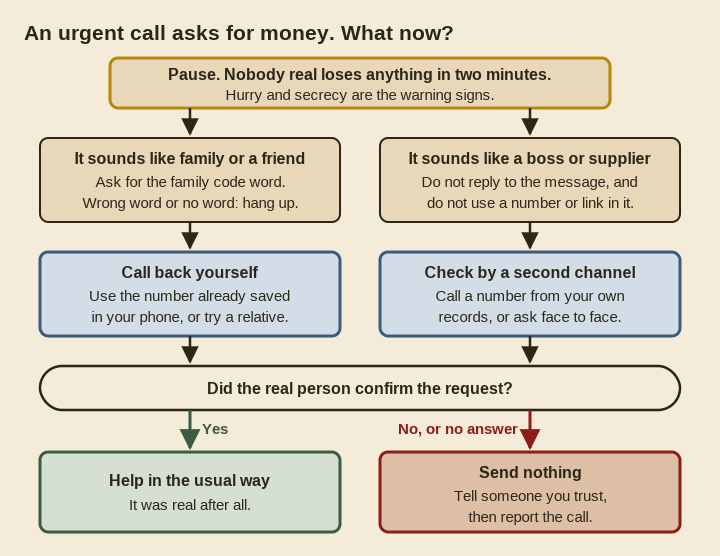 Two minutes of checking settles almost every one of these calls.
Watch out
Do not try to judge the voice by ear, and do not trust the number on your screen, which can be faked as well. The FBI still lists things to listen for, such as odd tone and word choice, but its own annual report says fakes are becoming harder to detect. Checking beats listening.
At work: the boss who needs a payment today
Businesses face the same trick wearing a suit. An email, a voicemail or even a video call that seems to come from an owner or a supplier asks for a payment today, or for bank details to be changed. The older email version is called business email compromise, and it is one of the costliest crimes the FBI tracks: about $3.05 billion in reported losses in 2025, according to the IC3 annual report, with more than $30 million of that tied to AI.
The defense is the call back rule written into policy. The FBI's September 2024 notice tells organizations to verify requests for changes in account information through a secondary channel. In practice that means three things:
- Any new payee, changed bank detail or rush payment is confirmed by phone, using a number from your own records and never one from the message.
- Two people approve payments above a set amount.
- Staff are told, out loud, that nobody gets in trouble for delaying a payment to check it. That includes when the request seems to come from the owner.
If money has already gone
Act quickly and without shame. Scams like these succeed against careful people every day.
- Call your bank, card issuer or payment app right now and ask them to stop or recall the payment. The FBI says time is of the essence.
- Report it to the FBI at ic3.gov, whatever the amount.
- Report it to the FTC at ReportFraud.ftc.gov.
- Tell your family, so the same caller does not try the next person.
Here is the list for this week.
- Choose a family code word and share it in person
- Tell every generation: asking for the word is always allowed
- Check that you have current phone numbers saved for close family
- Agree that any request for money by phone gets a call back first
- Set family social media accounts to private where you can
- At work, ask how payment changes are verified, and by whom
What to remember
- A voice, a face on video and a photo can all be faked. A short clip is enough to copy a voice.
- The warning signs are hurry, secrecy and payment that cannot be reversed.
- Agree on a family code word, in person, that appears nowhere online.
- Hang up and call back on a number you already have. Do this even when the voice is perfect.
- At work, confirm payment changes through a second channel before any money moves.
- If money has gone, call the bank first, then report at ic3.gov and ReportFraud.ftc.gov.
Pick the word tonight. For the other ways a scam reaches you, by email, text and phone, read Phishing, Vishing, Smishing: How the Message Gets In.