Articles & BlogBy Trapper W. Brown9 min read
For anyone who heard the name DeepSeek in the news and never got a calm explanation. By the end you will know what the company makes, why one release got so much attention, and what to check before you type anything into it.
DeepSeek is a company in Hangzhou, China, that builds artificial intelligence (AI) language models. Its page on Hugging Face, the site where most downloadable models are shared, says it was "founded in 2023." It makes a chat app, sells access to its models to developers, and publishes many of the models themselves as free downloads.
You should care for two reasons. The models are widely used, often inside other products. And the company became a test case for questions that apply to every AI provider: how were the models made, who can check the claims, and where does your data go?
 Shanghai at night, photographed from the International Space Station. Words typed into a hosted AI service travel to data centers in the provider's home country. Photo by NASA, public domain, via Wikimedia Commons.
What did it release, and when?
The dates below come from the change log in DeepSeek's own developer documentation and from its model pages, read on 12 November 2026.
| Date | Release | What changed |
|---|---|---|
| 26 December 2024 | DeepSeek-V3 | A general chat model with 671 billion parameters |
| 20 January 2025 | DeepSeek-R1 | The company's first reasoning model |
| 28 May 2025 | DeepSeek-R1-0528 | An update to R1 |
| 21 August 2025 | DeepSeek-V3.1 | One model that can answer quickly or think first |
| 1 December 2025 | DeepSeek-V3.2 | An update to both modes |
| 24 April 2026 | DeepSeek-V4 | Two sizes, Pro and Flash, each able to keep a million tokens in view |
| 10 September 2026 | DeepSeek-V4.1-Flash | The smaller model learns to read images |
A parameter is one of the adjustable numbers inside a model that hold what it has learned. A token is a piece of a word, and the number a model can "keep in view" is how much text it can work with at once.
The V4 model card gives the sizes: V4-Pro has 1.6 trillion parameters with 49 billion active at a time, and V4-Flash has 284 billion with 13 billion active. The article Qwen AI: The Model Family From Alibaba Cloud explains why big models list two numbers. As of this writing, the developer service offers two names, deepseek-flash and deepseek-v4-pro, and the Flash one was last updated on 17 October 2026.
Why did the January 2025 release draw so much attention?
Three things arrived together, and each one can be read on the company's own pages.
A claim. The R1 model card says the model performs at a level comparable to OpenAI's o1, a paid reasoning model from the American company OpenAI. That is the maker's report of its own tests.
A license. The same card says the code and the model weights are released under the MIT License. MIT is about as permissive as licenses get: use it, change it, sell it. A model its maker compared with a paid product could be downloaded by anyone.
A number. The technical paper for V3, posted in December 2024, said full training took 2.788 million hours of time on graphics processors. At an assumed rental price of 2 dollars per hour, the paper worked that out to 5.576 million dollars. The multiplication is easy to check: 2,788,000 times 2 is 5,576,000.
That last figure is the one to read carefully. The paper says it covers "only the official training" of the model and excludes earlier research and experiments. It is the cost of the final run, not the cost of building the company or learning how to do it. Compare the price of baking one cake with the price of opening a bakery.
One measure of the reaction comes from a US government body. The Center for AI Standards and Innovation, part of the National Institute of Standards and Technology, wrote on 30 September 2025 that downloads of DeepSeek models on model-sharing sites had risen "nearly 1,000% since January 2025."
What is a reasoning model, in plain words?
Ask an ordinary language model a question and it starts writing the answer at once, one word after another. That works for "what is the capital of France." It works badly for a puzzle with several steps, because the model commits to an answer before it has worked anything out.
A reasoning model does its scratch work first. It writes out a chain of steps, checks them, sometimes backs up and tries again, and only then gives a final answer. In R1's output the scratch work sits between two markers, <think> and </think>, and you can read it.
Here is a small example. A shop sells pens at 3 for 2 dollars. How much do 12 pens cost? A model answering on reflex might multiply 12 by 2 and say 24 dollars. A reasoning model writes: 12 pens is 4 groups of 3. Each group costs 2 dollars. 4 times 2 is 8. Then it answers 8 dollars. A good student does the same thing in the margin.
How R1 learned this is the interesting part. The model card describes an earlier version, R1-Zero, trained with reinforcement learning: the model tried problems, was rewarded for right answers, and was never shown worked examples written by people. The card says the habits of checking and reflecting appeared during that training. It also says R1-Zero had problems, including "endless repetition" and poor readability, which R1 was built to address by adding some starting examples before that training.
Thinking has a price. The scratch work is text the model has to produce, so answers take longer and cost more. That is why the later models let you choose. V3.1 was described as a hybrid with thinking and non-thinking modes, and the V4-Pro card lists three effort levels: low, high and max.
App, API or open weights?
There are three ways to use a DeepSeek model, and they are not alike.
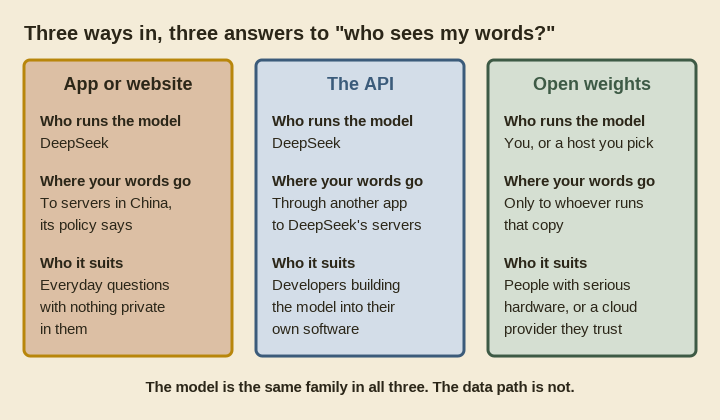 The same family of models, reached three ways. What differs is who handles your words.
The app and website. You sign up and chat. DeepSeek runs the model on its own computers.
The API. An API is a connection that lets one piece of software talk to another. A developer pays DeepSeek by usage and builds the model into a product. If you use that product, your words pass through it to DeepSeek.
The open weights. The weights are the model itself, published as files. The R1 card and the V4 cards all state the MIT License. Anyone can download them and run them where DeepSeek never sees a thing.
There is a catch with the third way. The full R1 model has 671 billion parameters, far beyond a home computer. So the company also released six distilled models, from 1.5 billion to 70 billion parameters. A distilled model is a small model trained to imitate a large one. The card says these were built on top of other makers' open models, from Alibaba's Qwen 2.5 line and Meta's Llama line, and that they carry terms from those bases too. When someone says they ran DeepSeek on a laptop in 2025, it was one of these. The article Hermes: The Open AI Models and Agent From Nous Research covers how running a downloaded model works.
Take two examples. One person wants help planning a trip. The app does that well, and a holiday plan is not much of a secret. A hospital's research team wants a model to help sort internal reports. For them, the app is the wrong tool, and the weights on a machine the hospital controls are a different conversation entirely.
What have regulators and governments said?
At least two official bodies have published on DeepSeek. Each is reported here with its date and only what its own page states.
Italy, 30 January 2025. The Italian data protection authority, the Garante, ordered an urgent and immediate limit on the processing of Italian users' data by the two companies behind the chatbot, Hangzhou DeepSeek Artificial Intelligence and Beijing DeepSeek Artificial Intelligence. Its notice says the companies had replied that they do not operate in Italy and that European law does not apply to them, and that the authority judged the reply wholly insufficient. It opened an investigation at the same time.
United States, 30 September 2025. The Center for AI Standards and Innovation published an evaluation of three DeepSeek models: R1, R1-0528 and V3.1. Among its findings: agents built on R1-0528 were, on average, 12 times more likely than the US models it tested to follow malicious instructions planted in their task. With a common trick for getting around safety rules, R1-0528 answered 94 percent of plainly malicious requests, against 8 percent for the US reference models. The center also said the models repeated inaccurate and misleading Chinese Communist Party narratives four times as often as the US models did.
Read that second item with its context. It is one government's evaluation, comparing a foreign company's models with those of its own country. It tested 2025 models, not the V4 line. And it is the published report of a standards body, which is why it is here.
Hidden instructions planted in a task are the subject of Prompt Injection: The New Phishing, Aimed at the Machine.
What should you weigh before using it?
Start with what the company itself says. DeepSeek's privacy policy, last updated on 10 February 2026, names Hangzhou DeepSeek Artificial Intelligence Co., Ltd. as the provider. It says: "we directly collect, process and store your Personal Data in People's Republic of China." It lists training and improving its technology among the uses of what you type, and it lists a right to opt out of that use.
None of this is unusual in kind. Every hosted AI service stores your words somewhere, under some country's law, and many use them to improve the product unless you say no. What changes from one provider to the next is which country, which law and which settings. The Qwen article in this set ends with five questions to ask of any hosted AI service, and they fit here without a word changed.
My own rule is simple. The more private the text, the closer the model should be to you. Public questions can go anywhere. Personal details deserve a provider whose terms you have read. Anything you would not put in an email to a stranger belongs on hardware you control, or nowhere.
Tip
If your employer or school has a list of approved AI tools, that list already answers this for work. Check before you install anything on a work device.
What to remember
- DeepSeek is a Hangzhou company, founded in 2023, that makes a chat app, a paid developer service and open models.
- R1, released on 20 January 2025, was a reasoning model: it works through a problem in visible steps before answering.
- It drew attention because the maker claimed top-tier results, gave the weights away under the MIT License, and had published a low training figure that covered only the final run.
- The app, the API and the open weights are three different data paths. Only the third keeps your words off the company's servers.
- Italy's privacy authority limited the app's data processing on 30 January 2025. A US standards body published security findings on 30 September 2025.
- The company's policy says personal data is stored in China. Decide what you type with that in mind, as you would with any provider.
If you want to see what "reasoning" looks like, ask a thinking model a puzzle with three steps and read the scratch work before the answer. It is the quickest way to understand both what these models can do and how they go wrong.