Articles & BlogBy Trapper W. Brown9 min readCurrent to 13 November 2026Facts only
As of 13 November 2026, the National Institute of Standards and Technology (NIST) has published a report on a question most organizations have not yet answered: what do you do when an AI system is attacked, or when it causes harm by itself? The report is NIST Internal Report (IR) 8621. NIST announced it on 2 November 2026. It summarizes a workshop held on 14 May 2026 that, in NIST's words, "brought together more than 400 participants from government, industry, academia, and other communities of interest."
Read it for what it is. IR 8621 is a record of what speakers and participants said, plus a list of work NIST says it plans. It sets no requirement for anyone. NIST may revise its plans, so check the publication page for changes.
 The Advanced Measurement Laboratory on the NIST campus in Gaithersburg, Maryland, photographed in 2004. Photo by Gail Porter, credited to NIST, public domain, via Wikimedia Commons.
What is IR 8621?
An incident, in security work, is an event that harms or threatens a system or the people who depend on it. Incident management is the planning, detection, response and recovery around such events. The site's article "The First Hour: The Incident Response Lifecycle" covers the standard version.
IR 8621 is titled "NIST Workshop on SI Incident Management." It lists five NIST authors and is dated November 2026. The report says the workshop followed "the federal AI Action Plan's directive" for NIST to work with stakeholders on "standards, response strategies, best practices, and technical tools" for these incidents.
One thing about the title needs explaining. "SI" stands for "super intelligence." A note in the report says: "Per the Sept. 29, 2026, Executive Order 14434: Inaugurating the Era of Super Intelligence, NIST is working to update its communications to incorporate the term 'super intelligence' as directed." The Federal Register lists Executive Order 14434 as signed on 29 September 2026 and published on 2 October 2026. In this report the term covers the same systems that the workshop's own session titles call AI: models, agents, their data and the infrastructure around them. This article uses "AI" from here on, except in titles and quotations.
The report also states its own limits. It says: "Sections 3 through 8 include summaries of presenter materials, discussions, and terminology from the workshop on May 14, 2026." Of the breakout sessions it says: "The synthesis that follows is not a verbatim transcript."
What counts as an AI incident?
The workshop sorted incidents into "two overlapping categories."
The first is cybersecurity incidents that affect AI systems. The report describes these as incidents "that jeopardize the confidentiality, integrity, or availability" of models, agents, data or supporting infrastructure. Its examples include "model theft, data poisoning, prompt injection," supply-chain attacks and compromised agents. Data poisoning means corrupting the data a model learns from. Prompt injection means slipping instructions into the text a model reads; the site's article "Prompt Injection: The New Phishing, Aimed at the Machine" explains it.
The second is incidents that AI systems can cause. The report describes "cases of misuse, malfunction, or high-stakes accidents" that lead to harm. Its examples include "unsafe outputs, hallucinations with operational consequences," overreliance and "harmful autonomous actions." A hallucination is a confident answer that is false.
One point from the breakout sessions ties the two together. Participants noted that "a technically secure AI system can still create an AI incident if it produces incorrect outputs, enables unacceptable decisions, or causes harm in a specific operational context."
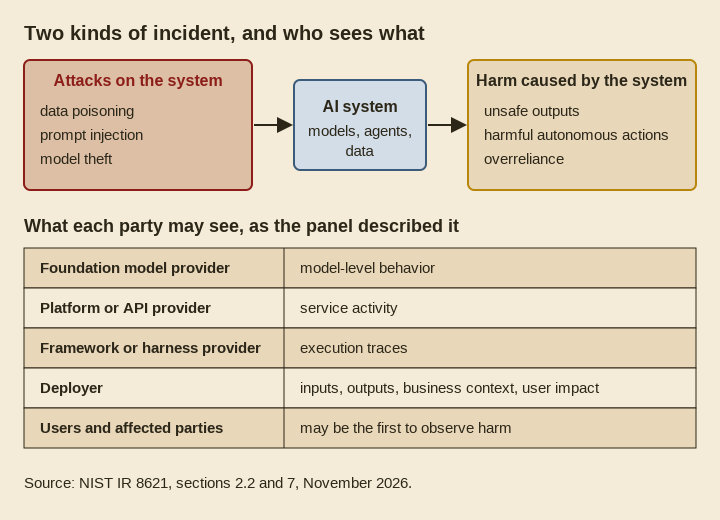 The report's two categories of incident and the panel's account of who sees what. Source: NIST IR 8621, sections 2.2 and 7, November 2026. Diagram by Warhawk Division.
Why did speakers say the usual playbook strains?
The report's introduction puts the problem this way: "Unlike traditional deterministic IT systems," these models "are probabilistic." Deterministic means the same input gives the same output every time. Probabilistic means it may not. The introduction says traditional incident response life cycles "may fracture or be incomplete" when applied to such systems.
The speakers summarized in the report gave specifics. Each of the following is a presenter's view as NIST recorded it, not a NIST finding.
- Detection. One presenter said traditional security telemetry (the measurements and logs a system sends out, such as network logs) "is largely blind to attacks like prompt injections" because they can look like valid use. His remedy was "reasoning-layer telemetry": records of prompts, outputs, tool calls and authorization decisions.
- Containment. The same talk said an agent's reach is set by its "authorization scope rather than a simple network segment." An agent here means an AI system that can take actions, such as sending email or changing files, with the permissions it has been given. Unplugging one machine does not withdraw those permissions.
- Evidence. A second presenter, the report says, "noted that many LLM deployments do not log prompts, responses, agent actions, the identities used to access data stores, or the specific data accessed." An LLM is a large language model, the kind of AI that produces text.
- Preparation. A third argued for governing "non-human identity": the service accounts, API keys and tokens that AI systems use to reach other systems. The report says these "often do not appear in traditional IR asset inventories."
The keynote described a survey that "convened 272 professional and academic experts from 37 countries" over three rounds. The report says those experts emphasized "a mismatch between responsibility and vulnerability": the parties best able to reduce risk are not always the ones most exposed to it. The survey's probability estimates are the experts' opinions, and this article does not repeat them.
Who is responsible when several companies are involved?
A panel took up this question. The report's summary says that "AI value chains fragment both visibility and responsibility." A value chain is the line of companies between the maker of a model and the person affected by it.
The panel's account, as the report gives it: a foundation model provider "may see model-level behavior," a platform or API provider "may see service activity," a framework or harness provider "may see execution traces," a deployer "may see inputs, outputs, business context, and user impact," and "users or affected parties may be the first to observe harm." The summary concludes: "No single actor necessarily has all of the evidence, authority, or technical control needed to detect, characterize, contain, and report an AI incident."
The panel also raised a caution about logging. Detailed logs are needed for tracing what happened, but the report records the warning that logs holding malicious prompts "can become a new attack surface" if automated systems later read them.
Another talk separated three things the report says "are often used interchangeably":
| Term | How the report describes it |
|---|---|
| Information sharing | "typically voluntary, proactive, ongoing," aimed at "collective learning and prevention" |
| Incident reporting | "typically reactive and often mandatory," flowing "from industry to a regulator or oversight body" |
| Incident response | "the operational process of containing, mitigating, and recovering from an identified incident in real time" |
What does NIST say it will do next?
Section 10 lists "possible next steps and deliverables." The report says their scope is "expected to evolve." It gives no dates.
- Establish a Community of Interest on the subject, and convene a task group on "Agent Capabilities, Monitoring, and Containment."
- Update NIST Special Publication (SP) 800-61, its incident response guidance, "including a potential Part A focused on cybersecurity incidents" and "a possible Part B" on misuse and malfunction. NIST's publication page dates the current revision, SP 800-61 Revision 3, to April 2025.
- Examine monitoring and logging practices, which "could inform updates" to SP 800-92, its log management guide.
- Examine incident information sharing, including how SP 800-150 "could address" this kind of information.
- Address the "identified gap" in traceability and observability, meaning the ability to follow and inspect what a system did.
- "Continue to Identify and Address Emerging Gaps."
What does the report not say?
- It is not a standard and creates no duty. NIST's own text says the publication "may be used by nongovernmental organizations on a voluntary basis."
- It does not count AI incidents or measure how often they happen.
- It does not rank companies or products. Its front matter says identifying commercial items "does not imply recommendation or endorsement of any product or service by NIST."
- It does not define "AI incident" for legal or regulatory purposes. Several speakers asked for clearer definitions.
- It gives no schedule for the next steps.
- Presenters cited specific past incidents as examples. Those are the presenters' accounts, and this article does not repeat them.
What to do
IR 8621 gives no instructions from NIST to the public. It does record "calls to action" from presenters, addressed to organizations that run AI systems and to NIST. The ones below are reported as the document gives them. They are the presenters' recommendations, and whether any fits your organization is a question for the people responsible for its security and legal obligations.
- Start with one system. One presenter's call was to "start with one AI system and build its governance record by cataloging its non-human identities, mapping its data flows end to end, documenting its failure modes, and building one containment decision tree."
- Keep the evidence. Another recommended "logging and retaining prompt and completion content by default where permissible," and, the report says, "recommended 30 days as a baseline retention period." The breakout summary notes a "direct tension" between such logs and privacy or compliance limits.
- Know how to switch access off. A call to action asks organizations to "measure and cut time-to-revoke for agent authorizations."
- Practice. The panel's calls include "operational tabletop exercises and simulations for AI-agent failures." A tabletop exercise is a talk-through of a made-up incident.
- Follow the source. The report's contact address is si-incident-management@nist.gov, and NIST says additional information, "potential updates, and document history" are on the publication page.
What to remember
- IR 8621 is a workshop report, published by NIST in November 2026. It records views and sets no rule.
- It sorts incidents into attacks on AI systems and harm caused by AI systems.
- Presenters said evidence is the weak point: many deployments do not log what an investigator would need.
- The panel said no single company in the chain sees the whole incident.
- NIST lists six possible next steps, including an update to SP 800-61, with no dates.
- "SI" in the title is the government's new term, used under Executive Order 14434.
The report's conclusion says this kind of incident management "is not an abstract future problem." The same paragraph says existing cybersecurity incident-response foundations "remain indispensable." Both statements are NIST's, and the full text is free at the address below.
Sources (5)
- NIST Computer Security Resource Center, "Workshop on SI Incident Management: NIST Publishes IR 8621", 2 November 2026
- NIST Computer Security Resource Center, "IR 8621, NIST Workshop on SI Incident Management" (publication page), November 2026
- NIST, "NIST Workshop on SI Incident Management", NIST IR 8621 (PDF), November 2026
- Federal Register, "Inaugurating the Era of Super Intelligence", Executive Order 14434, published 2 October 2026
- NIST Computer Security Resource Center, "SP 800-61 Rev. 3, Incident Response Recommendations and Considerations for Cybersecurity Risk Management: A CSF 2.0 Community Profile", April 2025