Articles & BlogBy Trapper W. Brown7 min readCurrent to 13 November 2026
 Illustration generated for Warhawk Division.
A bug in the part of the Linux kernel that handles incoming internet connections could let a remote attacker run code with no password and no click. Red Hat calls it "Critical," and Ubuntu scores it 9.8 out of 10. It is tracked as CVE-2026-98432 and has been patched upstream, but some older systems are still waiting on fixes. The unusual part of the story is how it was found. Anthropic, an AI company, says one of its internal models discovered the bug and wrote a working attack, and Red Hat's bulletin links to that research. Here is what each source says, and what "found with AI" does and does not mean.
What is the flaw?
The kernel is the core of an operating system. It sits between the hardware and every program, and it handles networking. The site's articles "What Is Linux?" and "Installing Software and Keeping Linux Patched" cover the basics.
Red Hat's bulletin, RHSB-2026-016, made public on 30 October 2026 and updated 11 November, sums it up:
"A use-after-free vulnerability was found in the Linux kernel's IPv4 networking subsystem. A remote, unauthenticated attacker could exploit a race condition during TCP connection request processing to trigger remote code execution."
Some definitions:
- Use-after-free means the program frees a piece of memory and then keeps using it. If an attacker can control what fills that memory in the meantime, they can sometimes take over the program.
- Race condition means the bug depends on two things happening at nearly the same moment, here on two different processor cores.
- TCP is the protocol most internet services use to set up a connection. Every web server, mail server and SSH login uses it.
Red Hat explains the trigger: "socket options are freed while still being accessed by a concurrent operation, such as a retransmitted connection request or a socket migration." It adds that exploitation "requires precise timing of network requests but does not require any privileges or user interaction."
The official CVE record, published by the Linux kernel's own security team on 15 October 2026, titles the fix "ipv4: free inet_opt and ireq_opt after an RCU grace period." RCU is a kernel method for freeing memory only once nothing else could still be reading it. The fix applies it in two places that did not have it.
Who is affected?
Red Hat says the flaw "affects any system running a vulnerable kernel version with IPv4 TCP networking enabled," and adds: "Since TCP is fundamental to nearly all networked services, the affected surface is broad." It lists Red Hat Enterprise Linux 8, 9 and 10 and OpenShift Container Platform as directly affected.
Ubuntu's page, last updated 11 November, lists the main kernel package as fixed in 26.10, 26.04 LTS, 24.04 LTS and 22.04 LTS. For 20.04, 18.04 and 16.04 it says "Vulnerable, work in progress." Many cloud-specific kernels have their own status lines, so check the one you actually run.
Ubuntu rates it 9.8, "Critical," on the CVSS 3.1 scale, the industry's standard 0-to-10 severity measure, with no privileges and no user interaction required.
 Any server accepting inbound TCP connections is in scope, according to Red Hat. Photo by NASA Goddard Photo and Video, public domain, via Wikimedia Commons.
Is it being exploited?
I have not found any official source that says so. Red Hat lists the investigation as "Ongoing." As of 13 November 2026, the flaw does not appear in CISA's Known Exploited Vulnerabilities Catalog, the government's list of bugs known to be used in real attacks. That can change, so check the catalog yourself.
A working exploit does exist, though, and that brings us to the AI part.
What does "found with AI" mean here?
On 27 October 2026 Anthropic's Frontier Red Team published a post titled "Discovering and exploiting vulnerabilities in critical, real-world software with Claude." It says the team "used an unreleased, internal research model to find critical vulnerabilities." One of its five examples is this Linux bug: "This vulnerability (CVE-2026-98432) was patched upstream and backported to all maintained stable kernel branches."
Anthropic describes what the model did: "After initial prompting, Claude wrote an exploit that allows a remote attacker to send packets to Linux servers with a multipath TCP listener to run arbitrary commands as root, without any credentials or user interaction."
The company also describes how long the attack took. "In our proof of concept, it takes 48 minutes to leak a kernel pointer and another five minutes to reach the shell command execution." The reason the attack can keep trying is that "a lost race only fails the handshake without crashing the whole system."
Everything in this section is Anthropic's own account of its own work. I have no independent way to check it, and I am presenting it as their claim. What I can say is that Red Hat's bulletin cites the post in its references.
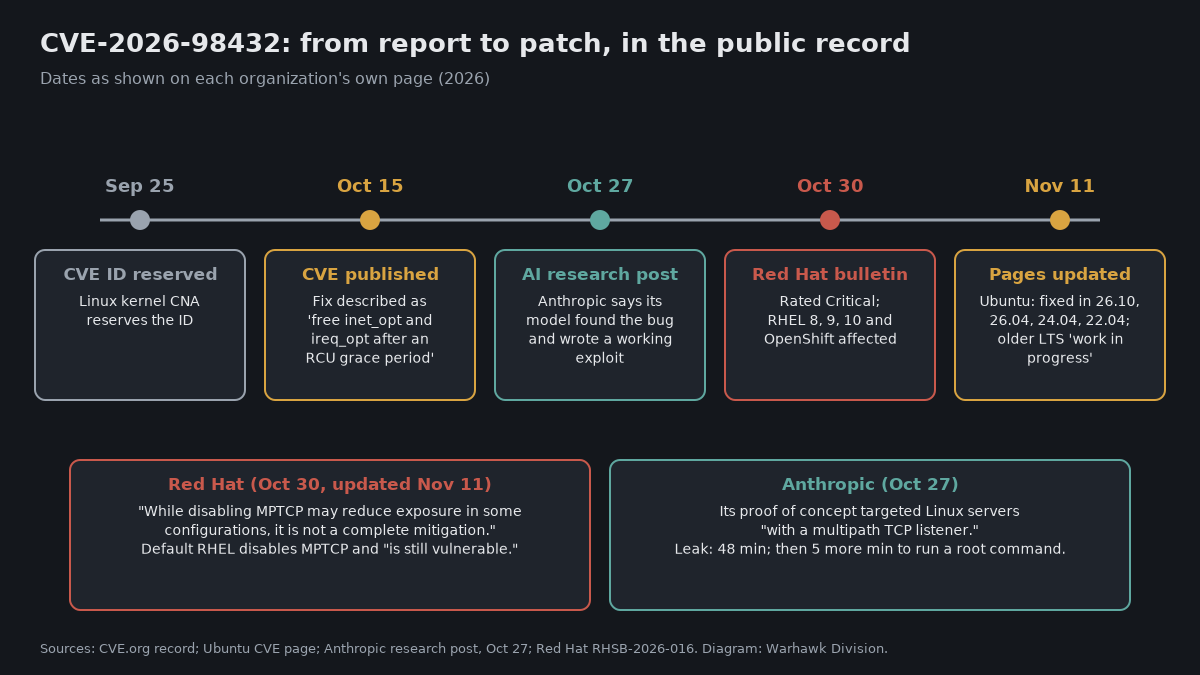 The public record on CVE-2026-98432. Data: CVE.org; Ubuntu; Anthropic, 27 October 2026; Red Hat RHSB-2026-016. Diagram by Warhawk Division.
Does turning off MPTCP protect me?
No, according to Red Hat. This is where reading the sources carefully pays off.
MPTCP, or Multipath TCP, lets one connection use several network paths at once. Anthropic's demonstration targeted servers "with a multipath TCP listener." Red Hat notes that "some organizations have recommended disabling MPTCP."
Red Hat pushes back directly: "Having MPTCP enabled is not a precondition of this vulnerability." It notes that Red Hat Enterprise Linux "disables MPTCP in its default configuration" and "is still vulnerable." It also warns that seeing no MPTCP listeners "should be treated as informational rather than as reassurance."
These two accounts do not contradict each other. Anthropic described one way to exploit the bug, and Red Hat is warning that there are others. A proof of concept shows one path to the flaw, not all of them.
So what is new here?
Three things, taken from the record rather than the hype.
First, the finding went through the normal process. Anthropic says it reported it under coordinated disclosure, which "gives developers 90 days to patch." A CVE was issued, the kernel was fixed, and distributions shipped updates. The AI did not skip the system.
Second, the claim goes beyond finding a bug. Anthropic says its models can now "discover and combine multiple vulnerabilities into a working exploit," which it calls work that has "historically been the domain of few specialist teams." That is a company describing its own product, and readers should weigh it that way. The Linux case is at least a concrete, patched, verifiable example.
Third, the advice is the same for both sides. Anthropic's closing line is "scanning your own code is more important than ever." If defenders can find bugs faster with these tools, so can anyone else. The site's piece "AI Will Not Replace Security Analysts, but It Will Replace the Ones Who Refuse to Use It" makes the case for using them.
What to do
- Patch the kernel and reboot. A kernel update does nothing until the machine restarts on the new kernel. Red Hat: "Applying kernel security updates as they become available is the only complete solution."
- Check your exact kernel package. Ubuntu's status table lists cloud, real-time and hardware-specific kernels separately.
- If you cannot patch yet, Red Hat and Ubuntu both publish a temporary firewall rule that drops incoming IPv4 TCP packets carrying IP options. Both say it reduces risk but does not fully prevent exploitation. Test it before you rely on it.
- Do not treat "MPTCP is off" as safe. Red Hat says it is not a mitigation on its own.
- Read the vendor bulletin, not a summary of a summary. "How to Read a Security Advisory Without Panicking" walks through it.
Where I land
- This is a no-login, remote-code flaw in the TCP code nearly every Linux server runs. Patch it.
- I have found no official report of attacks in the wild as of 13 November.
- "Found with AI" here means one company says its model found the bug and built the exploit, and the fix went through the normal disclosure process.
- The most useful detail is Red Hat's correction on MPTCP. One exploit path is not the whole threat.
The headline writes itself: AI finds a critical bug. The more useful lesson is older. Read the vendor's bulletin, patch, reboot, and do not trust one workaround to cover a flaw with more than one way in.
Sources (5)
- Red Hat, "RHSB-2026-016 Use-after-free - Linux kernel IPv4 (CVE-2026-98432)," public 30 October 2026, updated 11 November 2026: https://access.redhat.com/security/vulnerabilities/RHSB-2026-016
- Ubuntu Security, CVE-2026-98432, published 15 October 2026, updated 11 November 2026: https://ubuntu.com/security/CVE-2026-98432
- CVE Program, CVE-2026-98432 record: https://www.cve.org/CVERecord?id=CVE-2026-98432
- Anthropic Frontier Red Team, "Discovering and exploiting vulnerabilities in critical, real-world software with Claude," 27 October 2026: https://www.anthropic.com/research/discovering-vulnerabilities-with-claude
- CISA, Known Exploited Vulnerabilities Catalog: https://www.cisa.gov/known-exploited-vulnerabilities-catalog