Articles & BlogBy Trapper W. Brown10 min readCurrent to 12 November 2026Both sides
Most of the dollars you own are already digital. They are numbers in a bank's computer, and you move them with a card or a phone. So when people argue about a "digital dollar," they mean something narrower: electronic money issued by the central bank itself, the way paper bills are. The usual name is a central bank digital currency, or CBDC.
Why should you care? Because two changes are arriving together. Cash is being used less each year, and governments are deciding what public money should look like when most payments are electronic. The United States and Europe have, so far, given opposite answers. The arguments on both sides are about things every household has a stake in: privacy, who gets left out, what happens when the network is down, and who can stop a payment.
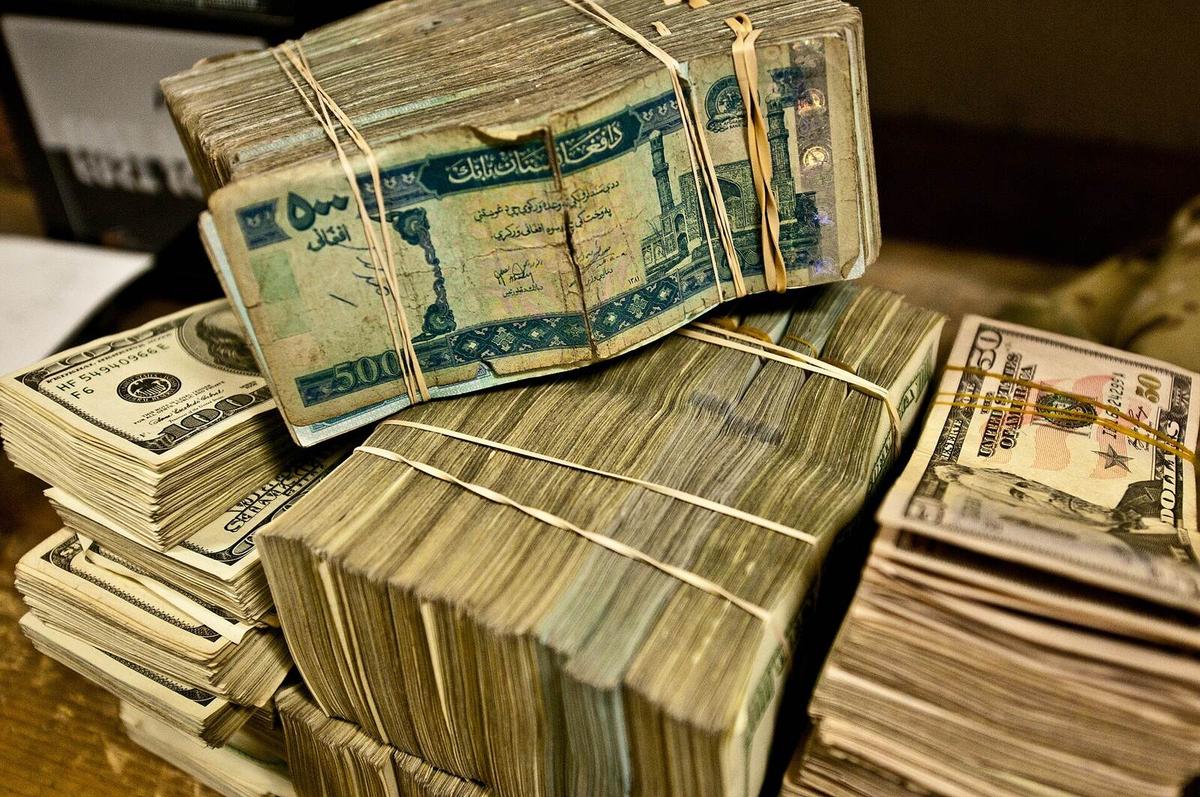 Bundles of U.S. and Afghan currency held by an Army finance unit in 2014. Photo by Sgt. Michael K. Selvage, U.S. Army, public domain, via Wikimedia Commons.
What counts as a digital dollar?
There are three kinds of money in this story, and the difference is whose promise each one is.
| Kind of money | Whose promise it is | Who can see a payment |
|---|---|---|
| Cash | The central bank's | The two people involved |
| Bank deposit (card, app, check) | A commercial bank's | The bank and the card network |
| Central bank digital currency | The central bank's | Depends entirely on how it is built |
The Federal Reserve's discussion paper of January 2022 defines a CBDC as "a digital liability of the Federal Reserve that is widely available to the general public." A liability is a promise to pay. A bank deposit is a private bank's promise, and a CBDC would be the central bank's own, like a paper bill.
A third thing often gets mixed in: stablecoins. These are digital tokens issued by private companies and meant to hold a value of one dollar each. Congress set rules for them in the GENIUS Act, which became Public Law 119-27 in July 2025. A stablecoin is a company's promise, so it is not a CBDC.
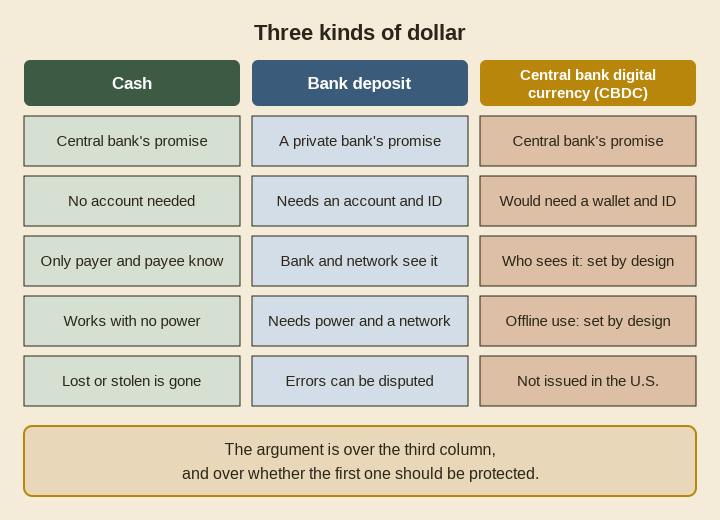 Cash and a CBDC are both the central bank's promise. Only one of them leaves a record.
Is cash really ending?
Not yet in the United States, though the direction is clear. The Federal Reserve's 2026 Diary of Consumer Payment Choice had 6,079 people record every payment for three days in October 2025. Cash made up 14% of payments, about six of the 47 an average person made in a month, and ranked third behind debit and credit cards. Four out of five people had used cash in the past 30 days.
Who uses it matters. People 55 and older made about 10 cash payments a month, and people 18 to 24 made two. Households earning under $25,000 used cash more than households earning over $150,000. The Federal Deposit Insurance Corporation's 2023 survey found that 4.2% of U.S. households, about 5.6 million, had no bank account at all. The two reasons they gave most often were not having enough money to meet minimum balances and not trusting banks.
Sweden shows where the road can lead. The Riksbank, Sweden's central bank, reported in March 2026 that 5% of people paid cash for their most recent store purchase in 2025, down from 40% fifteen years earlier. About one in three people who wanted to pay cash in a store had been turned away.
One legal point surprises many Americans. A Federal Reserve FAQ states that no federal statute requires a private business to accept cash. A shop may go card-only unless a state law says otherwise.
Where do things stand as of 12 November 2026?
United States. The Federal Reserve's 2022 paper said it favored no outcome and that the Fed "does not intend to proceed with issuance of a CBDC without clear support from the executive branch and from Congress, ideally in the form of a specific authorizing law." That support has not come. An executive order signed on 23 January 2025 bars federal agencies from "any action to establish, issue, or promote CBDCs." Executive orders can be reversed by a later one, so the House of Representatives passed a bill to write a ban into law, the Anti-CBDC Surveillance State Act, by 219 votes to 210 on 17 July 2025. The government's bill status file shows that vote as the bill's latest action. It has not become law.
Europe. The European Central Bank is heading the other way. On 30 October 2025 it moved its digital euro project into a new phase. It says that if European Union lawmakers pass the needed regulation in 2026, a pilot could begin in mid-2027 and the first digital euros could be issued during 2029. The European Parliament voted on 9 July 2026, by 416 to 169, to open talks with member governments on the law. The Parliament's own tracker, updated on 25 October 2026, says those talks are continuing.
Elsewhere. A Bank for International Settlements survey published in August 2025 found that 85 of 93 central banks, or 91%, were exploring a CBDC of some kind. Exploring is not launching, and launching is not the same as being used. An International Monetary Fund working paper on Nigeria's eNaira, the first CBDC in Africa, found a year after launch that it ran without disruption and that adoption "remains limited."
The case for a central bank digital currency
Supporters start from a simple worry. If cash fades and nothing replaces it, ordinary people will have no way to hold money that is a direct claim on the central bank. Every dollar would be some company's promise.
Public money stays available. The European Central Bank describes the digital euro as a complement to cash that would be free for basic use. The Riksbank has asked Sweden's parliament to study the law changes an e-krona would need, so that Sweden is not left behind if the euro area issues a digital euro.
It could reach people banks do not. The Federal Reserve's paper lists financial inclusion as a possible benefit, with the unbanked households counted by the FDIC in mind. It also says more study is needed on whether a CBDC would in fact help them.
It could be faster and cheaper. The same paper lists quicker payments, including across borders, as a possible gain.
Privacy can be designed in. The ECB says it "would not be able to directly link you to your payments," that small offline payments would be known only to the two parties, and that the digital euro "would never be programmable money," meaning money with rules attached about where or when it can be spent. Supporters add that card payments today are already visible to banks and card networks, so the fair comparison for a CBDC is with the card in your wallet.
Resilience. The digital euro design includes offline payments. A second, publicly run payment rail is a backup when a private one fails.
The case against
Opponents do not all make the same argument. Some object to the tool and others to losing cash.
A record of everything, held by the state. The 2025 executive order says CBDCs "threaten the stability of the financial system, individual privacy, and the sovereignty of the United States." The core fear is that a central bank ledger of everyday purchases could be searched, and that promises about privacy are policy choices a later government could change. The Federal Reserve's own paper says a CBDC would need to be "identity-verified," so it would not be anonymous the way cash is.
Control. If money is software, limits can be written into it: caps on how much a person holds, or blocks on some payments. The ECB already plans a limit on how much each user may hold. Critics ask what else could be limited once the mechanism exists. This is the question the site's opinion piece "Who Holds the Switch on a Universal Basic Income" asks about a payment program, applied to money itself.
Risk to banks. The Federal Reserve's paper warns that a CBDC could make runs on financial firms "more likely or more severe," because in a panic people could move deposits into central bank money with a tap. Banks fund loans with deposits, so money that leaves them is money they cannot lend.
No clear need. A Swedish government inquiry concluded in 2023 that there were "not sufficient societal needs" for an e-krona. Nigeria's experience suggests people may not use a CBDC even when one exists. Cards, instant bank transfers and regulated stablecoins already move digital dollars.
Cash does things nothing else does. It works in a power cut, needs no account and leaves no trail. The Riksbank, in a country where 5% of store purchases are made in cash, recommends that every adult keep about 1,000 kronor in cash at home for emergencies.
A family and a corner shop
Take a family of four and a corner shop with one card reader.
Today the family pays mostly by card. The shop pays a fee on each card sale, the family's bank sees each purchase, and a storm that knocks out the network stops both of them unless someone has bills in a drawer.
With a CBDC built the way its supporters describe, the family would have one more wallet, with a capped balance, that works offline for small amounts. The shop would have one more way to be paid. With a CBDC built the way its critics fear, the same wallet would be a record that a government office could read or restrict.
In a country with no CBDC and fading cash, neither of those happens. The family's payments stay with private companies, and its last anonymous, offline option gets harder to use each year. Each side of the debate treats that third outcome as a point in its own favor.
What is known, what is disputed and what is a value judgment
Known. Cash use is falling and is highest among older and lower-income people. No CBDC exists in the United States, and current federal policy forbids agencies from building one. The euro area is preparing one and has not decided to issue it. In Nigeria, the one launched CBDC cited here, adoption was limited a year in.
Disputed. Whether privacy protections would hold over decades. Whether a CBDC would reach unbanked households or simply add a wallet for people who already have several. How large the risk to bank funding is, and whether holding limits contain it. Whether private stablecoins fill the same need or raise their own risks.
A value judgment. How much you trust future governments compared with private payment companies. How much weight to give anonymity against the ability to trace crime. Whether keeping cash usable is worth what it costs shops and banks to handle it. No study can answer these for you.
What to remember
- Both sides agree that most money is already digital, and that the debate is about who issues it and who can see it.
- Both agree that cash use is falling and that the people who rely on it most are older, poorer or without bank accounts.
- Both agree that design decides everything: a CBDC could be built to protect privacy or to remove it.
- They divide on whether promises made at the design stage can be trusted to last.
- They divide on whether the public needs a digital form of central bank money at all.
- They divide on whether the right to pay in cash should be protected by law.
For a household, the practical side of this is small and does not depend on who wins. Know which of your ways to pay still work when the power or the network is down, and whether the shops you rely on still take bills.
Sources (14)
- Federal Reserve Board, "Money and Payments: The U.S. Dollar in the Age of Digital Transformation", January 2022
- Government Publishing Office, bill status for S. 1582, GENIUS Act, 119th Congress
- Federal Reserve Financial Services, "2026 Findings from the Diary of Consumer Payment Choice", May 2026
- FDIC, "2023 National Survey of Unbanked and Underbanked Households"
- Sveriges Riksbank, "Payments Report 2026", 12 March 2026
- Federal Reserve Board, FAQ, "Is it legal for a business in the United States to refuse cash as a form of payment?"
- The White House, executive order, "Strengthening American Leadership in Digital Financial Technology", 23 January 2025
- Government Publishing Office, bill status for H.R. 1919, Anti-CBDC Surveillance State Act, 119th Congress
- European Central Bank, press release on the digital euro, 30 October 2025
- European Parliament, Legislative Train, "Digital euro", 25 October 2026
- Bank for International Settlements, BIS Papers No 159, "Advancing in tandem: results of the 2024 BIS survey on central bank digital currencies and crypto", 22 August 2025
- International Monetary Fund, Working Paper 2023/104, Jookyung Ree, "Nigeria's eNaira, One Year After", 16 May 2023
- European Central Bank, digital euro privacy page
- European Central Bank, digital euro FAQ