Articles & BlogBy Trapper W. Brown10 min read
Meal prep means cooking once and eating several times. On one day you make a few plain building blocks. On the other days you put them together in different ways, which takes ten minutes and one pan. That is the whole idea.
It matters for two reasons. The first is money: food cooked at home is the most flexible line in most budgets, as our guide How to Manage Your Money When Everything Costs More explains. The second is the hour between getting home and eating, when tired people order takeout. A refrigerator with cooked rice and chicken in it wins that argument more often than good intentions do.
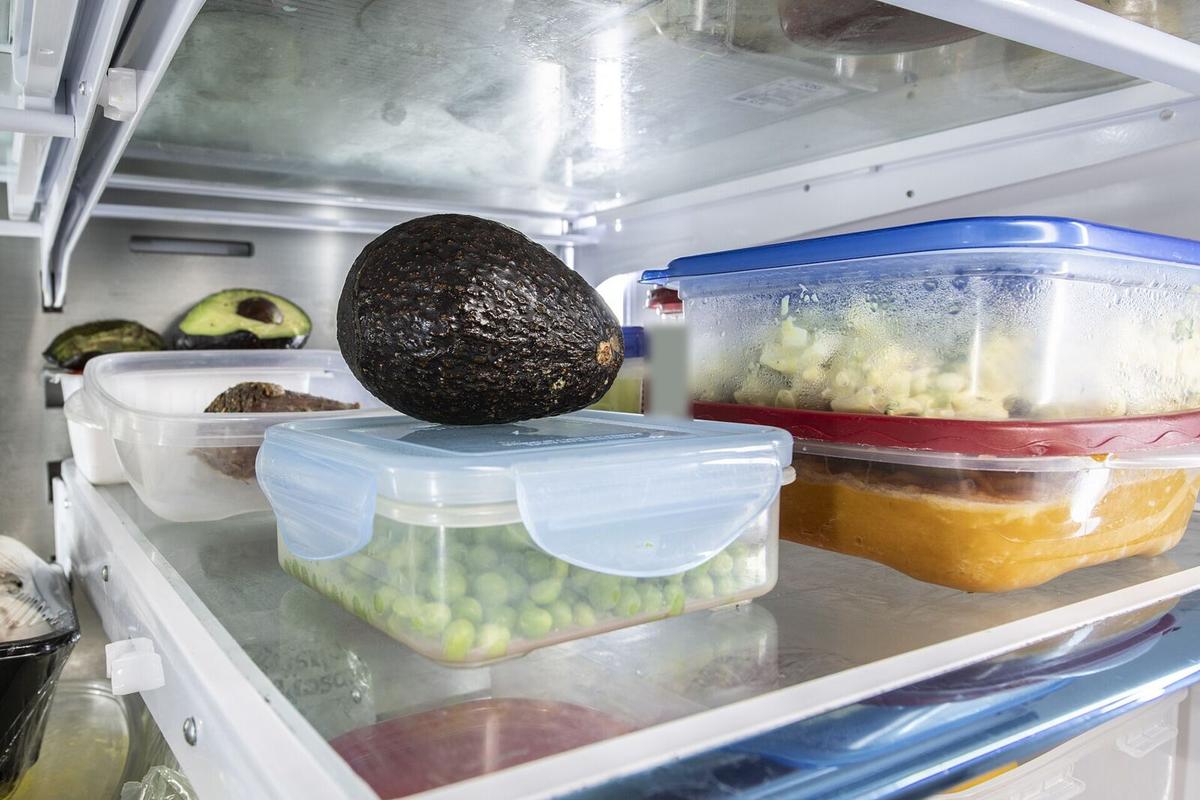 A week of meals starts as a shelf of labeled containers. The uncovered avocado at the back is the part not to copy. Photo by the US Department of Agriculture, public domain, via Wikimedia Commons.
This is a method more than a recipe book. Learn the pattern and you can swap in whatever is on sale.
The prep-day pattern
Pick one day. Cook four kinds of thing.
- A grain or starch. Rice, pasta, potatoes, or tortillas you only have to warm.
- A protein. Chicken thighs, ground meat, a pot of beans or lentils, a dozen hard-cooked eggs.
- Two vegetables. One cooked (a sheet pan of roasted broccoli, carrots or peppers) and one raw and washed (cabbage, cucumbers, salad greens).
- A sauce. Tomato sauce, a peanut or soy dressing, salsa, or yogurt with garlic and lemon.
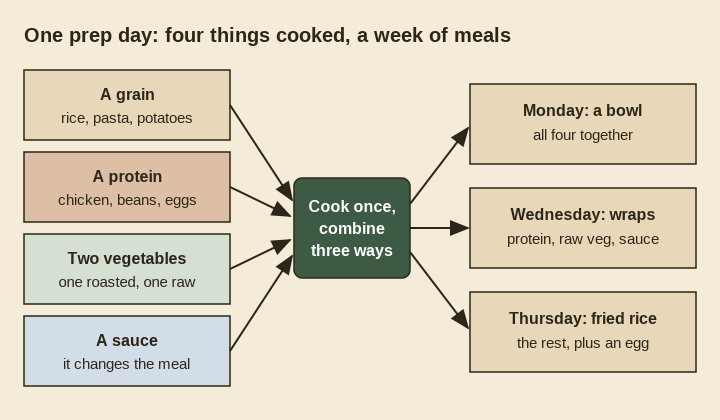 Four things cooked once become three different dinners.
The sauce does more work than it looks. Rice, chicken and broccoli with soy and ginger is one dinner. The same three with salsa in a tortilla is another. I think boredom ends more meal prep than effort does, and a second sauce is the cheapest cure.
By my estimate a full prep day takes about two hours, most of it waiting on the oven. Start the slowest thing first, which is usually the grain or the beans.
Ten easy meals
None of these needs a recipe card. Each is a few lines.
- Rice bowls. Rice, a protein, a cooked vegetable, a raw one, sauce on top.
- Sheet-pan chicken and vegetables. Chicken thighs and chopped vegetables, oil and salt, one pan, a hot oven.
- Chili. Ground meat or extra beans, canned tomatoes, onion, chili powder. Simmer until thick.
- Pasta with a big-batch tomato sauce. Make the sauce in quantity. Boil pasta fresh each time, which takes ten minutes.
- Fried rice. Cold cooked rice, any chopped leftovers, an egg scrambled in, soy sauce.
- Bean and cheese quesadillas. Tortilla, mashed beans, cheese, a dry pan until crisp.
- Chicken and vegetable soup. Broth, cooked chicken, whatever vegetables are left, a handful of rice or noodles.
- Baked potatoes with toppings. Bake a tray. Top with chili, beans, cheese or broccoli.
- Egg bake. Beaten eggs poured over cooked vegetables and cheese in a dish, baked until set.
- Slow-cooked shredded chicken or pork. Cooks unattended, then goes into sandwiches, tacos and bowls.
| Meal | Good for one | Scales to a family | Freezes well |
|---|---|---|---|
| Rice bowls | Yes | Yes | Rice and protein, yes |
| Sheet-pan chicken and vegetables | Yes | Yes, use two pans | Chicken, yes |
| Chili | Yes, freeze portions | Yes | Yes |
| Pasta with tomato sauce | Yes | Yes | Sauce, yes |
| Fried rice | Yes | Harder, cook in batches | Fair |
| Quesadillas | Yes | Yes, bake on a tray | Fair |
| Chicken and vegetable soup | Yes, freeze portions | Yes | Yes |
| Baked potatoes | Yes | Yes | No |
| Egg bake | Yes, lasts for days | Yes | Fair |
| Shredded chicken or pork | Yes, freeze portions | Yes | Yes |
The freezer column is my judgment about texture, not a safety rule. The safety rules come later.
How do you scale a recipe down for one, or up for four?
Most recipes are written for four. A person cooking for one has two choices, and the better one is usually not to shrink the recipe at all.
For one: cook four, eat one, store three. Take a recipe that serves four and uses 1.5 pounds of chicken thighs, 2 cups of dry rice and 4 cups of chopped vegetables. Cook all of it. Eat one portion tonight, put one in the refrigerator for the next few days, and freeze two. The work is the same as cooking for one, and you have bought three future dinners.
When you do need to shrink it, divide every ingredient by the same number. A quarter of that recipe is 6 ounces of chicken, half a cup of dry rice and 1 cup of vegetables. Three things do not divide neatly:
- Eggs. For half an egg, beat one and use half.
- Pan size. A small amount of food in a big pan dries out and burns. Use a smaller pan.
- Time. Cooking time follows thickness, not weight. One chicken thigh takes about as long as six. Check early anyway.
For four or more: multiply, with care. Doubling the main ingredients is safe. Seasoning is not so simple. As a rule of thumb, when you double a recipe, add one and a half times the salt and hot spices, taste, then add the rest if it needs it. Two more cautions: crowded sheet pans steam instead of roast, so use two pans, and a big pot takes much longer to boil and much longer to cool.
Waste comes from the odd half. Half an onion, half a can of beans, half a bunch of cilantro. Plan a second meal that week that uses the other half. For example, the leftover half can of tomatoes from chili goes into Thursday's soup.
What belongs in the freezer?
For a single cook the freezer is what makes this work. For a family it is the backup dinner on the night everything goes wrong.
Freeze in the portion you will eat, not in one large block. Flat bags of chili or soup stack like books and thaw quickly. Write the name and the date on everything, because frozen chili and frozen tomato sauce look the same in March.
Soups, stews, chili, tomato sauce, cooked rice, shredded meat and cooked beans come out of the freezer in good shape. Things that do not: baked potatoes, raw salad vegetables, and the mayonnaise salads. FoodSafety.gov, the federal food safety site, says egg, chicken, tuna and macaroni salads do not freeze well, and that hard-cooked eggs should not be frozen.
Tip
Freeze half on prep day, not on day four. Food frozen fresh tastes better when it comes out, and it removes the temptation to stretch the refrigerator portion one day too long.
A sample week for one person, and for a family of four
Both weeks use a Sunday prep day. Both move to the freezer portions later in the week, for a reason the next section explains.
| Day | One person | Family of four |
|---|---|---|
| Sunday (prep) | Cook rice, chicken thighs, roasted broccoli, a pot of chili. Freeze half the chili and half the chicken | Cook a double pot of chili, two pans of chicken and vegetables, rice, tomato sauce. Freeze half the chili and the sauce |
| Monday | Rice bowl with chicken and broccoli | Sheet-pan chicken, vegetables and rice |
| Tuesday | Chili over a baked potato | Chili with baked potatoes |
| Wednesday | Chicken wrap with raw cabbage and salsa | Chicken quesadillas, raw vegetables |
| Thursday | Fried rice with the last of the vegetables | Fried rice in two batches, with eggs |
| Friday | Chili from the freezer | Pasta with tomato sauce from the freezer |
| Saturday | Eggs, toast and fresh fruit | Egg bake with frozen vegetables |
The family's week is the same pattern at four times the volume, with one difference. I think children do better when the parts are served separately and they build their own bowl or wrap.
What goes on the shopping list?
Write the list from the pattern and not from recipes: one or two grains, two proteins, three or four vegetables, two sauces or the things to make them, plus eggs and tortillas. Check the refrigerator and cupboard first and cross off what you have. Then buy only the list.
To compare the cost of meals, work out cost per serving. Divide the price of a package by the number of servings you will get from it, do that for each ingredient, and add them up. A bag of rice that makes 20 servings costs one twentieth of its price per bowl. The answers are often not what the shelf price suggests: the large bag is cheaper per serving only if you use all of it, and the cheap ingredient you throw half of away was not cheap. Run the numbers with your own store's prices.
How long is it safe to keep?
Prepped food is safe when it is cooked hot enough, cooled fast and eaten in time. These rules are from the US Department of Agriculture's Food Safety and Inspection Service (FSIS) and from FoodSafety.gov, as their pages read on 12 November 2026.
Cook to temperature. Use a food thermometer. Poultry, casseroles and all reheated leftovers go to 165 degrees Fahrenheit. Ground meat and egg dishes go to 160. Steaks, chops and roasts of beef, pork and lamb go to 145 with a three-minute rest, and fish goes to 145.
The two-hour rule. FSIS says bacteria grow rapidly between 40 and 140 degrees, a range it calls the Danger Zone. Cooked food must be refrigerated within 2 hours, or within 1 hour if the air temperature is above 90 degrees. Food left out longer gets thrown away.
Cool big batches fast. This is the rule meal prep breaks most often. A big pot of soup takes a long time to cool, and FSIS says to divide it into shallow containers so it reaches 40 degrees quickly. Cut large roasts into smaller pieces. Hot food can go straight into the refrigerator.
Three to four days. FSIS says leftovers keep 3 to 4 days in the refrigerator or 3 to 4 months in the freezer. Frozen food stays safe indefinitely at 0 degrees, and the months are about quality. So Sunday's cooking is good through Wednesday or Thursday, and that is why the sample weeks switch to the freezer on Friday. Raw ground meat and raw poultry keep only 1 to 2 days in the refrigerator, so cook or freeze them soon after shopping. Hard-cooked eggs keep 1 week.
Thaw and reheat. FSIS lists three safe ways to thaw: in the refrigerator, in cold water in a leak-proof bag, or in the microwave. The kitchen counter is not on the list. Reheat leftovers to 165 degrees, and bring soups and sauces to a rolling boil. FSIS says frozen leftovers can also be reheated without thawing. It takes longer.
Watch out
Do not leave a pot on the stove to cool overnight. FSIS says perishable food left at room temperature for more than 2 hours should be thrown away, however good it looks in the morning.
What to remember
- Cook a grain, a protein, two vegetables and a sauce on one day, then combine them through the week.
- A second sauce is the cheapest way to avoid boredom.
- Cooking for one: make the full recipe and freeze the extra portions on prep day.
- Doubling: go easy on salt and spice, use two pans, and allow more time to boil and cool.
- Refrigerate within 2 hours, in shallow containers. Eat within 3 to 4 days or freeze.
- Reheat leftovers to 165 degrees Fahrenheit.
Start with one prep day and three of the ten meals. A food thermometer and a roll of masking tape for labels are the only equipment worth adding before you begin.