Articles & BlogBy Trapper W. Brown10 min readCurrent to 12 November 2026
Water is the supply people think about least and miss soonest. A burst main, a flood, a winter storm or a contamination notice can make the tap useless for days. Emergency water is simply water you have set aside, or know how to make safe, for the days when the tap cannot be trusted.
It is also the cheapest part of being prepared. Stored tap water costs almost nothing, and making doubtful water safe takes a pot, a stove or a bottle of plain bleach. What it takes is knowing the numbers before the day you need them.
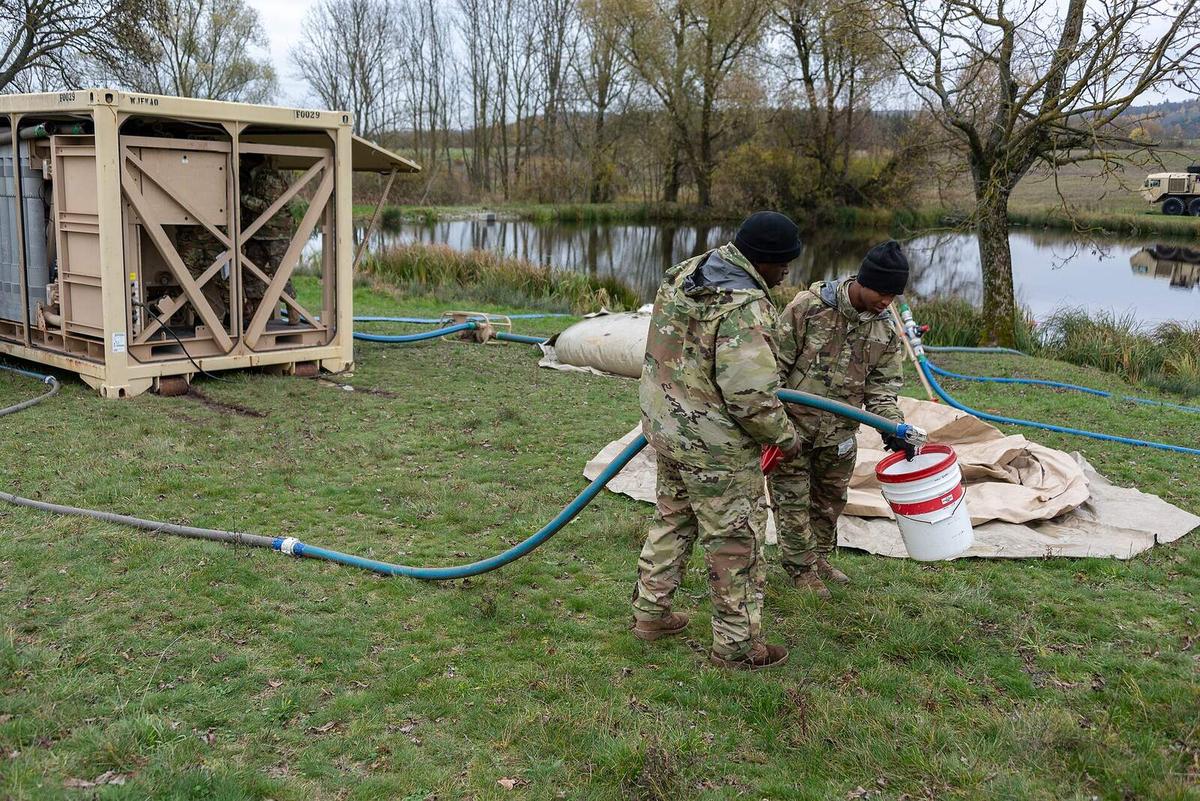 Even a calm, clear pond goes through a treatment unit before anyone drinks it. Photo by the US Army (Eugen Warkentin), public domain, via Wikimedia Commons.
How much water should you store?
The agencies agree on the daily figure. Ready.gov, the federal preparedness site, says to store at least one gallon per person per day for several days, for drinking and sanitation. The Centers for Disease Control and Prevention (CDC) says at least 1 gallon per person per day for 3 days, and to try for a 2-week supply if possible. The Red Cross puts it as a 3-day supply if you have to leave and a 2-week supply at home.
Why a gallon? An emergency booklet from FEMA and the Red Cross says an active person needs to drink at least half a gallon each day. The rest goes to cooking and washing. Ready.gov says children, nursing mothers and sick people may need more, and that a hot climate can double the need.
The arithmetic is short. One person needs 3 gallons for three days and 14 gallons for two weeks. A family of four needs 12 gallons for three days and 56 gallons for two weeks.
Fifty-six gallons takes planning, so a family might start with the 3-day amount and add to it. The FEMA booklet's advice for people short on space is to store as much as you can. It also says never to ration drinking water: drink what you need today and look for more tomorrow.
Which containers, and how often do you replace the water?
The CDC calls unopened, commercially bottled water the safest and most reliable emergency supply. Keep it sealed and check the date on it.
If you fill your own, the CDC says to use food-grade water storage containers, and never a container that once held a toxic chemical such as bleach or pesticide. The FEMA booklet warns against reusing milk and juice jugs, because milk protein and fruit sugars cannot be fully washed out and feed bacteria.
The CDC's steps for preparing a container:
- Wash it with soap and rinse it completely.
- Sanitize it with 1 teaspoon of unscented liquid household chlorine bleach in 1 quart of water. Shake so the solution touches every inside surface, wait at least 30 seconds, then pour it out.
- Let it air-dry, then fill it with clean water and seal it.
Label each container "drinking water" with the date. Replace water you stored yourself every six months. Keep it cool (the CDC says 50 to 70 degrees Fahrenheit), out of direct sunlight, and away from gasoline and pesticides.
Where is the hidden water in a home?
A house holds more water than its taps suggest. The FEMA booklet names three safe sources: the hot-water tank, the pipes and ice cubes. The CDC adds the liquid from canned fruit and vegetables.
Protect that water first. If you hear of broken water or sewer lines, the booklet says to find the main valve and turn it to the closed position, so that contaminated water cannot flow in. Learn where that valve is now.
From the pipes. Open the highest faucet in the home to let air in. A little water will trickle out. Then collect water from the lowest faucet.
From the water heater. Make sure the electricity or gas is off. Open the drain at the bottom of the tank. Start the flow by turning off the tank's water intake valve and turning on a hot-water faucet. Refill the tank before turning the power or gas back on, and if the gas was shut off, the booklet says a professional must turn it back on.
The two sources differ on one point. The older FEMA booklet says not to use water from toilet tanks. The CDC says the toilet tank (never the bowl) can be used if the water is clear and has not been treated with toilet cleaners. My rule: use it last, and treat it first.
Watch out
Do not drink water from radiators or boilers, waterbeds, or flood water. The CDC says pool and spa water can be used for washing and cleaning, but not for drinking. If water may contain fuel or toxic chemicals, the CDC says boiling and disinfecting will not make it safe: use bottled water or another source.
How do you make water safe to drink?
Three kinds of germ matter. Protozoa are tiny parasites such as Giardia and Cryptosporidium. Bacteria are smaller. Viruses are smaller still. Each method handles a different part of that list.
Start the same way every time. If the water is cloudy, the CDC and the Environmental Protection Agency (EPA) both say to let it settle and pour off the clear water, or filter it through a clean cloth, paper towel or coffee filter.
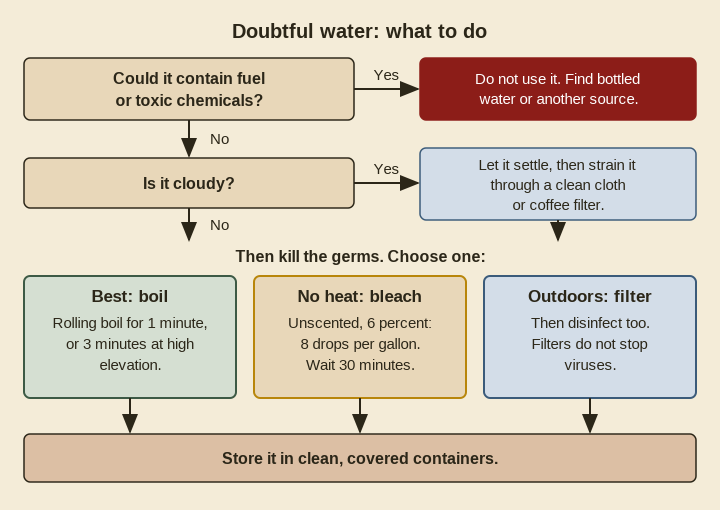 Rule out chemicals, clear the water, then kill the germs. Boiling is the first choice.
Boiling. The CDC calls boiling the best way to kill germs, and says it kills all three kinds. Bring the water to a rolling boil for 1 minute. At high elevation, boil for 3 minutes. The agencies draw that line in different places: the CDC says above 6,500 feet and the EPA says above 5,000 feet. Between the two, the longer boil costs two minutes of fuel. Let the water cool and store it in clean, covered containers. Boiled water tastes flat. Pouring it back and forth between clean containers helps.
Household bleach. This is the method for when you cannot boil. The EPA says to use only regular, unscented chlorine bleach, with a label that says it is suitable for disinfecting and that shows 6 or 8.25 percent sodium hypochlorite. Do not use scented or color-safe bleach, or bleach with added cleaners. Use bleach that is fresh, or that has been stored at room temperature for less than a year. Measure with a clean dropper.
| Water | 6% bleach | 8.25% bleach |
|---|---|---|
| 1 quart or liter | 2 drops | 2 drops |
| 1 gallon | 8 drops | 6 drops |
| 2 gallons | 16 drops (1/4 teaspoon) | 12 drops (1/8 teaspoon) |
| 4 gallons | 1/3 teaspoon | 1/4 teaspoon |
| 8 gallons | 2/3 teaspoon | 1/2 teaspoon |
That is the EPA's table as of 12 November 2026. Double the amount if the water is cloudy, colored or very cold. Stir, and let it stand for 30 minutes. The water should have a slight chlorine smell. If it does not, repeat the dose and wait another 15 minutes. The CDC's table gives the same 8 drops per gallon for bleach between 5 and 9 percent, and says to follow the bottle's own instructions for disinfecting water if it has them.
Filters. A filter is a physical strainer, and what it stops depends on the size of its holes. The CDC says most portable filters remove parasites but not viruses, and not all bacteria. A filter with an absolute pore size of 1 micron or smaller removes Giardia and Cryptosporidium. One with pores of 0.3 micron or smaller also removes bacteria. Neither removes viruses. (A micron is a thousandth of a millimeter. "Absolute" means no hole is larger than the stated size.) That is why the CDC's advice is to filter first and then disinfect.
Tablets and drops. These contain chlorine, iodine or chlorine dioxide. The EPA says to follow the label, because strengths differ by product. The CDC says chlorine and iodine do not work well against parasites. Chlorine dioxide tablets can kill Giardia. One CDC page calls them somewhat effective against Cryptosporidium, and another says they kill it if used correctly. The CDC also says not to drink iodine-treated water if you are pregnant, have thyroid problems or are sensitive to iodine, and that nobody should drink it for more than a few weeks at a time.
UV light. A portable ultraviolet unit, often shaped like a pen, can kill parasites, bacteria and viruses in small amounts of clear water. The CDC warns that it works poorly in cloudy water, because particles shade the germs from the light. Filter first.
Distilling. Boil water and catch the steam as it turns back into liquid. Ready.gov's method: fill a pot halfway, tie a cup to the lid's handle so it hangs upright inside the pot without touching the water when the lid is on upside down, and boil for 20 minutes. The water that drips into the cup is distilled. It is slow, and it is the only method here that takes out salt.
What does each method remove, and what does none of them remove?
| Method | Protozoa | Bacteria | Viruses | Salt, metals, most chemicals |
|---|---|---|---|---|
| Boiling | Yes | Yes | Yes | No |
| Bleach | Poorly | Yes | Yes | No |
| Filter, 1 micron absolute | Yes | Not all | No | No |
| Filter, 0.3 micron | Yes | Yes | No | No |
| Chlorine dioxide tablets | Giardia yes, Cryptosporidium in part | Yes | Yes | No |
| UV light, clear water only | Yes | Yes | Yes | No |
| Distilling | Yes | Yes | Yes | Yes, per Ready.gov |
The EPA says boiling and disinfection do not remove heavy metals, salts or most other chemicals. For water that may hold fuel or toxic chemicals, the CDC's answer is not to treat it at all.
What about water outdoors?
The FEMA booklet lists the outdoor sources: rainwater, streams and rivers, ponds and lakes, and natural springs. It says to avoid water with floating material, an odor or a dark color, to use saltwater only if you distill it, and never to drink flood water.
Every one of those sources needs treating. The CDC says rivers, streams and lakes may carry livestock waste, human sewage or chemicals, and that drinking straight from a clear mountain stream is generally not safe. As a rule of thumb, pick the clearest water you can reach, then treat it anyway. Our guide Lost or Stranded Outdoors: The Priorities That Keep You Alive explains where water falls among the other needs.
What do you do under a boil water notice?
In a city, the likeliest water emergency is a notice from the utility. The CDC describes three kinds.
- Boil water advisory. Use bottled water, or boil tap water for 1 minute (3 minutes above 6,500 feet), for drinking, cooking, brushing teeth, making ice and giving to pets. For babies on formula, the CDC prefers ready-to-use formula where possible. Boil even if you have a filter. Do not use water or ice from the refrigerator dispenser. Bathing is fine if you avoid swallowing the water, and so is laundry.
- Do not drink advisory. The problem is a chemical or toxin, and boiling will not help. Use bottled water for anything that goes in a mouth, and follow the notice for bathing.
- Do not use advisory. Do not use tap water for any purpose until it is lifted.
Two households
One person in an apartment stores 14 gallons in sealed jugs under the bed. A boil notice arrives. The stove works, so each morning she boils a pot for 1 minute, cools it and fills two pitchers.
A family of four keeps 12 gallons of bottled water and four food-grade 5-gallon containers. A storm cuts the power and the water, and the stove is electric. On day three the father draws water from the water heater, power off first. He treats 2 gallons at a time with 16 drops of 6 percent unscented bleach, stirs, waits 30 minutes and checks for a faint chlorine smell.
What to remember
- Store at least 1 gallon per person per day. Three days is the floor, and two weeks is the goal at home.
- Use sealed bottled water or clean food-grade containers. Date them, and replace home-filled water every six months.
- Know where your main valve is, and that the water heater and pipes hold a reserve.
- Boil for 1 minute, or 3 minutes at high elevation. If you cannot boil, use unscented bleach from the EPA table and wait 30 minutes.
- Filters stop parasites, and fine ones stop bacteria. They do not stop viruses.
- Nothing in the kitchen removes fuel or toxic chemicals. Find other water.
Print the bleach table and tape it inside the cupboard where the bleach lives, with a dropper next to it. The companion guide Building a Two Week Food Supply Without Wasting Money covers the shelf that goes beside the water.