Articles & BlogBy Trapper W. Brown11 min readCurrent to 12 November 2026Both sides
Two tools have moved from special cases into routine police work. An automated license plate reader is a camera that photographs every passing vehicle, reads the plate and stores the time and place. Facial recognition is software that compares a photo of an unknown person against a collection of known faces and returns the closest matches. Neither is new. What has changed is how many agencies have them and how cheap a search has become.
Why should you care? Because you are in the data whether or not you have done anything. Your plate is read when you drive to work. Your driver's license photo may sit in a collection that gets searched. The same systems also recover stolen cars and identify suspects in violent crimes. This guide sets out how the tools work, the strongest case for them, the strongest case for limiting them, and what is known as of 12 November 2026.
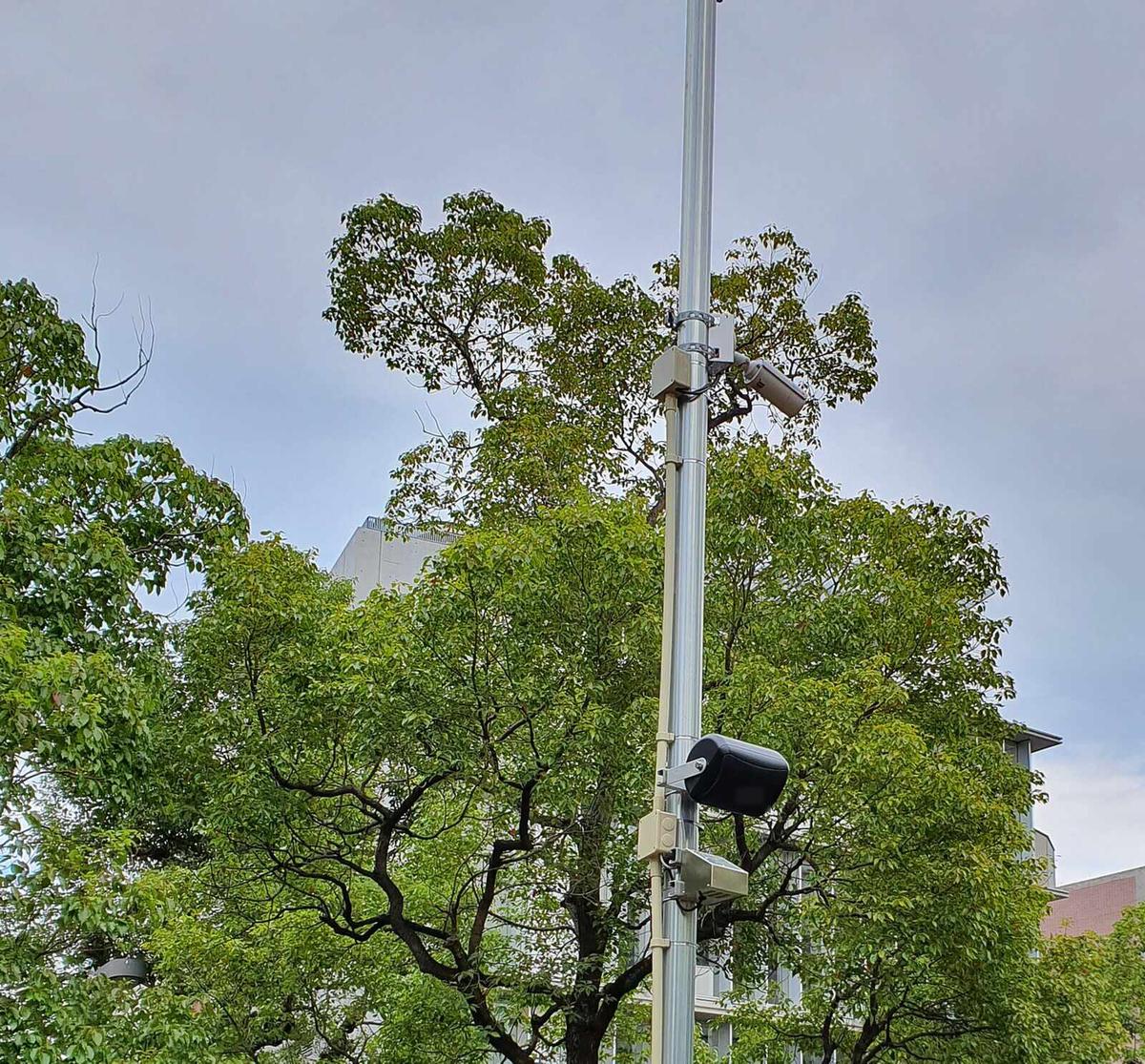 A camera on a pole is the visible part. What happens to the pictures afterward is set by policy and law. Photo by Syced, CC0, via Wikimedia Commons.
How do the two tools work?
They are different machines with a shared design: capture, compare, alert.
| License plate reader | Facial recognition | |
|---|---|---|
| What it captures | Every plate that passes, with time and location | A face from a photo or video |
| What it compares against | Lists of wanted plates, and its own stored history | A collection of known faces, such as mugshots or license photos |
| Typical police use | Alerts on stolen or wanted vehicles; searching where a car has been | Producing a list of possible names for an unknown face |
| Who is in the data | Every driver who passes a camera | Everyone whose photo is in the collection |
| Typical error | A misread plate, or an out-of-date wanted list | A lookalike returned as a match |
Plate readers are now standard equipment. A Congressional Research Service report from August 2024, citing a 2020 Bureau of Justice Statistics survey, says nearly 90 percent of sheriffs' offices with 500 or more deputies used them, and every police department serving more than a million residents did.
Facial recognition comes in two forms. The common one in American policing is a search after the fact: a detective submits a still from a security video and gets back a list of candidates. The other is live scanning of a crowd against a watchlist, which London's Metropolitan Police use openly. A High Court summary from April 2026 describes that system: faces in a public place are compared with a list of sought persons, and if there is no match the data is deleted at once.
How accurate are they?
Better than they were, and not evenly. The National Institute of Standards and Technology (NIST), the federal lab that tests these programs, reported in November 2018 that facial recognition software had become 20 times better at searching a database between 2014 and 2018. In its tests, 0.2 percent of searches failed to find a matching photo that was in the database, down from 4 percent in 2014.
A year later NIST looked at who the errors fall on. Its December 2019 study covered 189 algorithms from 99 developers and 18.27 million images of 8.49 million people. In one-to-one matching, it found higher rates of false positives for Asian and African American faces than for Caucasian faces, by "a factor of 10 to 100 times, depending on the individual algorithm." In one-to-many searches, the kind police run, false positives were higher for African American women. NIST also found that the differences varied widely between products, and that the most equitable algorithms were among the most accurate.
For plate readers, the Congressional Research Service notes that one estimate from 2019 put accuracy at around 90 percent, and that accuracy has been improving.
A worked example shows why a small error rate still matters. Suppose a face search makes a false match once in every 100,000 comparisons, and the collection holds 1.6 million photos, the size of one mugshot set NIST used. One search is 1.6 million comparisons. That is 16 lookalikes expected from a single search, whether or not the right person is in the collection at all. These numbers are an illustration, not a measurement of any product. The point is that a match is a lead to check and not an identification.
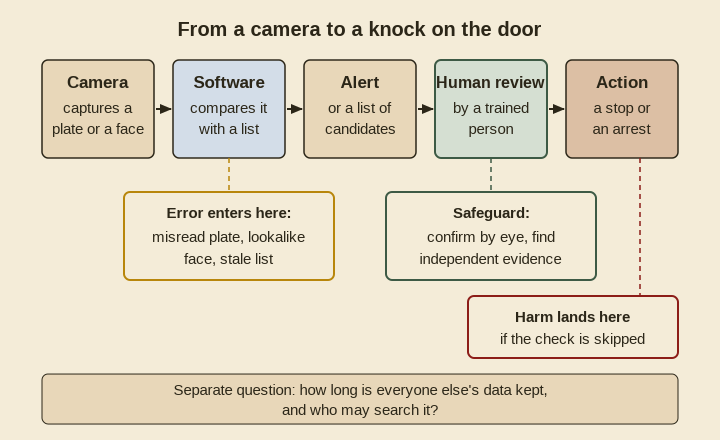 Errors enter at the comparison step and are either caught or acted on at the human step.
The case for using them
Here is the argument at its strongest.
These tools do in seconds what officers have always done slowly. Checking plates against a stolen-car list is old police work; a camera just does more of it. In a randomized experiment in Mesa, Arizona, published in a peer-reviewed journal, patrols with plate readers scanned eight times as many plates as officers checking by hand, and produced more hits, more arrests for stolen vehicles and more recoveries. A later study of 785 patrols at 33 crime hot spots found that plate readers increased stolen vehicle recoveries.
The same goes for faces. Detectives have always shown photos to witnesses and flipped through mugshot books. Software searches the book faster, and by NIST's measure it has become far more accurate in a few years. For some crimes, a still from a security camera is the only lead there is.
Courts have mostly agreed that this is lawful. In January 2026 a federal judge in Virginia ruled for the city of Norfolk in a challenge to its network of 176 plate cameras. The opinion notes that federal and state courts have "almost uniformly concluded" that photographing a plate on a public road, and searching the resulting database, is not a search under the Fourth Amendment. The reasoning is familiar: a license plate is displayed to the world on purpose, and nobody has a privacy claim to a public street.
Supporters also point out that the worst failures were failures of procedure. A match treated as a lead, checked by a trained person and backed by other evidence, should not put an innocent person in a cell. On this view the answer is rules and training, and a tool that finds a kidnapped child's car or names a violent offender should not be given up because some agencies used it carelessly.
The case for tight limits
Here is the other argument at its strongest.
Start with who bears the errors. NIST measured false positive rates that differed by race and sex, by large factors in some products. And procedure has failed in practice. In January 2020, Detroit police arrested Robert Williams outside his home after a face search on a blurry store video returned his old license photo. According to the American Civil Liberties Union, which represented him, he was held about 30 hours for a theft he did not commit. In London, the High Court's summary records that a community worker was wrongly matched to his brother's image in February 2024, stopped, and threatened with arrest when he declined to give fingerprints.
Oversight has lagged behind use. The Government Accountability Office found in September 2023 that seven federal law enforcement agencies had started using facial recognition services without requiring any training, and that six of them ran about 60,000 searches before training requirements were in place.
Then there is the dragnet. A plate reader records everyone, and almost none of those people are suspects. In the Norfolk case it was undisputed that the two plaintiffs' cars were photographed about 475 and 325 times in four and a half months. The Supreme Court held in 2018 that police must generally get a warrant for a person's historical phone location records, which it called "detailed, encyclopedic, and effortlessly compiled." The same opinion said it was not calling ordinary security cameras into question. Critics argue that a dense camera network is the same thing built from the roadside. The Norfolk judge himself agreed with other judges who cautioned that as cameras multiply, "the constitutional balancing could conceivably tip the other way." The case is on appeal.
Finally, the evidence that these tools cut crime is thin. The 33 hot spot study that found more recovered cars found no increase in arrests, and its authors concluded it "provides little clear evidence for the crime prevention efficacy" of plate readers in general patrol. An earlier randomized trial at 30 hot spots found no deterrent effect. On this view, the public is asked to accept permanent tracking in exchange for a benefit that has been measured mostly in recovered cars. The broader argument about why people with nothing to hide still have a stake is in "Privacy Is Not for People With Something to Hide."
What rules exist today?
The Congressional Research Service report says that, generally, federal law neither directs nor prohibits specific police tools such as plate readers. The rules are a patchwork of state laws, court settlements and department policies, and the differences are large.
| Place | Rule |
|---|---|
| New Hampshire, plate readers | Records must be purged within 3 minutes unless they produced an alarm that led to an arrest, a citation or similar. A match alone is not grounds for a stop |
| Virginia, plate readers | Data purged after 21 days. Use limited to listed purposes, such as a criminal investigation or a missing person. No sharing with other states' or federal databases |
| Maryland, facial recognition | Results may not be the sole basis for probable cause. Use is limited to listed serious crimes. No live identification |
| Detroit police, facial recognition | Under a June 2024 settlement, no arrest based on a face match alone, and no photo lineup based only on a face match, according to the ACLU |
| European Union | The AI Act prohibits live facial recognition in public spaces for law enforcement, except where strictly necessary for listed purposes |
| London | The High Court dismissed a challenge to the Metropolitan Police's live facial recognition policy on 21 April 2026 |
Take one commuter who passes three cameras a day, close to what the Norfolk plaintiffs averaged. In New Hampshire, three minutes after each pass, nothing is on file. In Virginia, the system holds about 63 sightings of that car at any moment: three a day for 21 days. Before Virginia's law, Norfolk kept 30 days, or about 90. The camera is the same in all three. The difference between a checkpoint and a travel history is the retention setting.
What is known, what is disputed, and what facts cannot settle
Known. Both tools are in wide use. Face matching has become much more accurate, and error rates still differ between products and between groups of people. Wrongful arrests after bad matches have happened. Plate readers recover stolen cars. So far, most courts have held that reading plates on public roads is not a search.
Disputed, and answerable with evidence. How much crime do these tools prevent or solve beyond car theft? How often do bad matches lead to stops and arrests that never make the news? Do the demographic gaps NIST measured in 2019 persist in the products agencies use now? Do rules such as "a match is only a lead" hold up on a busy night? Much of this could be measured if agencies logged and published their searches, hits and errors.
Value judgments. How much is it worth to live in a place where your movements are not recorded? Is a search of everyone's travel history different in kind from an officer watching one corner? Should a tool that solves some serious crimes be limited because of rare, grave errors, and who should carry that risk? No dataset answers those.
What to remember
- Both sides agree that a match, whether a face or a plate, is a lead that needs human checking and independent evidence before anyone is stopped or arrested.
- Both sides agree that accuracy has improved, that it varies by product, and that plate readers help recover stolen vehicles.
- They divide on whether collecting data about everyone to find a few is acceptable, and courts have not finished answering.
- They divide on how to read thin evidence about crime reduction: as a reason to limit the tools, or a reason to study them while using them.
- They divide on whether errors are a procedure problem that training can fix, or a reason to restrict the tools themselves.
- The settings that matter most are plain ones: how long data is kept, who may search it and for what, whether searches are logged, and whether the logs are published.
Anyone can put those four questions to their own police department or city council. The ruling to watch in the United States is the Fourth Circuit's decision in the Norfolk appeal. For the cameras people install themselves, see "Smart Home Devices: Cameras, Doorbells and What They Leak."
Sources (17)
- Congressional Research Service R48160, "Law Enforcement and Technology: Use of Automated License Plate Readers", 19 August 2024
- High Court of England and Wales, R (Thompson and Carlo) v Commissioner of Police of the Metropolis, press summary, 21 April 2026
- NIST, "NIST Evaluation Shows Advance in Face Recognition Software's Capabilities", 30 November 2018
- NIST, "NIST Study Evaluates Effects of Race, Age, Sex on Face Recognition Software", 19 December 2019
- Taylor, Koper and Woods, "Combating Vehicle Theft in Arizona: A Randomized Experiment with License Plate Recognition Technology", National Institute of Justice library
- Koper, Lum and others, "Do License Plate Readers Enhance the Initial and Residual Deterrent Effects of Police Patrol?", Journal of Experimental Criminology, 2021
- Schmidt v. City of Norfolk, E.D. Va., Opinion and Order, 27 January 2026
- ACLU, "Williams v. City of Detroit" case page
- GAO-23-105607, "Facial Recognition Services: Federal Law Enforcement Agencies Should Take Actions to Implement Training, and Policies for Civil Liberties", 5 September 2023
- Supreme Court of the United States, Carpenter v. United States, 585 U.S. 296 (2018)
- ACLU, "Schmidt v. Norfolk" case page, 20 April 2026
- Lum and others, "License Plate Reader (LPR) Police Patrols in Crime Hot Spots", 2011
- New Hampshire RSA 261:75-b
- Code of Virginia 2.2-5517
- Maryland Criminal Procedure 2-502
- ACLU, press release on the Williams v. City of Detroit settlement, 28 June 2024
- European Union, Regulation (EU) 2024/1689 (AI Act)