Articles & BlogBy Trapper W. Brown10 min readCurrent to 13 November 2026Facts only
As of 13 November 2026, the Federal Trade Commission (FTC) has two notices out that belong together. The first, a consumer alert dated 12 November 2026, says scammers are building copies of the FTC's own website. The second, dated 2 November 2026, asks the public a question: should social media sites, search engines and online marketplaces have to take steps against ads that impersonate a business or the government? Comments on that question are due by 30 November 2026.
The FTC is the federal agency that enforces consumer protection law. People report fraud to it at ReportFraud.ftc.gov. This article reports what the FTC published, in its words, and where to check it. Both pages can change, so read the official versions linked under Sources before you act.
 The Federal Trade Commission building at 600 Pennsylvania Avenue NW in Washington, the mailing address the agency gives for written comments. Photo by Carol M. Highsmith, public domain, via Wikimedia Commons.
What did the FTC say on 12 November?
The alert is titled "How to spot fake FTC websites and FTC impersonators" and is signed "BCP Staff." BCP is the FTC's Bureau of Consumer Protection.
It describes three things scammers do. In the alert's words, they "impersonate FTC employees (using real and made-up identities), pretend to be FTC 'agents' and show you fake FTC credentials like a badge, and create websites that use the FTC's logo to mimic the FTC's official website."
On the websites, the alert says: "Scammers clone the FTC's website, sometimes using the FTC's name, logo, web design, or content, to trick you into believing it's a real FTC website and steal your personal information." (The original uses dashes where commas appear here.)
How do you tell a real FTC site from a fake one?
The alert gives one test. It says the fakes include "scammy sites claiming to be the official FTC website that end in .com, .org, .us, or .online." Then: "But real FTC websites always end in .gov," and "that includes ReportFraud.ftc.gov."
The ending of a web address is called a top-level domain. Most endings can be bought by anyone. The .gov ending is different. It is run by the .gov registry, which is part of the Cybersecurity and Infrastructure Security Agency (CISA). The registry's own page says: "We verify the identity and eligibility of everyone who requests a .gov domain." The banner at the top of the FTC's alert page reads "An official website of the United States government."
In an October 2026 news release, the FTC listed 19 websites that registrars took down after the agency sent letters. A registrar is a company that sells and manages web addresses. The list shows what the copies look like. It includes "FTC-Complaints.org," "FTC-help.com," "federaltradecommission.net" and "Eftc.online." Each uses the agency's name or initials. None ends in .gov.
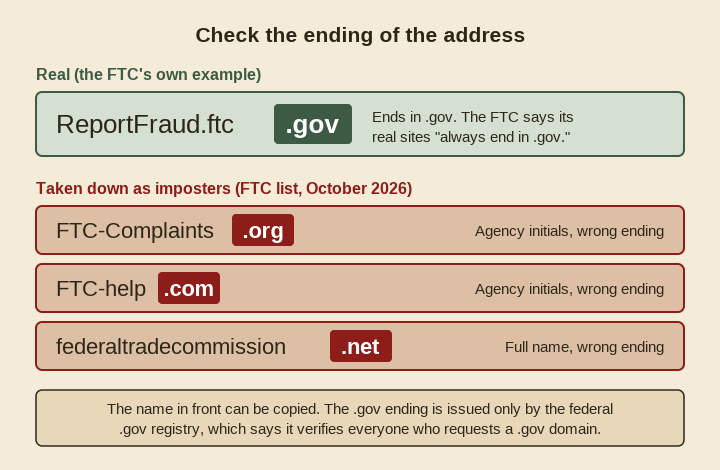 The FTC's test is the ending of the address. The three lower examples are from the FTC's October 2026 list of imposter sites that registrars took down.
What will the real FTC never do?
The alert states it plainly: "A real FTC employee will never say you have to 'protect' your money by transferring it or giving someone cash."
The FTC's page "How To Avoid Imposter Scams" adds: "The FTC will never threaten you, say you must transfer your money to 'protect it,' or tell you to withdraw cash or buy gold and give it to someone. That's a scam."
The line the agency prints at the bottom of its news releases says the same thing in other words: "The FTC will never demand money, make threats, tell you to transfer money, or promise you a prize."
That page also defines the term. An imposter scam, it says, "is when a scammer lies and pretends to be someone they're not to trick you into giving them money, access to your financial accounts, or your personal information." The site's article "Text and Phone Scams: The Fake Bank, the Fake Delivery, the Fake Grandchild" covers how those calls and messages work, so it is not repeated here.
How big is the problem, by the FTC's count?
All of these figures are reports made to the FTC. They are not a count of every scam.
| What the FTC published | Figure | Where |
|---|---|---|
| Imposter scam reports in 2025 | "more than 1 million" | Alert, 12 November 2026 |
| Reported losses to imposter scams in 2025 | "$3.5 billion" in the alert; "nearly $3.5 billion" in the Federal Register notice | Alert; notice of 1 October 2026 |
| Reported losses to all fraud in 2025 | "approximately $16 billion, a 25% increase compared to 2024" | Notice of 1 October 2026 |
| People who lost money in 2025 and said the contact started on social media | "almost 30%," with reported losses of "$2.1 billion" | Notice of 1 October 2026 |
The same notice says the FTC has estimated that the true cost of fraud in 2024, "adjusted to account for underreporting, may be as high as $195.9 billion."
What is the Impersonation Rule?
The Rule on Impersonation of Government and Businesses is a federal regulation, printed at 16 CFR Part 461. The alert says it "took effect in April 2024." Its text makes it a violation to "materially and falsely pose as, directly or by implication, a government entity or officer thereof," and it has a matching section for businesses. "Materially" is defined in the rule as "likely to affect a person's choice of, or conduct regarding, goods or services."
The FTC's October 2026 release says the rule "allows the FTC to file federal court cases seeking to get money back to injured consumers and civil penalties against rule violators," and that violators "may be required to pay refunds to affected consumers and civil penalties of up to $53,088 per violation." It reports 14 completed enforcement actions since the rule took effect, "resulting in over $80 million in redress for consumers to date."
Two FTC pages give two takedown figures, and they measure different things. The October release says registrars "took down 19 websites" in response to FTC letters, in a passage about "the past year." The 12 November alert says that since the rule took effect in April 2024, the agency "has demanded the removal of more than 30 FTC imposter websites."
What is the FTC asking about scam ads?
The question the FTC has put to the public is about the sites that carry the ads. Its notice says the conduct it is asking about "is not covered by the current Rule."
On 1 October 2026 the FTC published an advance notice of proposed rulemaking in the Federal Register, at 91 FR 62347. An advance notice is an early step. It proposes no rule text. In the notice's words, the Commission "is soliciting written comment, data, and arguments concerning the need for such rulemaking." The FTC's September news release says the Commission voted 2-0 to publish it.
The notice gives the FTC's stated reason for asking. It says impersonation scams "have been amplified by search engine, social media, and other digital marketplace platforms that profit from optimizing online ads for third parties, regardless of whether the third parties are legitimate." That is the agency's description. The notice supports it with news reports, lawsuits and documents about named companies. Claims in a lawsuit are allegations, not findings, and this article leaves the names out.
The 2 November consumer alert, "Tell the FTC about imposter ads online," puts the question in everyday terms: "Do you think platforms should take concrete steps to prevent impersonation ads from ever reaching consumers? Should the FTC propose new requirements to address these practices?" It gives three examples of what a requirement could be:
- "vet advertisers and ads before ads are posted";
- "give people a way to report ads they think are impersonating a business or the government"; or
- "investigate suspected impersonation ads and remove those that turn out to be scams."
The notice itself asks in both directions. Its questions include:
- "Is there a need for new regulations" to prevent these practices? "Why or why not?"
- "Should the Commission consider alternatives to new regulation, such as the publication of additional consumer and business education?"
- "What costs would the requirement impose on Platforms and on legitimate businesses advertising on Platforms?"
- "Would the requirement discourage Platforms from innovating their services or tools, particularly with respect to services or tools incorporating the use of artificial intelligence?"
- "Should the requirement trigger liability only if the Platform has some level of knowledge of, or participation in, the Impersonation Ad?"
The notice also says the measures it lists could, instead of being requirements, "form the basis of a safe harbor provision," meaning a platform that followed them would have a defense. This article takes no side on any of these questions.
What is not known
- The FTC has not proposed a rule. The notice does not say whether it will, or when.
- The FTC's pages do not say who runs the fake FTC sites or how many people entered information into them.
- The loss figures are reports. The FTC gives no measured total.
- As of 13 November 2026, the Federal Register's page for the notice showed 188 comments received. I could not confirm how many of those have been posted for the public to read.
What to do
These steps are the FTC's, from the pages cited.
- Check the ending before you type anything. The alert says: "Before you enter your personal information and report details, confirm you're on an official FTC site." Real FTC sites end in .gov.
- Do not use links or numbers in a message you did not expect. The FTC's imposter scam page says: "Contact the organization in question using a phone number, website, or email address you know is real."
- Do not move money to "protect" it. The same page says: "Anyone who tells you that is a scammer."
- Report it. The alert says to report an FTC imposter scam, "or any other type of scam," at ReportFraud.ftc.gov.
- If you already paid or gave out information, the FTC points to its page "What To Do if You Were Scammed."
- If you want to answer the FTC's question, the notice says comments "must be received on or before November 30, 2026," online at regulations.gov or on paper. It gives the exact line to write on a comment, which includes "Matter No. R207000."
- Keep private details out of a comment. The notice says your comment, "including your name and your State," will be placed on the public record, and that it should not include items such as a Social Security number, date of birth or financial account number.
What to remember
- The FTC says scammers clone its website, using its name, logo and design.
- The FTC's test: real FTC sites "always end in .gov." The fakes it describes end in .com, .org, .us or .online.
- The FTC says a real employee will never tell you to transfer money or hand over cash to "protect" it.
- Report scams at ReportFraud.ftc.gov, after checking the address.
- The FTC is asking whether platforms should have to screen, take reports on, or remove impersonation ads. It has proposed no rule. Comments close 30 November 2026.
The alert, the notice and the comment page are all linked below. If any of them has changed since 13 November 2026, the official page is the one to follow.
Sources (8)
- Federal Trade Commission, "How to spot fake FTC websites and FTC impersonators", 12 November 2026
- Federal Trade Commission, "Tell the FTC about imposter ads online", 2 November 2026
- Federal Register, "Rule on Impersonation of Government and Businesses" (advance notice of proposed rulemaking, 91 FR 62347), 1 October 2026
- Federal Trade Commission, "FTC Seeks Public Comment on Whether to Update Rule on Impersonation of Government and Businesses to Address Platforms' Role in Promoting Impersonation Scams", September 2026
- Federal Trade Commission, "FTC Highlights Efforts to Combat Imposter Scams and Protect Consumers", October 2026
- Federal Trade Commission, "How To Avoid Imposter Scams", read 13 November 2026
- Electronic Code of Federal Regulations, "16 CFR Part 461: Rule on Impersonation of Government and Businesses", read 13 November 2026
- Cybersecurity and Infrastructure Security Agency, "About the .gov registry", read 13 November 2026