Articles & BlogBy Trapper W. Brown10 min read
Most preparedness advice pictures a house with a garage, a yard and a car in the driveway. A large share of people live nothing like that. They live in apartments, ride trains, shop every few days and store very little. For them an emergency is rarely a wilderness problem. It is a systems problem: the power stops, or the water, or the trains, or the air conditioning during the hottest week of the year.
The city gives you real advantages in return. Help is close, neighbors are a wall away, and cities run services that small towns cannot. This guide covers the common urban disruptions (a long outage, a water main break or boil notice, a transit shutdown, a period of unrest, extreme heat) and what an ordinary household can do about each. Stocking a home and packing a go bag have their own guides in this series.
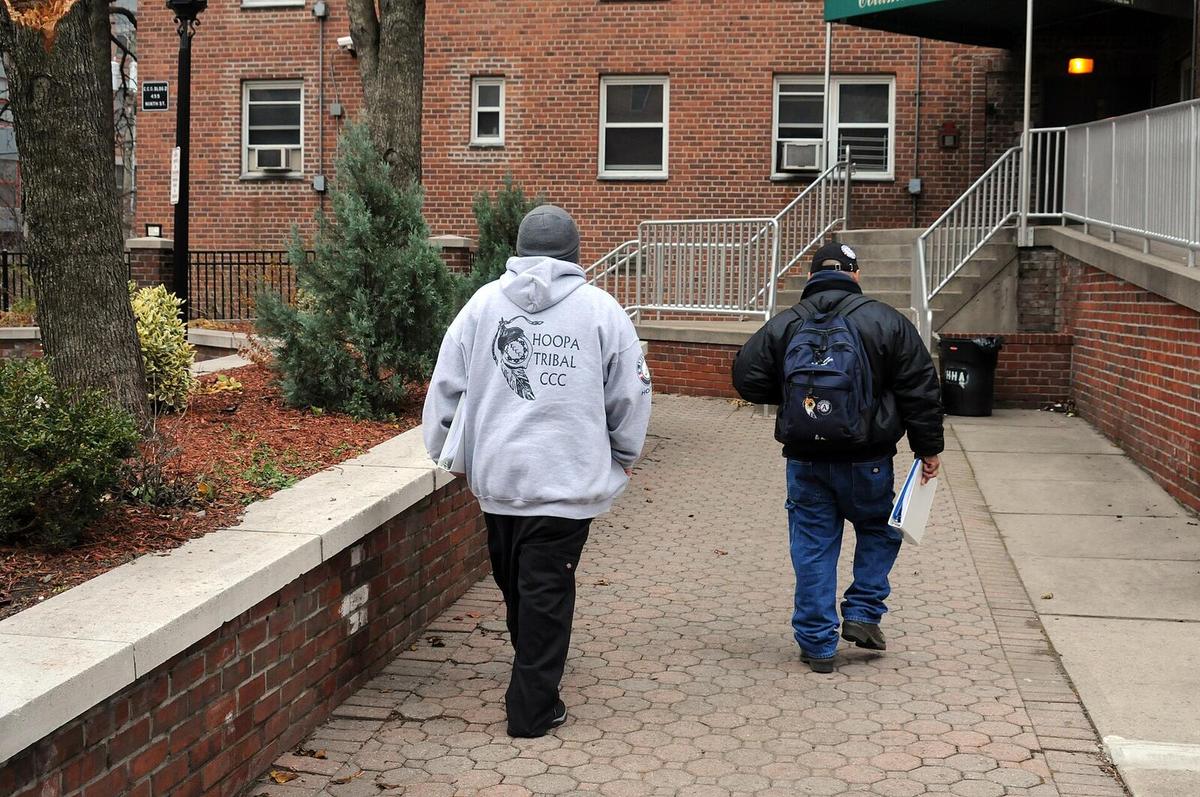 Volunteers go door to door at an apartment complex in Hoboken, New Jersey, in December 2012, a month after Hurricane Sandy. Photo by George Armstrong, FEMA, public domain, via Wikimedia Commons.
What changes when you live stacked up?
A tall building is a machine, and it runs on electricity. New York City's emergency guidance lists what an outage takes away: "your lights, elevators, air conditioning, heat, refrigerator, phone, and any medical equipment that runs on electricity."
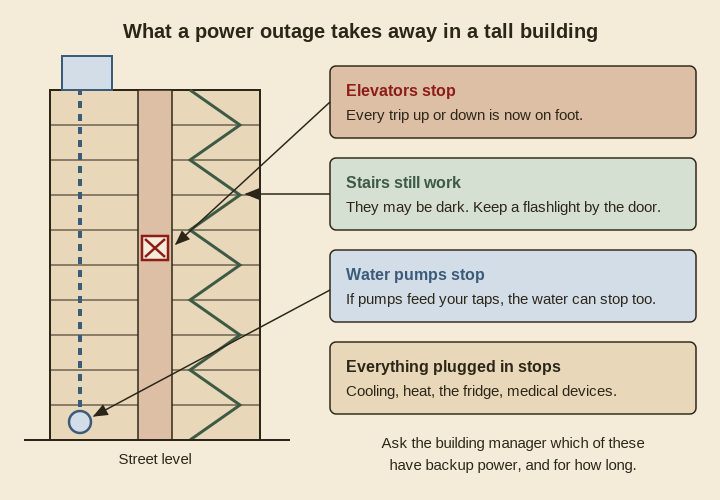 In a tall building, one failure (electricity) becomes four.
Three of those deserve a plan.
Elevators. Without them, your floor number becomes a physical fact. A healthy adult can walk down 13 flights. Walking up them with groceries is another matter, and for someone who uses a wheelchair or has a heart condition the stairs may not be an option at all. New York City's hurricane guidance says it plainly: "evacuate early if you rely on elevators to get out of your building."
Water. Many tall buildings use electric pumps to lift water. The same city guidance says: "If your building uses electric pumps for water, keep bottled water on hand in case the water stops." Find out which kind of building you live in before you need to know.
Stairwells and halls. They may be dark. Keep a flashlight, not a candle, by the door.
The most useful ten minutes you can spend is a conversation with the building manager. Ask what has backup power, for how long, and how the building tells residents what is going on.
What do you do when the power or the water fails?
For a power outage, the guide on staying in covers food, light and the danger of carbon monoxide from generators and grills. That danger is sharper in an apartment, where there is no outdoor spot 20 feet away. In short: nothing that burns fuel indoors, keep the refrigerator closed, and unplug electronics so a surge on return does not damage them.
Water trouble in a city usually arrives as a notice. The Centers for Disease Control and Prevention (CDC) describes three kinds, and they are not the same.
- Boil water advisory. Germs may be in the water. Use bottled water, or bring tap water "to a full rolling boil for 1 minute" (3 minutes above 6,500 feet), then let it cool. Use that water for drinking, cooking and brushing teeth. Skip the ice and the water from a refrigerator dispenser.
- Do not drink advisory. Chemicals or toxins may be in the water. CDC is direct: "Boiling water containing harmful chemicals or toxins will not make the water safe to use." Use bottled water.
- Do not use advisory. Rare. Do not use tap water for anything until it is lifted.
Read the notice to see which one you have. The water guide in this series covers storage and treatment.
How do you get home when transit stops?
A flood in the tunnels, a blackout or a security incident can stop trains and buses with a few minutes' warning. If you commute, the question is how you get home without them.
If home is five miles from work and you cover a mile in 20 minutes, the walk takes an hour and forty minutes. That is very doable in the right shoes and miserable in the wrong ones.
Ready.gov, the federal preparedness site, advises keeping a kit at work and being ready to shelter there for at least 24 hours. Its list for that kit is short: food, water, medicines and comfortable walking shoes, in a case you can grab. For a city commuter I would add three things:
- A paper map with your route marked. Phones die and networks jam.
- A small flashlight.
- A charged backup battery and cable.
Walk the route once on a pleasant day. Agree with your household where you will meet if phones are down, which the family communications plan guide in this series covers. And sometimes the right answer is not to walk at all: if the weather or the streets are bad, staying at work for the night is the plan Ready.gov has in mind.
Why is heat the one to take most seriously?
Because it kills more people than the dramatic hazards do, and it does so quietly. Ready.gov states it without hedging: "Extreme heat is responsible for the highest number of annual deaths among all weather-related hazards."
The National Weather Service (NWS) publishes the count. Over the ten years from 2016 to 2025, heat averaged 279 deaths a year in its records, more than twice the figure for floods.
| Heat | 279 deaths |
|---|---|
| Flood | 118 deaths |
| Rip currents | 76 deaths |
| Wind | 57 deaths |
| Tornado | 51 deaths |
| Cold | 35 deaths |
| Winter storm | 27 deaths |
| Hurricane (wind only) | 25 deaths |
| Lightning | 19 deaths |
Source: National Weather Service, Weather Related Fatality and Injury Statistics, 2025 (preliminary)
Two cautions. NWS says its 2025 figures are preliminary and that heat deaths are reported late and will likely rise. It also notes that CDC is the official source for cause of death. The ranking matters more than the exact count.
A blackout during a heat wave takes away the air conditioning that was keeping people safe. CDC lists who is at higher risk: people 65 and older, infants and young children, pregnant women, people with heart disease or asthma, and anyone working or exercising outdoors.
What works:
- Air conditioning, yours or someone else's. New York City calls it "the best way to stay safe during extreme heat." A few hours a day in a cooled library, mall or cooling center counts.
- Do not trust a fan alone. CDC warns: "In temperatures above 90°F, a fan can increase body temperature."
- Water, cool showers, and loose, light clothing.
- Know heat stroke. Ready.gov lists a body temperature above 103 degrees, hot dry skin, a rapid pulse, and dizziness or confusion. Call 911.
- Check on people. A phone call or a knock for anyone who lives alone.
How do you stay informed?
Three official channels are worth setting up before you need them.
Wireless Emergency Alerts. These are the loud messages that arrive on every phone in an area. Ready.gov explains that there is nothing to subscribe to and nothing to pay, that the alerts are not affected by network congestion, and that they arrive with a distinct sound and vibration repeated twice. Some phones need them switched on. Look in your notification settings for "Government Alerts" or "Emergency Alerts."
Your city's own alerts. Ready.gov advises signing up for alerts from your local emergency management agency. Many cities and counties offer texts, emails or calls about local emergencies: water main breaks, transit shutdowns, cooling center openings. New York's is called Notify NYC. Search your city's name with "emergency alerts" and sign up on the official .gov page.
NOAA Weather Radio. This is a nationwide network of more than 1,000 transmitters that broadcasts warnings 24 hours a day. It needs a receiver built for it, which is why Ready.gov's kit list names a NOAA Weather Radio next to the ordinary battery or hand-crank radio. Handheld two-way radios and mesh networks are covered in their own guides in this series.
The free FEMA App can also send weather alerts for up to five locations.
Cash, crowds and keeping your distance
Cash. A city runs on cards and phones until the power or the network drops. Ready.gov's list of what an outage can close includes "grocery stores, gas stations, ATMs, banks." Its advice is to keep a small amount of cash at home in small bills. Enough for a few days of food and a ride is a sensible target.
Unrest. Cities sometimes see days of protest, and occasionally disorder. For an ordinary household the guidance is unglamorous. Know where it is happening, and be somewhere else. Change your route or work from home for a day. Do not go to watch, and do not stop to film. If you find yourself near a crowd that feels tense, leave early and calmly by a side street, and keep moving until it is well behind you. Follow any official instructions, including curfews. None of this means treating other people as a threat. Our guide Situational Awareness Without Paranoia covers the habit of noticing early.
Neighbors. The best urban resource is in the next apartment. Learn two or three names on your floor. In an outage, knock on the door of anyone older or living alone.
What does the city itself provide?
More than most residents realize.
- 311. Many cities run a 311 line or website for non-emergency help: reporting a problem, finding a cooling center, asking about shelter. For danger to life, it is always 911.
- Cooling and warming centers. Cities open public buildings during heat and cold emergencies. New York's are found through its Cooling Center Finder or 311.
- Shelters. Ready.gov says you can find open shelters by texting SHELTER and your ZIP code to 43362.
- Utility registers. New York City tells residents who rely on electric medical equipment to register with their utility so they can be contacted in an emergency. Ask your own utility what it offers.
- Building management. If you rent, the landlord or superintendent is the first call for dark hallways, water problems and elevator outages.
When damage is widespread, federal help may follow. Our guide What FEMA Actually Does in a Disaster explains what that includes.
A renter on the 14th floor and a family in a row house
One renter, 14th floor. Her risks are the elevator and the water. New York City suggests enough supplies at home for up to seven days. At a gallon a day that is seven gallons, which at 8.33 pounds a gallon is about 58 pounds. Nobody wants to carry that up 13 flights during an outage, so it goes up now, by elevator, a few jugs at a time. She keeps shelf food that needs no cooking, a flashlight by the door, a battery radio, and $100 in small bills. She has asked whether the building's pumps and hallway lights have backup power. Her limit is written down: if the power is out for a second night in a heat wave, she walks down in the cool of the morning and goes to a friend who has air conditioning.
Two adults and two children, three-story row house. No elevator to lose and no building pumps to fail, so their weak points are different: a basement that can flood, shared walls, and upstairs bedrooms that hold heat. Their seven-day water is 28 gallons, stored in the basement on a shelf off the floor. They have one room with a window air conditioner where everyone sleeps during a heat wave, carbon monoxide alarms on each level, and the phone numbers of the neighbors on both sides. Both parents keep walking shoes and a paper map at work.
What to remember
- City emergencies are mostly systems stopping: power, water, transit and cooling.
- In a tall building, an outage means stairs, and it may mean no water. Ask your building manager what has backup power.
- Read a water notice carefully. Boiling fixes germs, not chemicals.
- Heat is the deadliest weather hazard in NWS records. A fan alone is not enough above 90 degrees.
- Turn on phone alerts, sign up for your city's alert service, and keep a battery radio.
- Keep small bills, walking shoes and a paper map. Stay away from crowds that feel tense. Know your neighbors.
Start with the question for the building manager, and sign up for your city's alerts while you wait for the answer.