Articles & BlogBy Trapper W. Brown6 min read
For anyone who sleeps in hotels, at any budget.
What do you do when you first open a hotel room door? Most of us drop the bags, find the outlet and fall onto the bed. I would like to borrow the first five minutes for something else.
Hotels are, on the whole, safe places to sleep. Staff are on duty all night, doors lock, and most stays pass without anything worth telling. This article is about a short routine that makes a quiet stay even more likely, and that pays off on the rare night when something does go wrong. It takes less time than connecting to the Wi-Fi.
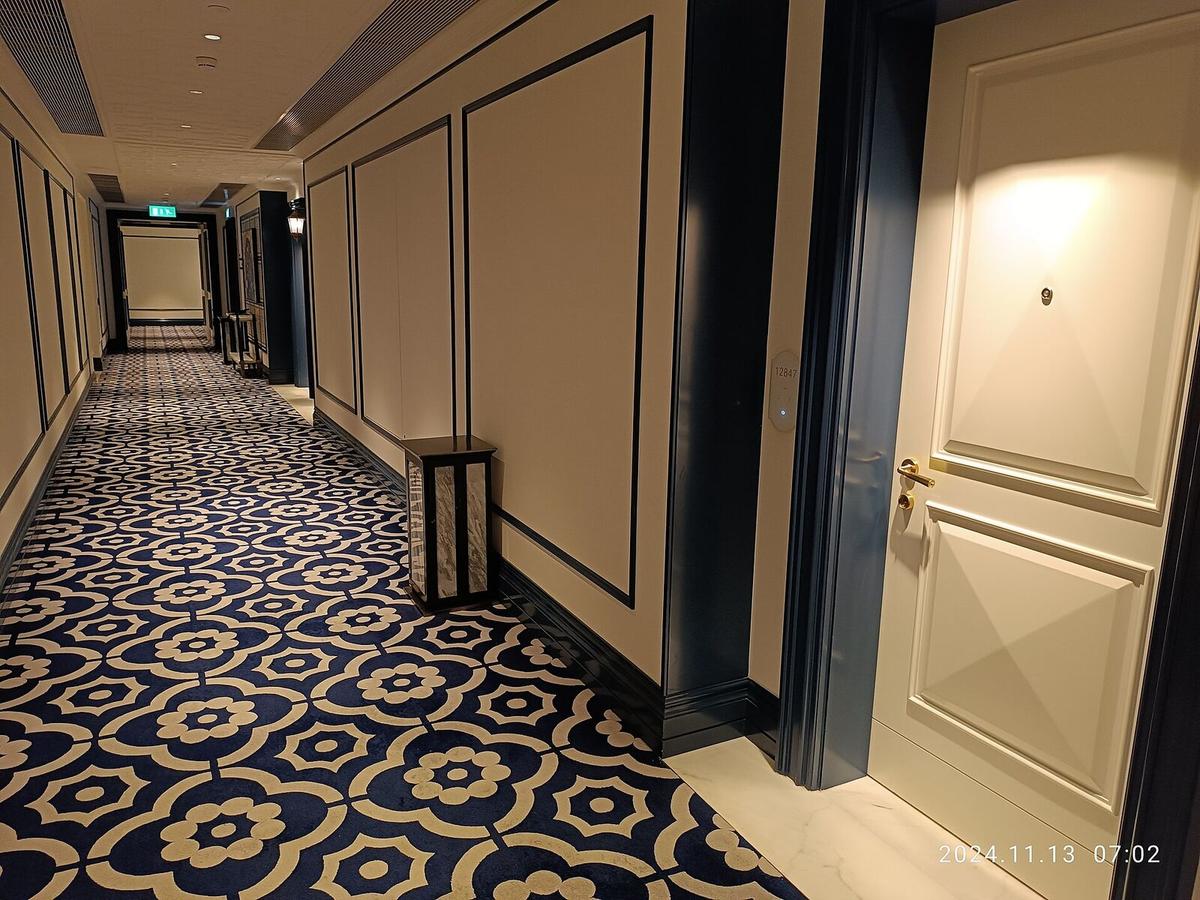 Everything in the five-minute check is in this one view: the door, its viewer, and the exit sign down the hall. Photo by JohnLEE Brothers, CC0 public domain dedication, via Wikimedia Commons.
I wrote this with US travelers going abroad in mind, because an unfamiliar country is where people feel least sure of themselves. Nearly all of it applies to any hotel, anywhere, including the one an hour from your house.
The door comes first
Before you unpack, stand inside the room and look at the door. It is the main thing between you and the hallway, so you want to know that it works.
| Check | What you want to see |
|---|---|
| Does the door close on its own? | It swings shut and latches without a push |
| Is there a deadbolt? | It turns fully and the door will not move with it thrown |
| Is there a second latch, bar or chain? | It is attached firmly and it engages |
| Is there a viewer in the door? | You can see the hallway through it clearly |
| Is there a connecting door to the next room? | It is locked from your side |
| Do the windows or balcony door open? | They lock, and they are locked now |
Let the door close by itself once and listen for the latch. A door that needs a pull to catch will, sooner or later, be left ajar by someone who is tired. If anything on that list is broken, the fix is simple: go back to the desk and ask for another room. You do not owe anyone an apology for it, and good hotels would rather know.
From then on, use every lock each time you are inside, and the deadbolt and second latch every night. In security work this is called layers of defense: no single lock has to be perfect when there are two or three of them.
Find your exits before you unpack
How would you get out if the hallway were dark and full of smoke? You answer that question now, while the lights are on.
The US Fire Administration's advice for hotel guests, published in 2023, comes down to three things:
- Choose hotels with hard-wired smoke alarms and sprinklers in each room.
- Find the two closest exits.
- Count the doors between your room and the exits.
The counting is the clever part. In smoke you may not be able to see an exit sign, but you can run your hand along the wall and count doors. So walk it once. Step into the hallway, find the nearest stairwell in each direction, and count the doors on the way to each. Open the stairwell door to confirm it is an exit and not a closet. The whole walk takes about a minute.
Back in the room, look up and find the smoke alarm and the sprinkler head. Then put your room key and your phone in the same spot every night, somewhere you could find them with your eyes closed.
You will hear confident rules about which floor to book. I looked for an official source that sets one and did not find it, so I am not going to hand you a floor number. Alarms, sprinklers and knowing your exits are the advice with a named source behind it.
Tip
Do the exit walk before you take your shoes off. Once you are settled you will not go back out to do it, and the first night is when the building is least familiar.
Keep the room number to yourself
Your room number is a small secret worth keeping. Someone who knows your name and your room can telephone you, knock, or try to persuade the desk they belong with you.
A few easy habits:
- If the clerk says your room number out loud with other people standing near, ask quietly for a different room and for the number to be written down.
- Keep the key card apart from the paper sleeve with the number on it.
- Do not say the number aloud in the lobby, the bar or the elevator.
- Wait to post photos that show where you are staying until after you have checked out.
A well-run hotel will not tell a caller which room you are in. It will offer to connect the call. If yours does it differently, that tells you something useful about how much to rely on the front desk.
Your valuables
Where should the passport go? Reasonable people disagree, and the answer depends on the room and the country. What matters is that you decide on purpose.
| Item | A sensible default |
|---|---|
| Passport | The room safe or on your person. Not loose in the room |
| Spare cards and most of your cash | The safe, with only a day's money in your pocket |
| Laptop or tablet | The safe if it fits. Otherwise in a closed bag, out of sight |
| Paper copies of your documents | A different bag from the originals |
| Jewelry you would grieve over | At home |
A room safe keeps honest people honest and keeps your things out of sight, and that covers most of the risk. It is not a bank vault, so the best protection for something irreplaceable is not to bring it. Keep the room tidy enough that you would notice if something moved.
Who is at the door?
What do you do when someone knocks and you did not order anything? You keep the door shut while you find out.
Look through the viewer and speak through the closed door. If the person says they are from the hotel (maintenance, housekeeping, security) and you were not expecting them, tell them to wait. Then call the front desk using the room phone, and ask whether they sent someone. Use the desk button on the phone, not a number the visitor offers you. A real employee will not mind waiting. Someone who objects, or who has gone when you come back to the door, has answered the question for you.
Watch out
A phone call to your room asking you to "confirm" a card number is a common trick. It often comes late at night, with a story about a problem at check-in. Hang up, and walk down to the desk in the morning. A hotel that needs your card again can ask for it in person.
The five minutes, as a list
- Let the door close on its own and confirm that it latches
- Test the deadbolt and the second latch
- Check that any connecting door, the windows and the balcony door are locked
- Find the two closest exits and count the doors to each
- Find the smoke alarm and the sprinkler in your room
- Put your passport and spare cards away, on purpose
- Pick one spot for your key and phone at night
What to remember
- Check the door before you unpack, and change rooms if a lock is broken.
- US Fire Administration advice: alarms and sprinklers in each room, two closest exits, count the doors.
- Your room number is nobody's business but yours and the desk's.
- Decide where your passport lives. Do not leave it to chance.
- Unexpected knock: door shut, call the front desk yourself.
None of this is meant to make a hotel feel like a risky place, because it is not one. A routine like this is the opposite of worry. You do it once, in five minutes, and then you stop thinking about the room and go enjoy the city.