Articles & BlogBy Trapper W. Brown10 min read
By the end you will be able to read a policy's first page, work out what a claim will cost you, and know where to turn when the answer is no.
Insurance is a trade. You accept a small, certain cost today, and in exchange someone else carries a large, uncertain cost that might arrive tomorrow. Health, car, home and life policies look nothing alike on paper, yet all of them run on that one trade and a little arithmetic.
It is worth an hour of your attention because the sums are large and the wording decides who pays. Learning what a deductible, a limit and an exclusion mean before a loss beats learning it after one. This is general education, not personal financial advice, and it recommends no company or product.
 An insurance adjuster measures a storm-damaged home in Gallatin, Tennessee, in April 2006. A claim starts with someone counting what was lost. Photo by Leif Skoogfors, FEMA, public domain, via Wikimedia Commons.
What is the one idea behind all insurance?
Pooling. Picture 1,000 households, each with a 1 in 200 chance of a house fire this year, and suppose a fire costs $100,000. No family can plan for that. But across 1,000 homes you would expect about five fires, or $500,000 in losses. Split evenly, that is $500 a home.
The premium is the price each household pays to be in the pool. It has to cover more than the expected losses, because someone must be paid to sell the policies, answer the phone and settle the claims. Say that adds $130, and the insurer keeps a $20 margin. The premium comes to $650.
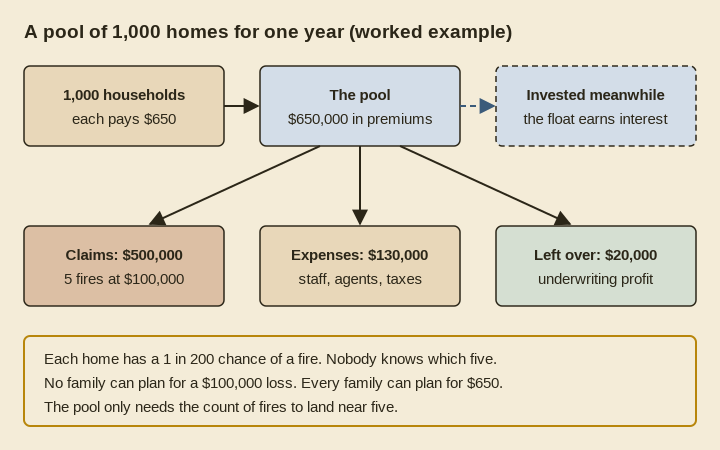 The pool cannot say whose house will burn. It only has to be right about how many.
Why does this work? Because of the law of large numbers: the more independent cases you add together, the closer the total comes to the average you predicted. Here is the paired example.
- One household on its own faces either no loss or a ruinous one. An average of $500 a year means nothing to it.
- A pool of 1,000 expects five fires, but by my own arithmetic the count will usually land anywhere from three to seven. That is a swing of $200,000 either way, enough to sink a small insurer in a bad year.
- A pool of 100,000 expects 500 fires, and the usual swing is only about 22 fires either way, under 5%. The bigger pool is far more predictable.
Two things follow. Size is safety, which is why insurers want many customers. And the cases have to be independent. A hurricane that hits every house in the pool at once breaks the arithmetic.
What do deductibles, copays and limits do?
They decide how a loss is split between you and the pool. HealthCare.gov, the federal marketplace site, and the glossary kept by the National Association of Insurance Commissioners (NAIC) define them this way.
| Term | Plain meaning |
|---|---|
| Deductible | The part of a loss you pay yourself before the insurer pays anything |
| Copay | A fixed amount you pay for a covered service, such as $20 for a visit |
| Coinsurance | Your percentage share of a covered cost, such as 20%, after the deductible |
| Limit | The most the policy will pay. The NAIC calls it the "maximum value to be derived from a policy" |
| Exclusion | A cause of loss the policy does not cover at all |
A higher deductible lowers the premium, because the pool no longer pays for small, frequent losses. Limits cap the other end. Exclusions remove whole categories, usually the ones that hit everyone at once or that belong in a different policy.
One caution about a word. In health insurance, coinsurance is your percentage share. In property insurance the same word names a different clause, one that reduces a payout when a building is insured for much less than its value. Read which one your policy means.
How does an insurer decide what to charge?
Through underwriting: sorting applicants by how likely and how large their losses are, then pricing each group. A driver with three accidents pays more than a driver with none. A wooden house far from a fire hydrant pays more than a brick one beside the fire station.
Underwriting exists to hold off two problems.
The first is adverse selection. People know things about their own risk that the insurer does not, and the people most likely to have a loss are the keenest to buy. If one price is offered to everyone, the pool fills with high-risk buyers, losses rise, the price rises, and the low-risk buyers leave. Pricing by risk group is the main answer to it.
The second is moral hazard. Once a loss is someone else's bill, people take a little less care. Nobody burns the house down, but the second lock may not get bought. Deductibles and coinsurance are the cure: they leave you with some of your own money in every claim.
How do insurers make money, and who watches them?
In two ways. The first is the underwriting result: premiums minus claims and expenses. The industry's yardstick is the combined ratio, which the NAIC describes as the loss ratio and the expense ratio added together. In the fire pool, $630,000 of claims and expenses against $650,000 of premium is a combined ratio of about 97%. Under 100% means an underwriting profit. Over 100% means a loss.
The second is float. Premiums arrive at the start of the year and claims are paid over months or years. In between, the insurer invests the money. If the pool's $650,000 earned 4% for half a year, that is $13,000, in a year when underwriting made $20,000. This is why an insurer can lose a little on underwriting and still stay in business.
Insurers buy insurance too. Reinsurance is, in the NAIC's words, a transaction in which another insurer "agrees to cover all or part" of the losses. It is how a company with 1,000 homes in one county survives the year the wildfire comes.
Regulation in the United States is done mainly by the states. Each has an insurance department that oversees the companies selling there and takes consumer complaints. The NAIC, founded in 1871, is the body through which the chief regulators of the 50 states, the District of Columbia and five territories set common standards.
How does a health claim work, in real numbers?
Health plans add two ideas. A network is, as HealthCare.gov puts it, the providers your plan "has contracted with." Inside it, prices are agreed in advance. The out-of-pocket maximum is "the most you have to pay for covered services in a plan year." For marketplace plans the legal ceiling on it is $10,600 for one person in 2026 and $12,000 in 2027, double that for a family.
Take an invented plan: a $2,000 deductible, 20% coinsurance and a $7,000 out-of-pocket maximum. You spend three nights in an in-network hospital.
- The hospital's list price is $38,000. Your plan's negotiated rate, the "allowed amount," is $13,500. The other $24,500 is written off under the contract. You never owe it.
- You pay the first $2,000, your deductible.
- Of the remaining $11,500, you pay 20%, which is $2,300. The plan pays $9,200.
- Your total is $4,300.
In October you need surgery with an allowed amount of $20,000. Your deductible is already met, so your share would be 20%, or $4,000. But you are only $2,700 short of your $7,000 maximum, so $2,700 is all you pay. The plan pays $17,300, and covered in-network care costs you nothing more that year.
What does not count toward the maximum, according to HealthCare.gov: your premiums, services the plan does not cover, out-of-network care, and charges above the allowed amount. The guide How Hospital Systems Work explains where that $38,000 list price comes from and why almost nobody pays it.
What other policies does a household meet?
| Policy | What it mainly pays for | A term to learn |
|---|---|---|
| Auto | Injury and damage you cause to others (liability). Optionally, damage to your own car | Collision covers a crash. Comprehensive covers fire, theft, weather and the like |
| Home or renters | The building if you own it, your belongings, liability, and living costs while you are displaced | Replacement cost pays to replace. Actual cash value subtracts depreciation |
| Life | A death benefit to the people you name | Term covers a set period. Permanent covers for life and costs more |
| Disability | Part of your income when illness or injury stops you working | The waiting period before benefits start |
The NAIC's consumer guides add details worth knowing. Most states require some car insurance to drive legally, and a lender may require collision coverage on a financed car. The people you name on a life policy are the beneficiaries, and you should state what percentage each receives.
Watch out
The NAIC states it flatly: "Floods and earthquakes are not covered by a typical homeowners policy." Each needs separate coverage. Find out before the water rises, because the answer will not change afterward.
Every policy opens with a declarations page, often called the dec page. It is the one-page summary of the whole contract, and the NAIC lists what it shows: the policy term, the coverage limits, the policy number, who is insured and what is covered. Read five things on it: the names, the dates, each limit, each deductible and the list of attached forms, called endorsements, which change the standard policy. If a name is misspelled or a car is missing, fix it now.
What can you do when a claim is denied?
A denial is a first answer, and there is a set order for challenging it. Start by asking for the reason in writing and the policy language it rests on.
For health plans, HealthCare.gov sets out two steps.
- Internal appeal. You ask the insurer to review its own decision. You must file within 180 days of the denial notice. The insurer must decide within 30 days for a service you have not yet received and within 60 days for one you have.
- External review. If the insurer still says no, an independent reviewer decides. You must ask within four months of the final denial. A standard review is decided within 45 days and an urgent one within 72 hours. Any charge to you cannot exceed $25, and the insurer is required by law to accept the result.
Some employer plans follow different rules, so check your plan documents for the exact route.
For any kind of policy, the third door is your state insurance department. It takes complaints against insurers and agents, and the NAIC's website lists every department. Keep copies of everything, write down the date and name for each phone call, and send appeals in a way that proves delivery.
Denials and appeals are also being automated on both sides, which is the subject of the opinion piece When the Insurance Machine Argues With the Hospital Machine.
What to remember
- Insurance is pooling: many pay a little so the few with a loss are made whole. It works because large numbers are predictable.
- Deductibles, copays and coinsurance are your share. Limits cap the insurer's share. Exclusions remove a cause of loss entirely.
- Insurers earn money from underwriting and from investing premiums before claims come due.
- In a health plan, work out the allowed amount, then your deductible, then your coinsurance, and stop at the out-of-pocket maximum.
- The declarations page is the summary. Check the names, dates, limits, deductibles and endorsements.
- A denied claim can be appealed inside the company, then outside it, and reported to the state insurance department.
Pull out one policy you already hold and find its declarations page. Ten minutes with that page will tell you more about your coverage than the brochure did.