Articles & BlogBy Trapper W. Brown11 min read
A go bag is a packed bag that sits near your door so that you can leave home in a few minutes and manage for about three days. That is the whole idea. It is for the evening a firefighter knocks and says the block has to clear out, or the morning a river is rising faster than the forecast said.
Most households will never use one, and that is fine. It costs little, and it turns a frantic ten minutes of opening drawers into picking up one bag. Ready.gov, the federal preparedness site, puts the reason in a line: build a go bag "so you don't need to scramble in an evacuation situation." This guide covers what goes in, what stays out, and how to keep the bag light enough that you will actually take it.
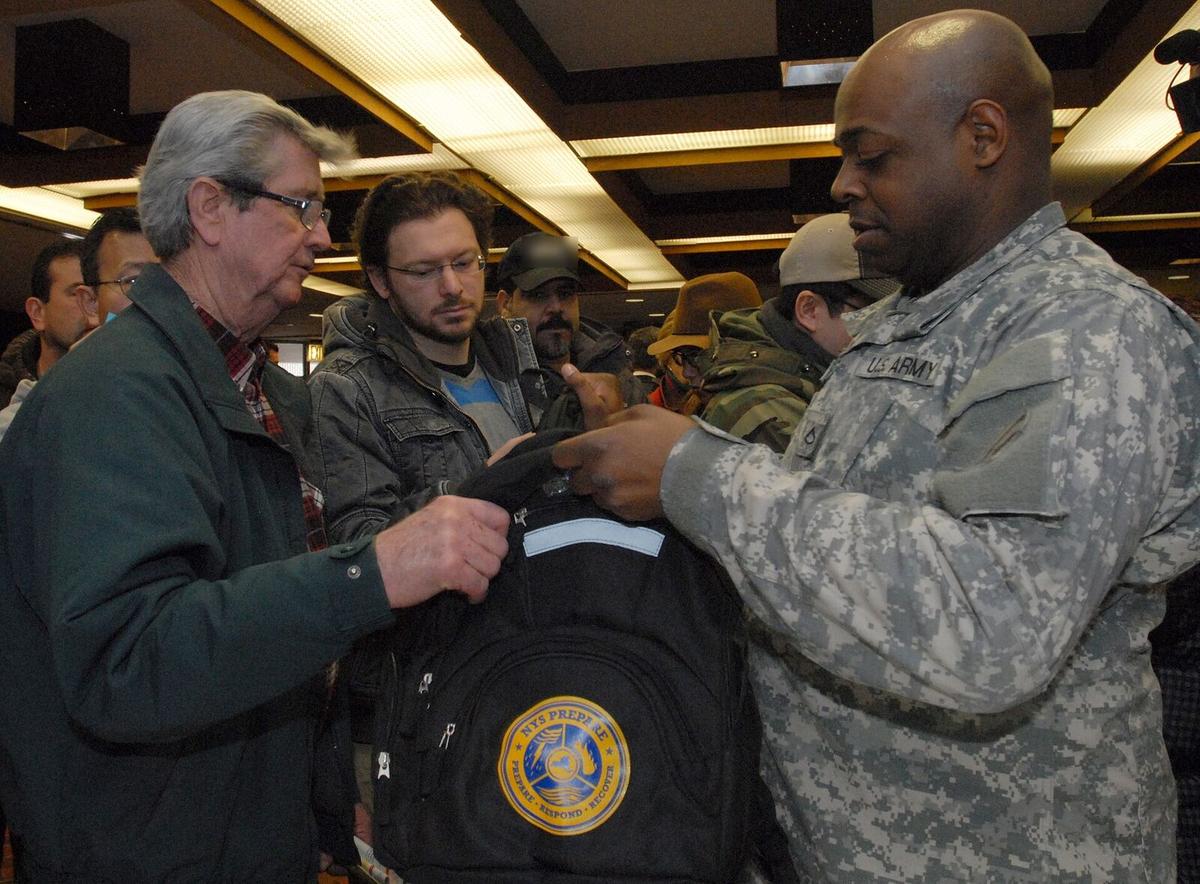 A New York Army National Guard soldier hands out a starter emergency kit, packed in an ordinary backpack, at a public preparedness class on Staten Island in February 2014. Photo by Sgt. 1st Class Raymond Drumsta, US Army National Guard, public domain, via Wikimedia Commons.
What is a go bag for?
It is for leaving, and only for leaving. The American Red Cross splits its supply advice by that line: a three-day supply for an evacuation and a two-week supply for staying home. Three days is about how long it takes to reach a relative, a motel or a public shelter and get settled.
That narrow job tells you what to leave out. A go bag does not need to feed you for a month or build a shelter. Ready.gov's page on shelters notes that public shelters "often provide water, food, medicine and basic sanitary facilities," and still advises bringing your own kit. The bag bridges the gap between your front door and the next safe roof.
How is it different from a home kit and a car kit?
People often build one giant kit and call it done. Ready.gov suggests three, because "you do not know where you will be when an emergency occurs."
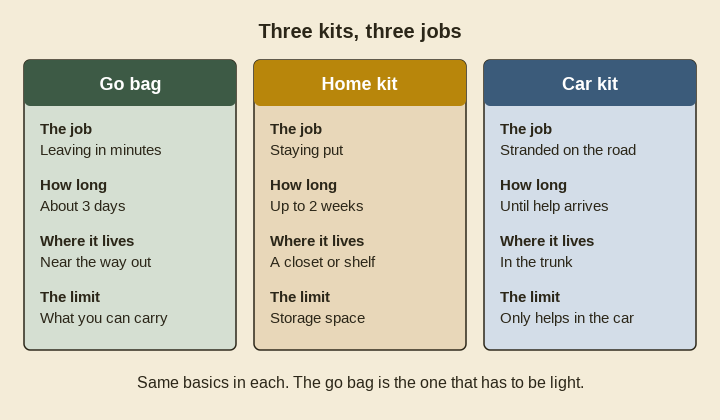 One list of basics, packed three ways for three different jobs.
The home kit is the big one: cases of water, a shelf of canned food, blankets. Weight does not matter because it never moves. The car kit adds what a stranded driver needs. Ready.gov lists jumper cables, flares or a reflective triangle, an ice scraper, a phone charger, a blanket, a map and cat litter or sand for traction.
The go bag is the small one, and its limit is your own back. Ready.gov describes it as something "you can carry when you evacuate on foot or public transportation." If you have a car, the car can carry extra. The bag still has to work without it.
What goes in it?
The core list below is drawn from two sources read for this guide: Ready.gov's Build A Kit page (last updated 1 July 2026) and the Red Cross survival kit list. They agree on nearly everything.
| Item | Why it is there | How often to check |
|---|---|---|
| Water in sealed bottles | You need it within hours | Twice a year |
| Ready-to-eat food (bars, nuts, small cans) | No stove, no fridge, no fuss | Twice a year, by the dates |
| Flashlight and extra batteries | Outages and evacuations go together | Twice a year: switch it on |
| Battery or hand-crank radio | News when the phone network is jammed | Twice a year |
| First aid kit | Small injuries while help is busy | Twice a year, and after any use |
| Medicines and a written list | Pharmacies may be shut | At every refill |
| Copies of documents | Proving who you are and what you own | Once a year, and after any change |
| Cash in small bills | Card readers need power and a network | Twice a year |
| Phone charger and backup battery | Your phone is your map and your alerts | Twice a year: recharge it |
| Change of clothes and sturdy shoes | You may leave in whatever you had on | Each season |
| Soap, wipes, toothbrush, sanitary items | Three days is a long time without them | Twice a year |
| Whistle, dust mask, local map, spare keys | Small, light and hard to improvise | Once a year |
A few notes on the rows.
Medicines. The Red Cross list says a seven-day supply. Ready.gov points out that about half of all Americans take a prescription medicine every day, so this row applies to most households. New York City's emergency management office adds a good habit: keep a written list of what each person takes, why, and the dose, and if you store spare medicine in the bag, replace it before it expires. Ask your pharmacist what is possible. Some medicines cannot be stockpiled, and some need to stay cold.
Radio and first aid. A small battery or hand-crank radio is enough. Handheld two-way radios, and what to do with a first aid kit when help is slow, have their own guides in this series.
Papers, cash and the digital copies
After a disaster, paperwork is how you get your life back. Insurance claims, federal aid, a replacement license and a new lease all start with proving who you are and where you lived.
The Red Cross lists what to copy: a medication list and key medical information, proof of address, the deed or lease, passports, birth certificates and insurance policies. Ready.gov's financial page adds photo ID and Social Security cards, which are needed to apply for federal disaster aid.
Carry them two ways.
- Paper copies in a zip-top bag inside the go bag. Copies, not originals. Originals belong somewhere safer, such as a fire-resistant box or a bank's safe deposit box.
- Digital copies. Ready.gov suggests an external drive or the cloud. Scan or photograph each page. A folder of scans of your identity documents is exactly what a thief wants, so the account that holds it needs a strong password used nowhere else. Our guide Password Managers: Picking One and Moving In covers that, and Backups That Work: The 3-2-1 Rule explains how to keep a copy off site, so that a fire or a flood cannot take every copy at once.
On cash, Ready.gov's reasoning is short: have small bills because "ATMs and credit cards may not work during a disaster." Small matters. Nobody at a gas station in a blackout can change a hundred.
How heavy is too heavy?
Neither Ready.gov nor the Red Cross gives a weight limit for a go bag, and I could not find an official one, so this guide will not invent a number. What the sources do give is enough to see the problem.
Both say one gallon of water per person per day. The US Geological Survey gives the weight of water as 8.33 pounds per gallon. Three days of water for one person is therefore three gallons, or about 25 pounds, before a single other item goes in. For a family of four it is 12 gallons, or about 100 pounds.
Nobody is walking far with that. So water is the item to split:
- In the bag: a couple of sealed one-liter bottles per person. A liter of water weighs one kilogram, about 2.2 pounds, so two bottles add roughly 4.4 pounds.
- Beside the bag: the rest of the three days in gallon jugs, ready to go into the car if you are driving.
- On foot: you carry the bottles and refill where you land.
Then test it, which is my real rule. Put the packed bag on, walk down your stairs and around the block for fifteen minutes. If you are glad to take it off, it is too heavy. Take out duplicates first, then anything you packed for comfort and not for need. New York City's advice on the bag itself is sensible: sturdy and easy to carry, "like a backpack or a small suitcase on wheels." Wheels are a fine answer for anyone who should not carry weight on their shoulders, as long as your way out does not depend on stairs.
How do you fit it to your household?
The core list is the same for everyone. The rest is personal, and it is where a bag is most often incomplete.
- Babies and children. Ready.gov lists formula, bottles, diapers, wipes and rash cream, plus books, games or puzzles. A child old enough to wear a small backpack can carry their own snack, a water bottle and one familiar toy. Check sizes at every refresh. Diapers and spare clothes are outgrown fast.
- Older adults. Ready.gov's page for older adults lists medicines, medical supplies, batteries and chargers, and copies of Medicare, Medicaid and other insurance cards. It also suggests that someone in your support network has a spare key and knows where the supplies are.
- Disabilities and medical devices. Ready.gov's list includes extra hearing-aid batteries, spare glasses, a patch kit and pump for wheelchair tires, and a charged spare battery for powered devices. New York City adds written instructions for any device you use.
- Pets. Ready.gov advises two pet kits: a larger one for home and "one lightweight version for if you need to evacuate." The light one holds several days of food and water, medicine, a leash and spare collar with ID, a carrier, and a photo of you with your pet in case you are separated. Many public shelters accept only service animals, so know in advance where your pet could stay.
- Climate. Ready.gov says clothing "appropriate for your climate." In a cold place that means a hat, gloves and a warm layer. In a hot one it means a sun hat and more water, since Ready.gov's water page notes that needs can double in very hot weather. Swap these at the seasonal check.
One adult in an apartment, and a family of four with a dog
One adult, third-floor apartment, no car. Everything has to be carried down the stairs and onto a bus. The bag is a daypack: two liters of water, a day and a half of bars and nuts, a flashlight, a small radio, a first aid pouch, seven days of a daily medicine with the written list, a zip-top bag of document copies, $100 in fives and tens, a charger and battery, a change of clothes, a toothbrush and wipes, a whistle, a mask and a paper map. The plan fills in what the bag cannot: a friend across town is the first destination, and the public shelter is the second.
Two adults, two children and a dog, with a car. One bag will not do. Each adult carries a full bag. Each child carries a small one with a water bottle, snacks, a jacket and a toy. One adult's bag holds the family's documents and cash, and the other holds the first aid kit and medicines, so that losing one bag does not lose everything. The dog has a tote with three days of food, a bowl, a leash, a spare collar and vaccination records. The 12 gallons of water sit in jugs next to the bags and go in the trunk. If the family has to leave on foot, the jugs stay and the bottles go.
Both households share one more item that weighs nothing: where to meet and whom to call. That belongs to the family communications plan, which has its own guide in this series.
Where does it live, and when do you check it?
Keep the bag where you would pass it on the way out: a hall closet, under the bed nearest the door, a hook by the garage. Do not bury it in a basement that floods or an attic you reach by ladder. Ready.gov says the kit should be in a designated place and that every member of the household should know where it is and who is responsible for it.
Check it twice a year. New York City ties the check to the clock changes for daylight saving time, which is easy to remember. Ready.gov says to replace expired items and to rethink your needs every year. At each check: swap food and water by their dates, test the flashlight, recharge the battery, update the document copies, count the cash, and try the clothes on the children.
Three mistakes account for most go bags that fail:
- Too heavy. It gets left behind, or it slows you down.
- Expired. Dead batteries, stale food, and medicine for a prescription that changed two years ago.
- A secret. One person packed it, and nobody else knows where it is.
What to remember
- A go bag is for leaving in minutes and lasting about three days. A home kit and a car kit are separate things.
- The core list from Ready.gov and the Red Cross: water, food, light, radio, first aid, medicines, documents, cash, charger, clothes and hygiene items.
- Water is the weight. Three days for one person is about 25 pounds, so carry bottles and keep the jugs ready for the car.
- Carry copies of documents, not originals, and keep protected digital copies as well.
- Add what your own household needs: children, older adults, medical devices, pets and the local climate.
- Check it twice a year, and make sure everyone at home knows where it is.
Start tonight with a bag you already own and the items already in the house, then put the first check date on the calendar. The communications plan guide in this series is the natural next read.