Articles & BlogBy Trapper W. Brown10 min readBoth sides
A four-year degree is one of the largest things a family ever pays for. It is also one of the few bought for a teenager, years before anyone knows how it will turn out. So the question in the title is fair, and it gets asked louder every year. A Pew Research Center survey of 5,203 adults, published in May 2024, found that only 22% thought a four-year degree was worth the cost if the student had to take out loans.
Two camps have formed. One says the degree still pays, and has the earnings tables to prove it. The other says the average hides too many people for whom it did not pay. Both are reading real data. This guide lays out each case at full strength, shows where the numbers come from, and works four examples so you can run your own.
 Graduates listen to the commencement speaker at a community college in Palau in May 2026. Photo by Shaina Marie ONeal, U.S. Navy, public domain, via Wikimedia Commons.
What does college cost in 2026?
Start with two words that mean different things. The sticker price is what a college publishes. The net price is what a student pays after grants and scholarships, which are aid that is not paid back.
The College Board's report Trends in College Pricing and Student Aid 2026, published this month, gives both for the 2026-27 school year.
| Type of college | Sticker tuition and fees | Full yearly budget at sticker price | Net tuition and fees after grants |
|---|---|---|---|
| Public two-year, in district | $4,210 | $22,000 | Covered by grants, on average |
| Public four-year, in state | $12,290 | $32,030 | $1,920 |
| Private nonprofit four-year | $46,350 | $67,610 | $17,280 |
The "full budget" adds housing, food, books, transportation and personal costs. After grants, the report estimates that a first-time, full-time, in-state student at a public four-year college needs $21,660 a year for everything. At a private nonprofit college the same sum comes to $38,540.
Two trends in that report surprise people. Net tuition at public four-year colleges peaked at $4,600 in 2012-13, in today's dollars, and has fallen to $1,920. And total borrowing by students and parents fell 38% over 13 years, to about $105 billion in 2025-26. Sticker prices rose again this year while the price the average student pays in tuition has been falling.
Then there are loans. Of students who earned a bachelor's degree in 2024-25, the College Board found 47% left with debt, and those borrowers owed $30,220 on average. Federal Student Aid set the rate on undergraduate loans first paid out between July 2026 and June 2027 at 6.52%, and on parent PLUS loans at 9.07%. A Congressional Research Service summary from July 2026 lists the limits that now apply: $31,000 in total for a dependent undergraduate, and for parents $20,000 a year and $65,000 in total per student.
What does a degree pay?
The Bureau of Labor Statistics publishes median weekly earnings by education every year. Median means the middle worker: half earn more, half less. The 2025 figures cover full-time workers aged 25 and over, and the bureau notes they leave out October because of the government shutdown.
| Less than high school | $770 |
|---|---|
| High school diploma | $966 |
| Some college, no degree | $1,062 |
| Associate's degree | $1,135 |
| Bachelor's degree | $1,578 |
| Master's degree | $1,876 |
The gap between a bachelor's degree and a high school diploma is $612 a week, or $31,824 over a year. Unemployment follows the same ladder: 2.8% for bachelor's holders and 4.3% for high school graduates in 2025.
Two economists at the Federal Reserve Bank of New York, Jaison Abel and Richard Deitz, turned figures like these into a rate of return in April 2025. Their sum has an idea in it that most family budgets miss. The largest cost of college is the wages the student does not earn while sitting in class. They put four years of net tuition at about $30,000 and four years of skipped wages at about $150,000.
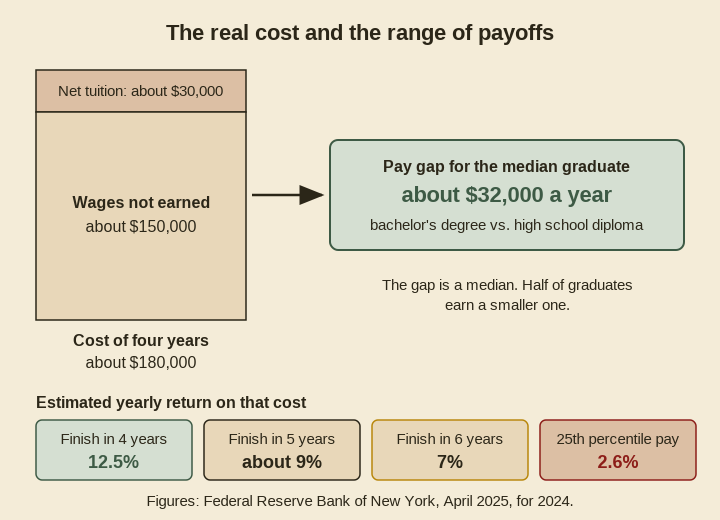 Most of the cost of college is the paycheck you give up, and the payoff depends heavily on finishing on time.
The case that it is still worth it
The people who say yes lean on four things.
The pay gap is large and has lasted. The New York Fed economists found the median worker with only a bachelor's degree earned about $80,000 in 2024 against $47,000 for the median worker with a high school diploma. They estimated the return on a degree at 12.5% a year for the median graduate.
The price most people pay has been falling. The College Board's net price and borrowing figures above are the evidence. In 2023-24, 79% of first-time, full-time students at public four-year colleges received grant aid.
The degree is a cushion as well as a raise. Lower unemployment at every step up the ladder means fewer months with no paycheck at all.
The return survives rough handling. In the same analysis, a student who got no financial aid at all still earned roughly 10%.
This side also points out that the public is judging sticker prices. A family that sees $46,350 and stops reading has not seen the $17,280 that the average student at such a college pays in tuition after grants.
The case that it too often is not
The people who say no, or "not for everyone," do not dispute the median. They dispute what it leaves out.
The median is one person. The same New York Fed authors wrote that a degree "might not be worth it for at least a quarter of college graduates." For a graduate at the 25th percentile of earnings, meaning three out of four graduates earn more, they estimated a return of 2.6%.
Many who start do not finish, or finish late. The National Center for Education Statistics reports that 64% of first-time, full-time students who began a bachelor's degree in fall 2014 had finished six years later. The earnings tables for graduates say nothing about the rest. The New York Fed found that taking five years cuts the median return to about 9%, and six years to 7%.
A degree does not guarantee a degree-level job. The New York Fed counts a graduate as underemployed when the job does not typically require a degree. In the third quarter of 2026 that described 42.5% of graduates aged 22 to 27.
Income is not wealth. A 2019 study in the Federal Reserve Bank of St. Louis Review found that for families headed by someone born in the 1980s, the extra wealth that came with a bachelor's degree was at a historic low for White families and could not be told apart from zero for other groups. The authors offered rising college costs and easier credit as possible reasons and called their evidence mixed.
Debt without the degree is the worst outcome. The Federal Reserve's household survey for 2024 found 30% of borrowers with some college or a technical degree were behind on their student loans, against 11% of those with a bachelor's degree.
This side also asks what the alternative is. The Bureau of Labor Statistics puts median pay for electricians at $63,190 a year as of May 2025. The usual route in is a high school diploma and a paid apprenticeship.
Four worked examples
These use the figures above. They are arithmetic for showing the method. They do not predict what any one person will earn.
1. The median case. Cost: about $180,000, by the New York Fed's count. Payoff: a pay gap of about $32,000 a year. Divide one by the other and the gap covers the cost in under six years of work. That is too rosy, because new graduates start below the median and taxes take a share, but it shows why the return comes out at 12.5%.
2. The loan. Borrow the average $30,220 and repay it over ten years at 6.52%. I calculate a payment of about $343 a month and about $41,200 repaid in all, of which roughly $11,000 is interest. Against a median pay gap of $612 a week, that is manageable. Against a job that pays what a high school diploma pays, it is $343 a month with nothing to cover it.
3. Two years and out. A student borrows the federal limit for two years, $12,000, and leaves without a degree. The payment is about $136 a month. Workers with some college and no degree earn a median of $1,062 a week against $966 for high school graduates, a gap of about $5,000 a year. This student has also given up two years of full-time wages, which at the high school median for adult workers would be about $100,000, and somewhat less at a teenager's starting pay.
4. One person and a household. A student who lives at home and starts at a public two-year college pays, on average, nothing in tuition after grants and still needs about $9,700 a year for housing and food. Compare the household where parents borrow the new $65,000 limit in PLUS loans at 9.07% to cover a private college. I calculate about $826 a month for ten years, close to $99,100 in all, owed by the parents whatever the student goes on to earn.
As a rule of thumb, the three numbers that move the answer most are the net price, the odds of finishing on time, and what graduates of that program earn.
What is known, what is disputed and what is a judgment call
Known. People with bachelor's degrees earn more and are unemployed less, on average, and the gap is large. Net prices at public colleges have fallen in real terms for a decade. Outcomes vary widely by major, by time to finish and by whether the student finishes at all. The New York Fed ranks engineering, computing and business degrees highest and education lowest.
Disputed. How much of the pay gap college causes. People who finish college differ from those who do not in ways that would affect pay with or without a degree, such as family money, health and test scores. Researchers disagree on how much of the gap is the schooling itself. It is also disputed whether the rise in underemployment is lasting, and whether today's 18 year olds should expect the returns that earlier graduates got.
A value judgment. How much risk is acceptable. A 12.5% median return with a one in four chance of a poor result is a fine bet to one family and a frightening one to another, and both are reading it correctly. Facts also cannot settle how much weight to give what college offers besides pay, or whether an 18 year old should carry the debt for a decision that adults steered.
What to remember
- Both sides agree that the median graduate earns far more than the median high school graduate: about $612 a week more in 2025.
- Both agree the biggest cost is four or more years of wages not earned, and that the net price is the number that matters.
- Both agree the worst result is debt with no degree, and that finishing late cuts the return sharply.
- They divide on how much of the pay gap college itself causes.
- They divide on whether a typical 18 year old should plan around the median or around the bottom quarter.
- They divide on how much a degree is worth apart from the paycheck.
Before a family signs anything, three figures are worth an evening: the college's net price for a household like theirs, its graduation rate, and what people who finished the same program go on to earn. The admissions office can be asked for all three in writing.
Sources (12)
- Pew Research Center, "Is College Worth It?", 23 May 2024
- College Board, "Trends in College Pricing and Student Aid 2026", November 2026
- Federal Student Aid, electronic announcement GENERAL-26-33, 4 June 2026
- Congressional Research Service IF12267, "Direct Loan Program Student Loans: Terms and Conditions", 24 July 2026
- Bureau of Labor Statistics, "Education pays, 2025", 1 September 2026
- Federal Reserve Bank of New York, Abel and Deitz, "Is College Still Worth It?", Liberty Street Economics, 16 April 2025
- Federal Reserve Bank of New York, Abel and Deitz, "When College Might Not Be Worth It", Liberty Street Economics, 16 April 2025
- National Center for Education Statistics, "Fast Facts: Graduation rates"
- Federal Reserve Bank of New York, "The Labor Market for Recent College Graduates"
- Emmons, Kent and Ricketts, "Is College Still Worth It? The New Calculus of Falling Returns", Federal Reserve Bank of St. Louis Review, Fourth Quarter 2019
- Federal Reserve Board, "Economic Well-Being of U.S. Households in 2024", May 2025
- Bureau of Labor Statistics, Occupational Outlook Handbook, "Electricians", 27 August 2026