Articles & BlogBy Trapper W. Brown10 min read
For anyone who owns an air fryer and has seen a video saying it is poisoning them. By the end you will know which worries have evidence behind them, which are small or unproven, and five habits that cover the real ones.
An air fryer is a compact oven with a strong fan. A heating element near the top gets hot, the fan drives that heat down and around a basket of food, and the moving air browns the surface the way hot oil would. That is all there is to it. Nothing about the method is exotic.
The worry is about what the machine is made of and what high heat does to food. Most baskets have a nonstick coating, the body is usually plastic, and browned potatoes contain a chemical with a bad reputation. Each of those deserves a straight answer. The short version: for ordinary use the known risks are small, one of them matters a great deal if you keep birds, and the fixes are cheap.
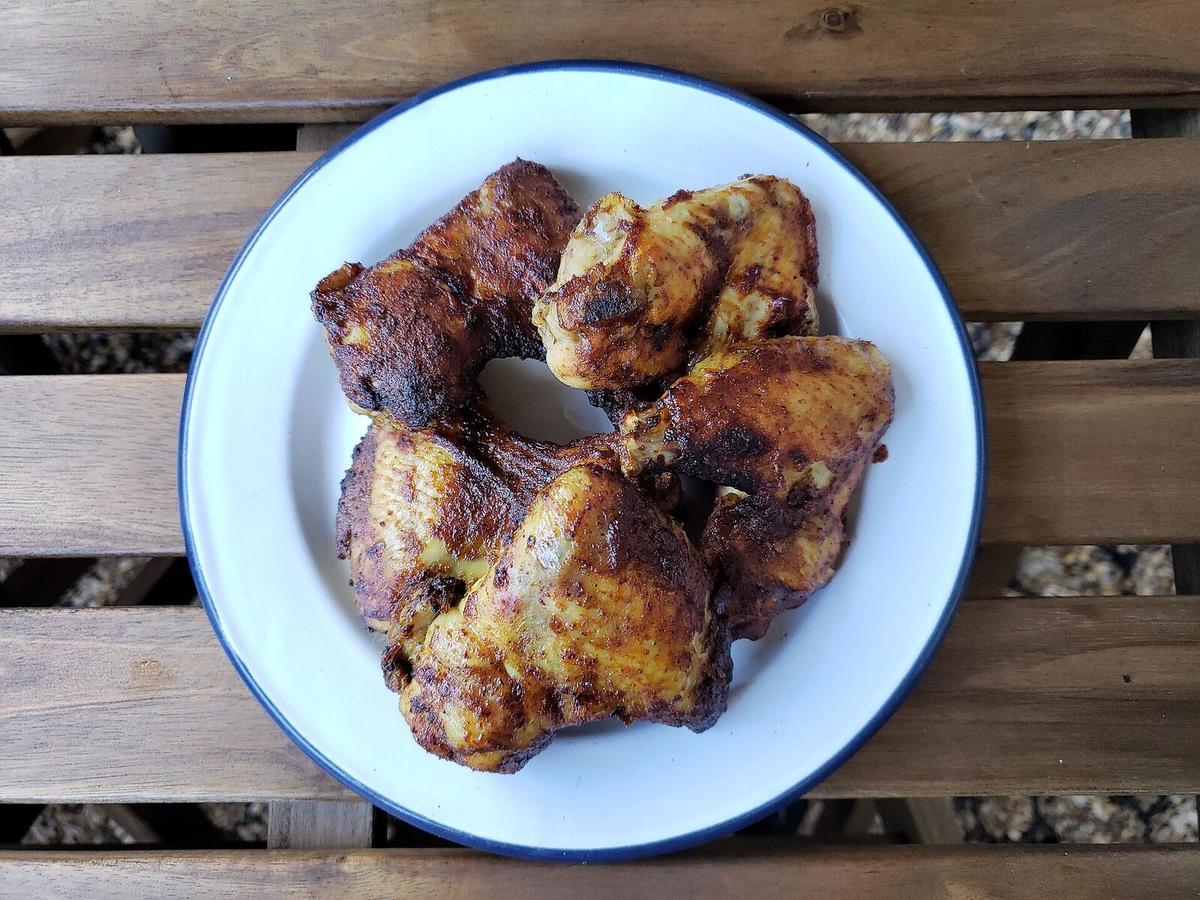 Air-fried chicken wings. The browning comes from hot moving air, with little or no added oil. Photo by Andy Li, CC0, via Wikimedia Commons.
How does an air fryer work?
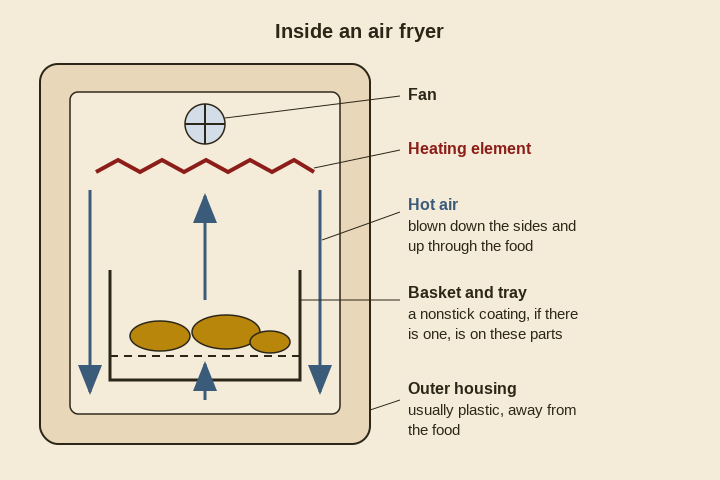 The parts that touch your food are the basket and tray. That is where the coating question lives.
Three parts matter for this article. The heating element is the hottest thing in the machine. The basket and tray touch the food, and on most models they are coated so that food releases easily. The outer shell, handle and controls are usually plastic and sit outside the cooking chamber.
So there are two separate questions. Is the coating a problem? And does cooking this way do anything bad to the food?
What are PTFE and PFAS, in plain words?
PFAS stands for per- and polyfluoroalkyl substances. It is a large family of manufactured chemicals built on bonds between carbon and fluorine. The US Environmental Protection Agency (EPA) describes them as "widely used, long lasting chemicals" whose components break down very slowly, and says they turn up in water, air, fish and soil around the world. Its wording on health is careful: exposure to some PFAS "may be linked to harmful health effects in humans and animals."
PTFE, short for polytetrafluoroethylene, is the slippery plastic on most nonstick pans and baskets. It is a member of the PFAS family, but an unusual one. It is a polymer: very long molecules locked into a solid. The PFAS that have caused the most concern, such as PFOA, are much smaller molecules, the kind that can move into water and food.
PFOA is worth a paragraph because its name is on so many boxes. It was once used as a processing aid in making PTFE. In 2006 the EPA asked eight major manufacturers to cut PFOA emissions and product content by 95% by 2010 and eliminate it by 2015, and the agency reports that all eight say they met those goals. In November 2023 the International Agency for Research on Cancer classified PFOA as carcinogenic to humans. A 2017 review in a pollution research journal points out that the replacement chemicals are less studied and are suspected of similar problems.
What do regulators say about nonstick coatings today?
The US Food and Drug Administration (FDA) permits PTFE-type coatings on cookware. Its page on PFAS in food contact uses, current as of January 2025, explains the reasoning. The coating is made by joining PFAS molecules into large ones and bonding that layer to the metal at high heat, a process that drives off nearly all of the small molecules that could move into food. In the agency's words, "Studies show negligible amounts of PFAS in this coating can migrate to food."
The FDA sees a different picture for grease-proof paper wrappers, where PFAS could reach food, and those products are no longer sold in the US market.
Some US states have gone further and restricted the whole chemical family in consumer products.
| Place | What the law does | Status as read on 12 November 2026 |
|---|---|---|
| Minnesota | Bans the sale of cookware with intentionally added PFAS | In force since 1 January 2025 |
| Colorado | Requires cookware labels to disclose intentionally added PFAS, and limits "PFAS free" claims | Applies from 1 January 2024 under a 2022 law |
| California | A bill to ban PFAS cookware from 2030 passed the legislature | Vetoed on 13 October 2025. The governor cited the effect on affordable cooking products |
So the regulators are not in conflict about food safety. The federal food agency says the amount reaching food is negligible. Some states are restricting the whole chemical family anyway, and the EPA's description of PFAS as long lasting explains the motive.
When do fumes become a real hazard?
When the coating is badly overheated. PTFE is stable at cooking temperatures and starts to break down when it gets much hotter. A 1993 review in an occupational medicine journal put the danger zone above 350 to 400°C, which is 662 to 752°F. Breathing the fumes can cause polymer fume fever: chills, fever and a cough that arrive a few hours later and feel like the flu. A 2015 toxicology review calls overheated nonstick cookware one of the more common ways people are exposed. A Japanese case report from 2012 describes a 29-year-old man who inhaled fumes from an overheated coated pan and recovered within two days in hospital.
Here is the arithmetic for your own kitchen. If the highest setting on your air fryer is 400°F, that is about 204°C. The fume threshold in the review is 350°C. The dial is set far below it. I found no independent measurements of how hot the coating itself gets next to the heating element, so treat that gap as reassurance and not as proof. An empty basket left running, or a coated part touching the element, is the situation to avoid.
Birds are another matter. Their breathing systems are far more efficient than ours, and fumes that give a person a short fever can kill a bird quickly. In a 1982 veterinary experiment, 32 budgerigars were exposed to fumes from overheated PTFE cookware or plain aluminum pans. The PTFE fumes caused acute breathing distress and rapid death in many of the birds. A 2012 report describes 60 of 65 newly hatched chicks dying in a research facility where heat lamp bulbs turned out to be PTFE coated.
For example, take two homes. In the first, one person cooks fries twice a week in a coated basket in a ventilated kitchen. Nothing in the published evidence suggests a problem. In the second, a family keeps a cockatiel in a cage beside the counter. For that household I would choose an uncoated basket or move the bird to another room with the door shut, every time. That is my rule, and the veterinary reports are the reason for it.
If you feel ill after breathing fumes from any overheated pan, or have a lung condition that makes this a worry, talk to your own clinician.
What about scratches, plastic parts and that new smell?
Scratches. A 2022 study in Science of the Total Environment used laser imaging on scratched nonstick pots and estimated that thousands to millions of tiny PTFE particles might be released during a simulated cooking session. That sounds alarming, and the honest position is that nobody knows what it means for health. The 2017 review says the fate of swallowed PTFE particles in the body is "not understood." PTFE is chemically inert, which is a reason for calm, and unproven is not the same as safe. A flaking basket has also stopped doing its job, so replacing it costs you nothing in the argument.
Plastic housing. The shell is outside the cooking chamber and does not touch food. I could not find a published study measuring what air fryer housings release in normal use, so there is no figure to give you in either direction.
New-appliance smell. I found no study of this either. Follow the first-use steps in your manual, which usually means washing the basket and running the machine briefly, and do it with a window open. A smell that persists, or any smell of burning plastic, is a reason to stop and contact the maker.
What is acrylamide, and should it worry you?
This one has nothing to do with coatings. Acrylamide is a chemical that forms in the food. The FDA explains that it comes from a natural reaction between sugars and an amino acid called asparagine in plant foods during high-temperature cooking such as frying, roasting and baking. Potatoes and grain foods are the main sources. Boiling does not produce it.
Is it dangerous? In animals, at very high doses, it causes cancer. In people, the evidence is unsettled. The European Food Safety Authority concluded in 2015 that acrylamide in food "potentially increases the risk of developing cancer for consumers in all age groups," while noting that human studies gave limited and inconsistent evidence. The FDA says "it's not clear exactly what risk acrylamide poses to humans." Both agencies publish advice on keeping it down.
Does an air fryer make more or less of it than a deep fryer? The studies disagree.
- A 2015 study at 180°C found air-fried potatoes had about 90% less acrylamide than deep-fried ones.
- A 2023 study found the highest average in air-fried potatoes (12.19 micrograms per kg, against 8.94 for deep frying and 7.43 for oven frying), but the differences were not statistically significant.
- A 2024 Korean survey of 184 air-fried foods found the most acrylamide in root and tuber crops.
My reading is that the appliance matters less than how brown you cook the food. The FDA's advice works in any machine:
- Cook fries and potato slices to a golden yellow, not brown.
- Soak raw potato slices in water for 15 to 30 minutes, then drain and blot them dry.
- Store potatoes in a cool, dark cupboard. Keeping them in the refrigerator can increase acrylamide during cooking.
- Toast bread to light brown.
What do "PFOA free" and "PFAS free" on the box mean?
| Label | What it tells you | What it does not tell you |
|---|---|---|
| PFOA free | That one chemical was not used | Whether the coating is PTFE. Major makers phased PFOA out by 2015, so nearly every new pan can say this |
| PTFE free | The coating is not the classic nonstick plastic | What the coating is, or how long it lasts |
| PFAS free | No chemical from the whole family was intentionally added | Little, unless a law backs it. Colorado allows the claim only when no individual PFAS was intentionally added |
| Ceramic | A mineral-based nonstick layer, sold as free of PTFE | How durable it is. Judge it by the warranty and by reviews of wear, not by the word |
A basket labeled "PFOA free" can be, and usually is, PTFE. That is not a trick so much as a claim that stopped meaning much a decade ago.
If you would sooner skip coatings altogether, there are three plain options. Stainless steel baskets and racks have no coating to wear out, and food sticks more unless you oil it lightly. Glass-bowl air fryers let you see the food and have a glass cooking chamber. Ceramic-coated baskets avoid PTFE, with the question mark over lifespan noted above. I am not going to name models. Look for the material of the basket in the specifications, a stated maximum temperature, and replacement baskets sold separately.
A short checklist
- Follow the manual's first-use steps with a window open.
- Never run a coated basket empty at full heat, and keep the kitchen ventilated while you cook.
- Use wood or silicone tools, wash by hand with a soft sponge, and replace a basket that is flaking.
- Cook starchy food to golden, soak cut potatoes first, and keep potatoes out of the refrigerator.
- If you keep birds, use uncoated cookware or keep the bird in another room.
What to remember
- An air fryer is a small fan oven. The coating question applies to the basket and tray.
- The FDA says negligible amounts of PFAS move from a nonstick coating into food.
- PTFE fumes are a hazard only when the coating is badly overheated, above about 350°C. For pet birds the danger is real and fast.
- Scratched coatings shed particles. Whether that harms people is unknown.
- Acrylamide depends mostly on how brown the food gets, in any appliance.
- "PFOA free" says very little. Minnesota bans PFAS cookware, and Colorado requires it to be labeled.
On the evidence available today, an air fryer used as intended is a low-risk way to cook. If the uncertainty about coatings still bothers you, a stainless steel or glass model removes the question for the price of a little more scrubbing.