Articles & BlogBy Trapper W. Brown10 min read
For anyone who has seen tyrosine on a supplement label and wondered whether it does anything. By the end you will know what the human trials found, how small they were, and what nobody has tested.
L-tyrosine is an amino acid, one of the building blocks of protein. You eat it every day in chicken, cheese, eggs and beans, and your body can also make it. N-acetyl L-tyrosine, often shortened to NALT, is the same molecule with a small chemical group attached, sold as a form that dissolves more easily in water.
It matters because of what the body builds from it. Tyrosine is the raw material for dopamine and norepinephrine, two of the brain's chemical messengers, and for thyroid hormones. That has led to a simple sales pitch: more raw material, sharper thinking. The trials tell a narrower story. Tyrosine seems to help a little when a person is under real strain, and to do little or nothing when they are rested.
One note before going on. NALT is not NAC. N-acetylcysteine is a different supplement, built on a different amino acid, with different uses.
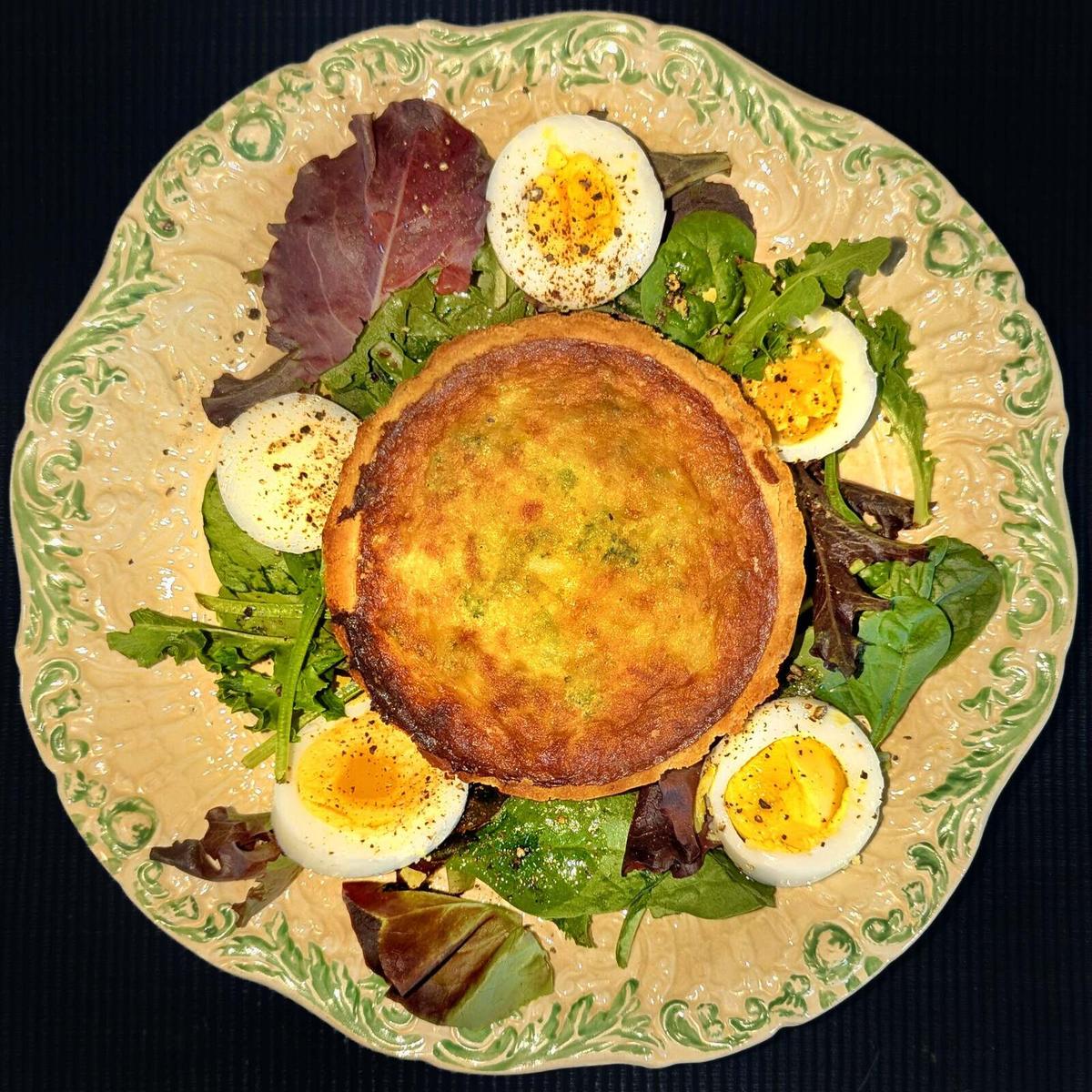 Eggs and cheese are ordinary sources of tyrosine. Most people get it from meals like this one. Photo by Daderot, CC0, via Wikimedia Commons.
What is tyrosine, and what does the body make from it?
Your body gets tyrosine in two ways. It takes it from the protein you eat, and it makes it from phenylalanine, another amino acid. MedlinePlus, the consumer health site of the US National Library of Medicine, describes an enzyme called phenylalanine hydroxylase that does this conversion. The same page says tyrosine is used to make several hormones, the skin and hair pigment melanin, and neurotransmitters, the chemicals that carry signals between nerve cells.
The neurotransmitter route runs in a line. An enzyme called tyrosine hydroxylase turns tyrosine into L-DOPA. L-DOPA becomes dopamine. Dopamine can then become norepinephrine and epinephrine (adrenaline). MedlinePlus groups these three as catecholamines and notes that they are released in response to physical or emotional stress.
Thyroid hormones start from tyrosine too. A 2019 review in Nature Reviews Endocrinology describes how iodine is attached to tyrosine units inside a large thyroid protein, and how pairs of those units are joined to form the hormones T4 and T3.
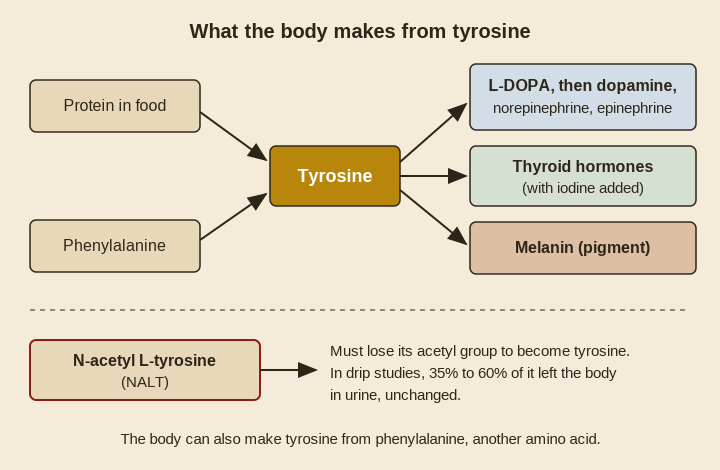 Tyrosine is a starting material. NALT has to be turned back into tyrosine before it can be used.
The idea behind the supplement is that hard stress uses up catecholamines faster than the brain can replace them, and that extra tyrosine keeps the supply line full. That is a reasonable idea. Whether it works in people is a question only trials can answer.
What did the trials under stress find?
Most of the research came from military laboratories, for an obvious reason: soldiers are asked to think clearly while cold, tired and overloaded. The studies are small, and nearly all gave one large dose and tested people a few hours later.
| Study | Who and how | What it found |
|---|---|---|
| Banderet and Lieberman, 1989 | US Army lab. Double-blind crossover, 100 mg per kg, 4.5 hours of cold and thin air | Fewer symptoms, less bad mood and less loss of performance, in those who reacted most to the conditions |
| Shurtleff and colleagues, 1994 | 8 men, 150 mg per kg or placebo, at 4°C or 22°C | Cold hurt a memory task. Tyrosine brought it back to the warm-room level. No effect in the warm room |
| Neri and colleagues, 1995 | US Navy lab. Awake more than 24 hours, half given 150 mg per kg, half placebo | Smaller decline on a tracking task and fewer lapses of attention, lasting about 3 hours |
| Deijen and colleagues, 1999 | 21 Dutch cadets in a combat course. 10 got a drink with 2 g tyrosine five times a day, 11 a carbohydrate drink | Better on a memory task and a tracking task after six days. No effect on mood |
| Thomas and colleagues, 1999 | 10 men and 10 women, 150 mg per kg or placebo | Better working memory when four tasks ran at once. No change on a simple two-task battery |
| Mahoney and colleagues, 2007 | 19 volunteers, each tested in cold water with and without tyrosine, 300 mg per kg in total | Cold lowered memory scores. Tyrosine raised the number of correct answers |
Two university studies from Leiden point the same way without the cold. In 2013, 22 female students did better on a hard version of a memory test after tyrosine, and no better on the easy version. In 2015, 22 adults switched between tasks with less lost time after tyrosine than after placebo.
Put together, the pattern is consistent. A systematic review from the University of Groningen in the Netherlands in 2015 covered 15 studies and concluded that a single load of tyrosine counteracts drops in working memory and information processing caused by demanding conditions. A second review that year, from Leiden, concluded that tyrosine helps "only when neurotransmitter function is intact" and dopamine or norepinephrine is temporarily run down.
To give a sense of scale: 150 mg per kg for a person who weighs 70 kg (154 pounds) is 10.5 grams in one sitting. That is a research dose given under supervision. It is a description of what was tested and nothing more.
What did the trials not find?
Read the right-hand column of the table again and look for the limits. Tyrosine did nothing for memory in the warm room. It did nothing on the simple task battery. It did nothing on the easy version of the memory test. Where there was no strain, there was no benefit.
For example, picture two people who take the same dose. One is a rested student reading at a desk. The other is a soldier at the end of a night without sleep, in the cold. The trials suggest the soldier might hold on to a little more working memory for a few hours. They give no reason to think the student gains anything.
The same reviews found little support in two other areas. Most studies of exercise performance showed no effect. And the Leiden review judged the potential for treating clinical disorders to be limited.
There are bigger gaps. Almost every study tested a single dose on a single day. The Groningen reviewers asked for trials in larger groups over several weeks, and I could not find one that settles the matter. Nobody knows whether daily use keeps working, stops working, or carries costs that a one-day study cannot see.
Does it work the same in older adults?
No, and this is the part that surprised the researchers.
In a 2017 Dutch trial, 17 adults aged 60 to 75 each took 100, 150 and 200 mg per kg on separate days. Their blood tyrosine rose higher than it did in 17 young adults given the same dose. Their working memory got worse as the dose went up, and worst in those whose blood levels rose most.
A 2018 brain imaging study of 24 healthy adults aged 61 to 72 found no overall change in two kinds of self-control after tyrosine. When age was taken into account, the older the person, the more tyrosine hurt one of the measures.
Two small studies are not the last word. They are enough to say that results in 20-year-old cadets should not be assumed to carry over to a 70-year-old.
Is the N-acetyl form better absorbed?
The evidence says it is not a better source of tyrosine, and the claim that it is rests on very little.
NALT was developed for intravenous feeding, where its ability to dissolve is useful. That is also where it was tested in people. In 1989, Swedish researchers gave 11 healthy volunteers 5 grams by drip over four hours. Blood tyrosine rose by 25%, and 56% of the dose came out in the urine unchanged. They wrote that its usefulness as a precursor in humans "is not apparent." A 1991 Austrian study in seven healthy people found that blood tyrosine did not rise at all and about 60% was excreted. A 2003 Canadian study of 13 adults on intravenous nutrition put the loss at about 35%.
All of that is by drip. For capsules, I found no human trial comparing NALT with plain L-tyrosine for blood levels or for thinking. The nearest thing is a 1989 mouse study that compared several modified forms of tyrosine and reported NALT as the least effective at raising tyrosine in the brain.
So every stress trial in the table used plain L-tyrosine, and the human data on NALT show a good share of it leaving the body unused. As a rule of thumb, a label that presents NALT as the more absorbable form is making a claim the published studies do not support.
Where is tyrosine in food?
Anywhere there is protein. These figures are from USDA FoodData Central, per 100 grams of food.
| Food | Tyrosine per 100 g |
|---|---|
| Parmesan cheese, hard | 2.0 g |
| Soybeans, dry roasted | 1.5 g |
| Pumpkin seed kernels, dried | 1.09 g |
| Chicken breast, roasted | 0.98 g |
| Egg, whole, raw | 0.5 g |
A 150 gram portion of roasted chicken breast (about 5 ounces) holds roughly 1.5 grams of tyrosine. A household that eats meat, dairy, eggs, beans or nuts most days is getting several grams a day between them without trying, and the body can make more from phenylalanine.
Who should be careful?
Talk to your own clinician before starting tyrosine or any supplement, above all if you take a prescription medicine or have a long-term condition. Four groups have particular reason to ask first.
- People taking MAO inhibitors. These are a class of antidepressant. The US prescribing information for phenelzine says patients should not take L-tyrosine or phenylalanine, in the same sentence that rules out dopamine and L-dopa, because of the risk of a dangerous spike in blood pressure.
- People taking levodopa. The label for carbidopa and levodopa, a Parkinson's medicine, says levodopa competes with certain amino acids for transport across the gut wall. Tyrosine is an amino acid of the kind that could compete.
- People with thyroid conditions. Tyrosine is a building block of thyroid hormone. I found no human trial showing that supplements cause harm in thyroid disease, and none showing they are safe. That is a question for whoever manages the condition.
- People with PKU. Phenylketonuria is an inherited disorder, found in about 1 in 25,000 newborns in the United States according to MedlinePlus, in which the enzyme that turns phenylalanine into tyrosine does not work properly. Diet in PKU is managed by a specialist team, and tyrosine is part of that plan. It is not a matter for self-treatment.
Older adults belong on the list too, for the reasons above. I found no trial in pregnant women or in children.
How do you read the label?
In the United States, the Food and Drug Administration says it "does not have the authority to approve dietary supplements before they are marketed." The maker is responsible for safety and for the label. That shapes what you will see.
- The claim. A supplement may say it "supports focus." It may not claim to diagnose, treat, cure or prevent a disease. A claim of the first kind must carry the line that begins "This statement has not been evaluated by the Food and Drug Administration."
- The form. The Supplement Facts panel names each ingredient. Check whether it says L-tyrosine or N-acetyl L-tyrosine. They are not interchangeable, and the trials used the first.
- The amount. Compare the milligrams per serving with what the studies gave. A capsule and a 10 gram research dose are far apart, and no trial shows that small daily amounts sharpen a rested mind.
- Blends. When an ingredient sits inside a "proprietary blend," the FDA's rules do not require the label to give its individual amount. You cannot judge a dose you cannot see.
Watch out
Do not add tyrosine on top of an MAO inhibitor or levodopa on your own. Both drug labels describe an interaction, and the first one describes a dangerous rise in blood pressure.
What to remember
- Tyrosine is an amino acid from ordinary protein. The body turns it into dopamine, norepinephrine, epinephrine, thyroid hormones and melanin.
- Small trials, mostly military, found that one large dose helped working memory for a few hours under cold, lost sleep or heavy multitasking.
- The same trials found no benefit in rested people doing easy tasks.
- In adults over 60, two small studies found no gain, and higher doses made memory scores worse.
- NALT has not been shown to be a better source. In drip studies, 35% to 60% of it was excreted unchanged.
- MAO inhibitors, levodopa, thyroid conditions and PKU are all reasons to ask a clinician first.
The evidence for tyrosine is real and small: a short-lived effect, in young adults, under conditions most people would pay to avoid. A plate with eggs or chicken on it supplies the same molecule.