Articles & BlogBy Trapper W. Brown7 min read
Security+ SY0-701, Objective 1.1: Compare and contrast the different kinds of security control
What do a door lock, a firewall rule and a page in the employee handbook have in common? All three are security controls. A control is anything you put in place to lower a risk: a device, a setting, a rule, a habit, or a person standing at a gate.
The first objective on the Security+ exam asks you to sort controls two ways. One sort asks who or what carries the control out. The other asks what the control does about a threat. Every control gets an answer to both questions, and once you see that, the objective turns into a grid you can fill in from memory.
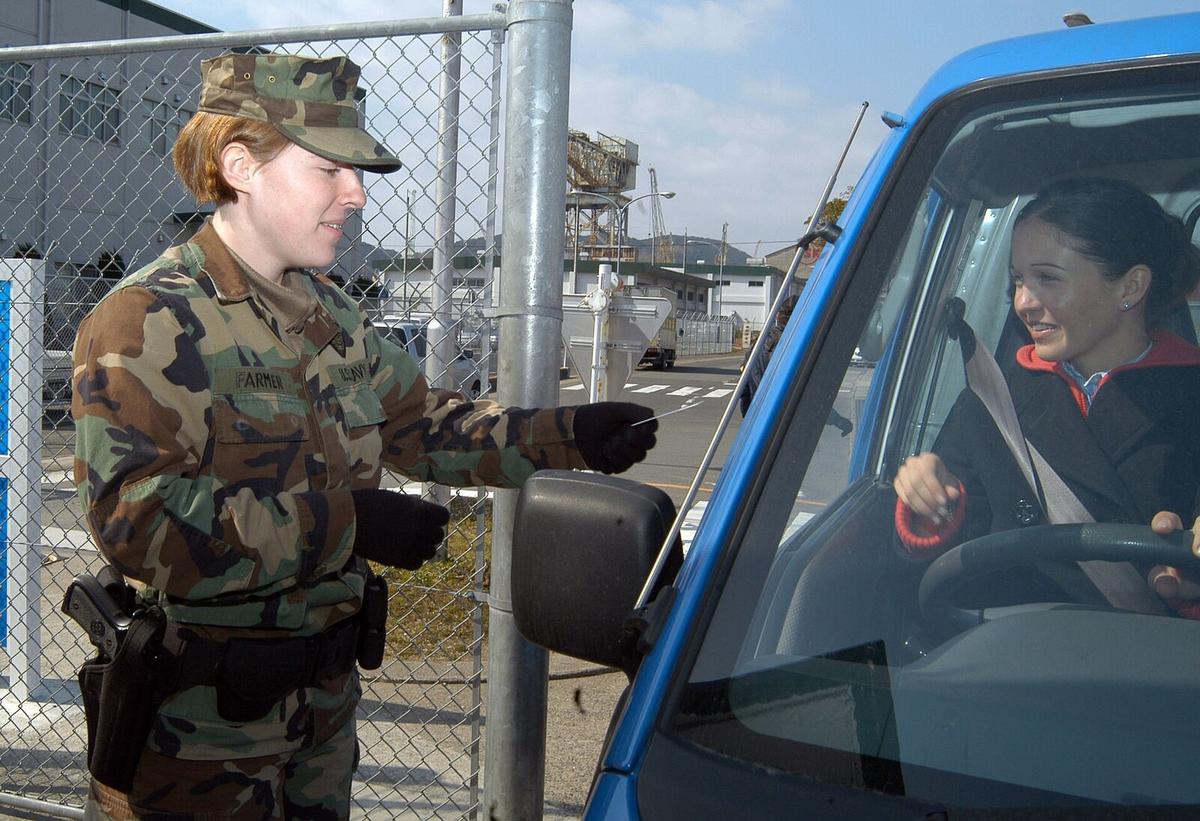 One gate, several controls: a person checking identification, a fence, and a presence anyone can see from the road. Photo by U.S. Navy, Photographer's Mate 3rd Class Yesenia Rosas, public domain, via Wikimedia Commons.
I think this is the right place for the exam to start. Beginners tend to picture security as a pile of products. The grid makes you ask a better question about each one: what job is this doing, and which jobs is nobody doing?
Four categories: who or what does the work?
A category describes how a control is carried out. There are four.
Technical controls are done by hardware or software. A firewall, disk encryption, antivirus and the login prompt itself all belong here. Some older books call them logical controls.
Managerial controls are decisions and oversight. Think of risk assessments, written policies, security plans and vendor reviews. They set direction for everything else.
Operational controls are carried out by people as part of daily work. Awareness training, a guard's rounds, a technician checking last night's backups and the steps of incident response are all operational.
Physical controls are things you can touch that limit or watch a space: locks, fences, badge readers, cameras, lighting.
| Category | Carried out by | Clinic example |
|---|---|---|
| Technical | Hardware and software | Screen lock after five idle minutes |
| Managerial | Leadership, on paper | Yearly risk assessment |
| Operational | People, day to day | Front desk staff verify a caller before resetting a password |
| Physical | Barriers and devices in the building | Locked door on the server closet |
The categories lean on each other. A policy (managerial) says visitors must be escorted. A receptionist (operational) does the escorting. A badge reader (physical) keeps the inner door shut, and the software behind it (technical) decides which badges open it. Take one away and the others get weaker. A badge system with no policy on who should get a badge hands out access by habit, and a policy with no badge system is a wish.
The pair that trips people up is managerial and operational. Here is how I keep them apart: managerial is deciding, operational is doing. The policy that says every new hire gets security training in the first week is managerial. The training session on Tuesday morning is operational.
Six types: what does it do about the threat?
A type describes the control's job. It helps to think about time: before an incident, during it, and after it.
| Type | Its job | Example |
|---|---|---|
| Preventive | Stops the incident from happening | A locked door, a firewall rule |
| Deterrent | Makes someone decide not to try | A warning sign, a visible camera |
| Detective | Notices and records what happened | Log review, a motion alarm |
| Corrective | Repairs the damage and returns things to normal | Restoring from backup |
| Compensating | Stands in when the usual control cannot be used | Isolating a device that cannot be patched |
| Directive | Tells people what they must do | An acceptable use policy |
Preventive, deterrent and directive controls work before anything goes wrong. A deterrent does not physically stop anyone. It changes the math in a person's head, and a determined intruder walks right past it. A directive control depends on people choosing to follow it, which is why it is usually paired with something that checks.
Detective controls work during and after. They stop nothing on their own. Their value is time: the sooner you know, the less you lose. Corrective controls come last and limit the damage.
Tip
Read the verb in the question. Stops or blocks means preventive. Discourages means deterrent. Identifies, records or alerts means detective. Restores or repairs means corrective. Substitutes means compensating. Instructs or requires means directive.
One control, two labels
Here is the part the exam cares about most. A control is never only "physical" or only "preventive". It carries one label from each list.
| Control | Category | Type |
|---|---|---|
| Firewall rule that blocks inbound traffic | Technical | Preventive |
| Login banner that says activity is monitored | Technical | Deterrent |
| Alert when an account fails to log in ten times | Technical | Detective |
| Acceptable use policy | Managerial | Directive |
| Quarterly review of who has access to what | Managerial | Detective |
| Guard checking IDs at the entrance | Operational | Preventive |
| Staff restoring files after an outage | Operational | Corrective |
| Fence around the parking lot | Physical | Preventive |
| "Authorized personnel only" sign | Physical | Directive |
| Fire extinguisher | Physical | Corrective |
Look at the photo above with that table in mind. The person checking the card is an operational control doing a preventive job. The chain-link fence behind her is physical and preventive. Her being visible from the road is a deterrent, and if she writes each visitor in a log, that log is detective.
You can run the same exercise on backups. The software that copies files every night is technical. The rule that says backups are kept for 90 days is managerial. The technician who tests a restore each month is operational, and the locked cabinet holding the offline copy is physical. All four exist to support one corrective job: getting the data back.
The photo also shows something else. One control can do more than one job. A camera that people can see deters. The recording it makes detects. On the exam, pick the type that matches what the scenario says the control is doing, and ignore everything else it could possibly do.
Watch out
The most common mistake is mixing the two lists. "Physical" is not a type and "preventive" is not a category. If a question asks for the category, cross out every answer that names a type before you think any further.
When the right control is not available
What do you do when the correct control cannot be used? You compensate.
Say a small clinic has a lab analyzer attached to a workstation running an operating system the manufacturer no longer updates. Patching is the normal preventive control, and here it is off the table. So the clinic puts the workstation on its own network segment, blocks it from the internet, lets it talk only to the lab system, and reviews its logs every week. None of those is the control you wanted. Together they cover most of the same risk. That is a compensating control.
A large hospital system has the same problem multiplied by 400 devices. It needs everything the clinic did plus a managerial control: a written exception for each class of device, with an owner and a review date, so that "temporary" does not quietly become ten years.
Use the grid to find gaps
The two lists are more than exam vocabulary. Sort your own controls by type and the weak spots show up fast.
Suppose the clinic lists its 20 controls and counts them.
| Preventive | 11 |
|---|---|
| Directive | 3 |
| Deterrent | 2 |
| Detective | 2 |
| Corrective | 2 |
| Compensating | 0 |
Source: Worked example in this article
Eleven of the 20 try to keep trouble out. Only two would tell anyone that trouble got in, and only two help the clinic recover. That is a risky shape, because no preventive control works every time. The next dollar here should probably go to detection or recovery before it goes to a twelfth lock.
Sort the same list by category and you learn something else. A clinic whose controls are nearly all technical is betting that its people will never be the way in. Verizon's Data Breach Investigations Report, 2026 edition, found the human element present in 62 percent of breaches. Training, procedures and clear policy are the controls aimed at that 62 percent, and none of them comes in a box.
What to remember
- A control is anything that lowers a risk.
- Four categories say how it is carried out: technical, managerial, operational, physical.
- Six types say what job it does: preventive, deterrent, detective, corrective, compensating, directive.
- Every control has one category and at least one type.
- Managerial is deciding. Operational is doing.
- A compensating control is a stand-in, and it should come with an owner and a review date.
If you keep one picture from this objective, make it the grid: four rows, six columns, and your own controls written into the squares. The empty squares are where to look next.