Articles & BlogBy Trapper W. Brown10 min readCurrent to 12 November 2026
Critical infrastructure is the short list of systems a country cannot run without: power, water, communications, hospitals, food, transport and a few more. For most of the last century these systems changed slowly. Utilities are now adding millions of connected devices, batteries the size of warehouses, private cellular networks and software that predicts when a pump will fail.
Why should you care? Because each new technology is there for a good reason, and each one also adds a new way for things to go wrong. You are also, more and more, part of the system. If you have solar panels on the roof or a smart meter on the wall, a piece of the grid lives at your house.
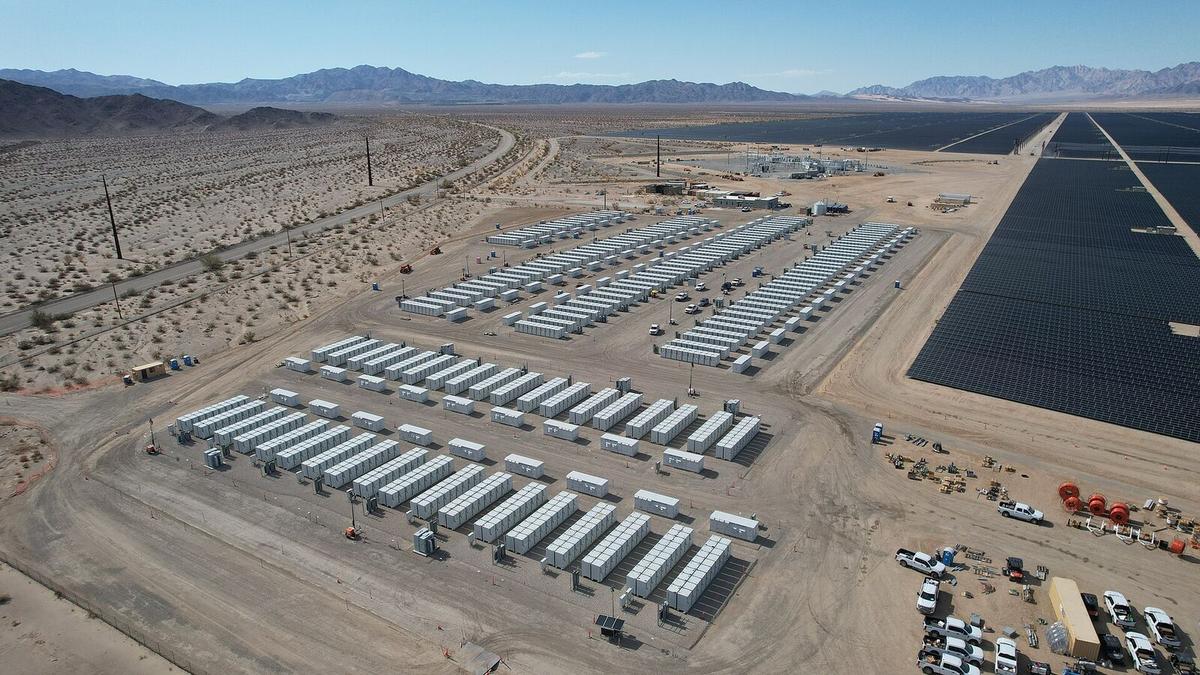 Grid batteries beside a solar farm and its substation in Riverside County, California: three of the technologies in this guide in one frame. Photo by the Bureau of Land Management California, public domain, via Wikimedia Commons.
What counts as critical infrastructure?
In the United States the answer is a list. The Cybersecurity and Infrastructure Security Agency (CISA) names 16 sectors whose assets, systems and networks are considered so vital that losing them would have a debilitating effect on security, the economy or public health and safety.
The 16 are: chemical; commercial facilities; communications; critical manufacturing; dams; the defense industrial base; emergency services; energy; financial services; food and agriculture; government services and facilities; healthcare and public health; information technology; nuclear reactors, materials and waste; transportation systems; and water and wastewater systems.
The policy behind the list is a National Security Memorandum on critical infrastructure security and resilience, published by the White House on 30 April 2024 and often called NSM-22. CISA says it reaffirmed the 16 sectors and assigned a federal agency to manage risk in each. As of 12 November 2026 the list is unchanged, though it is under review: an executive order of March 2025 called for a review of the memorandum, and the Congressional Research Service reported in March 2026 that NSM-22 was still the current guidance.
This guide stays mostly with energy and water, because everything else leans on them. The computers that run them are explained in the companion article What SCADA Systems Are and How They Are Vulnerable. This one is about what is being bolted on.
What is changing on the electric grid?
The old grid was a one-way street. Large power plants pushed electricity out to customers, and the utility owned nearly every device that mattered. The new grid is a two-way street with far more drivers.
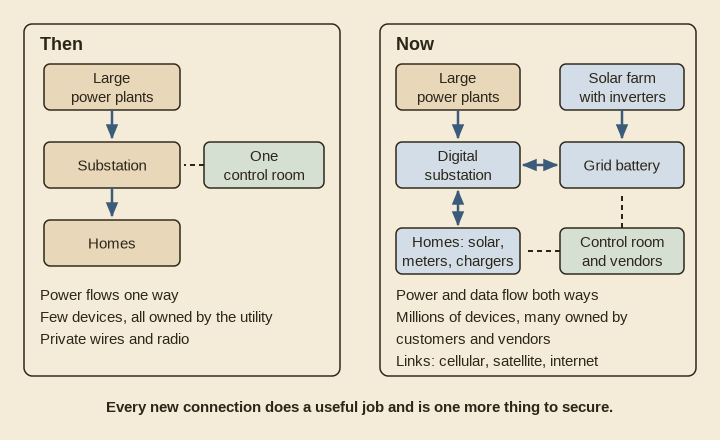 The grid used to be a few big machines on private wires. It is becoming millions of small ones on shared networks.
Smart meters. Advanced metering infrastructure (AMI) is a meter that reports your use to the utility over a network and can take commands back. The Energy Information Administration (EIA) counted about 119 million of them in the United States in 2022, about 72% of all electric meters. They end meter-reading visits and spot outages quickly. There are two new risks. The data shows when a home is occupied, which is a privacy matter. And many meters can switch a home's power off remotely, a convenience that in the wrong hands could turn off many homes at once.
Distributed energy and inverters. Solar panels and batteries make direct current. The grid runs on alternating current. The box that converts one to the other is an inverter, and anything connected through one is called an inverter-based resource. Old power plants are huge spinning machines whose physical weight steadies the grid. Inverters are software, and they do what their settings say. According to Texas RE, a regional arm of the North American Electric Reliability Corporation (NERC), the Federal Energy Regulatory Commission (FERC) issued an order in October 2023 directing NERC to write new reliability standards for these resources. The first three were approved by July 2025 and another package in February 2026. The security worry follows from the engineering one: thousands of identical devices, updated over the internet by their makers, all obeying the same settings.
Grid-scale batteries. The EIA reports that US utility-scale battery capacity grew by an average of 70% a year over the last three years, from 43.6 gigawatts at the end of 2025 to nearly 52 gigawatts by the middle of 2026, with about 54 gigawatts more planned over the following two and a half years. Each site has its own control software, its own fire safety system and its own remote link to a vendor.
Digital substations. A substation is where voltage is stepped up or down and where circuit breakers live. In an older one, each protective device is wired by hand with copper. In a digital one, small computers that NIST calls intelligent electronic devices watch the equipment and talk to one another over an Ethernet network inside the fence. That means the substation is now a computer network, with everything that comes with one.
How are sites being connected?
Remote pump stations and solar farms need a link back to the control room. Two newer ways of providing one are arriving.
A private 5G network is a cellular network the utility runs for itself. It carries far more data than old radio. CISA's general caution about 5G applies: the technology can increase the attack surface by introducing new vulnerabilities, and its supply chain can carry risk in with the equipment.
Satellite links reach places nothing else does. In March 2022, CISA and the FBI warned satellite communication providers and their customers that a successful intrusion into a provider's network could create risk for the customers connected to it. Their advice included adding your own encryption on top of whatever the provider supplies. When a control signal rides on somebody else's network, that network is part of your plant.
What are digital twins, AI and drones doing here?
A digital twin is a live software model of a real thing. NIST's 2025 report on the subject calls twins electronic representations of real-world entities. A water utility can use one to test what happens if a main breaks before it breaks. The risk is that the twin needs a constant feed from the real system, so it is one more connection out of the control network. A detailed model of a plant is also a handy map for an intruder.
AI for forecasting and predictive maintenance is the most useful and least dramatic use of machine learning in this field. For example, a model learns what a healthy pump's vibration looks like and flags the one that is drifting, weeks before it fails. In December 2025, CISA and Australia's cyber security agency, with partners in five other countries, published four principles for putting AI into operational technology. The guidance urges operators to keep monitoring, validating and refining their models. As a rule of thumb, an AI that advises an operator is a small risk, and an AI that operates a valve by itself is a large one.
Drones and robots now inspect power lines, dam faces, tanks and pipes, which keeps people off towers and out of confined spaces. The cost is that the drone photographs and maps sensitive sites, and the pictures go somewhere. In January 2024, CISA and the FBI published guidance on the risk that Chinese-manufactured drones pose to networks and sensitive information. The article Upcoming Drone Technology: What Is Arriving and What the Rules Say covers the aircraft themselves.
What about new kinds of plants?
Small modular reactors get a few lines here because they have their own article. The Nuclear Regulatory Commission describes them as light water reactors designed to be more compact and scalable, many of them with passive safety systems. Lazard's 2026 cost study notes that the projects it examined expect to start commercial operation in 2030 or later. The argument for and against nuclear is in Why Nuclear Power Is the Best Choice, and What the Real Risks Are.
Advanced water sensors are a quieter change. The Environmental Protection Agency (EPA) describes online water quality monitoring as instruments that measure water quality in real time in source waters and in the distribution pipes. They let a utility tune treatment and catch contamination early. Every sensor is also an input the control system trusts. A reading that has been tampered with can cause as much trouble as a tampered command.
Why does encryption become a long-term problem?
Most of this equipment protects its commands and software updates with public-key cryptography, the math behind the padlock in your browser. A large enough quantum computer would break that math. NIST's transition plan, made final in October 2026, says the older algorithms will be deprecated after 2030 and disallowed in its standards after 2035.
That sounds comfortable until you set it beside a maintenance schedule. NIST's own guide says industrial equipment often stays in service for 10 to 15 years and sometimes longer. A substation relay installed this year may still be working in 2040. If it cannot be upgraded, it will spend the back half of its life out of date. So post-quantum migration is a purchasing question today. The article Quantum Computing and the Risk to Encryption explains the science and the standards.
A small town water utility and a large electric utility
Take a water utility serving 4,000 people, one of more than 148,000 public water systems the EPA counts across the country. It has perhaps five employees, and none of them is a security specialist. It buys smart meters and a cloud dashboard as a package, set up by a contractor who keeps remote access for support. Federal law requires a community water system serving more than 3,300 people to complete a risk and resilience assessment and an emergency response plan, and to review them every five years. For this utility the main risk is plain: new technology arrives faster than anyone has time to configure it.
Now take an electric utility serving 3 million customers. It has a security team and NERC's enforceable reliability standards to meet. It runs digital substations, a private cellular network, thousands of inverters it does not own and battery sites run by other companies. Its problem is the opposite one: so many systems, vendors and connections that no one person can hold the whole picture.
| Small water utility | Large electric utility | |
|---|---|---|
| People | A handful, no security staff | Dedicated security and compliance teams |
| Main weakness | Defaults never changed, vendor left in charge | Too many systems and suppliers to track |
| Best first step | Use the help the EPA offers and a short checklist | Know every asset and every outside connection |
What can a resident reasonably do and ask?
At home, treat your own equipment as part of the grid, because it is. If you have solar, a home battery or a car charger, change the installer's default password, apply updates, and find out who else can control the device remotely. Keep some supplies for an outage. Ready.gov advises storing at least one gallon of water per person per day for several days.
In public, ask. Many small utilities answer to a town council or a board whose meetings are open. Fair questions include:
- Has our water system completed its risk and resilience assessment, and when was it last reviewed?
- Can any control system be reached directly from the internet?
- Which vendors have remote access, and who reviews it?
- If the computers failed tomorrow, could the staff run the plant by hand, and have they practiced?
- When we buy equipment meant to last 15 years, do we ask how it will be updated?
You do not need technical detail. You want to know whether somebody has thought about it.
What to remember
- Critical infrastructure in the United States means 16 named sectors. Energy and water hold up the rest.
- The grid is changing from a few large plants on private wires to millions of connected devices, many owned by customers and vendors.
- Each new technology solves a real problem and adds a connection to defend.
- Equipment bought now will outlast today's encryption, so the ability to update is worth asking about before the purchase.
- A resident's best tools are a changed password at home and a plain question at a public meeting.
None of these technologies is going back in the box, and most of them make the lights and the water more reliable on an ordinary day. For each one, find out who is responsible for it on a bad day.