Articles & BlogBy Trapper W. Brown6 min read
 Illustration generated for Warhawk Division.
Prices rose 0.4% in October 2026, according to the Bureau of Labor Statistics (BLS) report released on 10 November. That came after a 0.6% jump in September. Hours earlier, Federal Reserve Governor Christopher Waller said in a London speech that he leans toward raising interest rates at the Fed's December meeting. He added that if core inflation came in "around 0.3 percent or even higher," a bigger move "should be considered." Core inflation came in at 0.3%. This is an explainer, not investment advice.
What did the October report say?
The BLS measures inflation with the Consumer Price Index, or CPI. It is the price of a fixed basket of what households buy, including rent, groceries, gas, insurance and doctor visits, collected each month in 75 urban areas.
The release opens with this: "The Consumer Price Index for All Urban Consumers (CPI-U) increased 0.4 percent on a seasonally adjusted basis in October after rising 0.6 percent in September."
"Seasonally adjusted" means the BLS strips out the normal swings that happen every year at the same time, such as holiday sales and summer driving, so one month can be compared with the next.
Then there is "core" inflation, which leaves out food and energy because those two jump around the most. The BLS says core "rose 0.3 percent in October, as it did in September and August."
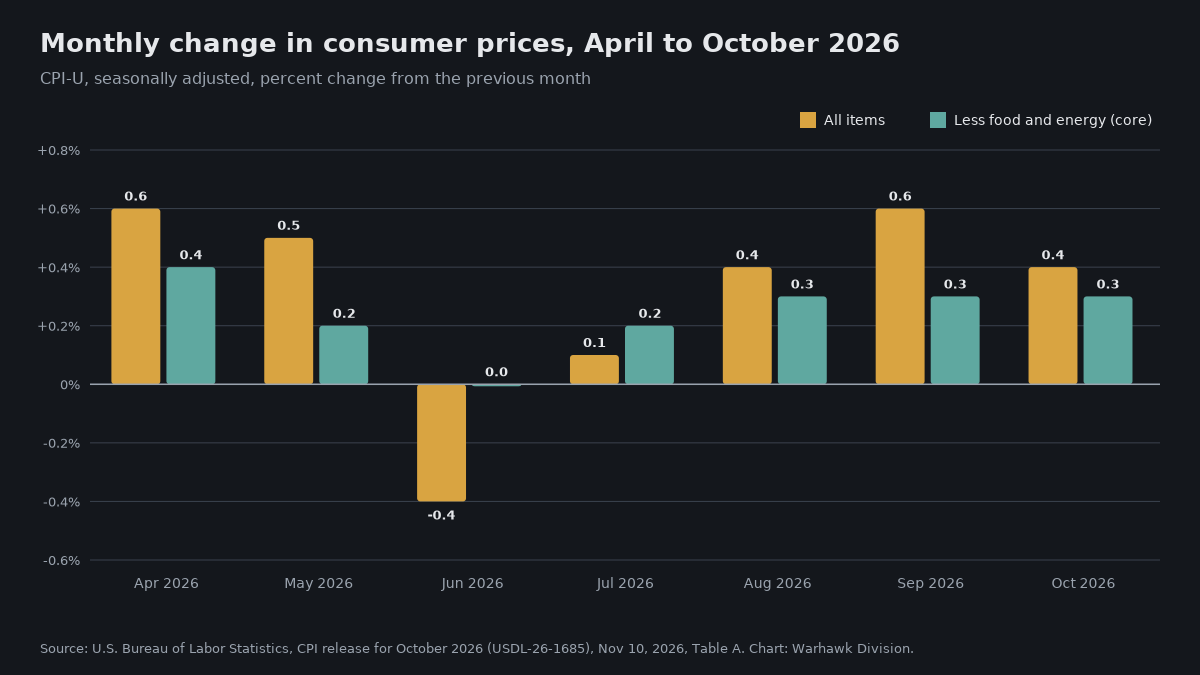 Monthly change in all items and core CPI, seasonally adjusted. Data: U.S. Bureau of Labor Statistics, CPI release for October 2026, 10 November 2026, Table A. Chart by Warhawk Division.
Where did prices go up?
The report breaks it down by category. For October:
- Shelter rose 0.3%. The BLS says it accounted "for over thirty percent of the monthly all items increase." Shelter is mostly rent and what the BLS calls owners' equivalent rent, an estimate of what homeowners would pay to rent their own home.
- Food rose 0.5%. Groceries rose 0.4% and restaurant meals 0.5%. Beef rose 0.9%, and snacks 1.0%.
- Energy rose 0.7%, after a 5.2% jump in September. Gasoline rose 1.0% seasonally adjusted. The BLS notes that "before seasonal adjustment, gasoline prices decreased 0.7 percent in October." Electricity rose 0.9%.
- Car insurance rose 0.7%, and recreation 0.8%.
- Hospital services rose 0.8%.
Two big categories fell. Used cars and trucks dropped 1.2%, and communication slipped 0.1%.
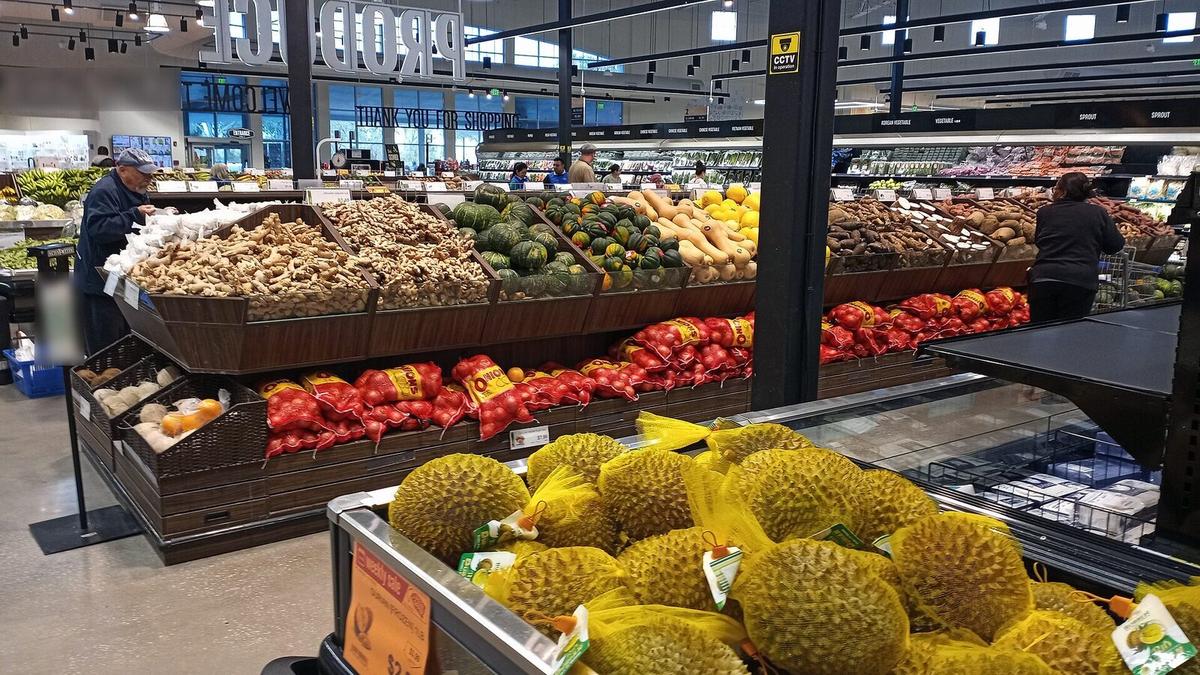 Groceries rose 0.4% in October, according to the BLS. Photo by MatthewHoobin, CC0, via Wikimedia Commons.
Why is there no year-over-year number?
This one surprised me. The headline most people look for is how much prices rose over 12 months, and this month the BLS did not publish it for most categories.
The reason is in a box at the top of the release: "BLS did not collect survey data for October 2025 because of a lapse in appropriations." A lapse in appropriations is a government shutdown. With no October 2025 numbers to compare against, the BLS says it "cannot publish 12-month percent changes for October 2026 for indexes where October 2025 data are unavailable."
A few categories do have a 12-month figure. Gasoline is up 37.4% from a year earlier, before seasonal adjustment. Used cars are down 3.3%, and new vehicles are up 0.7%.
What did Governor Waller say?
Waller spoke on 10 November 2026 at a conference in London, hours before the CPI report came out. He said so himself: "Inconveniently for today's event, we will get consumer price index (CPI) inflation for October in a few hours."
His view on the economy was mixed. He said "the U.S. economy is growing strongly," and that the unemployment rate "ticked down to 4.1 percent in October." On prices he was blunt: "Let's just say it. September's inflation data were bad. There was no silver lining."
Then he laid out his plan for December:
"Even if, as I expect, the monthly rate of inflation improves in October, I am leaning toward supporting an increase in our policy rate of 25 basis points at the FOMC's December meeting."
A basis point is one-hundredth of a percentage point, so 25 basis points is a quarter of a point. The FOMC, the Federal Open Market Committee, is the group at the Fed that sets interest rates.
He also named a trigger. If October core CPI was "around 0.3 percent or even higher," he said, "I believe a 50 basis point hike in the policy rate should be considered at the December meeting."
The BLS then reported core at 0.3%. His speech came before the number, and these were his views. His speech notes that they "are not necessarily those of my colleagues." One governor's lean is not a decision.
Where do rates stand now?
At its 27 to 28 October 2026 meeting, the FOMC held its target for the federal funds rate, the rate banks charge each other overnight, at 3.75% to 4%. The vote was 10 to 2. The statement says Lisa D. Cook and Beth M. Hammack "preferred to raise the target range for the federal funds rate by 1/4 percentage point at this meeting."
The statement also says "inflation remains elevated" and "the Committee will deliver price stability."
The next meeting is 8 to 9 December 2026. The November CPI report is scheduled for 10 December, the day after that meeting ends.
What to do
None of this is investment advice, and I will not tell anyone what to buy or sell. For a household budget, here is what the official numbers suggest is worth checking:
- Look at your biggest monthly lines first. Shelter, food, energy and car insurance are the categories the BLS says rose in October.
- Shop your car insurance. Motor vehicle insurance rose 0.7% in October. A quote comparison costs nothing but time.
- If you carry a credit card balance or a variable-rate loan, know your rate. The Fed's own statements show a rate increase is being discussed, and variable rates usually follow the Fed's rate.
- Watch the calendar. The Fed meets 8 to 9 December, and the BLS releases November CPI on 10 December.
The site's article "How to Manage Your Money When Everything Costs More" covers budgeting in more depth, and "The Cost of Home Energy Over the Last 50 Years" puts the energy numbers in context.
Where I land
- October's 0.4% was smaller than September's 0.6%, but core stayed at 0.3% for a third month.
- Shelter, food and energy did most of the work. Used cars were the main relief.
- One Fed governor said a 0.3% core reading could justify a larger hike. That is his view, and the committee has not decided.
- The shutdown left a hole in the data, so be skeptical of anyone quoting a precise 12-month rate for October.
Nobody knows what the Fed will do on 9 December, and I will not pretend to. What we do know is what was said on the record, and that is the useful part.
Sources (5)
- U.S. Bureau of Labor Statistics, "Consumer Price Index - October 2026" (USDL-26-1685), 10 November 2026: https://www.bls.gov/news.release/cpi.nr0.htm
- Governor Christopher J. Waller, "The Economic Outlook and Some Thoughts on Labor Market Dynamism," speech, 10 November 2026: https://www.federalreserve.gov/newsevents/speech/waller20261110a.htm
- Federal Reserve, "Federal Reserve issues FOMC statement," 28 October 2026: https://www.federalreserve.gov/newsevents/pressreleases/monetary20261028a.htm
- Federal Reserve, FOMC meeting calendars: https://www.federalreserve.gov/monetarypolicy/fomccalendars.htm
- BLS, Approximating missing data fact sheet: https://www.bls.gov/cpi/factsheets/approximating-missing-data.htm