Articles & BlogBy Trapper W. Brown13 min readCurrent to 12 November 2026Facts only
This is an account, as of 12 November 2026, of what clinical trials of psychedelic drugs have reported and what regulators have decided about them. It covers three drugs: MDMA, psilocybin and LSD. Every statement is tied to a published trial, a regulator's document or a law, with its date. Where a result comes from a company announcement that has not been through peer review, the text says so. It offers no forecast and no verdict.
The short version of the record: as of this date the U.S. Food and Drug Administration (FDA) has not approved any of the three. It refused one application in August 2024. A second was completed on 9 November 2026 and has not been decided. The report of a European Medicines Agency workshop held in April 2024 says no psychedelic medicine had been approved to date. Australia lets certain psychiatrists prescribe two of the drugs without having approved them as medicines.
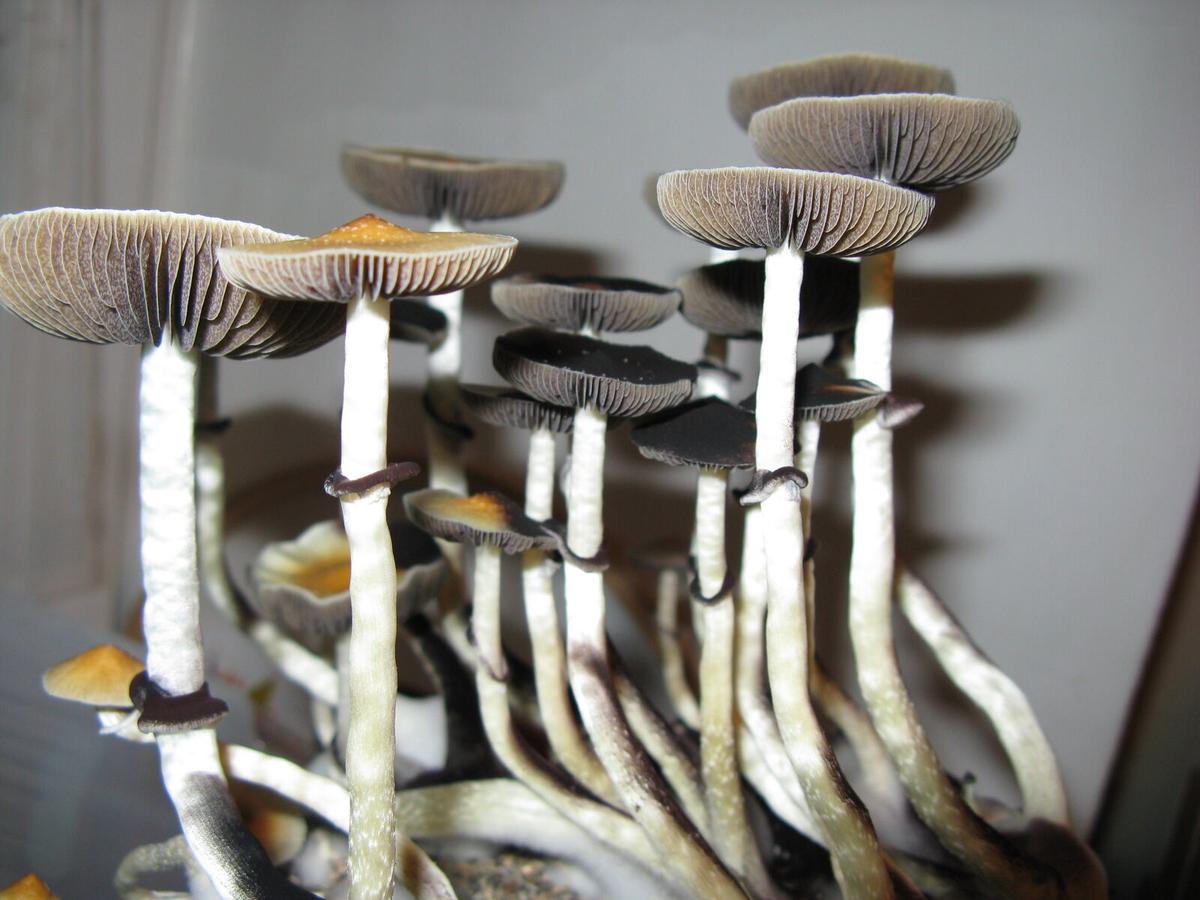 Psilocybe cubensis, a mushroom species that contains psilocybin; the trials described here used a synthetic form of the compound in measured capsules. Photo by Zergboy, public domain, via Wikimedia Commons.
This is not medical advice. Nothing here says that any of these drugs treats, cures or prevents a condition. If you or someone you know is struggling or in crisis in the United States, call or text 988.
Which drugs are these, and what is their legal status?
- MDMA (the FDA's documents use the name midomafetamine) has been studied with talk therapy for post-traumatic stress disorder (PTSD).
- Psilocybin is the active compound in certain mushrooms. It has been studied mainly for depression, including treatment-resistant depression, meaning depression that has not improved after other treatments.
- LSD (lysergide) has been studied for generalized anxiety disorder and for major depression.
The FDA's final guidance for researchers, dated July 2026, says many psychedelic drugs are Schedule I substances under the Controlled Substances Act "because they have a high potential for abuse and do not have a currently accepted medical use in treatment in the United States." It adds that if one were approved, the data on abuse potential would help decide how to reschedule it.
What did the MDMA trials find, and what did the FDA decide?
The trials. Two phase 3 trials were published in Nature Medicine. Phase 3 is the large, late stage of testing that regulators rely on. Both compared MDMA plus therapy against a placebo plus the same therapy and measured PTSD symptoms on a clinician-scored scale called CAPS-5, where a bigger drop is better.
- MAPP1 (June 2021): 90 people with severe PTSD. Scores fell 24.4 points with MDMA and 13.9 with placebo.
- MAPP2 (October 2023): 104 people with moderate to severe PTSD. Scores fell 23.7 points with MDMA and 14.8 with placebo.
The MAPP2 paper reported severe adverse events in 5 participants (9.4%) in the MDMA group and 2 (3.9%) in the placebo group, with no deaths.
The advisory committee. On 4 June 2024 the FDA's Psychopharmacologic Drugs Advisory Committee, a panel of outside experts, voted on the application from Lykos Therapeutics. The FDA's minutes record the result. On whether the data showed the drug was effective for PTSD: 2 yes, 9 no. On whether the benefits outweighed the risks under the FDA's proposed safety program: 1 yes, 10 no. The minutes say many members found that "functional unblinding," expectation bias and selection bias limited how far the results could be trusted. Those who voted yes said they "could not overlook" how large the effects were.
The decision. In August 2024 the FDA sent a complete response letter, which is its formal refusal to approve an application as submitted. The FDA later published the letter. It says the application "does not provide substantial evidence of effectiveness or establish the safety" of the drug for PTSD. The reasons it gives include:
- Study sites were trained not to record "positive" or "favorable" effects such as euphoria as adverse events, so signals of abuse potential and impairment were not captured, and FDA inspections found unreported adverse events at two or more sites.
- The trials did not show that the effect lasts beyond 18 weeks, and the long-term follow-up study had design problems.
- About 40% of participants said they had used MDMA before. The letter says that is much higher than expected in people with PTSD and raises the possibility of selection bias and expectation bias.
Since then. The following is a report, not a regulator's statement. On 10 August 2026 the nonprofit MAPS, which funded the original research, published a response to a report by the trade outlet Psychedelic Alpha that the company, now named Resilient Pharmaceuticals, had resubmitted its application. No FDA document confirming receipt or a decision was found for this account.
What did the psilocybin trials find?
Four peer-reviewed trials are cited most often. Depression was scored on the MADRS scale, which runs from 0 to 60, higher meaning more severe.
| Trial | Participants | Comparison | Main result as published |
|---|---|---|---|
| NEJM, November 2022 (phase 2) | 233 with treatment-resistant depression | One dose of 25 mg, 10 mg or 1 mg, with psychological support | At week 3 the 25 mg group improved 6.6 MADRS points more than the 1 mg group. The 10 mg group did not differ significantly from 1 mg |
| JAMA, September 2023 (phase 2) | 104 with major depression | One 25 mg dose or a niacin placebo, with psychological support | At day 43 the psilocybin group improved 12.3 MADRS points more than placebo |
| NEJM, April 2021 (phase 2) | 59 with major depression | Two 25 mg doses or six weeks of the antidepressant escitalopram | No significant difference on the main measure at week 6 |
| JAMA Psychiatry, October 2022 | 95 with alcohol dependence | Two psilocybin sessions or an active placebo, both with psychotherapy | Heavy drinking days over 32 weeks: 9.7% with psilocybin, 23.6% with placebo |
The papers also reported limits and harms. The 2022 NEJM trial found adverse events in 179 of 233 participants (77%), including headache, nausea and dizziness, and said "suicidal ideation or behavior or self-injury occurred in all dose groups." It found that sustained response at 12 weeks did not support the main result. The 2023 JAMA trial reported no serious adverse events but a higher rate of adverse events overall, and of severe ones, with psilocybin. The 2021 trial's authors wrote that larger and longer trials are needed to compare psilocybin with established antidepressants.
Phase 3, announced by the company. The results below come from Compass Pathways, the sponsor, and from trade press reports of its announcements. They had not appeared in a peer-reviewed journal when this was written.
- COMP005: 258 participants, one 25 mg dose against placebo. HCPLive reported on 9 November 2026 that the company's figure was a 3.6 point greater MADRS improvement at week 6.
- COMP006: 581 participants, two doses three weeks apart at 25 mg, 10 mg or 1 mg. HCPLive reported the company's figure as a 3.8 point greater improvement for 25 mg over 1 mg at week 6. In a release of 7 July 2026 the company reported serious adverse events over 26 weeks in 5.7% of the 25 mg group and 6.3% of the 1 mg group.
On 9 November 2026 Compass announced it had completed its new drug application to the FDA for treatment-resistant depression. Its release says the product contains a Schedule I substance and must be rescheduled before it could be sold. The FDA has announced no decision.
What did the LSD trials find?
Peer reviewed. A phase 2b trial published in JAMA in October 2025 randomized 198 adults with generalized anxiety disorder to one dose of LSD at 25, 50, 100 or 200 micrograms, or placebo. Anxiety was scored on the HAM-A scale (0 to 56). At week 4 the 100 microgram group improved 5.0 points more than placebo and the 200 microgram group 6.0 points more; the two lower doses did not differ significantly from placebo. Visual perceptual changes were reported by 92.5% of the 100 microgram group and 10.3% of the placebo group, and nausea by 40.0% and 7.7%.
Phase 3, announced by the company. Definium Therapeutics, formerly MindMed, announced three sets of phase 3 results in 2026. None was peer reviewed when this was written. The figures are as reported by Psychiatric Times and Healio from the company's releases.
- Emerge (22 June 2026), major depression, 149 participants: 8.1 MADRS points better than placebo at week 6.
- Voyage (12 August 2026), generalized anxiety, 214 participants: 5.4 HAM-A points better at week 12.
- Panorama (14 September 2026), generalized anxiety, 245 participants: 5.1 HAM-A points better at week 12.
All three figures are for a single 100 microgram dose.
In Panorama, adverse events were reported in 94.8% of the 100 microgram group and 62.9% of the placebo group. No application to the FDA for LSD had been announced as filed as of this date.
Why are these trials hard to judge?
The FDA's 2026 guidance names the central problem. Psychedelics cause "often intense perceptual changes," so most participants, and the therapists watching them, can tell who got the drug. The guidance calls this functional unblinding and says it "can lead to expectation bias": a person who knows they received the drug may expect to improve, and a person who knows they got the placebo may expect not to. The JAMA figures above show the size of the gap, with about nine in ten people on the 100 microgram dose reporting visual changes against one in ten on placebo.
The guidance recommends, among other steps, central raters who do not know which treatment a person received, asking participants and observers which treatment they think was given, and measuring the effect under blinded conditions at 12 weeks, with follow-up beyond that. It also asks sponsors to check whether a drug acts on a serotonin receptor called 5-HT2B, which it says "has been linked to heart valvulopathy in humans." Valvulopathy is damage to the heart valves.
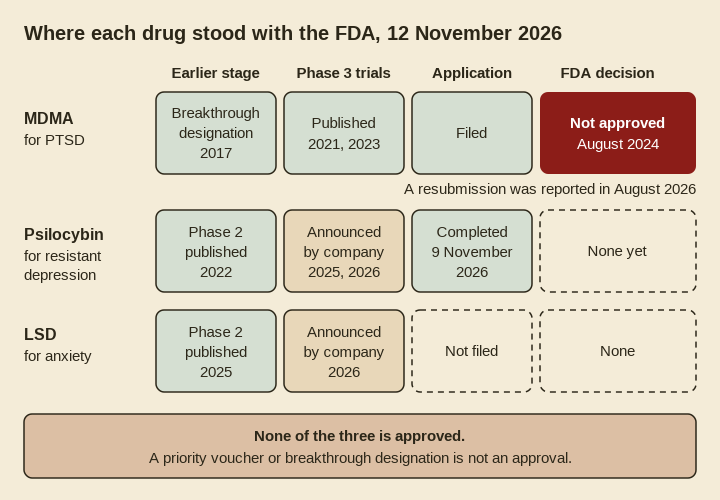 Where the three drugs stood in the FDA's process on 12 November 2026.
What have regulators and governments decided?
United States, federal.
- Executive Order 14401, signed 18 April 2026, directs the FDA to give priority review vouchers to qualifying psychedelic drugs that hold a Breakthrough Therapy designation, directs the FDA and the Drug Enforcement Administration to set up access under the Right to Try Act, tells the health department to allocate at least $50 million to work with states, and tells the Attorney General to review Schedule I products that complete phase 3 trials so rescheduling can follow approval quickly.
- On 24 April 2026 the FDA said it was issuing national priority vouchers to three companies studying psilocybin for treatment-resistant depression, psilocybin for major depression, and another drug, methylone, for PTSD. It also let a phase 1 study of noribogaine, a derivative of ibogaine, go ahead, and said that decision "does not mean the drug has been approved or found to be safe or effective."
- An FDA notice of 14 July 2026, announcing a public hearing for 14 September, states: "Neither national priority voucher issuance nor Breakthrough Therapy designation constitutes an FDA determination of safety or effectiveness, and neither is a substitute for marketing approval."
Where official bodies differ.
| Body | Position | Date |
|---|---|---|
| U.S. FDA | None of the three drugs approved. One application refused, one submitted and undecided | 12 November 2026 |
| Australia | Psilocybin and MDMA are not registered medicines, but approved psychiatrists may prescribe psilocybin for treatment-resistant depression and MDMA for PTSD | Since July 2023, as described in the European workshop report |
| European Medicines Agency workshop | No psychedelic medicine approved to date; the same approval rules apply as for any medicine | April 2024 |
| Oregon | State law, passed by voters in November 2020, directs the health authority to license psilocybin products and services | In operation |
| New Mexico | The Medical Psilocybin Act of 2025 lists treatment-resistant depression, PTSD, substance use disorders and end-of-life care | The act's text sets a deadline of 31 December 2027; the health department's page says 31 December 2026 |
The state programs operate under state law. The FDA guidance describes the federal Schedule I status separately.
Who do the sources say should be careful?
The trials did not enroll everyone. The 2023 JAMA psilocybin trial excluded people with a history of psychosis or mania, an active substance use disorder, or active suicidal thoughts with intent. The FDA's hearing notice lists cardiovascular disease, psychosis and suicidality as conditions "associated with greater risk of adverse outcomes" that screening should look for. Several trials required participants to taper off their existing psychiatric medicines first.
Every result above came from supervised sessions with measured doses and trained staff. None describes use outside a trial. Anyone considering a trial, or a change to a current treatment, should talk with their own clinician first.
What to remember
- As of 12 November 2026, the FDA has approved none of the three. The FDA's guidance describes such drugs as Schedule I.
- The FDA refused the MDMA application in August 2024, citing unreliable safety data, unproven durability and possible bias. A resubmission has been reported but not confirmed by the FDA.
- Peer-reviewed phase 2 trials reported that psilocybin and LSD lowered depression or anxiety scores more than a comparison dose or placebo. One trial found no significant difference between psilocybin and a standard antidepressant.
- Phase 3 results for psilocybin and LSD have been announced by their sponsors and were not yet peer reviewed. One psilocybin application reached the FDA on 9 November 2026.
- The FDA says a priority voucher or a breakthrough designation is not a finding that a drug is safe or effective.
- Regulators differ: Australia permits limited prescribing, the European workshop report said nothing had been approved as of 2024, and some U.S. states run their own programs under state law.
The documents to watch are the FDA's decision on the psilocybin application, any FDA statement on MDMA, and the journal publication of the phase 3 trials, which will let outside researchers check the companies' numbers.
Sources (25)
- Compass Pathways, "Compass Pathways Completes COMP360 Psilocybin New Drug Application to U.S. FDA for Treatment-Resistant Depression", 9 November 2026
- European Medicines Agency, report of the multi-stakeholder workshop on psychedelics, 16 to 17 April 2024
- FDA, "Psychedelic Drugs: Considerations for Clinical Investigations", final guidance, July 2026
- Mitchell and others, Nature Medicine, June 2021 (MAPP1)
- Mitchell and others, Nature Medicine, October 2023 (MAPP2)
- FDA, Psychopharmacologic Drugs Advisory Committee, summary minutes, 4 June 2024
- FDA, complete response letter, NDA 215455, Lykos Therapeutics, August 2024
- FDA, "FDA Embraces Radical Transparency by Publishing Complete Response Letters", 10 July 2025
- MAPS, statement, 10 August 2026
- Goodwin and others, New England Journal of Medicine, 3 November 2022
- Raison and others, JAMA, 5 September 2023
- Carhart-Harris and others, New England Journal of Medicine, 15 April 2021
- Bogenschutz and others, JAMA Psychiatry, 1 October 2022
- Compass Pathways, "Compass Pathways Announces Six-Month Data from Second Phase 3 Trial Confirming Rapid and Durable Profile", 7 July 2026
- HCPLive, report on the COMP360 new drug application, 9 November 2026
- Robison and others, JAMA, 21 October 2025
- Healio, report on the Emerge trial, 9 July 2026
- Psychiatric Times, report on the Voyage phase 3 trial, 12 August 2026
- Psychiatric Times, report on the Panorama phase 3 trial, 14 September 2026
- Executive Order 14401, "Accelerating Medical Treatments for Serious Mental Illness", 18 April 2026
- FDA, "FDA Accelerates Action on Treatments for Serious Mental Illness Following Executive Order", 24 April 2026
- Federal Register, notice 2026-14155, 14 July 2026
- Oregon Health Authority, "Oregon Psilocybin Services"
- New Mexico Senate Bill 219 (2025), final text
- New Mexico Department of Health, Medical Psilocybin Program page