Articles & BlogBy Trapper W. Brown7 min read
Security+ SY0-701, Objective 4.3: Explain the activities that make up vulnerability management
How many unpatched flaws are on your network right now? You do not know, and neither does anyone else until somebody looks. The trouble is that attackers look too.
Vulnerability management is the habit of looking first. You search for weaknesses on a schedule, decide which ones matter, do something about them, and then check that what you did worked. Objective 4.3 of the Security+ exam follows that same loop, and it adds a fifth step that people forget: telling someone what you found.
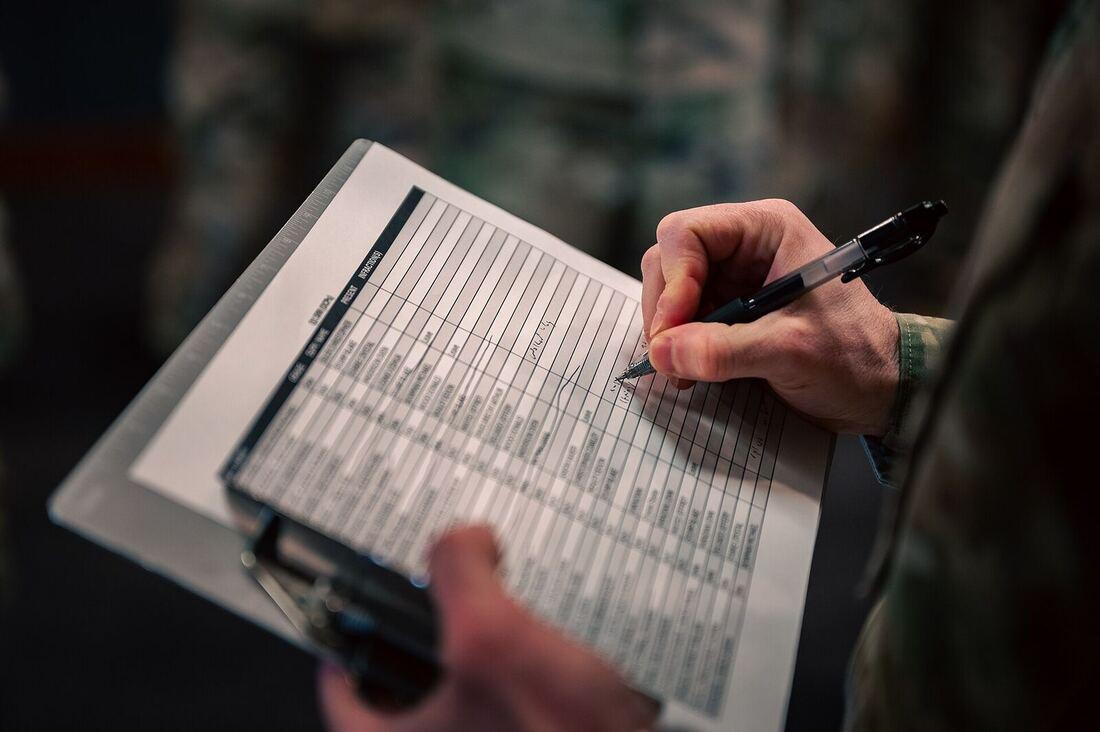
 Most of vulnerability management is patient desk work, done on a schedule. Photo by Staff Sgt. Devin Boyer, U.S. Air Force, public domain, via Wikimedia Commons.
Scan: how do you find them?
A scanner is the best-known tool, but it is only one of several ways to learn about a weakness.
| Method | What it does |
|---|---|
| Vulnerability scan | An automated tool checks each system against a list of known flaws and bad settings |
| Static analysis | Reads an application's source code without running it |
| Dynamic analysis | Tests the application while it runs, by feeding it bad input |
| Package monitoring | Watches the outside libraries your software is built on for newly reported flaws |
| Penetration testing | People try to break in the way an attacker would, chaining weaknesses together |
| Responsible disclosure program | A published way for outsiders to report a flaw to you. A bug bounty pays them for it. |
| System or process audit | A review of settings and procedures against a standard |
Static analysis, dynamic analysis and package monitoring are grouped on the exam as application security. They matter most if you write software, but package monitoring matters to everyone, because nearly every product you buy is built on someone else's libraries.
You also learn about weaknesses from threat feeds, which are streams of news about flaws and the people using them. The exam lists four sources:
- Open-source intelligence (OSINT): free, public material such as vendor advisories and government alerts.
- Proprietary or third-party: feeds you pay a security company for.
- Information-sharing organization: an industry group whose members trade warnings with each other. Healthcare, finance and energy each have one.
- Dark web: criminal forums and markets, watched for your stolen passwords or talk of a new exploit.
Rank: which ones matter?
Say a clinic runs its first full scan and gets 400 findings back: 12 critical, 60 high, 180 medium and 148 low.
| Critical | 12 |
|---|---|
| High | 60 |
| Medium | 180 |
| Low | 148 |
Source: Worked example in this article
Nobody can fix 400 things this month. The analysis step is how you cut the list down to what must happen now.
First comes confirmation. Scanners make mistakes in both directions. A false positive is a reported flaw that is not really there. A false negative is a real flaw the scanner missed, which is worse, because nobody is working on it.
Next, learn the two terms the exam most likes to swap. Common Vulnerabilities and Exposures (CVE) is a public list that gives each known flaw an ID, such as CVE-2026-12345. The Common Vulnerability Scoring System (CVSS) gives a flaw a severity score from 0 to 10.
| CVSS score | Rating |
|---|---|
| 0.1 to 3.9 | Low |
| 4.0 to 6.9 | Medium |
| 7.0 to 8.9 | High |
| 9.0 to 10.0 | Critical |
Tip
CVE is the name. CVSS is the score. If an exam question asks how to identify a specific flaw, the answer is CVE. If it asks how severe the flaw is, the answer is CVSS.
The score describes the flaw in general. To prioritize, you add what you know about your own situation:
- Vulnerability classification: what kind of weakness it is, such as a missing patch, a bad setting or a coding error. The kind tells you who has to fix it.
- Exposure factor: the share of an asset's value you would lose if the flaw were used.
- Environmental variables: facts about your setup. Is the system on the internet? Does it hold patient data? Is there another control in front of it?
- Industry and organizational impact: what the flaw would mean for a business like yours. A flaw in an infusion pump matters to a hospital and not at all to a law firm.
- Risk tolerance: how much risk leadership has agreed to live with, which sets your deadlines.
Back to the clinic's 12 criticals. On a closer look, 2 are false positives. Another 7 are on a lab network with no route to the internet. The last 3 are on systems that face the internet. Those 3 are this week's work.
One more input is whether attackers are using the flaw today. CISA keeps a Known Exploited Vulnerabilities catalog for that. Catalog version 2026.11.10 held 1,779 entries, and 295 of them were added in 2026 up to 10 November, against 245 in all of 2025.
| 2022 | 555 |
|---|---|
| 2023 | 187 |
| 2024 | 186 |
| 2025 | 245 |
| 2026 (to 10 Nov) | 295 |
Source: CISA Known Exploited Vulnerabilities catalog, version 2026.11.10
The Verizon Data Breach Investigations Report, 2026 edition, shows why that matters. Among breaches where the way in was known, and leaving out errors and misuse, exploiting a vulnerability was the first step in 31 percent. That is a share of breaches with a known starting point, not of all breaches.
Watch out
A common mistake is to sort by CVSS score alone and work down the list. A 9.8 on an isolated lab machine can wait longer than a 7.5 on your internet-facing VPN that attackers are already using.
Fix: what can you do about it?
Patching is the obvious response. It is one of five on the exam.
| Response | What it means | When it fits |
|---|---|---|
| Patching | Install the vendor's fix | Whenever a patch exists and can be tested |
| Insurance | Shift some of the financial loss to an insurer | Alongside other responses, never in place of them |
| Segmentation | Move the weak system onto its own network segment | Old equipment that cannot be patched |
| Compensating controls | Add a different control that lowers the same risk | When the direct fix is not possible yet |
| Exceptions and exemptions | A signed decision to leave the flaw in place | When the fix would cost more than the risk |
Hospitals know the segmentation case well. A scanner or pump that runs an old operating system may not be patchable without the maker's approval. You cannot fix it, so you fence it in: its own segment, with only the connections it needs.
An exception is temporary and has an end date. An exemption is standing. Both need a name and a signature, and both should come back up for review.
Verify: did the fix work?
A closed ticket says someone clicked "done." It does not say the flaw is gone. Patches fail to install, systems get restored from old images, and a fix on one server gets missed on its twin.
The exam lists three ways to check:
- Rescanning: run the same scan again and confirm the finding no longer appears.
- Audit: have someone outside the team review whether the process was followed, usually by sampling closed tickets.
- Verification: check the fix directly, by confirming the version number, reading the setting, or trying the exploit again.
I would rescan every time. It costs almost nothing, and it catches the quiet failures that otherwise sit there until the next quarter.
Report: who needs to know?
Reporting turns the work into decisions. The technical team needs the detail: which systems, which CVEs, which deadlines. Leadership needs the trend.
A useful report answers a few plain questions. How many findings are open at each severity? How old is the oldest critical? How long does a fix take on average? Which exceptions are about to expire? Is any of this getting better or worse since last quarter?
Keep the same measures from one report to the next. A number means little by itself, and a line across six months tells you whether the program is working.
What to remember
- The loop is identify, analyze, respond, validate, report. Then start again.
- Scans are one source. Application testing, threat feeds, penetration tests, disclosure programs and audits are the others.
- A false negative is worse than a false positive, because nobody knows to fix it.
- CVE names a flaw. CVSS scores it from 0 to 10.
- Rank by your own environment and by whether the flaw is being exploited, as well as by score.
- If you cannot patch, segment it, compensate for it, or sign an exception with an end date.
- Rescan after every fix.
The scanner will always find more than you can fix. A good program accepts that and makes sure the few flaws an attacker would reach for first are the ones you closed first.