Articles & BlogBy Trapper W. Brown11 min readBoth sides
Nine countries have nuclear weapons. Many more have none and rely on a promise: if they are attacked, a nuclear-armed ally will treat it as an attack on itself. That promise has a name, extended deterrence, and a nickname, the nuclear umbrella. Deterrence means stopping an attack by convincing the other side the cost would be too high.
The question in this piece is whether more allied countries, in Europe or in East Asia, should build weapons of their own instead of relying on the umbrella. It matters to an ordinary reader because either answer changes the odds of the worst event a government can cause. This guide lays out the strongest case on each side and takes neither. It is about weapons only. Civilian reactors are a different subject, covered in "Why Nuclear Power Is the Best Choice, and What the Real Risks Are."
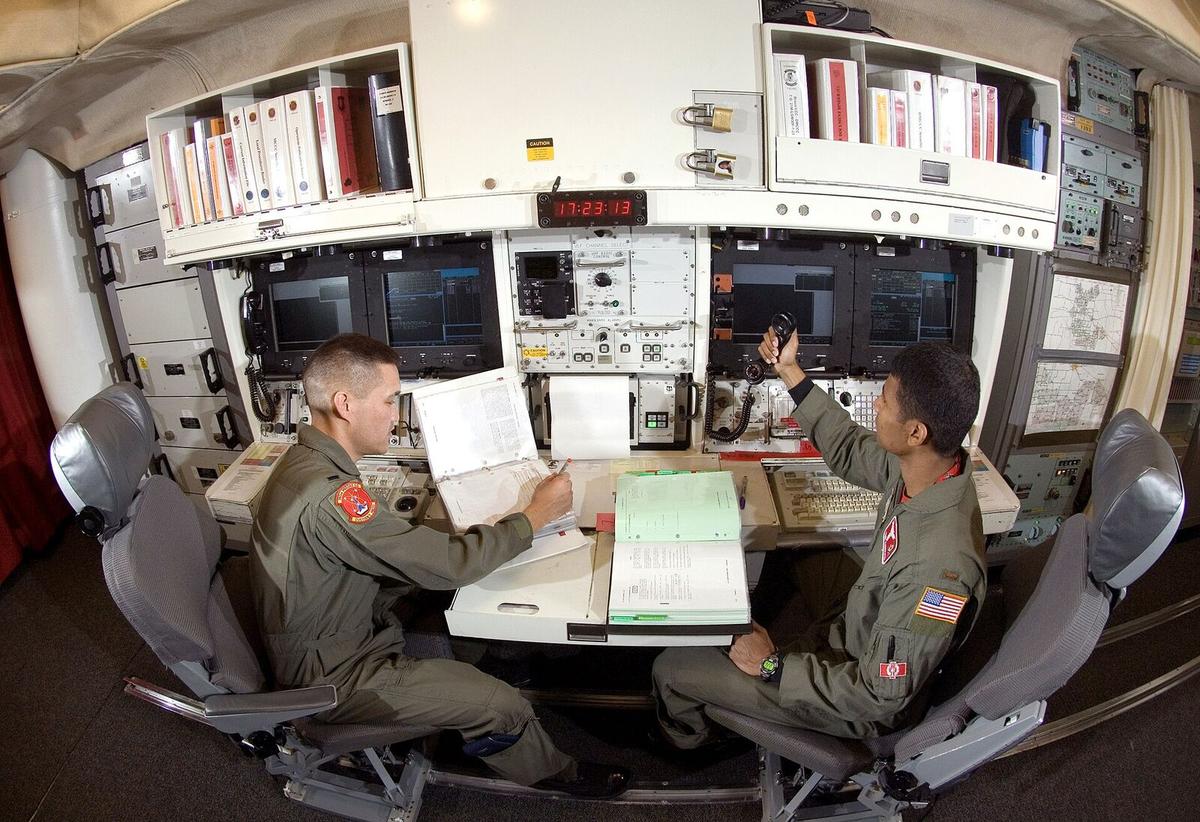 A two-person U.S. Air Force missile crew on alert in an underground launch control center. Photo by Master Sgt. Lance Cheung, U.S. Air Force, public domain, via Wikimedia Commons.
Who has nuclear weapons now?
The Stockholm International Peace Research Institute (SIPRI), an independent research body, publishes estimates each year. Its Yearbook 2026 counts warheads in military stockpiles, meaning those available for use, as of January 2026. These are estimates from public information. No government confirms all of them.
| Russia | 4,400 |
|---|---|
| United States | 3,700 |
| China | 620 |
| France | 290 |
| United Kingdom | 225 |
| India | 190 |
| Pakistan | 170 |
| Israel | 90 |
| North Korea | 60 |
Source: SIPRI Yearbook 2026, table 8A.1
The total is 9,745. Russia and the United States hold 8,100 of them, which is the "around 83 per cent" SIPRI reports. Two of the nine, France and the United Kingdom, are already American allies. Together they hold an estimated 515 warheads, about 12 percent of Russia's stockpile.
Almost every other country has signed away the option. The Treaty on the Non-Proliferation of Nuclear Weapons, known as the NPT, opened for signature in 1968 and took effect in 1970. The UN counts 191 states that have joined. In Article II, each state without the weapons undertakes "not to manufacture or otherwise acquire nuclear weapons." In Article I, the states that have them undertake not to hand them over or help anyone build them.
What does an ally have instead?
There are three arrangements, and the difference between them is who decides.
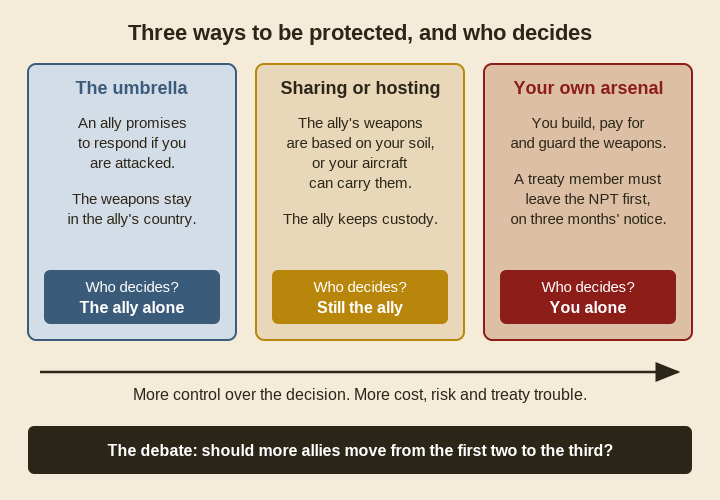 The three arrangements differ mainly in who holds the decision to use the weapon.
The umbrella. The ally's weapons stay at home and the ally decides. The 2023 Washington Declaration between the United States and South Korea is an example. The United States commits "to make every effort to consult" with Seoul on any possible nuclear use on the peninsula, and the two set up a Nuclear Consultative Group. South Korea, in the same text, reaffirmed its commitment to the NPT.
Sharing or hosting. American weapons sit in some NATO countries, and some allies fly aircraft able to carry them. NATO's policy page, updated on 25 September 2026, is plain about control: "The United States maintains absolute control and custody of its nuclear weapons forward-deployed in Europe." NATO says this is consistent with the NPT.
Your own arsenal. You build it, pay for it, guard it and decide alone.
The middle column is growing. SIPRI reports that in June 2025 the British government announced it would buy 12 aircraft able to carry American nuclear bombs and rejoin NATO's sharing mission, which would make the United Kingdom the sixth host nation beside Belgium, Germany, Italy, the Netherlands and Türkiye. France's new policy, described below, sits in the same column: the French defense ministry says it "does not involve sharing nuclear weapons or diluting decision-making authority, which remains exclusively national."
Each side reads the middle column its own way. People who want allied arsenals say it leaves the key in another capital, however close the weapon is parked. People who oppose them say it gives an exposed country most of the reassurance without adding a tenth arsenal to the world.
Why is this question back?
Four things happened close together, all of them on the record.
- Arms control lapsed. New START, the last treaty limiting American and Russian strategic weapons, expired in February 2026 without a replacement, SIPRI reports.
- The NPT's members could not agree. The treaty's review conference ran from 27 April to 22 May 2026 in New York and ended, in the UN's words, "without Consensus Outcome." The two before it ended the same way.
- France changed its posture. On 2 March 2026 the French president said he had ordered an increase in the number of French warheads and that France would stop publishing the figure. He described a "forward deterrence" in which parts of France's strategic forces could deploy to allied countries. He also said there would be no sharing of the final decision. Germany, the United Kingdom, Poland, the Netherlands, Belgium, Greece, Sweden and Denmark were named as partners in the talks.
- Allies started saying it aloud. SIPRI records that Polish officials have spoken in favor of hosting American weapons, and that Finland and Sweden have signaled openness to doing so in wartime. In South Korea, a Chicago Council on Global Affairs report published in February 2022 found 71 percent in favor of the country developing its own weapons. Asked to choose, 67 percent preferred a Korean arsenal and 9 percent preferred American weapons based in Korea.
What would an ally actually have to do?
Take a worked example. Call the country Ally A, a member of the NPT with an advanced civilian nuclear industry.
- Leave the treaty, or break it. Article X lets a party withdraw if "extraordinary events" have "jeopardized the supreme interests of its country." It must give notice "three months in advance" to every other party and to the UN Security Council, with its reasons. So the legal clock is about 90 days. The physical work of building a weapon is a separate and longer job, and no source read for this piece gives a reliable figure for it.
- Face its own protector's law. Under the U.S. Arms Export Control Act, if a country without nuclear weapons detonates a nuclear device, the president "shall forthwith impose" sanctions. They include ending most foreign assistance and ending sales of defense articles. An ally that buys American aircraft and missiles would feel that quickly.
- Live through the gap. Between the announcement and a working, survivable arsenal, Ally A has declared its intent and has nothing to show for it yet.
As a rule of thumb, the 90 days is the easy part. What comes after it is where the two sides disagree.
The case for more nuclear-armed allies
People who favor it make five arguments.
A promise is weaker than a weapon. The umbrella asks a protector to risk its own cities for someone else's. Even the strongest text, they note, promises consultation, not a shared decision. A government can change its mind. An arsenal you own does not depend on anyone's election.
Ukraine is the cautionary tale. In the Budapest Memorandum of 5 December 1994, signed as Ukraine joined the NPT, Russia, the United Kingdom and the United States reaffirmed their commitment to respect Ukraine's independence, sovereignty and existing borders. The text promises consultation if questions arise. It does not promise defense. In March 2022 the UN General Assembly voted 141 to 5 to demand that Russia withdraw its forces from Ukraine. Supporters of allied arsenals read this as proof of what assurances are worth.
Some evidence says nuclear pairs do not fight big wars. A 2009 study in the Journal of Conflict Resolution by Robert Rauchhaus found that when both states in a pair have nuclear weapons, "the odds of war precipitously drop."
The allies in question are stable. Britain and France have held arsenals for decades inside the alliance. Supporters ask why 515 allied warheads are acceptable and a few dozen more in another democracy are not.
The public wants it. In the South Korean poll above, only 11 percent of supporters changed their minds when told about possible sanctions.
The case against
People who oppose it make five arguments of their own.
The treaty is the thing holding the number at nine. If a respected member withdraws, opponents say, the argument for restraint weakens for everyone, including countries the allies fear. A treaty whose members could not agree on a text three times running may not survive a walkout.
Other evidence says the weapons do not buy peace. A 2015 study in the same journal, by Bell and Miller, used different methods and found that pairs in which both states have nuclear weapons "are not significantly less likely to fight wars." It also found that pairs in which only one state has them are more prone to low-level conflict. During the years an ally is building, that is the kind of pair it is in.
More arsenals mean more chances for error. Every new arsenal needs its own command system, guards, safety design and early warning, built from scratch and tested by time. Scott Sagan's 1994 article in International Security, titled "The Perils of Proliferation," applied organization theory to this problem.
The ally could lose the alliance it has. The sanctions law above is mandatory in its wording. An ally might end up with a small arsenal and a weaker partnership than before.
Neighbors respond. A new arsenal is a reason for a rival to build more, or to act before it is finished.
What is known, disputed, and a matter of values?
| Kind of question | Example | Status |
|---|---|---|
| Known | How many warheads exist, roughly, and who holds them | Estimated yearly by SIPRI |
| Known | What the NPT allows and how a state leaves | Written in Articles II and X |
| Known | Who controls shared weapons | The owner, by NATO's and France's own statements |
| Disputed | Whether two nuclear states are less likely to go to war | Peer-reviewed studies point both ways |
| Disputed | Whether one withdrawal would trigger others | A prediction either way |
| Value judgment | How much risk of nuclear use is acceptable to lower the risk of invasion | Facts cannot settle it |
| Value judgment | Whether a country should rest its survival on another's promise | Facts cannot settle it |
Both of the cited studies agree on one thing: nuclear weapons go along with more friction below the level of war. Rauchhaus writes that they "allow for more risk-taking in lower intensity disputes."
There is also a paired way to see the disagreement. For one country, the question is about its own survival, and an arsenal looks like insurance. For the alliance as a whole, the question is about the total number of fingers near triggers, and each new arsenal looks like added risk. Both views are reasonable from where they stand.
What to remember
Both sides agree on this much:
- Nine countries hold an estimated 9,745 usable warheads, and two of them hold about 83 percent.
- The NPT bars its non-nuclear members from building weapons and allows withdrawal on three months' notice.
- Under the umbrella and under sharing, the ally that owns the weapon keeps the decision.
- New START has expired, the 2026 NPT review ended without agreement, and France is enlarging its arsenal.
These questions divide them:
- Is a protector's promise believable enough to deter an attack?
- Do nuclear weapons in more hands make large wars less likely, or accidents and crises more likely?
- Would the treaty survive an ally leaving it?
A reader who wants to follow the argument can watch three things: whether Washington and Moscow replace New START, what the French talks with their eight partners produce, and whether any ally's government, as opposed to its public, moves from asking the question to answering it.
Sources (15)
- SIPRI Yearbook 2026, chapter 8, "World nuclear forces", Kristensen and Korda
- Treaty on the Non-Proliferation of Nuclear Weapons, United Nations Treaty Series vol. 729
- UN Office for Disarmament Affairs, "Treaty on the Non-Proliferation of Nuclear Weapons" page
- United States and Republic of Korea, "Washington Declaration", 26 April 2023
- NATO, "NATO's nuclear deterrence policy and forces", 25 September 2026
- French Ministry of Armed Forces, "Forward Deterrence: For a Nuclear 21st Century"
- United Nations, 2026 NPT Review Conference page
- French presidency, speech at the Ile Longue base, 2 March 2026
- Chicago Council on Global Affairs, "Thinking Nuclear: South Korean Attitudes on Nuclear Weapons", 21 February 2022
- 22 U.S.C. 2799aa-1, Arms Export Control Act, section 102
- Memorandum on security assurances in connection with Ukraine's accession to the NPT (Budapest Memorandum), 5 December 1994
- UN News, "General Assembly resolution demands end to Russian offensive in Ukraine", 2 March 2022
- Rauchhaus, "Evaluating the Nuclear Peace Hypothesis: A Quantitative Approach", Journal of Conflict Resolution, 2009
- Bell and Miller, "Questioning the Effect of Nuclear Weapons on Conflict", Journal of Conflict Resolution, 2015
- Sagan, "The Perils of Proliferation: Organization Theory, Deterrence Theory, and the Spread of Nuclear Weapons", International Security, 1994