Articles & BlogBy Trapper W. Brown10 min read
For anyone who has read that a single fruit repairs DNA, fixes sleep or cleans out the gut. By the end you will be able to sort a food claim into strong, weak or unproven, using kiwifruit as the worked example.
A superfood is whatever a package, a headline or a smoothie menu says it is. The word has no test behind it. Harvard's school of public health puts it plainly on its nutrition site: "There's no scientifically based or regulated definition for superfood."
That does not mean the foods wearing the label are useless. Many are excellent. It means the label tells you nothing, and you have to look at the studies one claim at a time. Kiwifruit is a good place to practice, because it has attracted every kind of claim, and the evidence behind them runs from solid to thin.
 No single fruit on this plate is doing the work alone. Photo by Fernanda Gonzalez Watergirl, CC0, via Wikimedia Commons.
Where did the word come from?
From advertising. The Harvard page traces the term to the early twentieth century, when the United Fruit Company ran an enthusiastic campaign to promote its main import, the banana. The page's own verdict on the word today is that it is "more useful for driving sales than it is for providing optimal nutrition recommendations."
The European Union does not regulate the word by name, but its food law limits how it can be used. Under Regulation 1924/2006, health claims are banned unless they have been assessed and placed on an approved list. Article 10 adds that a reference to "general, non-specific benefits" of a food for overall good health is allowed only when a specific approved claim appears alongside it. A vague promise of super-ness, on its own, does not meet that standard.
So the useful question is never "is this a superfood?" It is "which specific claim, tested in which people, with what result?"
What is actually in a kiwifruit?
Start with what can be measured in a lab, because that part is not in dispute.
According to USDA FoodData Central, 100 grams of raw green kiwifruit contains 74.7 milligrams of vitamin C and 3 grams of fiber. The NIH Office of Dietary Supplements lists one medium kiwifruit at 64 milligrams of vitamin C, against 70 for a medium orange. The recommended daily amount for adults is 90 milligrams for men and 75 for women. One kiwifruit therefore covers most of a day's vitamin C, and two cover all of it.
That is a real point in the fruit's favor. It is also true of oranges, sweet peppers and strawberries, which sit on the same NIH table. Being a good source of a vitamin is common among fruits and vegetables. It is not a superpower.
Does kiwi really repair DNA?
This claim traces back to a few small studies, the best known led by Andrew Collins and published in 2003. It is interesting science, and it has been stretched a long way.
Some background first. The DNA in your cells is damaged every day by oxidation, a chemical wear and tear, and cells have enzymes that repair it. Researchers can measure both in white blood cells with a test called the comet assay.
- 2001. Volunteers drank a single half liter of kiwifruit juice, with water as the comparison. Afterward, DNA in their blood cells was more resistant to oxidative damage applied in the lab. The study found no effect on the damage already present in the cells.
- 2003. In a randomized crossover study in the journal Carcinogenesis, healthy volunteers added kiwifruit to their normal diet for three weeks at a time, at different daily amounts, with two-week breaks. Existing oxidative damage in blood cell DNA fell, and a lab measure of repair capacity rose. The size of the effect was not related to how many kiwifruit people ate, and the activity of two repair genes did not change.
- 2010. A trial put 102 male smokers on a diet rich in antioxidant foods, on three kiwifruit a day, or on their usual diet for eight weeks. Gene activity was measured in 10 men from each group. Groups of genes linked to stress defense, DNA repair among them, were more active in both diet groups than in the controls.
Here is what that adds up to. In small groups, over weeks, eating kiwifruit shifted laboratory markers in blood cells in a favorable direction. The 2003 authors wrote that it is "probable" these effects would lower the risk of the kind of mutations that lead to cancer. That sentence is an inference. None of these studies followed people long enough to count a single case of disease, the missing dose effect is odd, and I found no large trial that repeated the result. The same tests have not been run on most other fruits, so nobody can say kiwi is special.
A fair summary: a promising lab signal, more than twenty years old, never scaled up.
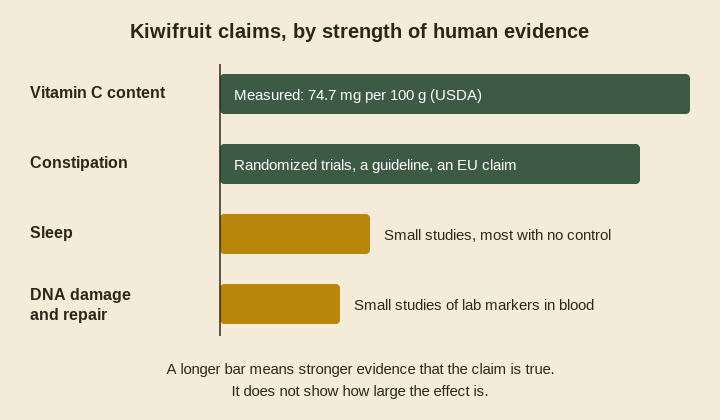 Four claims about one fruit, with four different levels of support.
Does kiwi help you sleep?
The claim usually cites a 2011 study in the Asia Pacific Journal of Clinical Nutrition. Twenty-four adults with self-reported sleep problems ate two kiwifruit an hour before bed for four weeks. Their sleep scores improved, and the time it took them to fall asleep dropped by about a third.
The weakness is in the design. Everyone ate the kiwifruit and everyone knew it. There was no comparison group, so the study cannot separate the fruit from the passage of time, the attention of being studied, or the simple expectation of sleeping better. A 2023 study of 15 elite athletes had the same design and the same limit.
One better-controlled study exists. In 2023, researchers gave 24 young men fresh kiwifruit, dried kiwifruit powder or water with an evening meal, in random order. Some ratings of morning alertness improved after the dried fruit. That is one evening, in 24 men, with modest results.
Eating two kiwifruit before bed is harmless for most people. The evidence that it improves sleep is weak.
Does kiwi help with constipation?
Yes, and here the evidence is of a different class.
A 2023 trial in the American Journal of Gastroenterology ran in several countries with 184 adults: 63 healthy, 60 with functional constipation and 61 with constipation-type irritable bowel syndrome. Each person ate two green kiwifruit a day for four weeks and took 7.5 grams of psyllium, a standard fiber supplement, for another four weeks, in random order. In both constipated groups, kiwifruit raised the number of complete bowel movements by more than 1.5 a week and improved measures of abdominal comfort.
An earlier US trial of 79 patients compared two kiwifruit a day with 100 grams of prunes or 12 grams of psyllium. All three increased bowel movements, and the share of patients who responded was similar.
That evidence has reached official guidance in two places.
- In 2025 the British Dietetic Association published the first full dietary guidelines for chronic constipation in adults, built on 75 randomized trials. It includes statements on kiwifruit: no difference from psyllium in the number of people who benefit, and a small edge for kiwifruit in stool frequency. It rates the evidence as low certainty. It also found that kiwifruit supplements, as distinct from the fruit, did not help.
- In July 2025 the European Commission approved a health claim, after a positive opinion from the European Food Safety Authority in 2021: "Consumption of green kiwifruit contributes to normal bowel function by increasing stool frequency." The claim applies only to fresh green kiwifruit, at 200 grams of flesh a day, which is two to three medium fruit. The application came from a kiwifruit marketing company, which is how the system works and worth knowing.
Note the size of the effect. Kiwifruit performed about as well as a fiber supplement and prunes. It works like a pleasant, effective source of fiber, which is what it is.
Which other foods have real human evidence?
Five foods that often carry the label, with the best human study I could find for each and its limit.
| Food | Human evidence | The limit |
|---|---|---|
| Blueberries | A 6-month trial in 115 adults with metabolic syndrome. One cup a day improved two measures of blood vessel function | Insulin resistance, the trial's main target, did not change. Half a cup did nothing |
| Oily fish | A Cochrane review of 86 trials and 162,796 people found little or no effect of omega-3 fats on deaths or heart events overall | Most trials used capsules. The review found little evidence on eating fish itself |
| Beans and lentils | A pooled analysis of 26 trials and 1,037 people. About one serving a day lowered LDL cholesterol by 0.17 mmol/L | Short trials, and the authors asked for longer, better ones |
| Nuts | A Spanish trial of 7,447 people at high risk. Those assigned a Mediterranean diet with nuts had fewer heart attacks and strokes than the control group | The paper was withdrawn and reissued after problems with how some people were assigned. It tested a whole diet, not nuts alone |
| Leafy greens | A study that followed 960 older adults for about 4.7 years. Those eating about one serving a day had slower decline on thinking tests | Observation only. People who eat greens differ in many ways |
Fermented foods deserve a line as well. A 17-week trial published in Cell assigned 36 healthy adults to a diet high in fermented foods or high in fiber. The fermented food group ended with more varied gut bacteria and lower markers of inflammation. Eighteen people per group is a start.
Look down the right-hand column. Every food on the list has a measured effect on something, and every one has a catch. A large US fish oil trial, with 25,871 participants, found no significant drop in major heart events. None of these foods has been shown to treat or head off a disease by itself.
Why does the pattern matter more than the food?
Because that is where the strongest evidence points. The most convincing result in the table tested a whole way of eating, with olive oil or nuts added to a diet already built on vegetables, legumes and fish. The Harvard page ends on the same idea and suggests building a "super plate" of varied foods instead of chasing one item.
A worked example makes the point. A person who adds two kiwifruit a day gains about 5 grams of fiber and well over a day's vitamin C. That is worth having. If the rest of the day is unchanged, it is also the whole gain. Now take a household of four that swaps one meat dinner a week for a bean dish, puts fruit on the table at breakfast and keeps nuts where the chips were. No single item on that list is a superfood. Together they move the family's whole diet toward the pattern that the largest trial tested.
As a rule of thumb, be most skeptical when a claim names one food and one dramatic benefit. Biology rarely works that way, and marketing often does.
Watch out
Kiwifruit is a known cause of food allergy. A 2023 review describes cross-reactions with latex and pollen, and says severe reactions are reported more often in children than in adults. Tingling or itching in the mouth after kiwi is a reason to stop and ask an allergist.
Food is not a supplement, but the same caution applies to kiwi extracts and "superfood" powders: talk to your own clinician before starting any supplement, especially if you take regular medicine.
What to remember
- "Superfood" is a marketing word with no scientific or legal definition.
- Kiwifruit is a very good source of vitamin C and a decent source of fiber. So are several other fruits.
- The DNA repair claim rests on small studies of lab markers in blood, never confirmed with health outcomes.
- The sleep claim rests mostly on studies with no comparison group.
- The constipation evidence is the strongest: randomized trials, a dietetic guideline and an approved EU claim for two to three fresh kiwifruit a day.
- Blueberries, fish, beans, nuts, greens and fermented foods all have some human evidence and clear limits. The best evidence is for eating patterns.
Kiwifruit earns a place in the fruit bowl on taste, vitamin C and fiber, with one well-tested benefit for the gut. The rest of what is said about it is still waiting for a trial large enough to check.