Articles & BlogBy Trapper W. Brown6 min read
 Illustration generated for Warhawk Division.
On 9 November 2026 the Food and Drug Administration (FDA) told patients and doctors about "a potential increased risk of non-arteritic anterior ischemic optic neuropathy (NAION)" with the class of drugs known as GLP-1s. It is ordering every maker of these drugs to add the risk to the warnings on the label. The FDA calls NAION "rare." It can cause "permanent vision loss" in one eye. The agency is not pulling any drug, and neither am I telling anyone what to take. Talk to your doctor before changing any medication.
What did the FDA announce?
The announcement is a Drug Safety Communication, the FDA's formal notice to the public when it learns something new about a drug's risks. It is dated 9 November 2026.
The agency says it "is requiring application holders for all GLP-1 RA medications to add information to the Warnings and Precautions section of labeling about the potential increased risk of NAION associated with use of these medications."
"Application holders" means the companies that hold FDA approval for each drug. "Warnings and Precautions" is the section of the official prescribing information that doctors read for serious risks.
Pay attention to the wording. The FDA says "potential increased risk" and "associated with." It does not say these drugs cause blindness, and I will not say it either.
What is NAION?
The FDA describes NAION as "a rare condition that can result in acute, painless, decreased vision in one eye, including permanent vision loss."
The name breaks down like this. "Optic neuropathy" means damage to the optic nerve, the cable that carries what the eye sees to the brain. "Ischemic" means it is caused by a lack of blood flow. In the FDA's words, "NAION is caused by decreased blood flow to the front part of the optic nerve (known as the optic disc), but the underlying cause is not completely understood." "Non-arteritic" means it is not caused by inflamed arteries, which is a different disease.
The FDA lists risk factors that "may include smoking, diabetes, high blood pressure, sleep apnea, anemia, and kidney disease." It adds that "if NAION has occurred in one eye, there is an increased risk that it will occur in the other eye."
Which drugs does this cover?
All of them in the class. A GLP-1 RA, or glucagon-like peptide-1 receptor agonist, mimics a gut hormone that lowers blood sugar after eating and acts on the parts of the brain that control appetite. The FDA's table lists these approved products:
- Byetta and generic exenatide
- Victoza and Saxenda (liraglutide)
- Trulicity (dulaglutide)
- Xultophy (liraglutide with insulin degludec)
- Soliqua (lixisenatide with insulin glargine)
- Ozempic, Rybelsus and Wegovy (semaglutide)
- Mounjaro and Zepbound (tirzepatide)
- Foundayo (orforglipron), approved in 2026
The FDA notes that tirzepatide also acts on a second hormone receptor, called GIP. It also says "NAION cases have been reported for all currently marketed GLP-1 RA products."
What did the FDA actually find?
The review started with a study. In July 2024 a team led by Hathaway published "Risk of Nonarteritic Anterior Ischemic Optic Neuropathy in Patients Prescribed Semaglutide" in JAMA Ophthalmology. The FDA says that "although FDA identified several limitations of this study, the agency determined that further assessment of the potential increased risk for NAION was warranted."
It then looked at four kinds of evidence.
Clinical trials. The FDA pooled 126 randomized, controlled trials with 134,253 patients. It found 15 probable NAION events: 10 among GLP-1 users, 5 among people on placebo, and none among those on other glucose-lowering drugs. That works out to 6.4 cases per 100,000 person-years on GLP-1 drugs and 3.8 on the comparison treatments.
A person-year is one person followed for one year. So 100,000 person-years could be 100,000 people for a year, or 50,000 people for two. By my arithmetic from the FDA's figures, the gap is about 2.6 extra cases per 100,000 person-years.
Insurance-claims data. FDA's Sentinel system, which studies real-world health records, followed adults with type 2 diabetes who started a GLP-1 or one of two other common diabetes drug types between 2019 and 2024. Compared with SGLT-2 inhibitors, there was "no statistically significant increase." Compared with DPP-4 inhibitors, "an increased risk of NAION was observed," with a hazard ratio of 1.43. A hazard ratio of 1.43 means a rate roughly 43% higher in that comparison.
Published studies. The FDA says "methodologically rigorous studies consistently reported an increased risk of NAION in patients with type 2 diabetes mellitus who initiated GLP-1 RAs" compared with those two other drug types.
Animal data. The FDA says its review "did not identify a mechanism for how GLP-1 RA use could increase the potential risk of NAION."
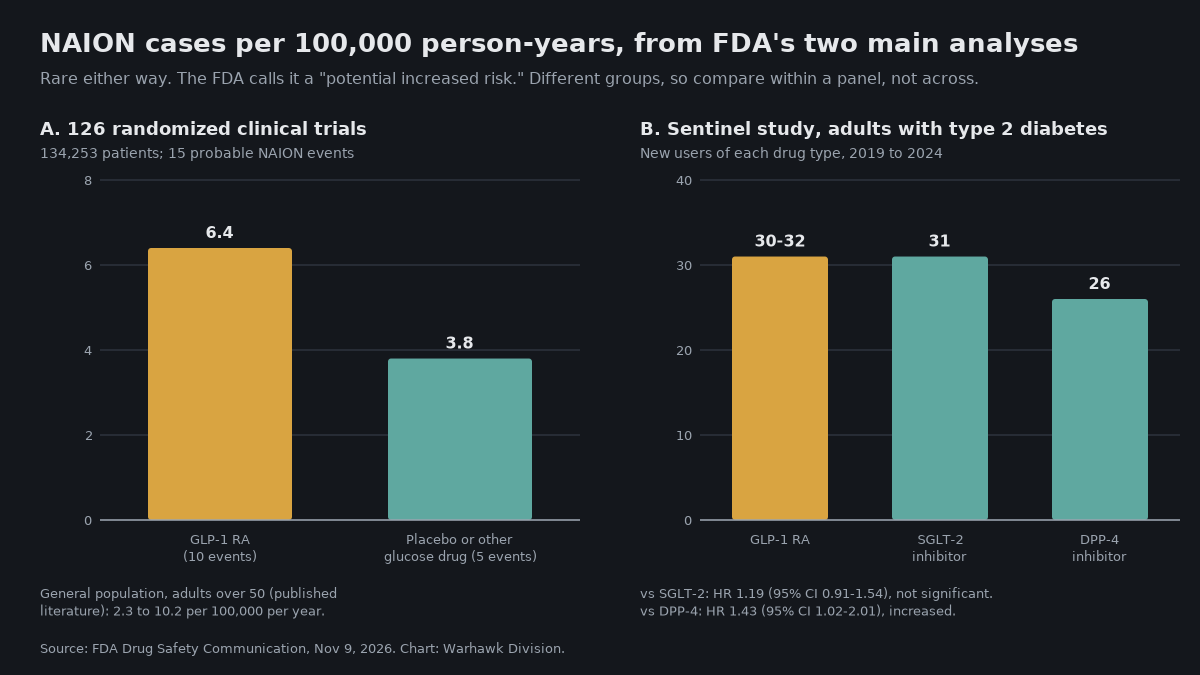 NAION rates from the FDA's trial meta-analysis and its Sentinel study. The two panels cover different groups of patients and should not be compared with each other. Data: FDA Drug Safety Communication, 9 November 2026. Chart by Warhawk Division.
For context, the FDA cites published literature putting NAION in the general population at "2.3 to 10.2 cases per 100,000 persons per year in adults older than age 50."
The FDA's conclusion: "there is a potential increased risk of rare NAION events in patients taking GLP-1 RAs."
What are the symptoms?
This is the part worth remembering. The FDA lists:
- "sudden, painless vision loss in one eye that patients may notice upon waking"
- "blurred or missing portions of vision (visual defects such as blind spots or tunnel vision)"
- "distortion of colors"
- "reduced central sharpness (e.g., blurry or hazy spots)"
The agency's instruction is plain: "Patients should contact their health care professional right away if they have any of these symptoms."
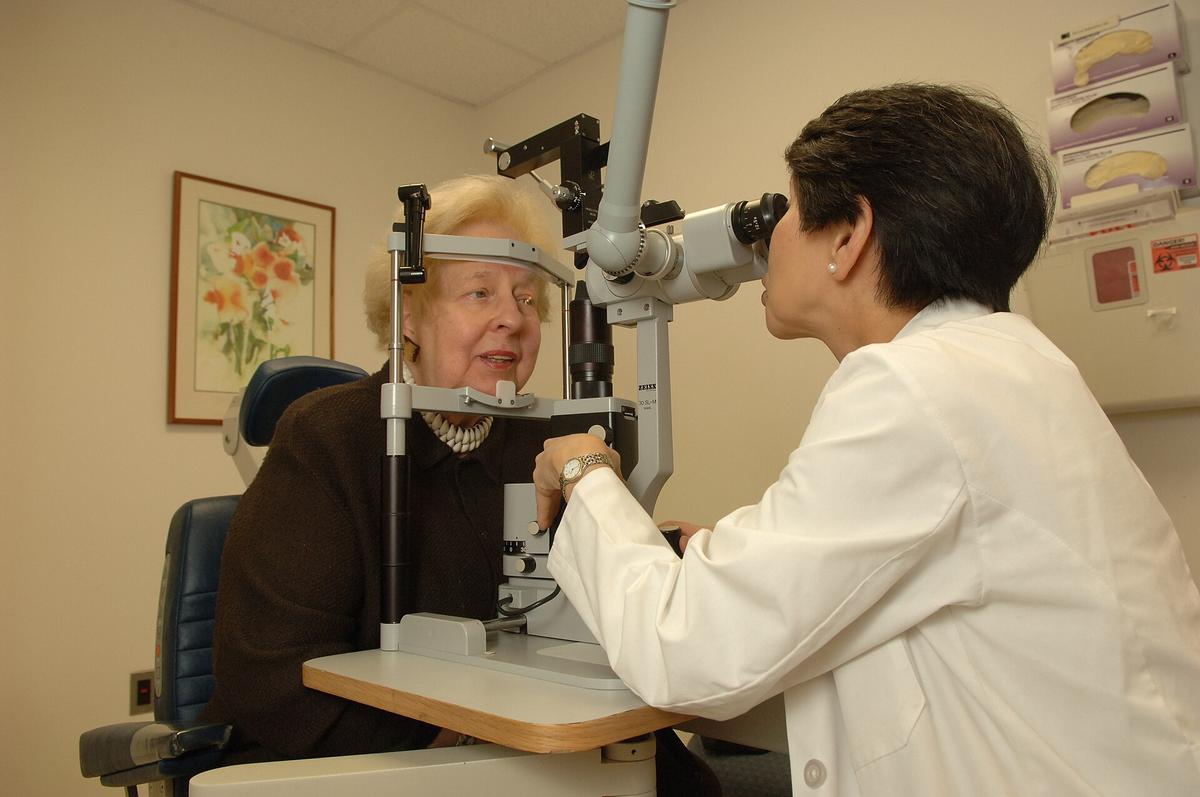 Dr. Emily Chew of the National Eye Institute examines a patient's eyes. Photo by the National Institutes of Health, public domain, via Wikimedia Commons.
What is the FDA telling doctors?
The agency tells health care professionals to "instruct patients to immediately report sudden onset of acute, painless, decreased vision" and, if NAION is suspected, to "promptly refer the patient to an ophthalmologist." It also says to "consider discontinuing the GLP-1 RA in patients who develop NAION, unless the benefits of treatment clearly outweigh the risk."
That is guidance for doctors, made patient by patient. It is not a reason for anyone to stop a drug on their own.
What to do
- Do not stop or change a medication because of an article, including this one. Talk to your doctor before changing any medication.
- Learn the symptoms above. Sudden, painless vision loss in one eye, often noticed on waking, is the headline.
- If you notice them, call your health care professional right away, as the FDA advises.
- If you have had NAION before, the FDA says to "talk with your health care professional about whether to continue taking" the drug.
- Report side effects to the FDA's MedWatch program online or at 1-800-332-1088.
Where I land
- The FDA's word is "potential increased risk." It is not "causes blindness."
- By the agency's own numbers, NAION is rare in people taking these drugs and in people who are not.
- The signal was strong enough to put on every label in the class, and that is enough reason to know the symptoms.
- Decisions about your treatment belong with your doctor.
A warning on a label is information, not a verdict. The most useful thing in this announcement is the symptom list, and it fits in one sentence. If the vision in one eye suddenly changes, call your doctor.
Sources (3)
- U.S. Food and Drug Administration, "FDA Requires Safety Labeling Changes for Glucagon-Like Peptide-1 Receptor Agonists (GLP-1 RAs) Due to Potential Increased Risk of Rare But Serious Eye Condition," Drug Safety Communication, 9 November 2026: https://www.fda.gov/drugs/drug-safety-communications/fda-requires-safety-labeling-changes-glucagon-peptide-1-receptor-agonists-glp-1-ras-due-potential
- Hathaway JT et al., "Risk of Nonarteritic Anterior Ischemic Optic Neuropathy in Patients Prescribed Semaglutide," JAMA Ophthalmology, 2024 (PubMed): https://pubmed.ncbi.nlm.nih.gov/38958939/
- FDA, MedWatch: The FDA Safety Information and Adverse Event Reporting Program: https://www.fda.gov/safety/medwatch-fda-safety-information-and-adverse-event-reporting-program