Articles & BlogBy Trapper W. Brown10 min read
A family emergency communications plan is a short, written answer to one question: if something happens while we are apart and the phones do not work, how do we find each other? It fits on a card. It costs nothing. Many households do not have one, because on a normal day the phone in your pocket makes the question feel silly.
The reason to care is that phones fail in ordinary ways long before anything dramatic happens. A storm takes out power to the towers. A big event puts so many callers on the network at once that calls stop connecting. A phone gets wet, lost or runs flat. In each case the people who cope best are the ones who decided ahead of time where to go and whom to tell. This guide walks through that decision, piece by piece.
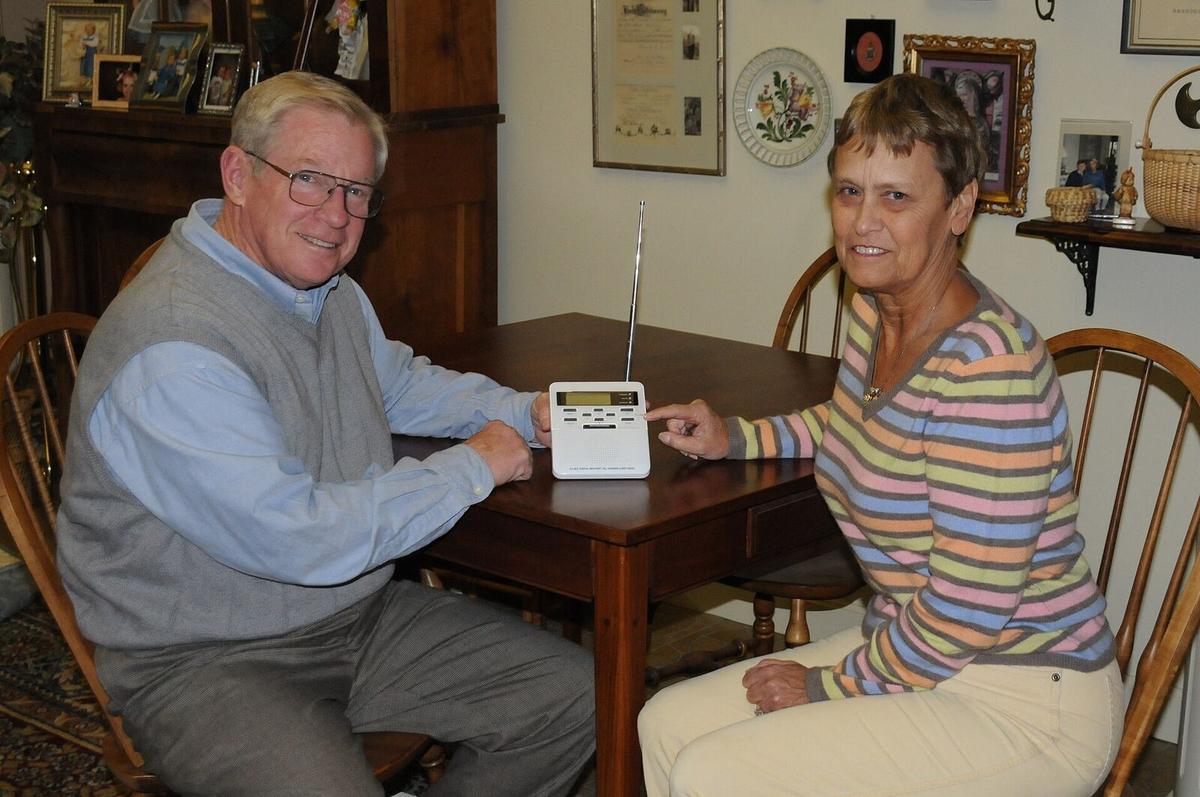 A plan is something a household sits down and agrees on, and a weather radio on the table is a good place to start. Photo by George Armstrong, FEMA, public domain, via Wikimedia Commons.
Why do texts get through when calls do not?
A voice call needs a steady connection held open for as long as you talk. A text is a tiny piece of data that can wait in line for a gap and slip through. When a network is overloaded, that difference decides who gets heard.
The Federal Communications Commission (FCC) and the Federal Emergency Management Agency (FEMA) publish joint tips that say the same thing in official words: text messages "may go through when your call may not," though delivery can be delayed when the network is busy. The same page gives four habits worth learning:
- Keep non-emergency calls short, or do not make them, so the network has room for emergency traffic.
- If a call fails, wait 10 seconds before redialing. Rapid redialing by thousands of people adds to the jam.
- If there are no signal bars at all, turn the phone off for a while. A phone hunting for a tower drains its battery fast.
- Call 911 only for emergencies. In some places you can also text 911, but the FCC says a voice call is still the preferred way to reach it whenever you can make one.
So the first rule of the plan is simple. In a crisis, text first, keep it short, and say the three things that matter: who you are, where you are, and whether you are OK.
Who should be your out-of-town contact?
Pick one relative or friend who lives far enough away that the same storm, outage or earthquake will not hit them too. Everyone in the household reports to that person. The logic is that the contact's phone, power and internet are working normally, and they can sit still and keep a list while the rest of you are moving.
Ready.gov, the federal preparedness site, builds this into its plan template along with a separate "In Case of Emergency" contact. The FCC suggests saving a contact under that exact name in every phone, so a stranger or a first responder knows whom to call.
Three practical points. Ask the person first. Make sure they know how to text. Give them the full list of names and numbers, so they can pass messages between you.
Where do you meet?
Phones are only one way to find each other. A place works with no battery at all. Ready.gov's card has four lines for meeting places, and each answers a different problem:
- Indoor. A safe spot inside the home, for a tornado or similar danger.
- Neighborhood. A spot just outside, such as a neighbor's mailbox or the big tree on the corner, for a house fire. Its purpose is counting heads.
- Out of neighborhood. A library, a place of worship or a friend's house across town, for when you cannot get home or the street is closed.
- Out of town. A relative's home in another city, for an evacuation.
Add one rule the card does not print: how long to wait. My rule is that whoever arrives first waits until an agreed hour, leaves a note, then moves to the next place on the list.
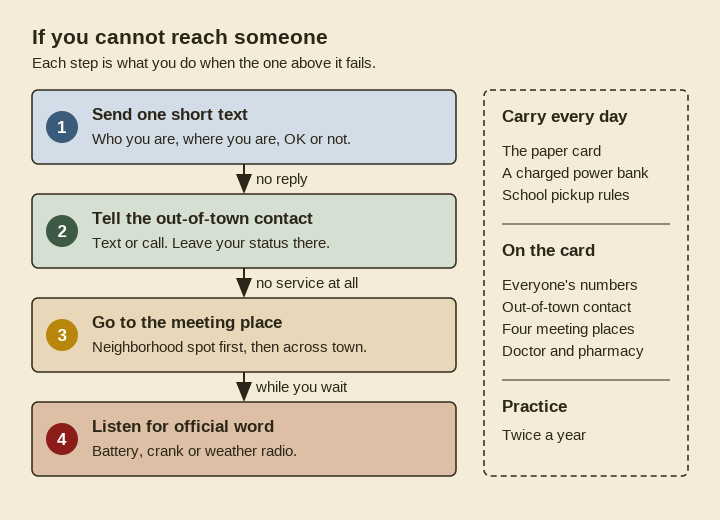 The plan is a ladder: each step is what you do when the one above it fails.
What goes on the paper card?
Ready.gov offers a free fillable card, FEMA publication P-1095, meant to be folded and carried. Print one for every wallet, purse, school bag and glove box. Paper matters because the numbers you need are stored in the one device that just stopped working. Few of us can still recite more than one or two phone numbers from memory.
Here is a filled-in example. Every name and number below is made up.
| Line on the card | Example entry |
|---|---|
| Household | The Sample family, 123 Example Street, Anytown |
| Home phone | 555-0100 |
| Pat Sample (parent) | Mobile 555-0101. Allergic to penicillin |
| Jordan Sample (parent) | Mobile 555-0102. Work: Anytown Clinic, 555-0110 |
| Alex Sample (age 15) | Mobile 555-0103. Anytown High, office 555-0120 |
| Sam Sample (age 8) | Anytown Elementary, office 555-0130. Pickup: Pat, Jordan or Aunt Dee only, photo ID |
| In Case of Emergency contact | Dee Placeholder (aunt), 555-0140 |
| Out-of-town contact | Grandpa Lou Sample, Otherville, 555-0150. Text first |
| Indoor meeting place | Basement, under the stairs |
| Neighborhood meeting place | The mailbox at number 124, across the street |
| Out-of-neighborhood place | Anytown Public Library, front steps, 400 Main Street |
| Out-of-town place | Grandpa Lou's house, 9 Sample Lane, Otherville |
| Other numbers | Doctor 555-0160. Pharmacy 555-0170. Electric company 555-0180 |
The real card also has room for insurance policy numbers, a veterinarian and utilities. Fill in what applies and leave the rest.
How will you hear official warnings?
Three systems reach you without your asking. Know all three.
Wireless Emergency Alerts (WEA). These are the loud, buzzing messages that take over your phone screen. The FCC says the system has been used nearly 96,000 times since it began in 2012. Alerts are free, you do not sign up, and they are sent to every capable phone in the affected area, including visitors. They are also not ordinary text messages: the FCC says many carriers send them with a technology separate from calls and texts. To receive one, the phone must be on, not in airplane mode, and in range of a participating tower.
You can switch most alert types off, so check that nobody has. On an iPhone, Apple's instructions are to open Settings, tap Notifications, scroll to the bottom and look under Government Alerts. On Android, Google's help page points to Settings, then Notifications, then Wireless emergency alerts. Wording varies by phone maker.
The Emergency Alert System. This is the interruption on broadcast television and radio. It is the reason a battery or hand-crank radio belongs in the house. Ready.gov's basic kit list includes one, along with extra batteries.
NOAA Weather Radio. A network of more than 1,000 transmitters broadcasts National Weather Service warnings and forecasts all day, every day. A receiver built to the Public Alert standard sounds an alarm when a warning is issued for your county, even at 3 a.m. with the volume down. The Weather Service says home receivers start at about $20. I think it is the best value on this page.
How do you keep the phones alive?
A phone with no charge is a paperweight with your contacts locked inside.
- Turn on low power mode early, dim the screen, and close what you are not using.
- Keep a charged power bank for each adult. As an example of the math: if a phone's battery is 4,500 milliamp-hours, a 10,000 milliamp-hour bank is about two refills on paper, and somewhat less in practice because some energy is lost as heat.
- A car is a charger. The FCC adds a caution: do not run the engine in a closed garage, because of carbon monoxide.
- Know your home phone. The FCC notes that phone service delivered over an internet connection stops in a power outage unless it has a backup battery, and that many cordless handsets need wall power too.
What about satellite texting, radios and mesh?
Satellite texting is the biggest change in years, and it is still settling. Many recent phones can now send a text by satellite when there is no cell signal and no Wi-Fi. As of November 2026, the makers' and carriers' own pages describe it this way:
- One major phone maker's support pages say every model from a named generation onward can text emergency services by satellite and can send regular messages by satellite as well. The feature is free for two years after the phone is activated.
- Another maker's help page says its phones from one recent generation onward (with one budget model excluded) can reach emergency services by satellite.
- One national carrier sells satellite texting as part of some plans or as a monthly add-on, says it works automatically on most phones from the last four years, and offers text to 911 by satellite to anyone with an eligible phone, including customers of other carriers who register.
All of them list the same kind of limits. You must be outdoors with a clear view of the sky. One maker says a message can take 30 seconds under ideal conditions and several minutes under trees. Service "may be delayed, limited, or unavailable," in one carrier's words.
What to do with this: look up your own phone model and plan today, run the demo mode if your phone has one, and write on the card whether each family member's phone can do it. Treat it as a strong backup that needs open sky and a charged battery.
Radios sit on the lower rungs of the ladder, for households that want them. Two-way radios let a family or a street talk over short distances with no network at all. Which ones are legal to use, and how, is the subject of "Setting Up a Civilian Handheld Radio Such as a Baofeng." Small text-messaging mesh radios are covered in "Meshtastic and Open Source Mesh Networks: Texting Without a Cell Tower." Both are useful only if the plan says which channel and what time to listen. For example: "radios on at the top of every hour for five minutes." What to pack and whether to stay or leave are covered in "How to Build a Go Bag You Can Actually Carry" and "Bugging In: When Staying Home Beats Leaving."
Schools, workplaces, and people who need a different channel
A school will not hand a child to whoever shows up, and in an emergency that is exactly what you want. Ready.gov's card has a section for school, childcare, caregiver and workplace plans. Ask each one three questions now. How will you tell parents what is happening? Where do students go if the building is evacuated? Who is allowed to pick up my child, and what do they need to show? Put the answers on the card. Do the same for a parent in assisted living.
Then adapt the plan to the people in it. Ready.gov's guidance for people with disabilities suggests a weather radio with a text display and a flashing alert for someone who is deaf or hard of hearing, plus pen and paper for talking with people who do not sign. For someone who is blind or has low vision, label supplies in Braille or large print. For anyone, printed cards that tell a first responder how best to communicate with you are worth carrying. If the household's first language is not English, write the card in both languages. Ready.gov publishes the card in several.
Take two households. A family of four on a school day has people in four buildings: the plan's hard part is the 8-year-old's pickup rule and the teenager knowing to text Grandpa Lou. A person who lives alone has a different hard part: nobody will notice they are missing. For them the out-of-town contact matters most, along with one neighbor who agrees to knock.
What to remember
- Text first. Short texts get through when calls do not.
- Choose one out-of-town contact and tell everyone to report there.
- Agree on four meeting places: indoor, neighborhood, across town and out of town.
- Put it on paper. One card in every wallet and school bag.
- Check that emergency alerts are switched on, and own a weather radio and a battery or crank radio.
- Practice. My rule is twice a year, when the clocks change.
Practice can be ten minutes at dinner: everyone texts the out-of-town contact, the youngest points to the neighborhood spot, and someone checks that the cards are still in the bags. The first run tends to turn up a wrong number.