Articles & BlogBy Trapper W. Brown10 min read
A meme is an idea that spreads by being copied, and usually changed a little on the way. Today the word mostly means a picture with a caption or a short clip that thousands of people remake in their own version. The habit is far older than the phone in your hand.
It is worth knowing the history for a practical reason. Memes are now one of the main ways people joke, argue, advertise and campaign. Someone who understands how they are made and why they travel is harder to fool and has more fun.
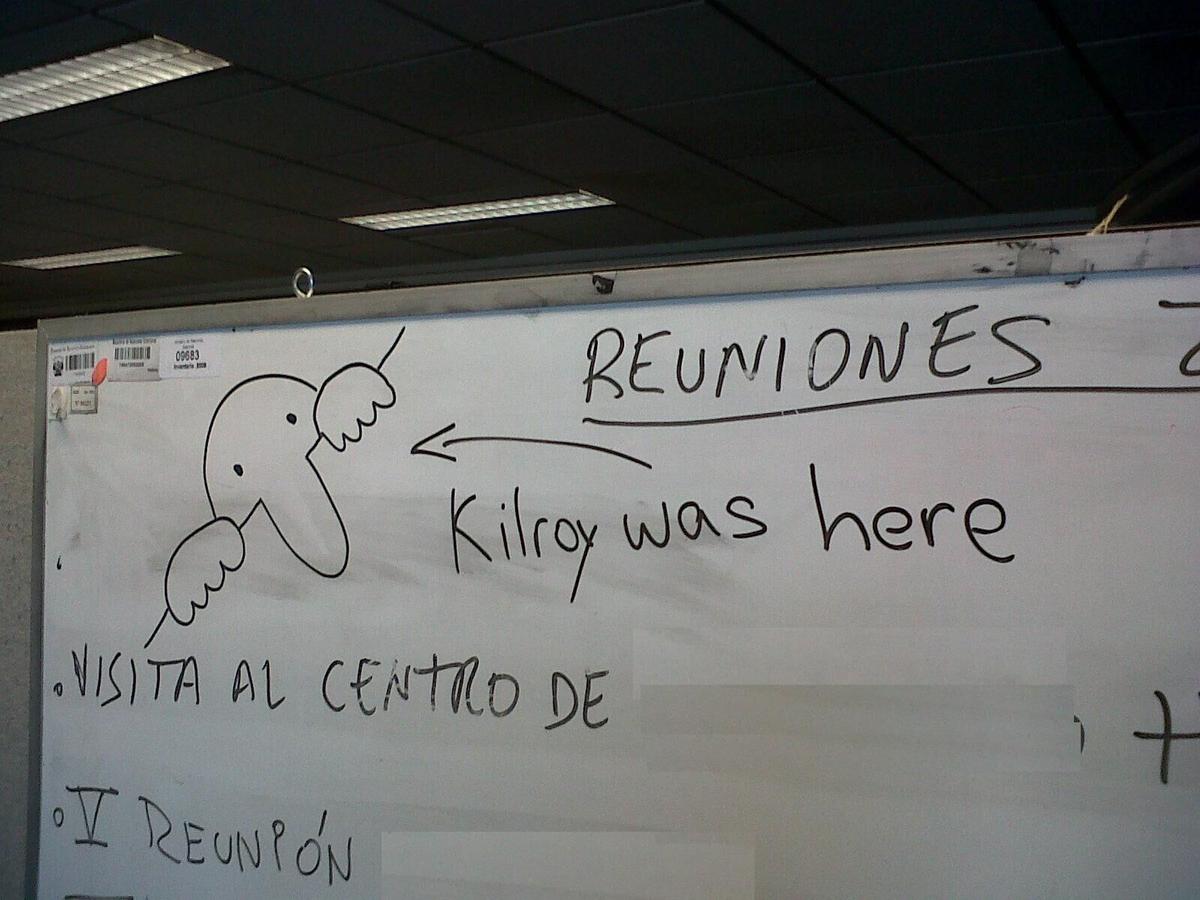 A wartime doodle, redrawn on a meeting-room whiteboard decades later. Copying with small changes is what makes a meme. Photo by Bakula, CC0, via Wikimedia Commons.
Where did the word come from?
The word is younger than the thing. According to Encyclopaedia Britannica, the term meme was introduced in 1976 by the British evolutionary biologist Richard Dawkins in his book The Selfish Gene. Britannica traces it to a Greek word meaning "imitated."
Dawkins was not writing about jokes. He wanted a name for a unit of culture that passes from person to person by imitation, the way genes pass from parent to child. A tune, a catchphrase, a way of making pots: each one gets copied, each copy can vary, and the versions that are easiest to remember and repeat crowd out the others.
The internet borrowed the word and narrowed it. In her 2013 book Memes in Digital Culture (MIT Press), the communication scholar Limor Shifman defines internet memes as groups of digital items with common characteristics, made with awareness of each other, and circulated, imitated and transformed online by many users. Britannica points out one more difference. Dawkins's memes changed by accident, like mutations. Internet memes are altered on purpose.
What did memes look like before the internet?
The best known example is a doodle. During the Second World War, American troops drew a bald man peeking over a wall with the words "Kilroy was here." The National Park Service, which runs the World War II Memorial in Washington, says the graffiti appeared first in the Atlantic theater and later in the Pacific, and became a universal sign that American soldiers had come through. Its origins, the Park Service says, are most likely a British cartoon combined with the name of an American shipyard inspector.
Two Kilroy engravings are tucked into the memorial as a nod to that generation. The Park Service's visitor page offers no map: "You have to find them yourself!"
Chain letters worked the same way, with money attached. Time magazine reported on 13 May 1935 that a "send a dime" letter had swamped Denver. You mailed a dime to the name at the top of a list of six, crossed it off, added your own name at the bottom and sent copies to five new people. If nobody broke the chain, the letter promised, you would receive 15,625 dimes, or $1,562.50. Time said the Denver post office took on more than 100 extra workers to handle the mail.
Look at what those two have in common with a modern meme. Each has a fixed frame that is easy to copy (the drawing, the list of six names), a slot for your own contribution (the wall you drew it on, your name) and a reason to pass it on. The chain letter's arithmetic also shows the catch. Five to the sixth power is 15,625, and a few more rounds would need more people than exist.
The early internet: a smiley, a baby and a bad translation
The first online meme with a birth certificate is the smiley. On 19 September 1982 at 11:44 in the morning, a Carnegie Mellon University computer scientist named Scott Fahlman posted to a campus message board. People kept mistaking jokes for serious posts, and arguments followed. He proposed marking jokes with three characters, :-), and added, "Read it sideways." The original post was thought lost until it was recovered from old backup tapes in 2002.
Fahlman's account says the convention spread within the university and then to other universities and research labs over the early networks.
Before the web took over, most of this happened on text discussion systems such as Usenet, a worldwide set of topic-based message groups. In-jokes, catchphrases and running gags moved from group to group as people quoted each other.
| When | What | Where the date comes from |
|---|---|---|
| 1935 | The "send a dime" chain letter | Time, 13 May 1935 |
| 1940s | "Kilroy was here" drawn by American troops | National Park Service |
| 1976 | Dawkins coins the word meme | Encyclopaedia Britannica |
| 1982 | The :-) smiley is proposed | Carnegie Mellon University |
| 1996 | The dancing baby animation is released | Its co-creator, Michael Girard |
| By 2000 | "All your base are belong to us" spreads on forums | ACMI, Australia's museum of screen culture |
| 2012 | First YouTube video passes one billion views | MIT Press, describing Shifman's book |
| 2017 | The Library of Congress opens its Web Cultures Web Archive | Library of Congress |
The dancing baby was a short loop of a computer-drawn infant doing a dance. Michael Girard, one of the people who made it, has said it began as a sample file showing off animation software released in 1996. It spread across the early web and then onto television, far from the software demo it was made for.
"All your base are belong to us" came from a video game. ACMI, the Australian museum of screen culture, traces the line to Zero Wing, a 1989 Japanese arcade game whose 1992 home console version had an awkward English translation. By 2000, ACMI says, the phrase was spreading across online forums.
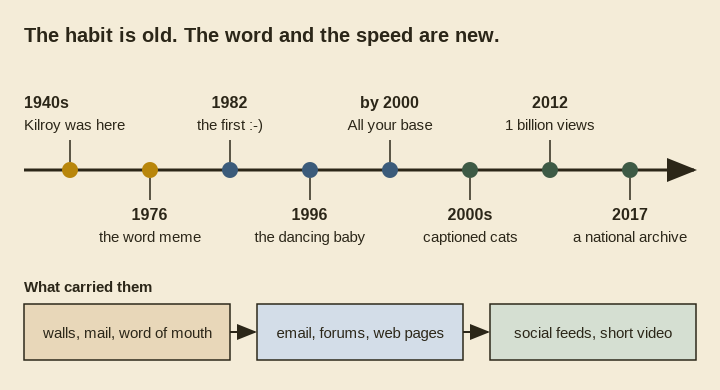 The carrier changed three times. The habit of copying with a twist did not.
Cats with captions
The format most people picture when they hear "meme" is the image macro: a photograph with bold text laid over it, usually a setup at the top and a punch line at the bottom. The picture stays the same and the words change, so anyone can make one in a minute.
The most famous early family was LOLcats: pictures of cats with captions misspelled on purpose. A study of them, by Kate Miltner in the journal First Monday in 2014, interviewed 36 LOLcat fans. It found that people mostly shared them with someone else's enjoyment in mind, and that the same joke served very different groups as a badge of belonging.
Where did these formats come from? Largely from forums and imageboards. A forum is a website where people post messages under topics. An imageboard is a forum built around posting pictures, often without names attached. Miltner's study credits one large imageboard with turning LOLcats into a recognized format before a mainstream humor site made them popular with a wider audience. These boards produced a great deal of the internet's shared humor. They also hosted plenty that was crude or cruel, and this guide leaves those examples out.
Feeds, short video, ads and campaigns
Social media changed the speed. On a forum you had to go looking. In a feed, a meme arrives because a friend pressed a share button, and the system counts every share in public.
Video followed the same path. The MIT Press description of Shifman's book notes that in December 2012 "Gangnam Style" became the first YouTube clip viewed more than one billion times, and that thousands of viewers answered with their own versions. That response is the meme. Short-video apps later built the template into the product: a sound or a dance that any user can reuse with one tap.
By 2017 the Library of Congress was treating all of this as heritage. Its American Folklife Center launched the Web Cultures Web Archive that June to preserve what the Library called "a new kind of folklore": GIFs, memes and emoji.
Once memes drew crowds, people with something to sell or promote showed up. Companies now post in meme formats because a joke that gets shared is advertising nobody had to pay to place. Political campaigns, advocacy groups and governments of every leaning use memes for the same reason: a picture and eight words travel further than a policy paper. Shifman's book treats memes as a new way for ordinary people to take part in politics, in democracies and in countries that are not. The same compression that makes a meme travel also strips out context, so a meme is a good reason to go and read more and a poor place to stop.
The newest change is in who, or what, makes them. Image and video generators can now turn a typed sentence into a finished picture, which removes the last bit of skill meme-making required. It also makes it easy to show a real person doing something that never happened. Our article Deepfakes and Voice Cloning: The Family Code Word covers that risk.
Why do some memes spread and most do not?
Researchers have tested this, and two findings hold up well.
The first is about feeling. In 2012, Jonah Berger and Katherine Milkman studied every New York Times article published over three months to see which ones were shared most. Their paper in the Journal of Marketing Research found that content stirring up high-energy emotions was shared more, whether the emotion was positive (awe) or negative (anger, anxiety). Content that left people sad, a low-energy emotion, was shared less. Being surprising, interesting or useful helped too.
The second is about luck and crowding. A 2012 study in Scientific Reports by L. Weng and colleagues looked at more than 120 million retweets from about 12.5 million users. They then built a model in which every meme was equally good and people simply had limited attention. The model still produced a few huge hits and a long tail of flops, much like the real data. In other words, a meme can go viral without being better than the ones that died. There is only so much attention, and position in the network matters.
Put together: memes that are easy to copy, leave a slot for your own twist and make you feel something strongly have an edge, and after that a good deal is chance. For example, a post that makes people angry may be shared widely, and that says nothing about whether it is accurate.
Who owns a meme?
Usually somebody does, at least in part. Under US law a photograph or a film frame is protected by copyright from the moment it is made, and adding a caption does not transfer it to you.
Most memes still circulate without trouble, partly because owners rarely object and partly because of fair use. The US Copyright Office describes fair use as a doctrine that permits the unlicensed use of copyrighted works in certain circumstances, such as criticism, comment, news reporting and teaching. Courts weigh four factors: the purpose and character of the use (including whether it is commercial), the nature of the original work, how much of it was used, and the effect on the market for the original. Uses that add something new with a different purpose, which the Office calls transformative, are more likely to be found fair.
The Office adds a caution. Courts decide these cases one at a time, and there is no formula: no percentage or amount of a work is guaranteed to be safe. Because the first factor asks about commercial use, I think a joke shared among friends sits in a different position from the same image printed on shirts for sale.
AI adds a twist. In a report published on 29 January 2025, the Copyright Office concluded that AI output can be protected only where a human author determined enough of its expressive elements, and that typing a prompt alone does not qualify. So a meme made entirely by a generator may belong to no one, while the photograph it imitates may still belong to someone.
None of this is legal advice, and the Copyright Office says it cannot give individual advice either.
What to remember
- The word meme dates to 1976. The practice of copying a joke with a twist is much older, as Kilroy shows.
- A meme has a fixed frame, a slot for your own change and a reason to pass it on.
- The smiley of 19 September 1982 is the earliest online example with a precise date.
- Strong, high-energy emotion helps content spread. So does plain luck.
- A caption does not make a picture yours. Fair use is judged case by case.
- A meme compresses an argument. Check the full story before you share one about real events.
Next time a meme makes you laugh, look for the frame and the slot. Then, if you are near the National Mall, go and find the two Kilroys.