Articles & BlogBy Trapper W. Brown6 min read
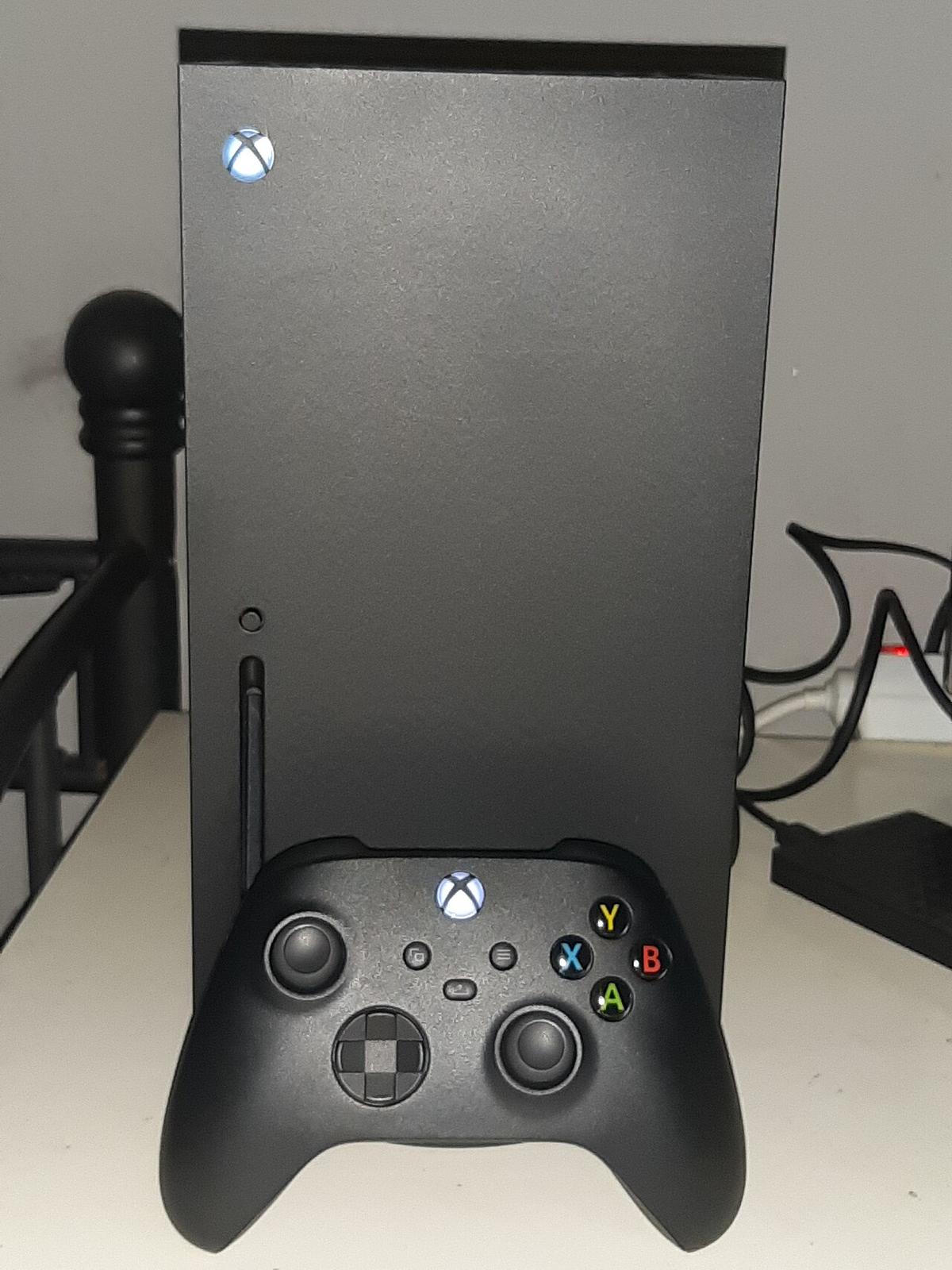 An Xbox Series X console and controller. Photo by Raimond Spekking, CC BY-SA 4.0, via Wikimedia Commons.
Grand Theft Auto VI launched on PlayStation 5 and Xbox Series X/S with no announced PC release date. Almost immediately, a leaked Xbox archive circulated online, and reverse engineers began trying to make the console files run on Windows. Social media posts quickly claimed a playable PC port was around the corner. That is not what happened. Here is an objective look at what was leaked, what the technical barriers actually are, how the publisher responded, and why downloading "GTA VI PC" archives is a serious security risk.
What was leaked?
A source using the name "Cyberleek" distributed an archive of roughly 209 GB claiming to be a November Xbox Series X/S build of Grand Theft Auto VI. The initial release did not include the main executable file, which meant anyone who downloaded it could only inspect game assets, not run code. The executable was released later, which is when porting attempts started in earnest.
Because Rockstar Games has not released an official PC version, the leak drew immediate attention from two very different groups: reverse engineers curious about how far modern Xbox-to-Windows translation can go, and opportunistic piracy and malware sites looking for high-volume search traffic.
Why did people think an Xbox build could run on PC?
At first glance, the idea sounds plausible. Unlike older consoles that used custom PowerPC or Cell processors, the Xbox Series X/S runs on an AMD Zen 2 x86-64 processor and an RDNA 2 graphics chip, the same broad hardware family found in millions of Windows PCs. Its operating system is also built on a Windows core, and its graphics layer is based on DirectX 12.
That shared foundation is why open-source projects like "Leonida" attempted static recompilation: taking the compiled Xbox binary, translating or stubbing out console-specific calls, and trying to launch it on a standard Windows machine.
In practice, sharing an x86-64 CPU is only the first layer of the stack. Five console-specific barriers sit between a raw Xbox dump and a playable Windows game.
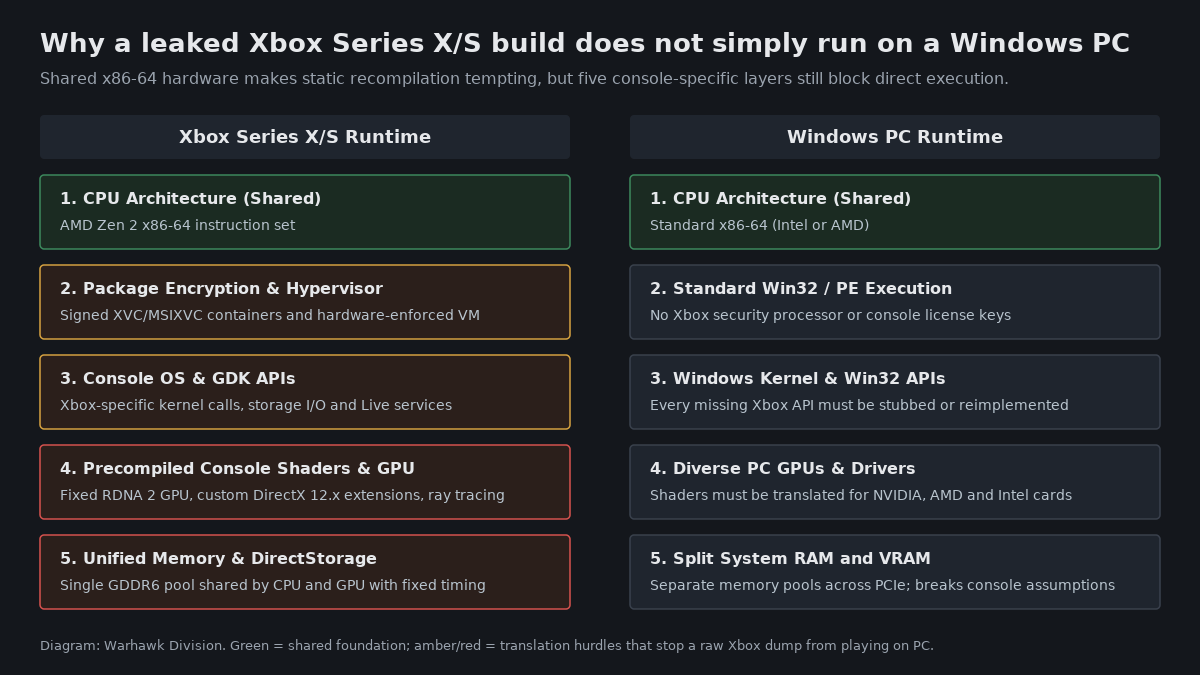 Why a leaked Xbox Series X/S build does not simply run on Windows. Diagram by Warhawk Division.
- Package encryption and the Xbox hypervisor. Retail Xbox games are packaged in signed, encrypted containers (XVC/MSIXVC) and run inside a hardware-enforced virtual machine. A Windows PC does not have the Xbox security processor or console license keys.
- Console OS and GDK APIs. Even though the Xbox OS shares DNA with Windows, games call console-specific kernel, storage, input, and Xbox Live APIs. Every one of those calls has to be stubbed out or reimplemented from scratch on Windows.
- Precompiled shaders and fixed GPU targets. On a console, developers compile graphics shaders for one exact RDNA 2 chip and use Xbox-specific DirectX 12 extensions. On PC, those shaders have to be translated cleanly across dozens of NVIDIA, AMD, and Intel driver stacks.
- Unified memory versus split RAM and VRAM. An Xbox Series X/S shares one pool of fast GDDR6 memory between the CPU and GPU. A PC splits system RAM from graphics card VRAM across the PCIe bus. A massive open-world, ray-traced game built around unified memory assumptions breaks quickly when forced onto split memory.
- Scale and stability. Even if a static recompiler gets past startup, keeping a 200+ GB open-world engine stable through streaming assets, physics, audio, and ray tracing takes months or years of engineering, not a weekend patch.
What actually booted?
Reports from the reverse-engineering community and tech outlets show that early recompilation attempts reached black screens, brief audio cues, and initial legal or settings screens. That is a notable technical milestone for researchers, but it is nowhere near a playable game. Videos or posts claiming a smooth, playable GTA VI PC build from the Xbox dump are either misleading or outright fake.
How Take-Two and Rockstar responded, and what happened on 24 November 2026
Take-Two Interactive and Rockstar Games moved quickly to shut down distribution and community coordination. Before it was pulled down, Project Leonida had grown into the largest hub for the effort, with a primary Discord server approaching 180,000 members.
On 24 November 2026, reports confirmed that Take-Two and Rockstar targeted the operation, leading to the sudden disappearance of the Leonida GitHub repository and the termination of its main Discord server. Shortly afterward, the project's lead administrator, known online as NotRexed (who publicly stated he is a 15-year-old developer), announced he was stepping away from the project entirely, citing both the takedown and personal stress from school, sports, and intense community pressure.
From a legal standpoint, distributing copyrighted console binaries and keys is straightforward copyright infringement, regardless of whether the goal is research or piracy. Expecting a public, community-maintained PC port of a flagship release to survive on GitHub or Discord was never realistic.
What is happening now, and when is the official PC version coming?
The shutdown of Project Leonida did not end the chatter. Smaller, fragmented groups and independent developers have continued experimenting through Telegram channels and smaller Discord servers, often relying on AI-assisted coding tools ("vibecoding") to stub out missing Xbox calls. Community trackers such as PortWatchVI have even appeared to monitor dozens of separate projects chasing basic milestones like rendering the open world or stabilizing frame rates. None of them has produced a stable, playable PC build.
Meanwhile, Rockstar Games has not commented publicly on the leaks or takedowns, and no official PC release date has been announced. However, industry reporting from GamesBeat indicates Rockstar is internally targeting Q1 2027 for an official PC release, which would be a much shorter wait than the multi-year gaps on previous Rockstar titles.
The cybersecurity risk: fake "GTA VI PC" downloads
Whenever a major game has a console-only launch and a high-profile leak, infostealer campaigns follow within hours. Attackers upload trojanized archives, fake "Leonida recompilers," and password-protected ZIP files to YouTube descriptions, Telegram channels, and SEO-spam download sites.
Because the real Xbox dump is over 200 GB, attackers often distribute a small 50 MB "installer" or "patcher" that claims to download the rest. Running an unsigned executable from an anonymous piracy thread is one of the fastest ways to lose browser session cookies, saved passwords, Discord tokens, and crypto wallets.
If you want to understand how those attacks work and why Windows flags them, see our articles "Windows protected your PC: What the SmartScreen Warning Means" and "Your Account Was in a Breach: What to Do Next."
Where I land
- A roughly 209 GB Xbox Series X/S build of GTA VI leaked online, followed by its executable, sparking static recompilation attempts like Project Leonida, whose Discord briefly approached 180,000 members.
- Shared x86-64 hardware makes the idea look simple, but console APIs, precompiled shaders, and unified memory assumptions mean early efforts only reached black screens, audio cues, and initial legal/settings screens, not a playable game.
- On 24 November 2026, Take-Two and Rockstar took down Project Leonida's GitHub repository and Discord server, and its lead developer stepped away. Fragmented Telegram and Discord groups continue to experiment, but no playable public build exists.
- Downloading unofficial "GTA VI PC" builds, cracks, or recompilers carries a high risk of infostealer malware. With industry reports pointing to an official PC release window as early as Q1 2027, waiting for Rockstar's official release is the only safe option.
Sources (5)
- Eurogamer and PC Gamer, reporting on the 24 November 2026 Project Leonida takedown and fragmented porting efforts, November 2026: https://www.eurogamer.net/ and https://www.pcgamer.com/
- PCMag and Overclock3D, coverage of Project Leonida's shutdown and lead developer NotRexed stepping away, November 2026: https://www.pcmag.com/ and https://overclock3d.net/
- GamesBeat, reporting on Rockstar's internal Q1 2027 target for the official GTA VI PC release, November 2026: https://venturebeat.com/games/
- Notebookcheck and TweakTown, coverage of the 209 GB Cyberleek Xbox archive, PortWatchVI trackers, and boot attempts, November 2026: https://www.notebookcheck.net/ and https://www.tweaktown.com/
- Photo file page, Wikimedia Commons: https://commons.wikimedia.org/wiki/File:Xbox_Series_X_mit_Controller.jpg