Articles & BlogBy Trapper W. Brown12 min read
For anyone who has searched their own name, found their address and their relatives on a site they never signed up for, and wondered how it got there. Checked against the official pages on 15 November 2026.
A data broker is a business that collects information about people and sells it, without dealing with those people directly. California's privacy agency puts it in one line: a business that gathers and sells consumer information that the consumer did not give it. You know the store, the app and the county office that hold a piece of your record. You have probably never heard of the company that bought the pieces and joined them.
That matters for two reasons. The first is safety: an address, a phone number and a list of relatives are the raw material for a scam call, and for someone trying to find a person who does not want to be found. The second is that you have more say than you may think. Some states now make brokers register, one state runs a free deletion service, and many sites will remove a listing if you ask. This article covers what those tools do and where each one stops.
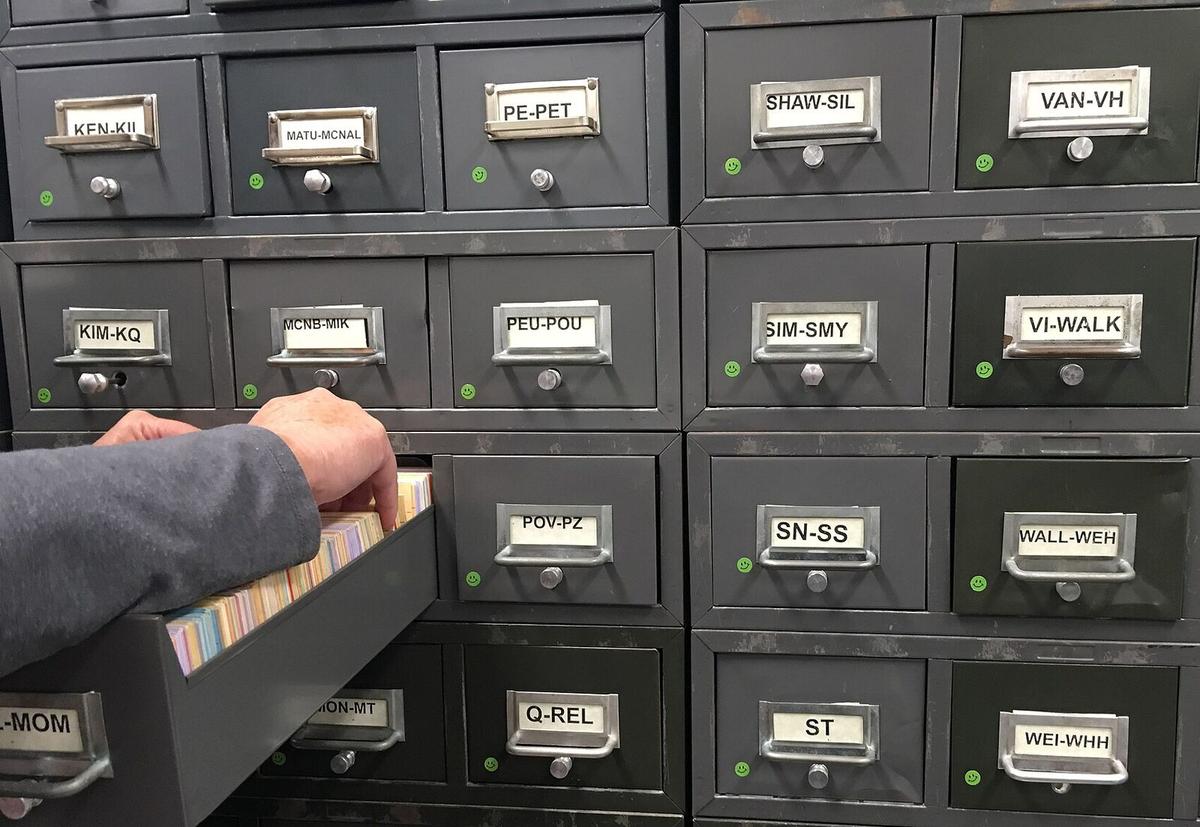 Public records, like these land record cards in a Vermont town clerk's office, are one of the places a broker's file starts. Photo by MarkBuckawicki, CC0, via Wikimedia Commons.
What does a data broker know about you?
The Federal Trade Commission studied nine data brokers and published the results on 27 May 2014, with recommendations to Congress. It found that brokers collect and store billions of data elements covering nearly every U.S. consumer, usually without the consumer knowing. One of the nine held 700 billion data elements. The FTC also found that brokers draw inferences, which are guesses built from the raw data, including potentially sensitive ones about ethnicity, income and religion.
California's privacy agency, which now calls itself CalPrivacy, lists what brokers collect today: Social Security numbers, precise location, browsing history, email addresses, phone numbers, interests, health-related information and shopping habits. It lists the buyers too: advertisers and marketers, employers and recruiters, political campaigns, retailers, landlords and debt collectors.
The kind you are most likely to meet is the people search site. The FTC describes these as a type of data broker that builds a report from public records, public social media profiles and information bought from other brokers. A report can hold your age, current and past addresses, property sales, marital status, education and work history, court records, and the names and addresses of family members.
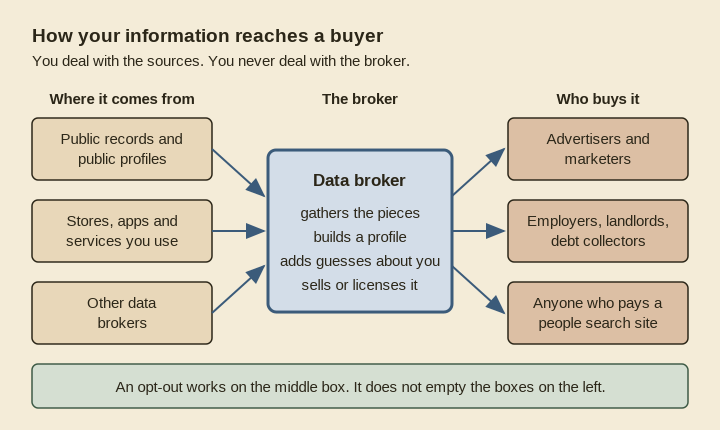 You deal with the sources on the left, and the broker in the middle is the part an opt-out reaches.
Is there a list of who the brokers are?
In four states, yes. CalPrivacy says California, Oregon, Texas and Vermont require data brokers to register. Each registry is public and free to search.
| State | Who runs the registry | What its page says, read 15 November 2026 |
|---|---|---|
| California | CalPrivacy (California Privacy Protection Agency) | Brokers register each January and pay a $6,000 fee this year. The same agency runs the deletion platform described below. |
| Vermont | Secretary of State | Brokers register between January 1 and January 31. The page links to a Data Broker Search. |
| Texas | Secretary of State | Registration costs $300 and lasts one year. The office says it files registrations and has no authority to regulate or investigate a broker's practices. |
| Oregon | Division of Financial Regulation | Registration has been required since January 1, 2024, and costs $600. Each broker must supply a short description of how to opt out, which the division publishes. |
Two cautions. A registry is a list of who signed up. It does not tell you that a company holds your record, or that a company missing from the list is not a broker. And state law here moves quickly. Vermont's legislature site already shows a second version of its definition of "data broker" that takes effect on January 1, 2027. Read the state's own page on the day you use it.
There is no federal registry. In December 2024 the Consumer Financial Protection Bureau proposed a rule that would have applied the Fair Credit Reporting Act, the law that governs credit reports, to information sold by data brokers. The Bureau withdrew the proposal in a Federal Register notice on May 15, 2025, saying a rule was not necessary or appropriate at this time.
The FTC still brings cases one at a time. For example, on May 4, 2026, it announced a proposed court order against a company it describes as an Idaho-based data broker, and that company's subsidiary. The FTC had alleged that the companies sold location data from hundreds of millions of mobile devices that could be used to trace where people went. The proposed order bars them from selling or sharing sensitive location data unless the consumer gives affirmative express consent.
How does California's deletion platform work?
California's Delete Act, passed in 2023, told the state to build one place where a resident could ask every registered broker to delete their data. CalPrivacy calls it the Delete Request and Opt-out Platform, or DROP. Everything in this section is how the agency's own pages describe it on 15 November 2026.
- It is free. The agency says it will never charge to use DROP.
- It is for California residents. Residency is checked through the state's California Identity Gateway.
- It opened on January 1, 2026. Brokers have been required to process requests since August 1, 2026, and must come back for new requests at least every 45 days.
- One request goes to more than 600 registered brokers.
You need only a name, a date of birth and a ZIP code. You may add email addresses, phone numbers, a phone's advertising ID, a connected TV's ID and a vehicle identification number, and the agency says more detail makes a match more likely. DROP hashes what you enter, which means it turns each item into a scrambled code, so brokers compare codes and do not see the original.
When you submit, you get an 8-digit DROP ID. Keep it and do not share it. It is how you check your status later, and the agency says a status can take up to 90 days to appear. Each broker reports one of five results.
| Status | What CalPrivacy says it means |
|---|---|
| Deleted | The broker matched you and deleted the personal information it is not exempt from deleting |
| Exempted | The broker has information about you and the law lets it keep all of it |
| Opted-out | The broker could not make an exact match, still has the data, and can no longer sell or share it |
| Record not found | The broker has nothing on you, or could not find you with what you gave |
| Pending | The broker has not processed the request yet |
As a worked example, take a California resident who submits a request on 15 November 2026. Brokers must collect new requests at least every 45 days, so each one should have picked it up by 30 December 2026. Counting the agency's 90 days from the day of the request gives 13 February 2027 as a reasonable date to check the status. The agency's timeline also says that by November 2026 every broker in DROP should have finished its first cycle, so the system is past its start-up phase. After the first pass the request keeps working. The agency says DROP is ongoing, and brokers must re-check and delete new matching data at least every 45 days.
A parent can submit for a child, and a family member can submit for an elderly relative. If you are helping a parent, "Protecting an Older Parent From Fraud" covers the rest of that job.
How do you opt out by hand?
If you do not live in California, or you want a listing gone this week, you ask each site yourself. The FTC's advice on people search sites says you can opt out of many of them on your own, for free, one at a time. Its steps are short:
- Search for yourself on people search sites. Try your name with your city, and old addresses.
- Follow each site's own opt-out process.
- Check back from time to time for new listings.
Three habits make this less painful. Keep a simple log: site, date, what you asked for, and the confirmation. Give a site only what it needs to find your listing, and consider a separate email address for these requests. And use the registries: Oregon publishes each registered broker's opt-out instructions, and the Texas page says a broker with a website must post a notice on it.
For a household, the arithmetic is worth doing first. Say a family of four finds listings on ten sites, and each request takes about ten minutes. That is 40 requests and close to seven hours, which is an evening a week for a month. A sensible order, in my view, is the adults first and the listings that show a current address before the rest.
Watch out
Some companies sell removal as a subscription. The FTC notes you can do it yourself for free, and suggests that before you pay you ask how many sites the service covers, whether it tells you which sites it opted you out of, and how often it checks again. My own rule: be wary of any site that asks for more information to remove you than it already shows about you.
What about the credit card offers in the mail?
Those come from a different list. The FTC explains that a prescreened offer arrives because a company asked a credit bureau for a list of people whose credit reports meet its criteria. Prescreening does not hurt your credit score.
The credit bureaus run one official opt-out, and the FTC gives two ways to reach it: optoutprescreen.com or 1-888-5-OPT-OUT (1-888-567-8688). You can opt out for five years, or permanently. The permanent choice requires you to sign and return a form called the Permanent Opt-Out Election form. You will be asked for your name, address, Social Security number and date of birth, so type the address yourself and do not follow a link from an email. The FTC says requests are processed within five days, though offers already in the pipeline may keep arriving for several weeks.
This opt-out stops offers. It does not stop anyone from opening credit in your name, which is the job of a credit freeze, and "Credit Freezes and Identity Theft: A Step by Step Guide" walks through that.
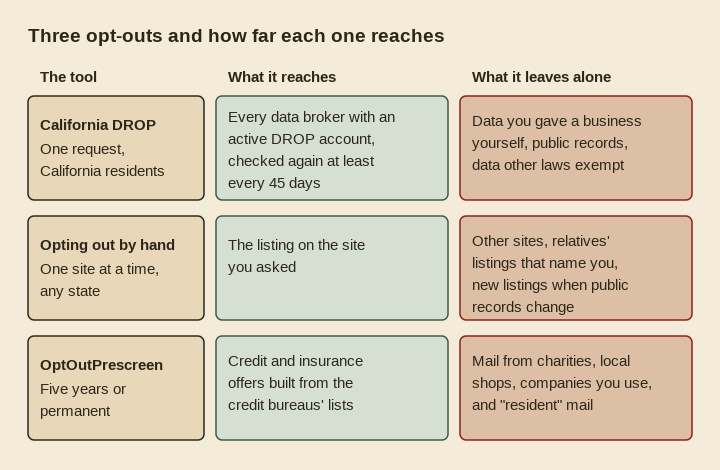 Each opt-out covers one kind of list, so most people need more than one.
What does removal not fix?
Opting out is worth doing, and it has limits that the official pages state plainly.
Public records stay public. The FTC says opting out of a people search site does not remove your information from government records, and a listing can come back when those records change. CalPrivacy says the same of DROP: publicly available data, such as vehicle or real estate ownership or voting records, is not deleted.
Data you handed over yourself stays where you put it. DROP does not reach what the agency calls first-party data, the information you gave a business directly when you opened an account. You can still ask that business to delete it, as a separate request.
Other laws carve out whole categories. CalPrivacy lists patient health information covered by HIPAA, information covered by the Fair Credit Reporting Act, and financial information covered by the Gramm-Leach-Bliley Act as exempt from DROP.
Other people's listings still name you. The FTC notes your details may still appear in a relative's or neighbor's report.
What already leaked is still out. No opt-out recalls a password or a Social Security number exposed in a breach. "Your Account Was in a Breach: What to Do Next" covers that, and "Text and Phone Scams: The Fake Bank, the Fake Delivery, the Fake Grandchild" covers the calls that follow.
What to remember
- A data broker sells information about you that it did not get from you. People search sites are the kind most readers will find first.
- California, Oregon, Texas and Vermont keep public registries of brokers. Each state's page is the place to check the current rules.
- California residents can use DROP for free: one request, more than 600 brokers, re-checked at least every 45 days. Save the 8-digit DROP ID.
- Everyone else can opt out by hand, one site at a time, at no cost. Keep a log and check back.
- Prescreened credit and insurance offers have their own opt-out at
optoutprescreen.comor 1-888-567-8688, for five years or permanently. - No opt-out removes public records, data you gave a company yourself, or anything already exposed in a breach.
Whether any of this should be the individual's job at all is a fair question, and "Privacy Is Not for People With Something to Hide" argues that side of it. In the meantime, an hour with the list above removes the listings that are easiest for a stranger to find.
Sources (14)
- California Privacy Protection Agency (CalPrivacy), "Delete Request and Opt-out Platform (DROP)", read 15 November 2026
- CalPrivacy, "How DROP works", read 15 November 2026
- CalPrivacy, "Personal information and data brokers", read 15 November 2026
- CalPrivacy, "About DROP and the Delete Act", read 15 November 2026
- California Privacy Protection Agency, "Information for Data Brokers", read 15 November 2026
- Vermont Secretary of State, "Data Broker", read 15 November 2026
- Vermont General Assembly, 9 V.S.A. § 2430, "Definitions", read 15 November 2026
- Texas Secretary of State, "Data Brokers", read 15 November 2026
- Oregon Division of Financial Regulation, "Data Broker registry", read 15 November 2026
- Federal Trade Commission, "FTC Recommends Congress Require the Data Broker Industry to be More Transparent and Give Consumers Greater Control Over Their Personal Information", 27 May 2014
- Federal Trade Commission, "What To Know About People Search Sites That Sell Your Information", July 2022
- Federal Trade Commission, "What To Know About Prescreened Offers for Credit and Insurance", November 2023
- Federal Trade Commission, "FTC to Ban Kochava and Subsidiary from Selling Sensitive Location Data to Settle Charges They Sold Location Data Linked to Millions of Mobile Devices", 4 May 2026
- Consumer Financial Protection Bureau, "Protecting Americans From Harmful Data Broker Practices (Regulation V); Withdrawal of Proposed Rule", Federal Register, 15 May 2025