Articles & BlogBy Trapper W. Brown6 min read
For anyone with a front door to look after, at home or at a small office.
What is the one thing that keeps a building safe? There isn't one. A lock can be left open. A camera records a problem without stopping it. An alarm is only as useful as the person who answers it.
People who protect buildings for a living gave up on the perfect single measure a long time ago. They think in layers: deter, detect, delay, respond. Each layer does one small job, and each one covers for the others on the day they fall short. The same four words work on a house and on a ten-person office, and most of what they ask for costs very little.
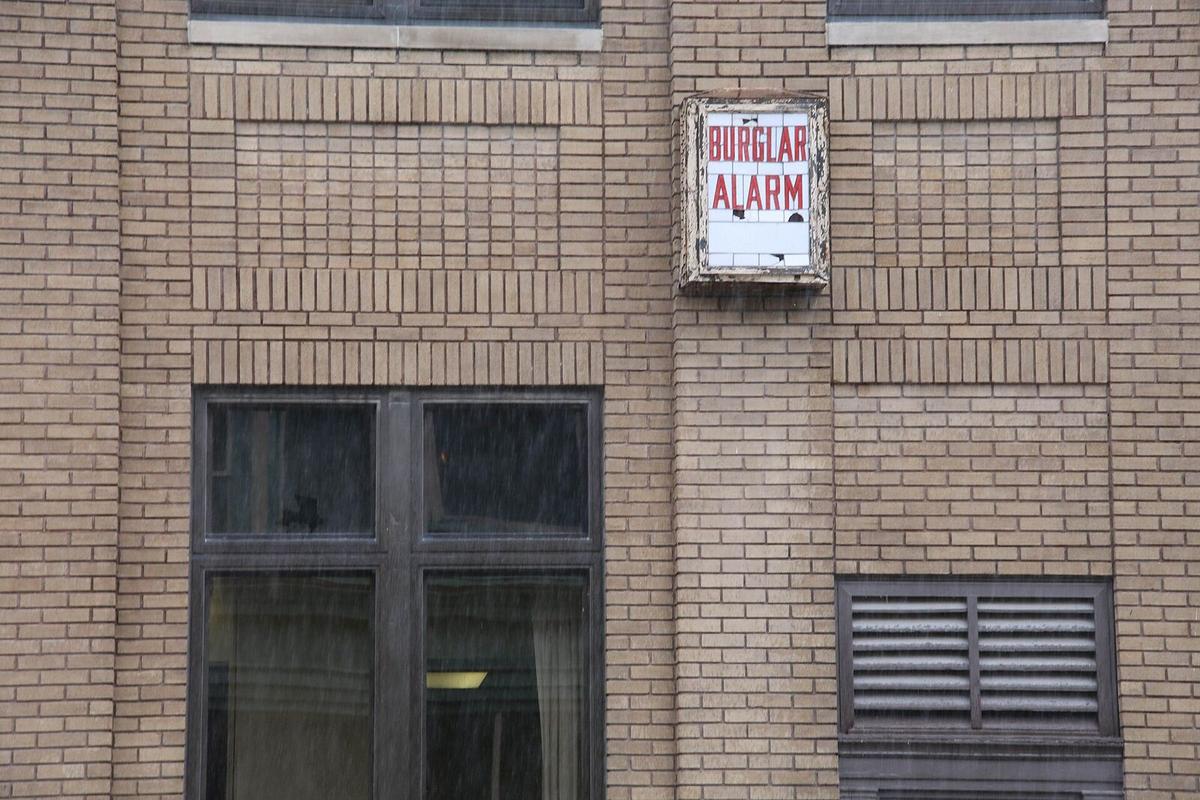 The sign on the wall is one layer, and the window below it is another. Photo by Paul Sableman, public domain, via Wikimedia Commons.
Why is one measure never enough?
Because every measure fails sometimes. Doors get propped open on hot days. Batteries die. People forget. If you rely on one thing, the day it fails is the day you have nothing.
Layers change the question you ask. You stop asking "is this lock good enough?" and start asking "what happens after this fails?" A layer does not have to be perfect. It has to buy one of two things: time or attention. Time, so that getting in takes longer than someone is willing to stand there. Attention, so that somebody notices while it is still happening.
| Layer | Its job | What it buys |
|---|---|---|
| Deter | Make the place look like more trouble than it is worth | The attempt never starts |
| Detect | Notice that something is happening | Attention |
| Delay | Slow down anyone who keeps going | Time |
| Respond | Bring a person who can act | An end to it |
Security+ teaches the same idea for computer networks under the name defense in depth, and the idea was borrowed from buildings in the first place.
Deter: more trouble than the place next door
Deterrence does its work before anything happens. Someone deciding whether to try a door looks at the place first, and what they see either invites them or sends them along.
At home, that means lights that come on at dusk or when something moves, shrubs trimmed low enough that the door and windows can be seen from the street, and the ordinary signs that someone lives there and pays attention: mail collected, bins brought in, a neighbor who waves.
At a small office, it means a lit entrance and a lit lot, a front desk that faces the door, a sign saying the premises are monitored, and a back door that is not hidden behind stacked pallets. A person who can be seen from the street has a reason to keep walking.
Deterrence has a limit, and you should know it. It only works on someone who is weighing the odds, and you never find out how often it worked. That is why it is the first layer and never the only one.
Detect: knowing that something is happening
If someone keeps going anyway, the next job is to know about it. Detection is anything that turns a quiet event into a noticed one.
At home, that is a sensor on a door or window, a motion light, a doorbell camera that sends an alert to your phone, a dog, or a neighbor who knows which cars belong in your drive. At the office, it is alarm contacts on the doors, a camera on each entrance, a sign-in sheet for visitors, and staff who are comfortable asking a stranger in the hallway, "Can I help you find someone?"
That last one costs nothing, and I would put it ahead of most hardware. A person who notices and speaks up is the oldest detection there is.
Watch out
A camera that nobody watches is not a detect layer. It is a record for afterwards. If no alert reaches a person who will look at it, you have bought evidence, which is useful, but you have not bought attention.
Delay: doors, locks and the time they buy
Delay is the layer most people think of first: doors, locks, windows, fences, safes. Its job is to make getting in slow.
At home, start with what you already own. The Bureau of Justice Statistics report Victimization During Household Burglary looked at 2003 to 2007. The data is old, but the finding is hard to forget: where no one was home, entry was through an unlocked door or window in 40% of burglaries and through an open one in 17%. The delay layer was there. It was not in use.
After that come the modest upgrades: a solid exterior door, a deadbolt, a strike plate held by long screws that reach the frame, and window locks that are actually turned.
At a small office, delay also lives inside the building. The front door has to open for customers, so the locked layer moves inward: the records room, the server closet, the cash drawer, the cabinet where laptops sleep at night.
No barrier holds forever. With unlimited time and nobody watching, any door can be opened. Delay matters because detection has already started a clock.
Respond: who comes, and how fast?
This is the layer people skip, and it is the one that gives the other three their meaning. When the alarm sounds in the middle of the night, who gets the call? What do they do? How long does it take?
At home, the answer might be you, a neighbor with a key, a monitoring company, or the police through 911. At an office, add a named keyholder and a short written list of whom to call, kept where the opening and closing staff can find it.
For an ordinary person, responding does not mean confronting anyone. It means getting yourself somewhere safe, calling 911, and telling the dispatcher what you saw.
| Layer | At home | At a small office |
|---|---|---|
| Deter | Lights at dusk, trimmed shrubs, signs of life | Lit entrance and lot, a desk facing the door |
| Detect | Door sensors, doorbell camera, neighbors | Alarm contacts, cameras, staff who ask |
| Delay | Locked doors and windows, a deadbolt | Locked inner rooms, cabinets, a safe |
| Respond | You, a neighbor, a monitoring service, 911 | A keyholder, a call list, 911 |
Do your layers add up?
The layers work in order, and the test is simple. The time your delay layer buys has to be longer than the time it takes to detect and respond. A strong door with no alarm buys time that nobody uses. A loud alarm on a door that opens at a push tells you about a loss that has already happened.
Tip
Walk from the street to the thing you would least like to lose. Count what would discourage, notice, slow and answer along the way. A layer with nothing in it is where your next hour or your next dollar should go.
You can do that walk today:
- Stand at the street after dark. Can you see the door and the ground-floor windows?
- Check that every exterior door and window is closed and locked when you leave.
- Name what would alert a person if a door opened while the place was empty.
- Name who gets that alert, and ask them what they would do.
- At the office, write down who holds keys and who is called first.
- Pick the emptiest layer and add one thing to it this month.
What to remember
- No single measure protects anything. Plan for each one to fail.
- Every layer buys time or attention. Ask which one yours buys.
- Deter first, because the attempt that never starts costs you nothing.
- Detection only counts when it reaches a person.
- Locks only delay when they are locked.
- Decide who responds before you need them.
None of this asks you to turn a home into a fortress or an office into a checkpoint. It asks you to look at what you already have, find the layer with nothing in it, and fill that one first.