Articles & BlogBy Trapper W. Brown9 min readCurrent to 13 November 2026Facts only
As of 13 November 2026, five U.S. government agencies say they "are aware of malicious cyber activity targeting industrial refrigeration and cold chain monitoring systems globally." They said so in a three-page fact sheet dated 5 November 2026. The fact sheet names no victim, no product and no attacker. It describes what the actors "may" do, what "could" follow, and eight steps it urges the owners of these systems to take.
This matters outside the server room because the equipment in question keeps food, medicine and chemicals at a set temperature. The fact sheet is addressed to the organizations that own and run that equipment, not to households. This article reports what the document says and stops where it stops. Check the official page for changes, because agencies revise these notices.
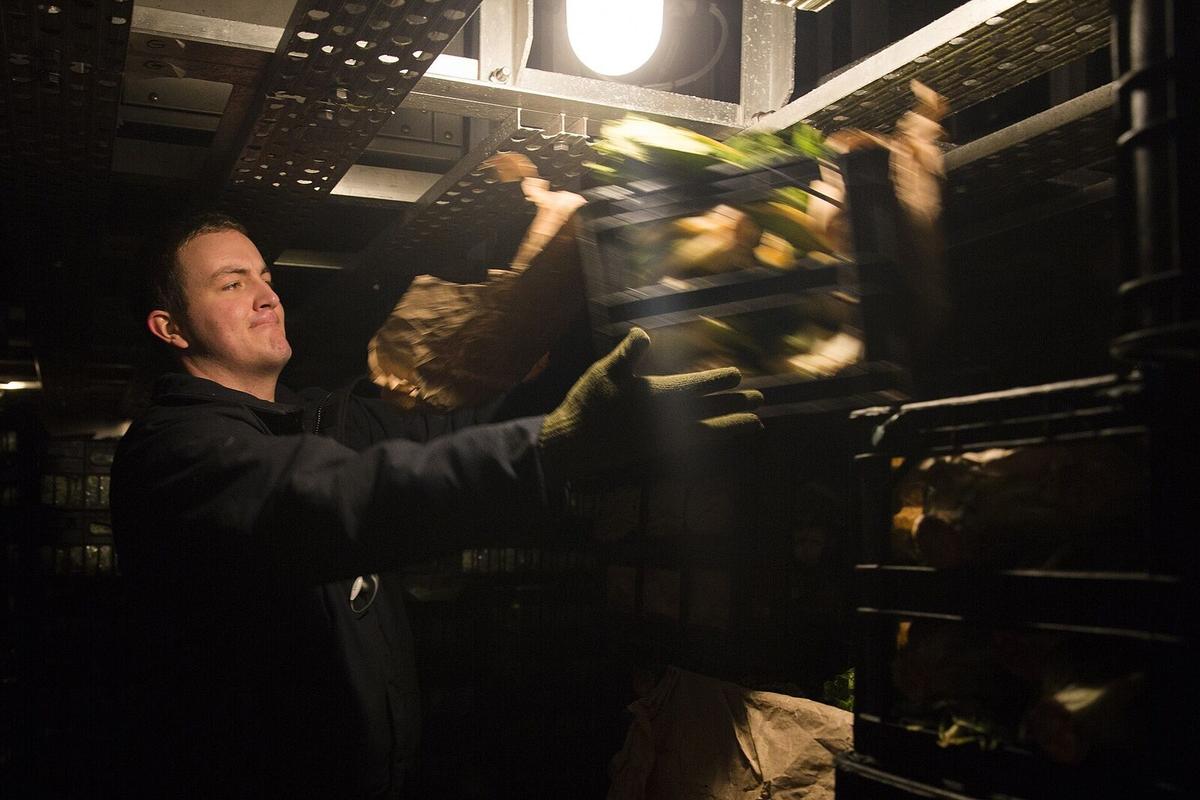 Refrigerated storage works only while a set temperature is held. A sailor stores food in a walk-in refrigerator aboard USS Kearsarge in 2013; the photo is an illustration and has no connection to the fact sheet. Photo by the U.S. Navy (Mass Communication Specialist Seaman Hunter S. Harwell), public domain, via Wikimedia Commons.
What did the agencies publish?
The document is titled "US Government Partners Urge Hardening Industrial Refrigeration and Cold Chain Monitoring Systems." The Cybersecurity and Infrastructure Security Agency (CISA) lists it as a fact sheet with a publish date of 5 November 2026. The PDF is marked "As of November 5, 2026."
Five agencies wrote it: CISA, the Federal Bureau of Investigation (FBI), Health and Human Services (HHS), the U.S. Department of Agriculture (USDA) and the Department of Transportation. The fact sheet calls them "the authoring organizations."
The PDF is marked TLP:CLEAR. TLP stands for Traffic Light Protocol, a labeling scheme for how widely a security document may be shared. CISA's page on the protocol says sources may use TLP:CLEAR "when information carries minimal or no foreseeable risk of misuse." In plain terms, this one is meant to be passed around.
What is a cold chain, and who uses these systems?
A cold chain is the series of refrigerated steps that keeps a product cold from where it is made to where it is used: the plant, the truck, the warehouse, the store or the pharmacy. A cold chain monitoring system is the electronics that watch and record temperature along the way.
The fact sheet says organizations in four sectors "widely use these systems, including in refrigerated transport services." The four are Healthcare and Public Health, Chemical, Food and Agriculture, and Transportation Systems. It lists what the systems are used for: "automated and remote monitoring of temperatures, continuous temperature logging, defrost cycle management, and energy optimization."
Two terms need a line each. A controller is the small computer that reads temperature sensors and switches compressors, fans and heaters on and off. A defrost cycle is a planned stretch of warming that melts ice off the cooling coils so the unit keeps working.
What does the fact sheet say the actors may do?
The Threat section is two short paragraphs and two lists. Its first sentence says the authoring organizations "are aware of malicious cyber actors targeting electronic temperature controllers and commercial refrigeration controllers in retail grocery and cold storage facilities."
The next sentence is the center of the document: "The actors may exploit vulnerabilities or weaknesses in unpatched or internet-accessible controllers to remotely alter settings and force units into continuous heating and defrost cycles, which can cause widespread inventory loss and equipment hazards."
Note the verbs. The agencies say they are "aware of" targeting. They say the actors "may" exploit weaknesses. They do not say how often it has happened or where.
The fact sheet lists three ways in, which it calls vectors:
- Authentication bypass. In general terms, getting past a login check without valid credentials.
- Arbitrary code injection. In general terms, getting a device to run instructions the attacker supplies.
- Weak configurations. Settings that leave a device easier to reach or control than it needs to be.
Those one-line meanings are the general sense of the terms. The fact sheet gives the three names and no technical detail, and this article adds none.
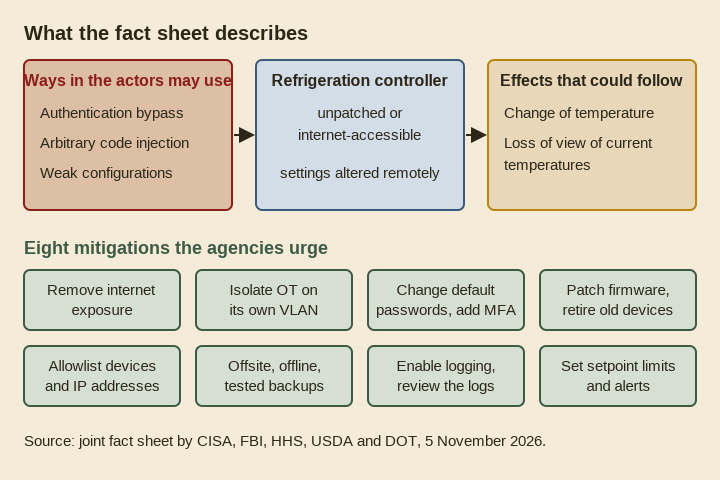 The threat and the eight mitigations as the fact sheet lists them. Source: joint fact sheet by CISA, FBI, HHS, USDA and DOT, 5 November 2026. Diagram by Warhawk Division.
What could happen if a controller is changed?
The fact sheet says that "upon successful exploitation of the flaws, the actors could achieve the following effects." There are two.
The first is "change of temperature." The document says this "could" do four things:
- "Affect the service life of the system"
- "Create a fire hazard"
- "Cause loss of inventory"
- "Indirectly harm consumers if products are consumed after unsafe storage"
The second is "loss of visibility into current temperatures (a denial-of-view condition)." Denial of view means the people watching the system can no longer see its true state. The cooler may be warm while the screen shows nothing, or shows stale numbers.
Every item on that list is something the agencies say "could" happen. The fact sheet reports no injury, no fire and no dollar figure.
Why does a few degrees matter?
The fact sheet gives no temperatures. Two other federal pages show why a setting is worth protecting.
The Food and Drug Administration's consumer page "Are You Storing Food Safely?" (content current as of 18 January 2023) says: "Keep the refrigerator temperature at or below 40° F (4° C)." It also says: "The freezer temperature should be 0° F (-18° C)." Those are FDA's figures for a home kitchen. Commercial facilities work under their own rules, which this article does not cover.
On vaccines, the Centers for Disease Control and Prevention's Vaccine Storage and Handling page, which says its toolkit was updated on 14 July 2026, carries this line: "Do not use vaccines stored outside recommended temperatures unless safety and effectiveness are confirmed by public health authorities or vaccine manufacturer(s)." The same page tells providers to "use digital data loggers (DDLs) for routine storage, transport, and temporary clinics and have at least one backup." A data logger is a device that records temperature over time.
Put those next to the fact sheet's second effect. If a product has to stay inside a range, and the record of its temperature is the proof that it did, then a system that can be altered or blinded puts both the product and the proof in question. That last sentence is this article's reading of the three documents together, not a statement from any one of them.
What does the fact sheet not say?
It is short, and what it omits is worth listing.
- Who. It names no actor, group or country.
- Which products. It names no manufacturer, model or software version. Its disclaimer says the authoring organizations "do not endorse any commercial entity, product, company, or service."
- Which flaws. It lists no CVE numbers, the public IDs used to track specific software flaws.
- How many. It gives no count of incidents, facilities or losses.
- Where. It says "globally" and names no place.
- Household equipment. It speaks of industrial and commercial systems. It says nothing about home refrigerators.
As of 13 November 2026 I could not confirm any of those details from the fact sheet or from CISA's page for it, and this article does not fill the gaps from other reporting.
What to do
This section repeats the fact sheet's own instructions. They are written for owners and operators of these systems, and the agencies "urge owners and operators to immediately take the following actions." If you run such equipment, read the original and work with the people who install and service your system.
The fact sheet ties each step to CISA's Cross-Sector Cybersecurity Performance Goals (CPGs), which it describes as "a minimum set of practices and protections that CISA and NIST recommend all organizations implement."
| The fact sheet's step | What it says, in short | Term explained |
|---|---|---|
| Eliminate public internet exposure | Do not expose control system devices, "particularly controller panels," to the internet. If remote access is necessary, protect it with a firewall or edge device kept up to date. | An edge device sits between a private network and the internet. |
| Isolate operational technology (OT) devices | Create a dedicated OT virtual local area network (VLAN) "to separate OT devices from business networks." | OT is the equipment that runs physical processes. A VLAN is a walled-off section of a network. |
| Enforce credential security | "Change default passwords," strengthen passwords, and "implement phishing-resistant multifactor authentication wherever feasible." | Multifactor authentication (MFA) asks for something beyond a password. |
| Apply patches | Keep device firmware up to date, and identify, retire and replace devices that are at end of life. | Firmware is the software built into a device. End of life means the maker no longer supports it. |
| Restrict access | Maintain "device and IP address allowlisting," limiting access to devices and addresses "authorized to make changes." | An allowlist names what is permitted and blocks the rest. |
| Have reliable backups | "Maintain current backups offsite and offline and test them." | Offline means not reachable from the network. |
| Monitor and report | "Enable logging" and "regularly review logs for unexpected activity." Where logs are not available, collect network traffic between the assets. | A log is a device's record of what happened and when. |
| Review setpoint ranges | "Define and maintain reasonable setpoint limits" for devices downstream of controllers, and "establish alerting for deviations." | A setpoint is the target temperature a unit is told to hold. |
The fact sheet also says where to report. The authoring organizations "recommend U.S. organizations report suspicious or criminal activity" related to the fact sheet:
- CISA's 24/7 Operations Center: contact@cisa.dhs.gov or 1-844-Say-CISA (1-844-729-2472).
- The FBI's Internet Crime Complaint Center (IC3), or a local FBI field office.
- HHS, at HHSCyber@hhs.gov or its 24/7 Operations Center at 202-619-7800, "for assistance mitigating potential disruptions to the delivery of healthcare resulting from health and medical supply chain impacts."
It asks that a report include, when available: the date, time and location of the incident; the type of activity; the number of people affected; the type of equipment used; and the name of the submitting organization with a point of contact.
For background on several of these steps, the site's articles "Segmentation, Patching, Least Privilege: The Boring Fixes That Work" and "Passwords, Passkeys and MFA: Identity Done Right" explain the ideas at length.
What to remember
- Five U.S. agencies published the fact sheet on 5 November 2026. It says they are "aware of malicious cyber activity targeting industrial refrigeration and cold chain monitoring systems globally."
- The stated risk is that actors "may" remotely alter settings on "unpatched or internet-accessible controllers."
- The two effects it lists are a change of temperature and a loss of view of current temperatures.
- It names no attacker, product, flaw, place or count.
- It urges eight steps, starting with taking controllers off the public internet.
- It gives contacts at CISA, the FBI and HHS for reports.
The fact sheet is three pages and free to read. If refrigeration is part of your work, the original is the document to act on, and CISA's page is the place to look for any update.
Sources (6)
- CISA, "US Government Partners Urge Hardening Industrial Refrigeration and Cold Chain Monitoring Systems" (web page), 5 November 2026
- CISA, FBI, HHS, USDA and DOT, "US Government Partners Urge Hardening Industrial Refrigeration and Cold Chain Monitoring Systems" (PDF fact sheet), 5 November 2026
- CISA, "Traffic Light Protocol (TLP) Definitions and Usage", read 13 November 2026
- CISA, "Cross-Sector Cybersecurity Performance Goals", read 13 November 2026
- FDA, "Are You Storing Food Safely?", content current as of 18 January 2023
- CDC, "Vaccine Storage and Handling", toolkit updated 14 July 2026