Articles & BlogBy Trapper W. Brown6 min read
For anyone who works in a building with a locked door, from the front desk to the back office.
How does a stranger get into a locked building? Most of the time, somebody holds the door.
That is not a criticism of the person holding it. We are raised to be polite, and letting a door close in someone's face feels rude. People who want to be inside a building without permission know this, and they count on it. The lock, the badge reader and the camera all work fine. The way in is the kindness of the person walking through ahead of them.
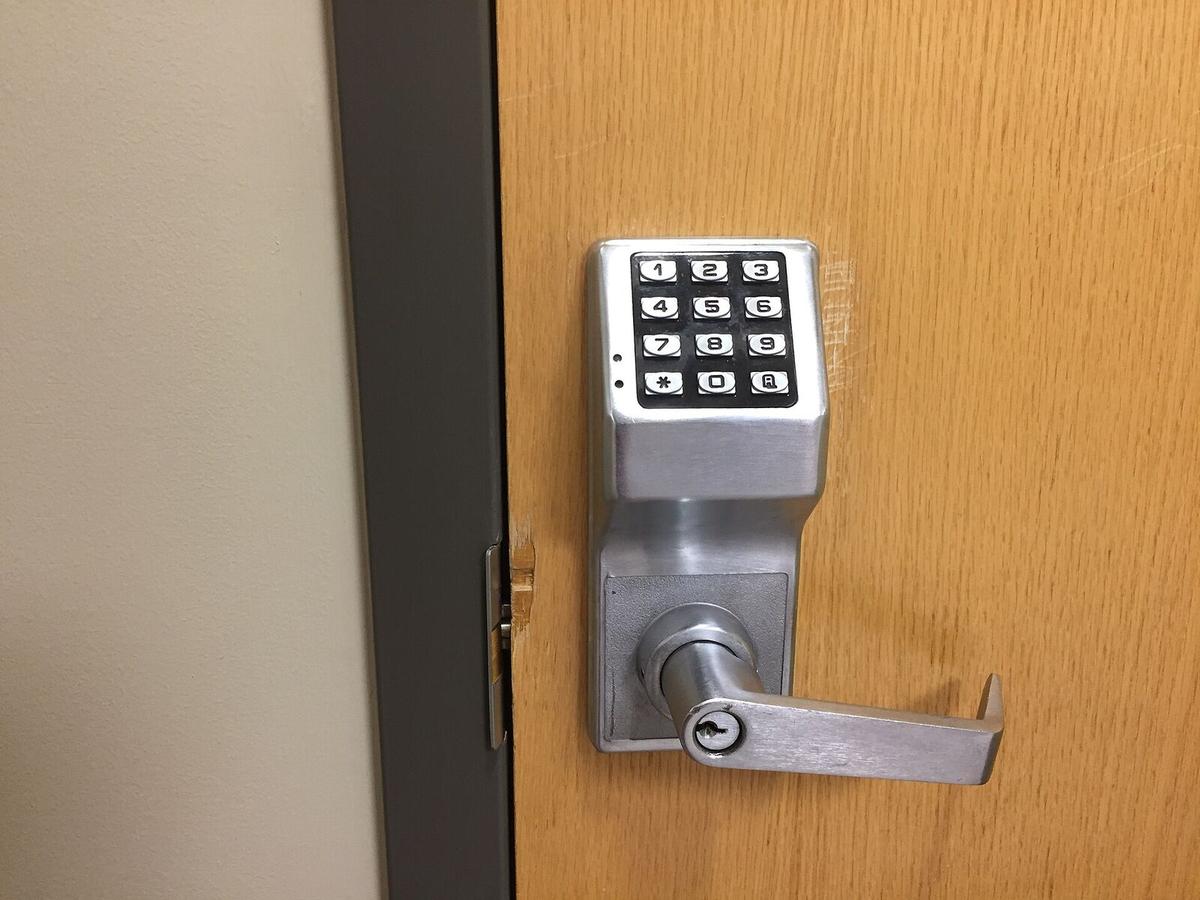 The lock checks the person who enters the code, and nobody who follows them through. Photo by Khrystinasnell, CC0, via Wikimedia Commons.
This article is for the people at that door. It will not teach anyone how to get in. It will help you spot the common approaches and give you words to use that are firm and still friendly.
Why is the door the weak point?
A badge reader checks one person: the one who badged. It has no idea how many people walked through while the door was open. Following an authorized person through a secured door is called tailgating. When the authorized person knowingly holds the door, some call it piggybacking. Either way, one check let two people in.
Security+ files this under social engineering: getting past a control by working on a person instead of the control. The door did its job. The person was asked, without words, to make an exception, and people are generous with exceptions.
It also helps to know what an unescorted stranger can reach once inside: unlocked computers, paper on desks, keys in drawers, bags under chairs, and the quiet back rooms where nobody would think to question them.
What do the usual approaches look like?
They are ordinary on purpose. Each one borrows a reason you would normally accept.
| Approach | What you see | Why it works |
|---|---|---|
| Tailgating | Someone arrives at the door just as you open it | Closing a door on a person feels rude |
| Full hands | Boxes, coffee trays, a cart | You want to help |
| The uniform or clipboard | A vest, a tool bag, a lanyard, a work order | They look like they belong and look busy |
| The delivery | A package that "needs a signature upstairs" | Deliveries are routine |
| The urgency | "The meeting has started," "the leak is getting worse" | You do not want to be the reason for a delay |
| The name drop | "The manager is expecting me" | You do not want to question the boss |
Notice what is missing from that table: any description of what the person looks like. A vest and a clipboard can be bought by anyone, and so can a suit. The honest contractor and the dishonest one look the same. What separates them is whether someone inside is expecting them, and a short check answers that.
Watch out
Do not judge by appearance, confidence or how busy someone seems. Looking like you belong is the whole approach. Check the visit, not the person: who are they here to see, and does that person know?
What do you say?
You do not need to accuse anyone, and you should not. Offer help, because help is also a check.
- At the door: "Sorry, I can't let anyone in on my badge. The front desk will get you sorted."
- To someone with full hands: "Let me get the front desk to help you with that."
- In a hallway: "Hi, can I help you find someone?"
- To a contractor: "Who called this in? I'll let them know you're here."
- To urgency: "I understand. Checking will be quick, and then you're covered too."
Every one of those is polite, and every one of them sends the visitor toward someone who can verify them. A real visitor loses a minute and usually thanks you. Someone who should not be there now has a choice between a front desk that will ask questions and the exit.
If you blame the rule, it gets easier. "They make us do this for everyone" takes the personal sting out. It also happens to be true in any workplace that takes the rule seriously.
How does a visitor process work?
A visitor process exists so that no single employee has to make a judgment call at a door. It moves the decision to one place, the front desk, and gives everyone else a simple line to say.
| Step | What happens | What it prevents |
|---|---|---|
| Expected | The host tells the front desk who is coming and when | Surprise visitors with a good story |
| Sign in | The visitor gives a name, company and host, and shows identification if your policy asks | Anonymous visits |
| Confirm | The desk calls the host, using a number the desk already has | A made-up appointment |
| Badge | The visitor wears a dated visitor badge where it can be seen | Confusion about who is a guest |
| Escort | The host collects the visitor and stays with them | Wandering |
| Sign out | The badge comes back and the time is noted | Not knowing who is still inside |
The confirm step matters most. The desk calls the host on a number the desk already has. It does not call a number the visitor hands over, and it does not accept "I just spoke to her." For contractors and utility crews, the same rule applies one level up: the work was requested by someone here, or it gets confirmed with the company through a number you looked up yourself.
A small office without a front desk can do a short version. One door for visitors, one person who answers it, and a shared habit that nobody else lets a stranger in.
What if they push back?
Most people will not. They will say "no problem" and walk to the desk. Pressure is itself worth noticing. Urgency, irritation, flattery and a senior name are the usual tools for getting someone to skip a check, and a real visitor has little reason to use them.
Stay friendly and repeat yourself: "I'm sure it's fine. The desk will get you in." You do not have to win an argument. You only have to decline to be the exception.
Tip
If you find a stranger already inside and something feels off, do not block the way or follow them into a quiet area. Walk to where other people are, tell the front desk, your manager or security what you saw and where, and let them handle it. If you believe someone is in danger, call 911.
Managers have a part in this too. The first time an employee is scolded for making a vice president wait at the desk, everyone learns that the rule is optional. Thank that employee where others can hear it.
What you can do today
- Let the door close behind you, and check that it latched.
- Practice one sentence out loud: "I can't let anyone in on my badge, but the front desk will help."
- Find out how visitors are supposed to sign in where you work.
- Tell the front desk before your next visitor arrives.
- Wear your own badge where it can be seen, so a missing badge stands out.
- Learn whom to tell if you see an unescorted stranger.
What to remember
- The lock rarely fails. Courtesy gets the door opened.
- A uniform, a clipboard or a package proves nothing about the visit.
- Offer help that leads to the front desk. It is polite and it is a check.
- Confirm with the host using contact details you already have.
- Urgency and name-dropping are reasons to slow down.
- Report what you saw. Do not confront or chase.
Holding the door is a good habit almost everywhere. At a secured entrance, the kind thing is different: you walk the visitor to the person whose job is to welcome them properly.