Articles & BlogBy Trapper W. Brown7 min readCurrent to 12 November 2026Opinion
Opinion. For some people an AI companion could be the only workable source of company they have, and it should be judged against their real alternative, with the risks that studies and regulators report kept in plain view.
Most arguments about AI companions compare the chatbot to a friend. Next to a friend it loses every time. It cannot bring soup, it will not notice that you have stopped answering the door, and it does not miss you. If that were the choice, I would tell everyone to close the app and call somebody.
I think that for some people it is not the choice. Picture a widow who no longer drives and has outlived her friends, or a man caring alone for a wife with dementia. Picture someone whose anxiety or disability makes a room full of strangers impossible this year. On a given evening the alternative for them may be silence. For those people I think a companion could be the only viable option. I say "could" on purpose, because the evidence is early and some of it cuts against me.
 For a person with nobody to call, the comparison that matters is an evening alone. Photo by Frank McKenna, CC0, via Wikimedia Commons.
How many people have nobody to call?
A 2020 report from the National Academies of Sciences, Engineering, and Medicine found that approximately one-quarter of Americans aged 65 and older who live in the community are considered socially isolated.
Isolation is a health problem as well as a sad one. The Surgeon General's office, citing published studies, says social isolation raises the risk of premature death by 29 percent, and that adults who often feel lonely are more than twice as likely to develop depression as adults who rarely or never do. So leaving a lonely person with nothing is not the safe choice it looks like.
What do the studies show?
The studies show some relief, and they also give reasons for care.
A working paper by Julian De Freitas and three colleagues, posted in July 2024, ran a series of experiments. Talking with an AI companion eased loneliness about as well as interacting with another person, and more than activities such as watching online videos. A week-long study found the relief repeated after each day's use. What mattered most was whether people felt heard. These are short-term effects, measured over minutes and days.
A state agency has reported something similar. In August 2023 the New York State Office for the Aging said a pilot that put an AI companion device in the homes of more than 800 older New Yorkers showed "a 95% reduction in loneliness." The release was issued together with the device's maker and does not say how loneliness was measured, so I read it as a hopeful sign and nothing firmer.
Then there is the result that points the other way. A four-week randomized study posted in March 2025 by Cathy Mengying Fang and colleagues followed 981 people through more than 300,000 messages with a chatbot. Those who chose to spend more time with it each day ended the study lonelier, socialized less with real people, and were more emotionally dependent on it. The authors are careful: time spent was not assigned, so they "cannot definitively determine" which way the cause runs, and the study had no group that used no chatbot at all. Still, it is a warning.
My honest reading is this. Short-term relief looks real. Heavy use goes along with worse outcomes. And nobody has yet run the long study on the people I am describing, the ones with no other option.
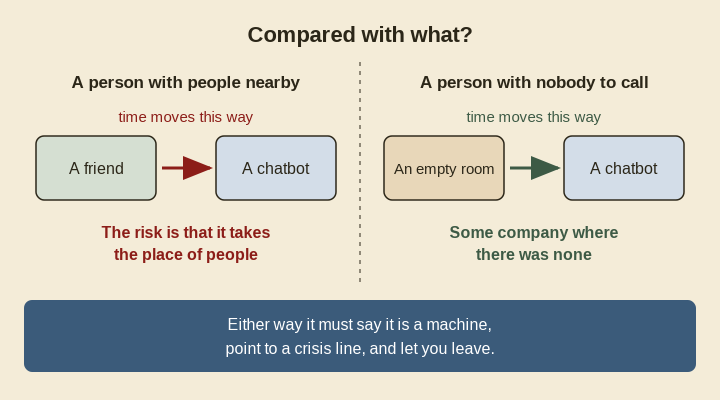 The same product is a different trade depending on what it replaces.
The strongest case against
The case against has three parts, and each one is sound.
The first is displacement. An hour with a machine is an hour not spent rebuilding human ties, and a machine that is always available and never difficult can make people seem like hard work. The Fang study fits that worry.
The second is incentive. A product paid for by attention is built to hold attention. A companion that is designed never to let the conversation end is not acting as a friend.
The third is the vulnerable user, above all children and people in crisis. Regulators have moved on this. On 11 September 2025 the Federal Trade Commission ordered seven companies to explain how they measure, test and monitor the possible harms of companion chatbots to children and teens. California's Senate Bill 243, signed on 13 October 2025, requires operators to keep a protocol for conversations about suicide or self-harm, including a referral to crisis services. For a user known to be a minor, it requires a reminder at least every three hours that the chatbot is not human. In Congress, the KIDS Act passed the House on 29 June 2026 by 267 votes to 117. It would require chatbots to tell minors that they are talking to a machine and to give crisis line information. As of 12 November 2026 it sits in a Senate committee.
What does this side get right? All three points. A chatbot is not a crisis service. If you or someone you know is thinking about suicide or self-harm, call or text 988 in the United States. The 988 Suicide and Crisis Lifeline is free, confidential and open at all hours. A companion app that does not say so clearly is failing at the most basic part of the job.
Where do I part ways? The critique describes the average user and the worst product. A rule written for the average user that removes the option from the person with no other also has a cost, and it falls on people nobody hears from.
What should change, and who should change it?
I would regulate how these products behave and leave them legal.
- Makers should say plainly that it is a machine, hand off to a crisis line, drop any design that punishes leaving, and publish what they measure. "A Company Should Have to Answer for Its Chatbot" makes the wider case for holding makers to account.
- Legislatures should follow the conduct-based pattern in the California law, with tighter rules for minors.
- Researchers and the agencies that fund them should run the missing study: isolated adults, a year or more, with a comparison group.
- Families and care organizations should treat a companion as a bridge. For example, a daughter three states away who sets one up for her father should keep the Sunday call and watch whether he goes out less. A home care agency that offers one to 200 clients should count whether visits and phone calls rise or fall.
As a rule of thumb, if the companion is pointing a person back toward people, keep it. If it is standing in for them, change something.
Where I land
- Next to a friend, a chatbot loses. For a person whose alternative is an empty room, I think it can win.
- The evidence for short-term relief is decent. The evidence on long-term use is thin, and heavy use goes with worse outcomes.
- Children and people in crisis need hard rules, and a crisis line in plain sight.
- Judge each case against the person's real alternative.
I would be glad to be wrong about how many people have no other option. Until the long studies are in, I would keep the option open for them and keep measuring.
Sources (9)
- National Academies of Sciences, Engineering, and Medicine, "Social Isolation and Loneliness in Older Adults: Opportunities for the Health Care System", 2020
- U.S. Surgeon General, "Social Connection" page
- De Freitas, Uguralp, Uguralp and Puntoni, "AI Companions Reduce Loneliness", arXiv, 9 July 2024
- New York State Office for the Aging, news release, 1 August 2023
- Fang, Liu, Danry and others, "How AI and Human Behaviors Shape Psychosocial Effects of Extended Chatbot Use: A Longitudinal Randomized Controlled Study", arXiv, 21 March 2025
- Federal Trade Commission, "FTC Launches Inquiry into AI Chatbots Acting as Companions", 11 September 2025
- California Senate Bill 243, Chapter 677, Statutes of 2025
- H.R. 7757, KIDS Act, 119th Congress, all actions
- 988 Suicide and Crisis Lifeline