Articles & BlogBy Trapper W. Brown7 min readOpinion
 Illustration generated for Warhawk Division.
Opinion. The Cybersecurity Information Sharing Act of 2015 protects companies that share hacking warning signs with each other and with the government. Its protections now run out on 11 December 2026. Congress has moved the deadline in small steps all year. A short extension does have real arguments behind it, but I think it is time for a long renewal with a few fixes.
What is this law, and why does the name confuse people?
The law is usually called "CISA 2015." That clashes with CISA, the Cybersecurity and Infrastructure Security Agency. In this piece "the act" means the 2015 law and "CISA" means the agency.
The Congressional Research Service (CRS) is Congress's nonpartisan research staff. Its In Focus brief IF12959 was updated on 3 September 2026. The brief says the act lets the federal government "collect and disseminate threat information" and lets private companies "voluntarily share that information with the government, as well as among themselves."
According to CRS, the main provisions say that:
- Private companies may share information about cyber threats with each other and with the government.
- They "will not be subject to antitrust liability" for doing so. Antitrust law limits how competitors coordinate.
- They are protected from liability for certain authorized activities, including monitoring their own systems and sharing.
- Personally identifiable information (PII), meaning data that points to a specific person, "must be removed" from shared information.
- Shared information is exempt from federal and state disclosure requirements, such as public records requests.
The best-known program built on the act is Automated Indicator Sharing (AIS), run by the Department of Homeland Security (DHS). CRS quotes the program's definition of an indicator: a "technical artifact or observable that suggests an attack is imminent or is currently underway, or that a compromise may have already occurred." That might be a malicious web address. The site's article "Logs: What to Keep and How to Read Them" shows where these signs turn up.
How did we get to a December deadline?
The U.S. Code's notes for 6 U.S.C. 1510 lay out the dates. The act took effect on 18 December 2015. It was written to end on 30 September 2025, ten years later.
The notes then record two changes in 2026. Public Law 119-75, signed on 3 February 2026, replaced the 2025 end date with 30 September 2026. Public Law 119-103, signed on 2 September 2026, moved it again to 11 December 2026. CRS says that last change came with the Continuing Appropriations and Extensions Act, 2027, which is a stopgap spending bill.
Cybersecurity Dive reported on 3 November 2026 that "after the law's initial 10-year operating period expired in 2025, lawmakers passed several short-term extensions." I could not confirm from official records exactly what happened between 30 September 2025 and February 2026, so I am leaving that period out. The diagram below shows only the changes recorded in the U.S. Code.
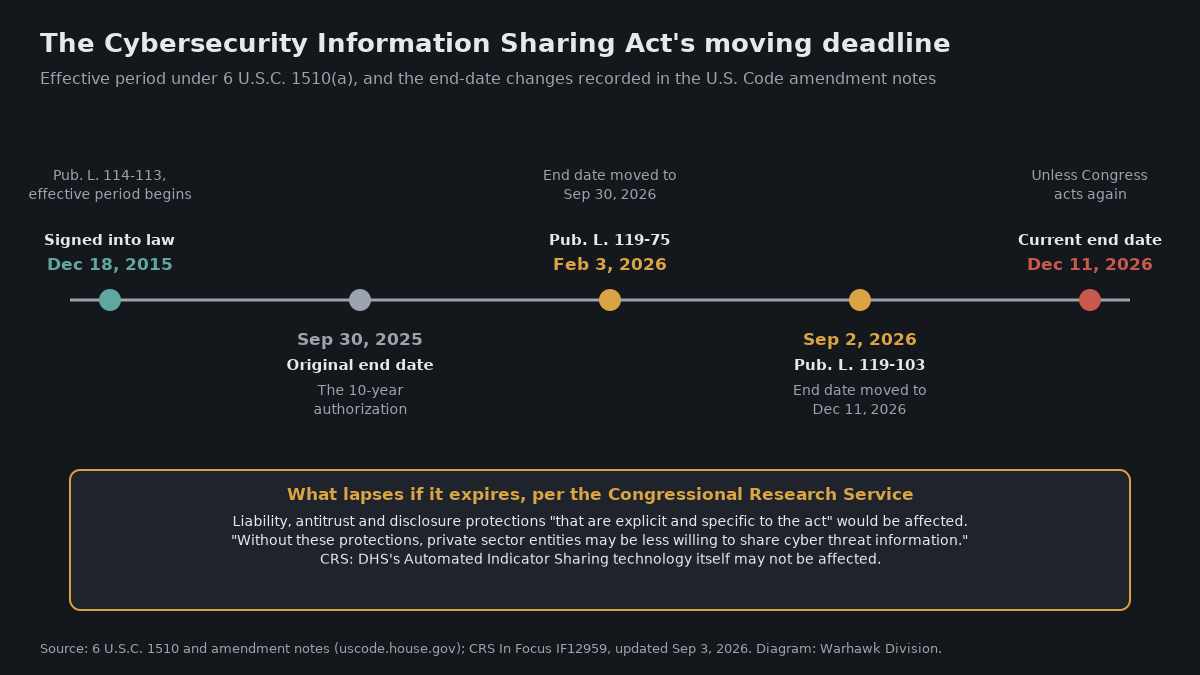 Source: 6 U.S.C. 1510 and its amendment notes (uscode.house.gov); CRS In Focus IF12959, updated 3 September 2026. Diagram by Warhawk Division.
What happens if it lapses?
CRS says the protections "that are explicit and specific to the act would be affected by the act's expiration." Those are the information protections, antitrust protections, liability protections and disclosure protections.
CRS lists three possible effects:
- "Without these protections, private sector entities may be less willing to share cyber threat information with the federal government and each other."
- The government "may find itself in the same position that drove passage of the act - not knowing the extent of current cyber threats."
- The market for companies that provide cybersecurity services to other companies "may collapse without these explicit authorizations."
CRS also notes a limit. Expiration "may not affect the technical capabilities DHS created to enable the AIS program," because DHS started building it under other authorities. The pipes would stay. The question is whether companies would keep using them.
Section 1510(b) keeps the act's protections in force for actions taken before it expires. Sharing after a lapse is the open question.
What the other side gets right
Plenty of reasonable people do not want a quick ten-year renewal. Three of their arguments deserve a straight answer.
Privacy was the central fight in 2015. CRS says that at the time, privacy protections for individuals' information and "limitations on the use of program information were of primary concern." Handing companies liability shields and disclosure exemptions in exchange for sharing data with the government is a real trade. It deserves a fresh look every so often. A sunset is one way to force that look.
A short extension buys time to think. CRS states it directly: "A shorter-term extension may provide Congress additional time to observe how the authorities in the act interact with newer cybersecurity provisions." The biggest of those is the Cyber Incident Reporting for Critical Infrastructure Act of 2022 (CIRCIA). It requires certain organizations to report cyber incidents and ransomware payments. Wanting to see how the two laws fit before locking in a decade is fair.
The act may be out of date. CRS says operational technology, the computers that run physical equipment, and edge devices such as routers "are not explicitly captured by the definitions currently contained within the act." It also says artificial intelligence "is not specifically addressed." Renewing outdated text for ten more years without fixing it would be lazy. The site's article "What SCADA Systems Are and How They Are Vulnerable" explains why those systems matter.
Why I still think the short-term approach is wrong
The act's value is legal certainty. A company's lawyer decides whether the security team can share a sample with a competitor or with DHS. That lawyer reads the end date. When the date is always a few months off, the safe advice is to slow down. CRS makes the same point in neutral terms: a longer authorization "may provide stakeholders (including the private sector) with more certainty."
The privacy record also matters. CRS reports that "recent Inspector General reviews have not found that PII has been shared in violation of the act." That does not settle the privacy debate. It does mean the official reviews CRS cites have not found the abuse critics feared.
The "wait and see" argument about CIRCIA has limits too. CRS describes the two laws as working "in tandem and not as a replacement for each other." The act covers "continual, omnidirectional information sharing," while CIRCIA covers "occasional, unidirectional reporting." The act does not need to sit on hold until CIRCIA is fully settled.
There is now a vehicle for renewal, too. Cybersecurity Dive reports that the House draft of the fiscal 2027 National Defense Authorization Act (NDAA), the yearly defense policy bill, "includes a provision reauthorizing and renaming" the law and would add AI to the topics companies can share about. The same report says "the Senate's draft NDAA does not include" a reauthorization. It also reports that three dozen business groups asked for a ten-year renewal.
 Photo by Carol M. Highsmith, public domain, via Wikimedia Commons (Library of Congress, highsm.12505).
What should change
- Renew for a long, fixed term, not months. Keep a sunset so Congress has to look again, but make it long enough for companies to plan.
- Update the definitions. CRS flags operational technology, edge devices and AI as gaps. Fix them in the same bill.
- Keep and strengthen the privacy rules. Keep the requirement to strip PII and keep the Inspector General reviews. Make the review results easy for the public to find.
- Settle the mandate question separately. CRS notes Congress "could require" some groups, such as cybersecurity firms or cloud providers, to share. That is a big change and deserves its own debate, not a rider on a deadline bill.
- Act before 11 December. If the NDAA cannot carry it in time, a clean bridge extension is better than a lapse.
Where I land
- The act's protections for voluntary threat sharing expire on 11 December 2026.
- Its critics have real points on privacy, timing and outdated definitions. Those points argue for fixing the act, not for leaving it on a short leash.
- The official record CRS cites shows no PII violations. It also shows that companies' willingness to share depends on legal certainty.
- My view: Congress should renew the act for years, fix the definitions and keep the privacy checks. It should do this through the NDAA or another bill before the deadline.
Sources (5)
- Congressional Research Service, "The Cybersecurity Information Sharing Act of 2015: Expiring Provisions," IF12959, updated 3 September 2026: https://www.congress.gov/crs-product/IF12959
- CRS IF12959, version 11 (PDF): https://www.congress.gov/crs_external_products/IF/PDF/IF12959/IF12959.11.pdf
- 6 U.S.C. 1510, effective period, with amendment notes: https://uscode.house.gov/us/usc/t6/s1510/
- Cybersecurity Dive, "AI threats create urgent need to renew cybersecurity information-sharing law, businesses tell Congress," 3 November 2026: https://www.cybersecuritydive.com/news/cisa-2015-reauthorization-congress-ndaa-letter-businesses/873591/
- Photo file page, Wikimedia Commons: https://commons.wikimedia.org/wiki/File:Dusk_at_U.S._Capitol,_Washington,_D.C..jpg