Articles & BlogBy Trapper W. Brown15 min readFacts only
Updated 15 November 2026. The first version of this article was a snapshot taken at 6:47 pm Eastern on 13 November, while the ground stop was still in effect. This version adds the end of the stop, the cause officials have given so far, the cancellation counts and the recovery.
At 3:54 pm Eastern time on Friday, 13 November 2026, the Federal Aviation Administration (FAA) told every aircraft operator in the country that "all airports are ground stopped." Departures halted nationwide. At 8:19 pm Eastern the same evening, the FAA's Command Center published a new advisory: the nationwide ground stop "has been cancelled."
The FAA's advisories give the reason as a communications failure affecting its long-distance air traffic control centers. Officials have since described a preliminary cause, and the investigation is still open.
This article is a record of what official sources had published as of about 10:00 am Eastern on 15 November, which is when I last read the FAA's own pages. Airlines were still recovering at that time, so check the live sources in the last section before you act on anything here.
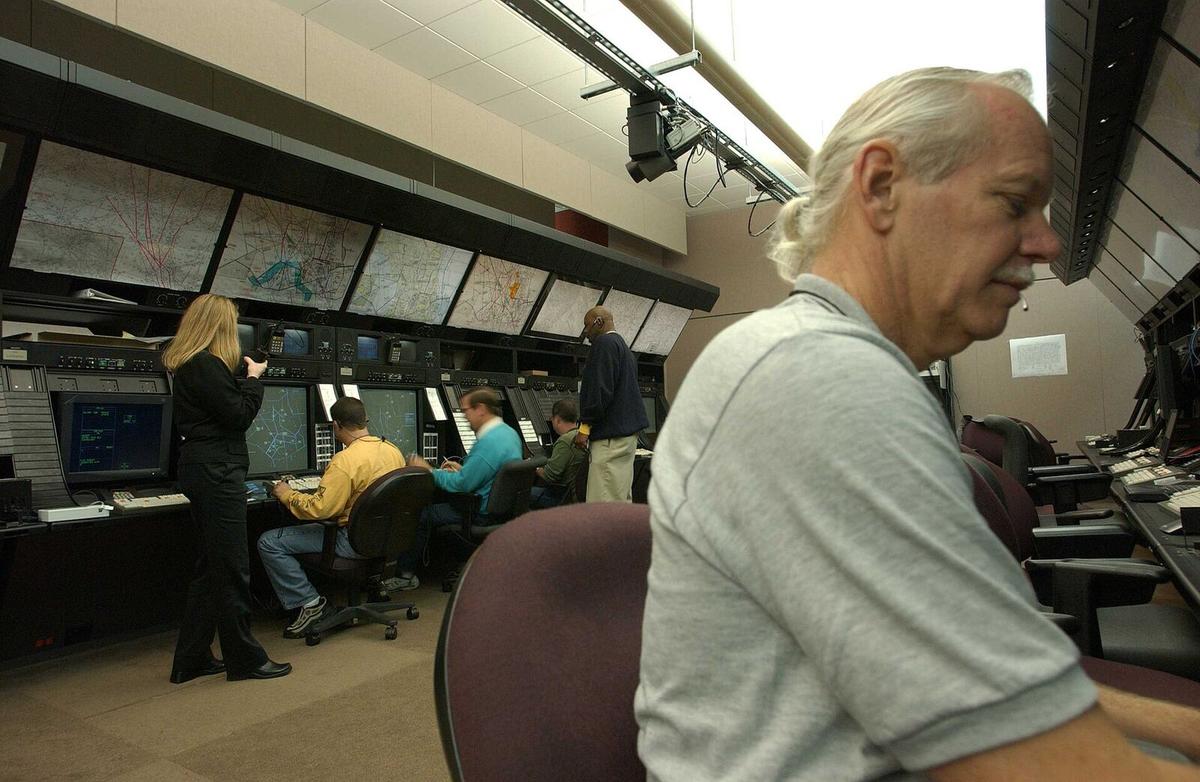 Controllers at the FAA's Washington Air Route Traffic Control Center, an en route center of the kind named in the 13 November advisories; the photo is undated and does not show that day. Photo by the Federal Aviation Administration, public domain, via Wikimedia Commons.
What happened, in order
The FAA runs a facility called the Air Traffic Control System Command Center. The FAA's Pilot/Controller Glossary describes it as the facility responsible for "monitoring and managing the flow of air traffic" across the National Airspace System, which is the FAA's name for the whole network of U.S. airspace, airports, equipment and rules. Its numbered advisories are stamped in Coordinated Universal Time (UTC, also written "Z"), which is five hours ahead of Eastern Standard Time. I have converted the times below.
The numbering restarts each day at midnight UTC, which is 7:00 pm Eastern. That is why the advisories from Friday evening carry low numbers and the date 14 November.
| Eastern time | FAA advisory | What it says |
|---|---|---|
| 3:28 pm | 107 | Ground stop for Chicago O'Hare starting 3:10 pm. Condition: "EQUIPMENT / OUTAGE." Comment: "COMMS ISSUES." |
| 3:30 pm | 108 | Diversion recovery activated for all airports. |
| 3:31 pm | 109 | Ground stop for Chicago Midway starting 3:17 pm, same condition. |
| 3:54 pm | 111 | "ALL AIRPORTS ARE GROUND STOPPED." |
| 4:20 pm | 116 | Expect airborne holding at any airport. |
| 4:21 pm | 117 | Flight plan handling extended for all en route centers "DUE TO NATIONWIDE COMMS FAILURE." |
| 5:46 pm | 120 | The ground stop "REMAINS IN EFFECT." Next update expected at 11:00 pm. |
| 7:37 pm | 001, dated 14 November | Operations plan: the stop "REMAINS IN EFFECT FOR A LARGE PORTION OF THE COUNTRY," and some coastal facilities have released some international departures. |
| 8:19 pm | 005, dated 14 November | "THE FAA COMMAND CENTER NATIONWIDE GROUND STOP HAS BEEN CANCELLED." |
| 7:44 am, 14 November | 054, dated 14 November | Cancels Advisory 117. Flight plan handling returns to normal at all centers. |
Advisory 111 is the order itself. It says the stop is "DUE TO EXTRAORDINARY CIRCUMSTANCES AND FOR REASONS OF SAFETY," that "ALL DEPARTING TRAFFIC SHOULD REMAIN GROUND STOPPED UNTIL FURTHER NOTICE," and that "INBOUND INTERNATIONAL FLIGHTS WILL BE MANAGED ON A CASE BY CASE BASIS."
Advisory 005 is the end of it. It gives no reason and no detail beyond the one sentence in the table. Its event time begins at 8:16 pm Eastern and it was sent at 8:19 pm. News reports give the time as 8:15 pm.
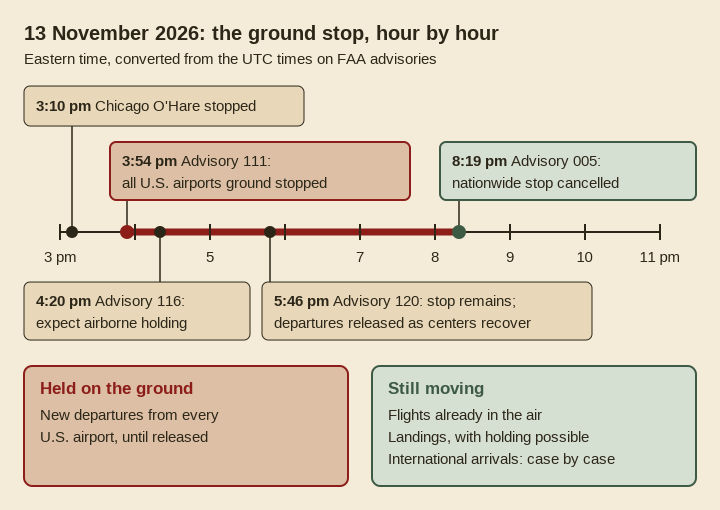 The afternoon and evening of 13 November 2026 from the FAA Command Center's advisories, and what the order did and did not stop.
How long did it last?
By the stamps on the FAA's advisories, the nationwide order ran from 3:54 pm to 8:19 pm Eastern, which is 4 hours and 25 minutes. NBC News, using 8:15 pm as the end, counts 4 hours and 21 minutes.
The end of the order was not the end of the disruption. The Command Center's advisory list shows ground stops at individual airports through the rest of the night, with the first sent at 8:41 pm Eastern and the last one cancelled at 1:30 am. The airports were Chicago O'Hare, Seattle, San Diego, Newark, Minneapolis-St. Paul, Los Angeles, Dallas Fort Worth and Atlanta. I read the titles and times of those advisories, not the reason given in each one.
Is this a government shutdown?
No. Some people are calling this "the FAA shutdown," but the two things are different.
A government shutdown follows a lapse in appropriations, which means Congress has not passed the law that funds an agency and the agency must stop work that is not legally excepted. In 2025, during a shutdown, an FAA emergency order required flight reductions at 40 airports. That was a funding event.
What happened on 13 November 2026 is an operational order. None of the FAA advisories I read mention funding or staffing as the reason. They cite equipment and communications.
What is a ground stop?
The FAA's glossary defines a ground stop as "a process that requires aircraft that meet a specific criteria to remain on the ground." The glossary adds that ground stops "normally occur with little or no warning."
On an ordinary day ground stops are local and short. A related tool is the ground delay program, which the glossary describes as a process "when aircraft are held on the ground" to "limit airborne holding."
A stop that covers every airport is rare. The last one the FAA documents on its own site was on 11 January 2023, when its Notice to Air Missions system failed. A Notice to Air Missions, or NOTAM, is a notice that, in the FAA's words, "provides safety information to flight crews." That morning the FAA ordered airlines to pause domestic departures until 9:00 am Eastern, and it announced at 8:50 am that the stop had been lifted. CNBC and ABC News both report that the one before that followed the attacks of 11 September 2001.
What stopped and what kept moving?
The order stopped departures. It did not tell aircraft already flying to land at once.
- Stopped: new departures from all U.S. airports. Advisory 120 lists "DESTINATION AIRPORT: ALL" and "FACILITIES INCLUDED: ALL."
- Kept moving: flights already in the air. United Airlines said its airborne flights would continue, according to NBC Chicago and CNBC.
- Slowed: arrivals. Advisory 116 told operators to "EXPECT AIRBORNE HOLDING TO ANY AND ALL AIRPORTS." Airborne holding means circling in a set pattern while waiting for a turn to land.
- Diverted: some flights. A diversion is a landing at an airport other than the planned one. Advisory 108 switched on the Command Center's diversion recovery process for all airports.
- Case by case: international flights inbound to the United States.
The stop also ended in stages. Advisory 120, at 5:46 pm, said flights would be allowed to depart as the en route facilities recovered. San Francisco International Airport said flights bound across the Pacific were cleared to leave at about 6:00 pm Eastern, according to NBC News. By 7:37 pm the Command Center's operations plan described a "NATIONWIDE GROUND STOP W/SELECTIVE RELEASES," with coastal facilities releasing some international departures. The full cancellation followed 42 minutes later.
How many aircraft were in the air when the order came depends on who is counting. Transportation Secretary Sean Duffy said more than 3,500, according to NBC News. The flight tracker Flightradar24 counted about 3,100 bound for U.S. airports, according to CBS News. Homeland Security Secretary Markwayne Mullin said all flights were accounted for and the planes landed safely, CBS News reports.
What caused it?
The advisories give the reason in three words: "COMMUNICATIONS FAILURE."
The facilities involved are the Air Route Traffic Control Centers, also called en route centers. The FAA glossary says they handle aircraft "principally during the en route phase of flight," meaning the long cruise between airports, as opposed to takeoff and landing. The FAA's facility list names 21 of them, from Anchorage to Miami, and a 10 November FAA statement on another subject refers to 22.
The FAA's only written statement, posted in its newsroom on 13 November, is two sentences long and is headed "preliminary and subject to change." It says the stop followed "communication issues impacting multiple Air Route Traffic Control Centers" and that FAA technicians are investigating. When I read the page on 15 November, the FAA had not posted a second statement.
Everything more specific comes from officials speaking at briefings, as reported by news outlets. These accounts agree on the outline and differ on details:
- Routers. Secretary Duffy said on Friday night that routers became overloaded with data and began to give inconsistent information, and that officials then shut the system down, according to CBS News.
- Maintenance work. On Saturday, Duffy and FAA leaders attributed the failure to routine maintenance by a contractor on the FAA's telecommunications network, part of a move from copper wire to fiber optic cable, according to NPR. NPR and NBC News both name the contractor as L3Harris. NBC News reports the company said it is cooperating with the FAA's investigation. NPR said it had asked the company for comment and had not yet heard back.
- One site, many centers. The problem began at a remote FAA site, and officials detected disruptions at 17 of the agency's 22 centers, according to NBC News. NPR reports officials were asked why work at one location could spread so widely and said that is still under investigation.
- Not settled. Investigators are still looking at whether the outage came from faulty equipment, installation or configuration, NBC News reports. CBS News says its government sources gave conflicting accounts of the cause.
- No sign of an attack. Secretary Mullin said on Friday night that no cyberattack had been found and that the outage had no connection to a separate Microsoft service outage that week, according to CBS News. NBC News reports officials also said they saw no evidence that artificial intelligence played a role.
The FAA said it first noticed instability in its network at about 3:36 pm Eastern, according to NPR. That is 18 minutes before Advisory 111.
No official source I read has published a written finding on the root cause. Treat the account above as preliminary, which is how the officials themselves described it.
How many flights were affected?
The FAA has not published a count on its own pages. The figures below come from briefings and from private flight trackers, by way of news outlets.
| Figure | Source |
|---|---|
| 9,159 flights cancelled and 7,190 delayed on Friday, 13 November | FlightAware, reported by CBS News |
| About 5,600 more cancelled on Saturday, 14 November, as of 6:00 pm Eastern | FlightAware, reported by NBC News |
| 50,000 flights scheduled on Friday; 20,000 not yet complete when the stop began; 12,000 of those "unable to recover" | FAA Administrator Bryan Bedford, reported by NBC News |
Bedford said the 12,000 were roughly 9,000 commercial flights and 3,000 private and general aviation flights, according to NBC News.
CBS News, citing FlightAware, reports that Friday was the second-worst day for cancellations in the United States this year, behind a snowstorm on 25 January.
Where do things stand now?
The FAA's system. Secretary Duffy wrote on Saturday that operations were returning to normal and that "it is safe to fly," according to CBS News. Bedford said the air traffic control system was stable on Saturday morning, NBC News reports. When I read the FAA's status page at about 10:00 am Eastern on 15 November, it listed no nationwide event. It showed only the possible local ground stops and delay programs that appear on an ordinary day.
The airlines. Recovery takes longer than the stop, because aircraft and crews end the night in the wrong cities. Bedford said airlines were expected to be back to full schedules by Sunday night, 15 November, according to NBC News. American Airlines said on Saturday night that its planned cancellations were complete, that individual flights might still be cancelled, and that customers should expect disruption through the weekend, NBC News reports. Alaska Air Group said it had cancelled more than 400 flights, affecting nearly 37,000 passengers, according to the same report.
The investigation. It is open. No date has been given for a finding.
What to do if you are flying this week
Check your airline before you leave for the airport. The FAA gives this advice on its statements page, and Detroit Metro Airport repeated it during the stop, according to ClickOnDetroit.
Watch the FAA's live pages. The National Airspace System status page at nasstatus.faa.gov lists ground stops and delay programs by airport. The advisory database at fly.faa.gov lists every Command Center advisory in order.
Expect delays after a stop ends. This one showed why. The nationwide order was cancelled at 8:19 pm on Friday, single airports were stopped again until 1:30 am, and thousands of flights were cancelled the next day. The last nationwide stop followed the same pattern on a smaller scale: after it was lifted on 11 January 2023, the FAA described operations as "resuming gradually."
Know the federal refund rule. Under 14 CFR Part 260, if an airline cancels your flight or changes it significantly and you choose not to travel, the airline owes you a full refund of the fare, even on a nonrefundable ticket. You must also decline the rebooking or credit it offers. "Significantly" means, among other things, a departure or arrival moved by three hours or more on a domestic trip, or six hours or more on an international one. The refund is due within 7 business days for a credit card purchase and 20 calendar days for other payment. The rule text covers "any cancelled flight" and makes no exception for the cause.
There is one narrow exception in how the rule is enforced. The Department of Transportation has said that, through 7 July 2027, it will not enforce the refund requirement where a flight is only given a different flight number and the passenger is rebooked on it without a significant change or delay. If your renumbered flight also leaves hours late, the rule above still applies. The article "Flight Cancelled or Delayed: What the Federal Refund Rule Says" covers the rule in full.
Use the waivers. A travel waiver is an airline's own offer to let you change dates without a fee. Delta, in a statement stamped 6:00 pm on 13 November, said it had options in place "allowing customers to change their flight at no extra cost." United will waive change fees and fare differences for trips rebooked on United, in the same cabin and between the same cities, departing between 12 and 20 November, according to ABC7 Chicago. I could not open United's own notice to confirm those terms. Waivers have date limits and conditions, so read your own carrier's travel alert before you change anything.
What to remember
- The FAA ground stopped all U.S. airports at 3:54 pm Eastern on 13 November 2026 (Advisory 111) and cancelled the order at 8:19 pm (Advisory 005, dated 14 November). That is 4 hours and 25 minutes.
- The stated reason is a communications failure at the en route centers. Officials have pointed to routers and to contractor maintenance work on the FAA's telecommunications network. That account is preliminary and the investigation is open.
- Officials say they have found no sign of a cyberattack.
- This was not a funding shutdown. It was an operational safety order.
- Departures were held. Flights in the air continued and landed.
- FlightAware counted 9,159 cancellations on Friday and thousands more on Saturday. The FAA's administrator said airlines should be back to full schedules by Sunday night, 15 November.
- A cancelled or significantly changed flight you decline to take is refundable under federal rule.
The two pages that will show any new problem first are the FAA's advisory database and its status page, both linked below.
Sources (32)
- FAA Air Traffic Control System Command Center, "ATCSCC Advisories for 2026-11-13" (advisory list), read 15 November 2026
- FAA Command Center, "ATCSCC Advisories for 2026-11-14" (advisory list), read 15 November 2026
- FAA Command Center, "Advisory 111: National Ground Stop", 13 November 2026
- FAA Command Center, "Advisory 005: CNX Nationwide Ground Stop", dated 14 November 2026
- FAA Command Center, "Advisory 001: Operations Plan", dated 14 November 2026
- FAA Command Center, "Advisory 054: Extended Flight Plan Drop Times Cancellation", 14 November 2026
- FAA Command Center, "Advisory 120: Nationwide Ground Stop", 13 November 2026
- FAA Command Center, "Advisory 116: Nation Wide Airborne Holding", 13 November 2026
- FAA Command Center, "Advisory 117: All Centers Extended Flight Plan Drop Times Implemented", 13 November 2026
- FAA Command Center, "Advisory 108: All Airports Diversion Recovery Activated", 13 November 2026
- FAA Command Center, "Advisory 107: CDM Ground Stop, ORD", 13 November 2026
- FAA Command Center, "Advisory 109: CDM Ground Stop, MDW", 13 November 2026
- FAA, "FAA Statement on Nationwide Ground Stop", 13 November 2026
- FAA, "National Airspace System Status", read 15 November 2026
- FAA, "General Statements", read 15 November 2026
- FAA, "FAA NOTAM Statement", 11 and 19 January 2023
- FAA, "Pilot/Controller Glossary: G" (ground stop, ground delay program), read 13 November 2026
- FAA, "Pilot/Controller Glossary: A" (Air Route Traffic Control Center, Command Center), read 13 November 2026
- FAA, "Pilot/Controller Glossary: N" (National Airspace System, NOTAM), read 13 November 2026
- FAA, "Air Traffic Control Facilities", page last updated 13 January 2026
- Electronic Code of Federal Regulations, "14 CFR Part 260: Refunds for Airline Fare and Ancillary Service Fees", current to 10 November 2026
- Department of Transportation, "Airline Refunds and Other Consumer Protections" (extension of enforcement discretion), Federal Register, 7 July 2026
- Delta Air Lines, "Delta statement on FAA nationwide ground stop", 13 November 2026, 6:00 pm
- NPR, "Telecom outage triggers rare nationwide FAA ground stop, stranding travelers", 14 November 2026
- CBS News, "FAA lifts nationwide ground stop that disrupted thousands of flights", updated 14 November 2026
- NBC News, "Flight chaos continues as air travel attempts to get back to normal after ground stop" (live updates), updated 15 November 2026
- NBC News, "Live updates: FAA grounds flights nationwide because of communication issue", 13 November 2026
- CNBC, "FAA issues nationwide ground stop citing communication issues affecting 'multiple' air traffic control facilities", 13 November 2026
- ABC News, "FAA issues rare nationwide ground stop; no indication of 'nefarious attack'", 13 November 2026
- NBC Chicago, "FAA issues nationwide ground stop 'due to extraordinary circumstances'", 13 November 2026
- ABC7 Chicago, "FAA ground stop live updates: What to know as nationwide flights are grounded", 13 November 2026
- ClickOnDetroit, "Live Updates: FAA issues ground stop for all airports nationwide", 13 November 2026