Articles & BlogBy Trapper W. Brown11 min read
For anyone who has pulled out a plate that was scalding at the rim and still frozen in the middle, and wondered what the box was doing for those two minutes.
You press a button, a light comes on, a hum starts and a glass plate begins to turn. Nothing inside glows. Two minutes later the soup is steaming and the bowl is only warm. Unlike a stove or a toaster, a microwave oven heats food without first heating something else: no flame, no red coil, no hot air.
It does that with radio waves. The oven is a small, sealed radio transmitter aimed at your lunch, and nearly every odd thing it does (the cold center, the turning plate, the dotted screen in the door, the rule about foil) follows from how those waves behave.
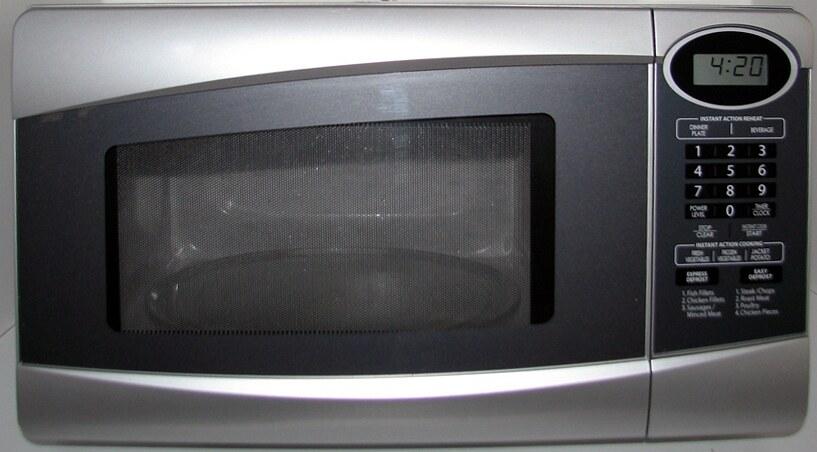 The dotted screen in the window is a working part of the oven, and it is sized to the wave inside. Photo by Wrightmt, public domain, via Wikimedia Commons.
What is a microwave?
The U.S. Food and Drug Administration (FDA), which has regulated the manufacture of microwave ovens since 1971, describes microwaves as "a form of electromagnetic radiation similar to radio waves."
The FDA lists three properties that make them useful for cooking:
- They are reflected by metal.
- They pass through glass, paper, plastic and similar materials.
- They are absorbed by foods.
The whole oven is built on those three facts. Metal walls keep the waves in, the glass plate lets them through, and the food soaks them up.
The word "radiation" worries people, so one distinction matters. The FDA says microwaves are non-ionizing radiation, which means they do not have enough energy to knock electrons out of atoms the way X-rays can. The article "CT Scans and MRI: How Each Works and How They Differ" covers the ionizing kind. What microwaves can do is heat things, and the FDA is plain that this includes body tissue at high levels. That is the reason the box is sealed.
Where do the waves come from?
They come from a part called a magnetron, which the FDA describes as an electron tube. The same kind of tube is used in some radar sets.
Georgia State University's HyperPhysics reference explains how it works. At the center is a heated metal rod, the cathode, which gives off electrons. Around it is a ring of metal, the anode, and an electric field pulls the electrons outward toward that ring. A magnet is mounted so its field runs along the axis of the tube. A magnetic field pushes a moving electron sideways, so the electrons do not fly straight out. They are swept around in a circle.
The ring has hollow chambers cut into it. As the cloud of electrons sweeps past the openings, it sets the charge in those chambers sloshing back and forth at the chambers' natural frequency, the way blowing across a bottle sets the air inside ringing at one note. That sloshing charge radiates the microwaves.
From the magnetron the waves travel down a short metal duct called a waveguide and out into the cooking chamber, which the federal standard calls the cavity.
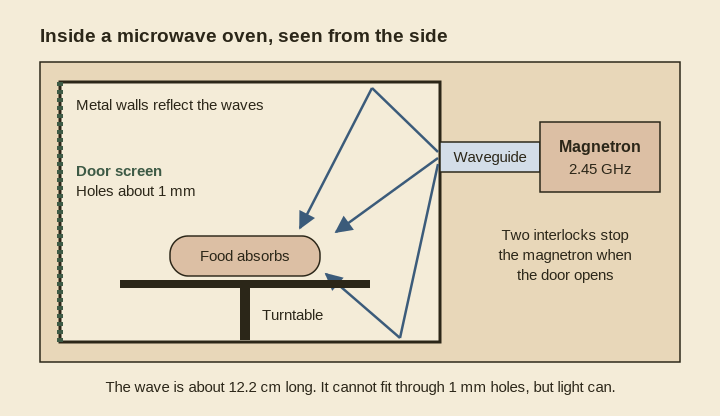 The magnetron makes the waves, the waveguide delivers them, and the metal box keeps them bouncing until the food absorbs them.
Why 2.45 GHz?
Frequency is how many times a wave swings back and forth each second. One gigahertz (GHz) is a billion swings a second. HyperPhysics states that modern ovens operate at 2,450 megahertz, which is 2.45 GHz.
Part of the reason is legal. Radio spectrum is rationed, and a few slices are set aside for industrial, scientific and medical (ISM) equipment, meaning machines that use radio energy to do work, not to communicate. The federal rule for microwave ovens, 21 CFR 1030.10, defines an oven as a device that heats food with energy in the ISM heating bands between 890 and 6,000 megahertz. The Federal Communications Commission's table at 47 CFR 18.301 lists one of those bands as 2,450 megahertz, plus or minus 50.
Part of the reason is physics. A physics lecture from the University of California, San Diego calls 2.45 GHz a good compromise. At a lower frequency food would absorb the waves poorly and they would pass through. At a higher frequency the surface would absorb everything and the waves would not get in.
The frequency fixes the size of the wave. Here is the arithmetic:
- Wavelength is the speed of light divided by the frequency.
- The National Institute of Standards and Technology gives the speed of light as exactly 299,792,458 meters per second.
- Divide by 2,450,000,000 swings per second and you get 0.122 meters.
So the wave in your oven is about 12.2 centimeters long, a little under five inches. That one number explains both the hot spots and the door.
How does a radio wave heat soup?
A water molecule is lopsided: one end carries a slight positive charge and the other a slight negative one. A microwave is, among other things, an electric field that reverses direction over and over. At 2.45 GHz it completes a swing every 408 trillionths of a second, so it reverses about every 204.
As the San Diego lecture puts it, the water molecules flip back and forth with the field because they cannot help it. In liquid water they are packed together, so every twist shoves the neighbors. That jostling is heat. The FDA's version is that the waves make the water molecules vibrate, and the friction between molecules produces the heat that cooks the food.
Wet food heats fastest. The FDA notes that foods high in water, like fresh vegetables, cook more quickly than other foods. Glass, paper and most plastic let the waves pass, which is why the bowl is heated mostly by the soup.
Ice heats badly. In ice the molecules are locked in place and cannot flip, the lecture explains, so a few melted pockets run ahead while the ice beside them sits there. That is why a defrost setting switches the magnetron on and off: the pauses give the heat time to spread.
How much energy does it take? The U.S. Geological Survey says water must absorb 4,184 joules to warm one kilogram by 1 degree Celsius. For example, take a cup holding 250 grams of water at 20 degrees and bring it to 100:
- 0.25 kilograms times 4,184 times 80 degrees is 83,680 joules.
- If the water absorbs 700 watts, which is 700 joules a second (an example figure, not a rating), that takes 120 seconds.
Two minutes, in other words.
Why are there hot spots, and why does the plate turn?
The walls reflect the waves, so the chamber is full of waves crossing each other. Where two crests keep meeting, the field is strong. Where a crest keeps meeting a trough, they cancel. The pattern does not move, and physicists call it a standing wave. The San Diego lecture describes the result as hot spots and cold spots, and says it helps to rotate the food through the pattern.
The strong places sit half a wavelength apart. Half of 12.2 centimeters is 6.1 centimeters.
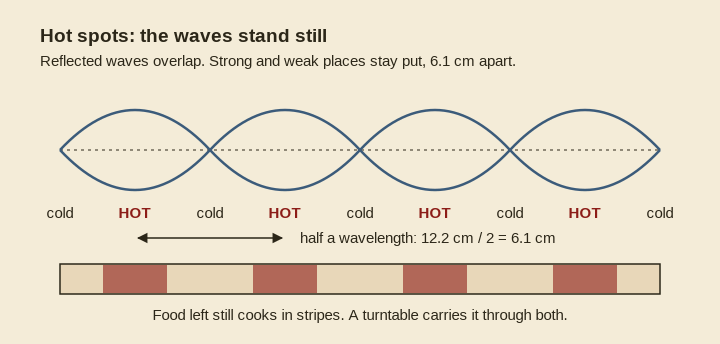 Reflected waves overlap into a fixed pattern, with strong places about 6.1 cm apart.
Universities use this as a classroom experiment. Demonstrations from the University of Arizona and Delft University of Technology both remove the turntable, heat something flat (chocolate, or an uncooked papadum) for a few seconds, and measure between the melted or scorched places. Arizona's write-up expects about 6 centimeters. Double it for the wavelength, multiply by the frequency, and you have measured the speed of light with a candy bar: 0.12 meters times 2,450,000,000 is 294,000,000 meters per second, within 2 percent of the real figure.
The turntable is the simple fix: if the pattern will not move, move the food. The federal rule has a name for any feature that does this job, a stirrer, and defines it as something meant to give uniform heating by constantly changing the standing wave pattern or moving the load.
There is a second reason for a cold middle. HyperPhysics puts the depth at which microwave power in room temperature water has fallen by about 63 percent at roughly 1.4 centimeters. The waves deliver their energy to the outer layer, and the center of a thick dish waits for warmth to creep inward.
What does the screen in the door do?
It is a metal wall you can see through. HyperPhysics gives the holes as about 1 millimeter across, against a wave about 120 millimeters long. A wave that is some 120 times wider than the hole cannot pass through it, so to the microwaves the screen is solid metal. Visible light has a wavelength near 500 billionths of a meter, about 2,000 times smaller than the holes, so it passes freely and you can watch the cheese bubble. A University of Illinois physics answer adds that the glass does no shielding at all. The screen does the work, and the glass keeps the splatter in.
The federal standard backs the screen with numbers and switches.
| What 21 CFR 1030.10 requires | The number |
|---|---|
| Most leakage allowed before sale, measured 5 cm from the surface | 1 milliwatt per square centimeter |
| Most leakage allowed over the oven's life, same distance | 5 milliwatts per square centimeter |
| Safety interlocks that stop the oven making microwaves | At least 2 |
| What happens if an interlock fails | A monitor makes the oven inoperable until repaired |
The FDA says the 5 milliwatt limit is "far below the level known to harm people," and that the energy drops off fast with distance: a reading 20 inches from the oven would be about one hundredth of the reading at 2 inches.
What do people get wrong?
These are the FDA's answers, from its consumer page on microwave ovens. They are the agency's statements, not advice from me.
"It cooks from the inside out." The FDA says ovens "do not cook food from the 'inside out.'" In thick foods the outer layers are heated mainly by microwaves and the inside mainly by heat conducted from them.
"It makes food radioactive." The FDA says microwave energy is changed to heat as food absorbs it and does not make food radioactive or contaminated. When the magnetron stops, the waves are gone.
"It destroys the nutrients." The FDA says microwave cooking does not reduce nutritional value any more than conventional cooking, and that food may keep more of its vitamins and minerals because it cooks faster and without added water.
"2.45 GHz is the frequency water is tuned to." It is a popular story. HyperPhysics says resonance of that kind is not a major factor in heating liquids and solids in an oven. The frequency is an assigned band and a workable compromise.
"Leaking radiation is what hurts people." The FDA says most injuries related to microwave ovens are burns from hot containers, overheated food or exploding liquids, and that radiation injuries have been very rare and tied to unusual circumstances or improper servicing. It says there is little cause for concern about leakage unless the door hinges, latch or seals are damaged, and it recommends not using an oven whose door does not close firmly or is bent, warped or otherwise damaged.
"Metal is fine" and "metal is never fine." The FDA's wording is that metal pans and aluminum foil should generally not be used, because they reflect the waves, cook the food unevenly and may damage the oven. It points to the instructions that come with each oven for which containers to use.
Watch out
The FDA describes one hazard that surprises people. Water heated by itself in a clean cup can go past its boiling temperature without appearing to boil. The agency says a slight disturbance, such as picking up the cup or adding a spoonful of instant coffee, "may result in a violent eruption," and it tells users not to exceed the heating times in the oven's manual.
What to remember
- A magnetron turns electricity into radio waves at 2.45 GHz. The wave is about 12.2 centimeters long.
- Metal reflects the waves, glass and paper pass them, and water absorbs them and turns them into heat.
- The waves heat the outer centimeter or two. The middle of a thick dish warms by conduction, which is why it lags.
- Reflections make a fixed pattern of hot and cold places about 6 centimeters apart. The turntable moves food through it.
- The door screen works because its holes are about a hundredth the size of the wave. Federal rules cap leakage at 5 milliwatts per square centimeter at 5 centimeters and require two interlocks.
- Per the FDA, the injuries that do happen are mostly burns, including from superheated water.
The FDA's page, linked below, is short and worth reading in full, and your own oven's manual has the final say on containers and heating times. As for the frozen middle of that plate, it is conduction, still catching up with the waves.
Sources (11)
- FDA, "Microwave Ovens", content current as of 12 October 2023
- Code of Federal Regulations, 21 CFR 1030.10, "Microwave ovens"
- Code of Federal Regulations, 47 CFR 18.301, "Operating frequencies"
- Georgia State University, HyperPhysics, "Microwave Ovens"
- Georgia State University, HyperPhysics, "The Magnetron"
- University of California, San Diego, Physics 8, "Faraday Cages and Microwaves", lecture 14, 18 May 2006
- University of Illinois Urbana-Champaign, Physics Van, "Grandma's Microwave Oven", 22 April 2008
- Delft University of Technology, Show the Physics, "Hot spots in the microwave"
- University of Arizona, Wyant College of Optical Sciences, "Measure the Speed of Light with a Microwave"
- NIST, "CODATA Value: speed of light in vacuum", 2022 values
- U.S. Geological Survey, Water Science School, "Specific Heat Capacity and Water"