Articles & BlogBy Trapper W. Brown10 min read
For anyone who has stood next to a rattling truck and wondered why it is not built like a car engine. By the end you will know what makes a diesel different, why it does the world's heavy work, and what its exhaust equipment is for.
A diesel engine burns fuel inside cylinders to push pistons, as a gasoline engine does. The difference is how the fire starts. A diesel has no spark plug. It squeezes plain air so hard that the air becomes hot enough to light the fuel the moment the fuel is sprayed in.
That one change explains nearly everything else about diesels: why they are heavy, why they pull so hard, why they go farther on a gallon, and why their exhaust needs so much cleaning. The US Environmental Protection Agency (EPA) says diesel engines and vehicles make up about a third of the country's entire transportation fleet. Almost everything you own reached you behind one.
This guide assumes you know the four strokes, the crankshaft, compression ratio, torque and horsepower. If not, read How a Gasoline Car Engine Works first. It covers them in plain words.
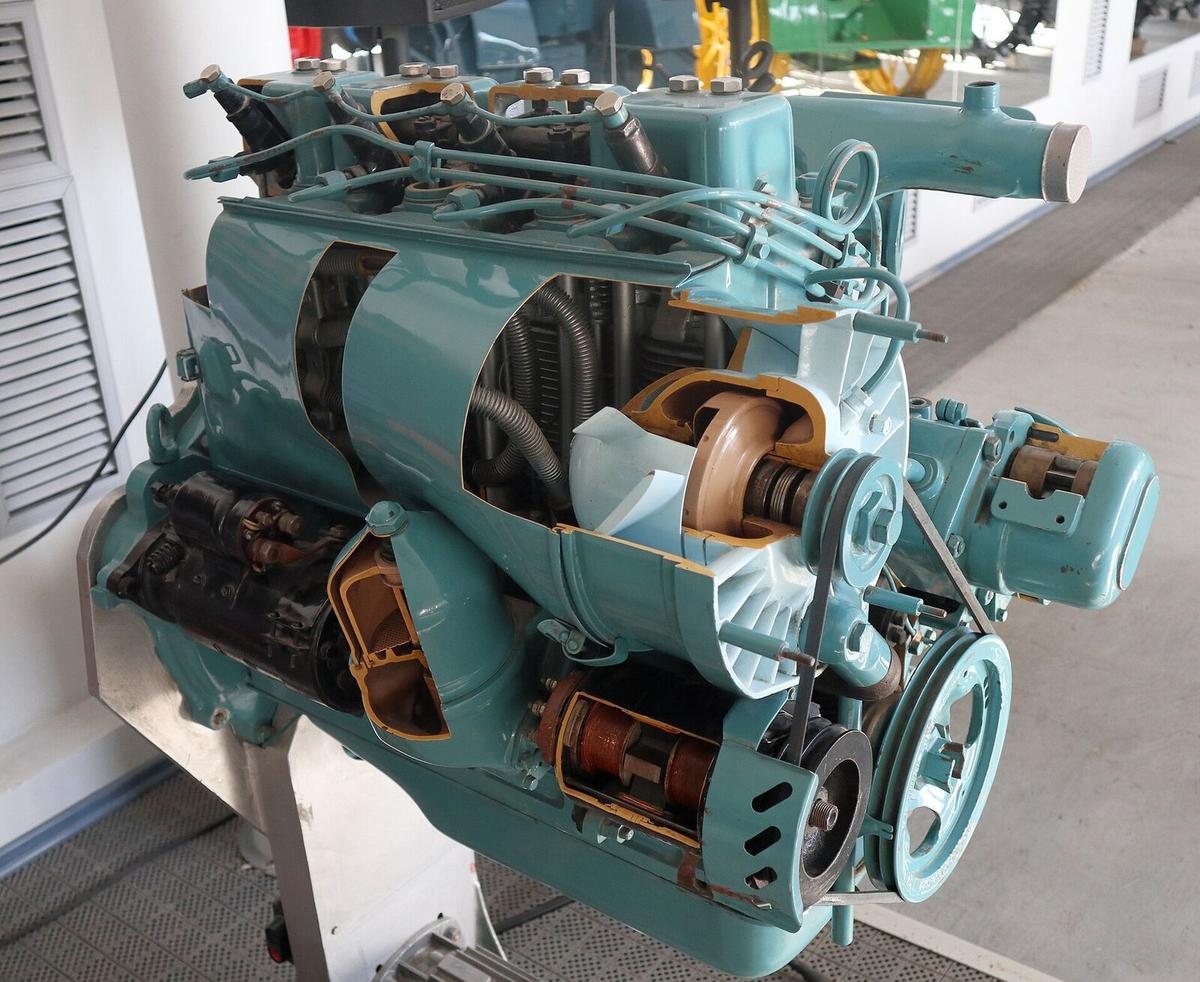 A cutaway diesel. The thin pipes along the top carry fuel at high pressure to an injector in each cylinder. Photo by Александр Сигачёв, CC0, via Wikimedia Commons.
What is different inside a diesel?
Pump up a bicycle tire and the pump gets warm. Squeezing air heats it. A diesel takes that effect to an extreme.
The same four strokes apply, with two changes. On the intake stroke, a diesel draws in only air. On the compression stroke, it squeezes that air far harder than a gasoline engine could. A US Department of Energy handbook on diesel engines says compression ratios from 14 to 1 up to 24 to 1 are commonly used. Near the top of the stroke, an injector sprays fuel into the hot air, and the fuel vaporizes and ignites by itself. Engineers call this compression ignition.
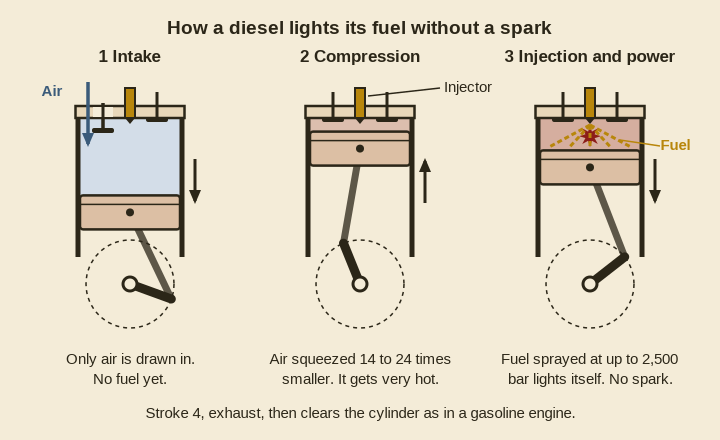 Compression ignition. The heat comes from the squeeze, and the timing comes from the injector.
Why can a diesel squeeze so much harder? In a gasoline engine, the fuel is already in the cylinder during compression. Squeeze too hard and it lights early, which is knock. In a diesel there is nothing to light until the injector opens. The handbook makes the point directly: the higher ratios are possible because only air is compressed.
The driver's pedal works differently too. A gasoline engine controls power by limiting the air. A diesel always takes a full gulp of air, and the handbook notes that speed is set only by how much fuel is injected.
How does the fuel get in?
Under enormous pressure. The fuel has to enter air that is already tightly compressed, and it must break into a mist fine enough to burn in the instant available.
Modern diesels use direct injection, which means the injector sprays straight into the cylinder. Most use a common rail: one strong tube that holds fuel at high pressure and feeds every injector, with a computer deciding exactly when each one opens. One maker's data sheet for truck systems lists pressures from 1,800 to 2,500 bar. A bar is roughly the pressure of the air around you, so that is up to about 36,000 pounds per square inch.
Parts made for those pressures have very fine clearances, which is why the Energy Department handbook stresses that diesel fuel must reach the engine extremely clean.
A cold engine is the weak point of the design. Cold metal soaks up the heat of compression, and the air may not get hot enough to light the fuel. So most small diesels have glow plugs: small electric heaters that warm each cylinder for a few seconds before a cold start. That is the coil-shaped light on the dashboard that asks you to wait.
Why do diesels pull so hard and use less fuel?
Three reasons stack up.
First, the fuel holds more energy. The US Energy Information Administration (EIA) lists diesel at 137,381 British thermal units (Btu) per gallon and gasoline at 120,214. That is about 14 percent more in every gallon.
| Gasoline | 120,214 Btu |
|---|---|
| Diesel | 137,381 Btu |
Source: U.S. Energy Information Administration, Units and calculators explained
Second, the engine wastes less of it. A harder squeeze means the hot gas expands further and gives up more of its heat as push. The government site fueleconomy.gov says diesel engines are generally one-third more efficient than their gasoline counterparts.
Third, the two effects multiply. Fueleconomy.gov says a diesel vehicle can often go about 20 to 35 percent farther on a gallon. For example, if a gasoline pickup gets 20 miles per gallon, the same truck with a diesel would get about 24 to 27. Over 15,000 miles a year, that is 750 gallons against 555 to 625. Now picture a freight company with 50 trucks that each burn 15,000 gallons a year. That is 750,000 gallons. An engine that went 20 to 35 percent less far on each one would need 150,000 to 260,000 gallons more.
The pull comes from pressure. A diesel's burn pushes much harder on the piston, so the engine makes strong torque at low speed. To survive that, it has to be built heavier. The handbook says a diesel weighs more than a gasoline engine of equal horsepower because of the stronger materials needed.
Turbocharging is close to universal. The same handbook notes that most diesel engines are either turbocharged or supercharged. A turbocharger uses exhaust gas to spin a compressor that packs more air into the cylinders. Gasoline engines must limit this to avoid knock. A diesel has no such limit, so it gladly takes the extra air and burns more fuel with it.
Where did the diesel engine come from?
From one stubborn engineer. EIA records that the German engineer Rudolf Diesel patented his original design in 1892. The Deutsches Museum in Munich, which holds his prototype, tells the rest. Diesel first started a test engine in August 1893 at a machine works in Augsburg. It took another four years to make one that worked properly.
That engine, built in 1896 and 1897, passed its acceptance tests in February 1897. It had one cylinder, turned at 172 rpm and made 20 horsepower. The museum's catalogue says it turned 26.2 percent of the fuel's heat into useful work, about double the steam engines of its day. The museum still has it.
Why trucks, ships, trains and generators?
EIA's list of diesel users reads like a list of hard jobs: freight and delivery trucks, trains, buses, boats, farm and construction machines, military vehicles, and generators that back up hospitals and large buildings.
They share three needs that a diesel meets.
- Fuel is their biggest running cost. An engine that goes a fifth to a third farther on a gallon pays for its extra weight quickly.
- They move heavy loads from low speed. That takes torque more than top-end horsepower.
- They run for long hours. An engine built heavy enough to stand diesel pressures tends to last.
Size is no barrier either. The Energy Department handbook describes diesels from a few horsepower up to 10,000, and calls them fuel efficient and extremely reliable if maintained properly. In most locomotives the diesel does not even turn the wheels. It drives a generator, and electric motors do the pulling.
What is the emissions problem, and what deals with it?
The same hot, high-pressure burn that makes a diesel efficient makes two pollutants.
Nitrogen oxides (NOx) form when the nitrogen and oxygen in air combine at very high temperature. They contribute to smog. Soot, which regulators call particulate matter, forms where droplets of fuel burn without enough air around them. It is the black smoke old diesels were known for.
Modern diesels carry a chain of equipment to handle both.
| Equipment | What it does | What EPA documents say |
|---|---|---|
| Exhaust gas recirculation (EGR) | Feeds some cooled exhaust back into the intake | Lowers combustion temperature and oxygen, so less NOx forms |
| Diesel particulate filter (DPF) | Traps soot in a porous filter, then burns it to ash | Cuts particulate matter by more than 85 percent |
| Selective catalytic reduction (SCR) | Sprays a urea solution into the exhaust ahead of a catalyst | Turns NOx into nitrogen and water, cutting it by up to 90 percent |
The urea solution is sold as diesel exhaust fluid (DEF) and lives in its own small tank. It is not a fuel additive and never goes in the fuel tank.
The fuel changed as well. Starting in 2006, EPA phased in ultra-low sulfur diesel, with no more than 15 parts per million of sulfur. The Energy Department says engine research has cut NOx and particulate emissions by more than 99 percent over the last 30 years.
What should you know about the fuel?
Cetane is diesel's counterpart to octane, and it runs the other way. Octane measures how well gasoline resists lighting by itself. Cetane measures how readily diesel does light under compression. The Energy Department's fuel data site says a higher cetane number means an engine that starts more easily, with less delay before ignition. Federal rules set a minimum cetane index of 40, or a cap on certain compounds as an alternative.
Gelling is the winter problem. Diesel contains wax. A national laboratory report explains that below a temperature called the cloud point, wax crystals form in the fuel and can clog the filter. Winter fuel in cold regions is blended to resist this.
Biodiesel is made from vegetable oils and fats and is sold blended with regular diesel. B5 means up to 5 percent, and the Energy Department says every engine maker approves it. B20, up to 20 percent, is the common higher blend. It has 1 to 2 percent less energy per gallon, and richer blends can gel in the cold.
Renewable diesel starts from the same fats and oils but is processed until it is chemically the same as petroleum diesel. It meets the same fuel standard and can replace regular diesel outright.
What should an owner know?
- Never put gasoline in a diesel. If you do, do not start the engine. Have the tank drained.
- Wait for the glow plug light before a cold start.
- Keep the DEF tank filled and act on dashboard warnings early.
- Give the particulate filter a chance to clean itself. EPA explains that the trapped soot burns off only when the filter gets hot enough. A diesel used only for short trips rarely gets there, so a longer highway drive now and then helps.
- Change the fuel filter on schedule and drain the water separator if your vehicle has one.
- Buy winter fuel in winter. Fuel bought in a warm region can gel when you drive it somewhere cold.
Tip
Before buying a diesel for mostly short trips around town, ask whether you will ever work it hard enough to benefit. Diesels pay back on long distances and heavy loads.
What to remember
- A diesel has no spark plug. It compresses air at 14 to 1 up to 24 to 1 and the heat lights the fuel.
- Fuel is injected straight into the cylinder at very high pressure, up to about 36,000 pounds per square inch.
- Diesel fuel holds about 14 percent more energy per gallon, and the engine is roughly a third more efficient.
- Strong low-speed torque, long life and low fuel use are why trucks, ships, trains and generators use diesels.
- The cost is NOx and soot. EGR, a particulate filter and SCR with exhaust fluid deal with them.
- Cetane is ease of ignition, wax causes winter gelling, and renewable diesel is a direct replacement fuel.
Next time a truck passes, look for the small second filler cap beside the fuel tank. That is the exhaust fluid. For an engine that took the opposite path, with no pistons going up and down at all, read How Rotary (Wankel) Engines Work.