Articles & BlogBy Trapper W. Brown12 min read
For anyone who has watched a phone battery that used to last all day give up by mid-afternoon. By the end you will know what is inside the battery, what moves when you charge it, why it fades, and why a damaged one is treated with respect.
Your phone says 23 percent. You plug it in, walk away, and an hour later it says 100. Nothing was poured in. No part visibly moved. Yet something inside went from one place to another, and tonight it will go back.
That something is lithium. The lithium-ion battery runs phones, laptops, power tools, e-bikes and electric cars, and its three main inventors shared the 2019 Nobel Prize in Chemistry. It is worth understanding for two reasons: it wears out in a way you can see on your own screen, and on rare occasions it fails in a way that makes the news.
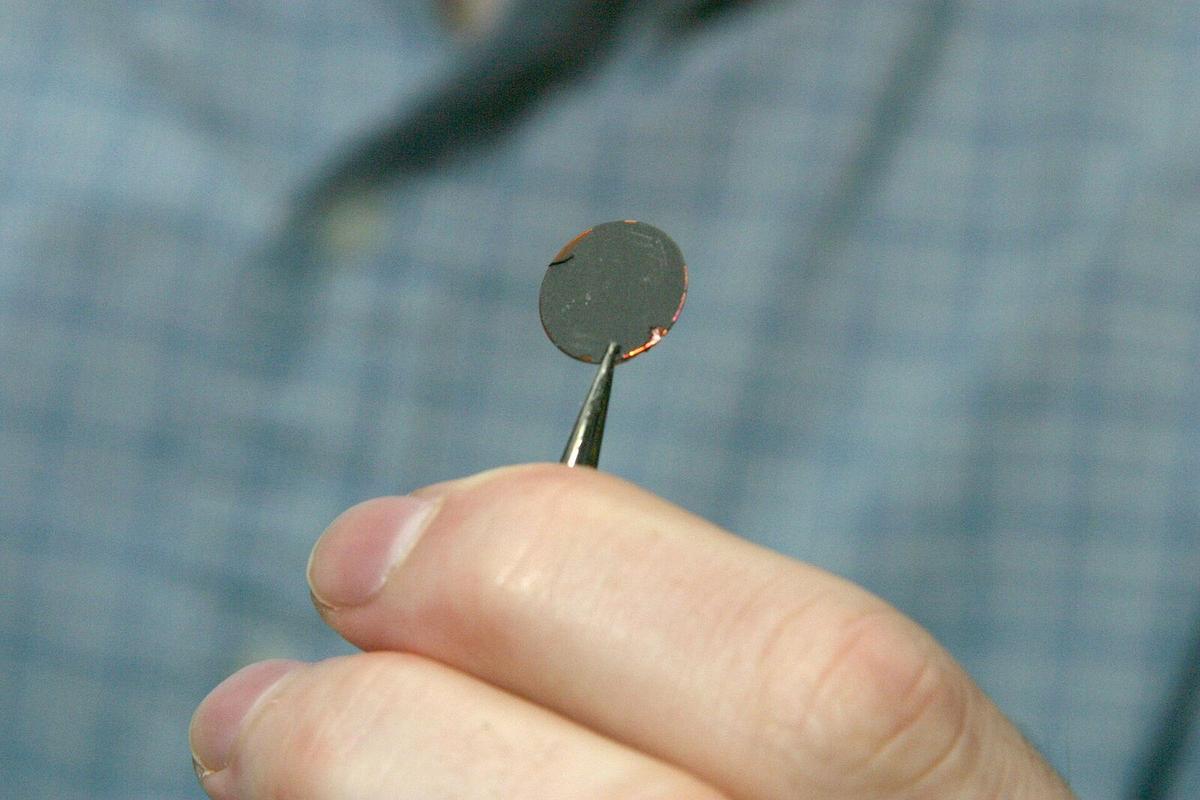 A test electrode for a lithium-ion battery: copper foil coated with a silicon and graphite mix, held by a researcher at Sandia National Laboratories. Photo by the U.S. Department of Energy, public domain, via Wikimedia Commons.
What is inside one?
A battery pack is made of one or more cells. The Occupational Safety and Health Administration (OSHA) lists what every lithium cell holds: "a positive electrode, a negative electrode, a separator, and an electrolyte solution."
| Part | What it is | What it does |
|---|---|---|
| Anode | The negative electrode. In phones and laptops it is usually graphite, a form of carbon. | Holds the lithium when the cell is charged |
| Cathode | The positive electrode. Usually a metal oxide that contains lithium. | Holds the lithium when the cell is empty |
| Electrolyte | A liquid with a lithium salt dissolved in it | Lets lithium ions cross between the two sides |
| Separator | A thin sheet with tiny pores | Keeps the two electrodes from touching while ions pass through |
An ion is an atom with an electric charge. A lithium ion is a lithium atom that has given up one electron.
The University of Washington's Clean Energy Institute says the most common pairing in portable electronics is a lithium cobalt oxide cathode with a graphite anode. Other cathodes it lists include lithium manganese oxide and lithium iron phosphate.
What does charging actually move?
Two things move, by two different paths.
The U.S. Department of Energy's Office of Science describes it this way: "Electrons move through the circuit, while simultaneously ions (atoms or molecules with an electric charge) move through the electrolyte." The ions take the inside route. The electrons cannot follow them, since the electrolyte does not carry electrons, so they take the outside route through the wire. That outside trip is the electric current that runs your phone.
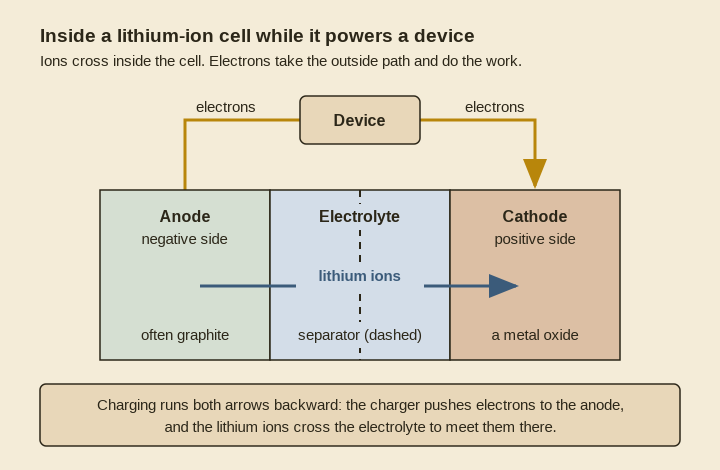 Ions cross inside the cell while electrons take the outside path through the device.
Using the battery. The Clean Energy Institute explains that during discharge, lithium atoms in the anode separate from their electrons. The ions "pass through the electrolyte until they reach the cathode, where they recombine with their electrons." The electrons get there by way of your device.
Charging it. The charger pushes the electrons back the other way. In the Office of Science's words, "When the electrons move from the cathode to the anode, they increase the chemical potential energy, thus charging the battery." The ions follow through the electrolyte.
Where do the ions go when they arrive? Graphite is built in flat layers, like a stack of paper. The lithium slips into the gaps between the sheets. Chemists call this intercalation. The Clean Energy Institute notes that the graphite is "not physically warped by charging or discharging", which is a large part of why the trick can be repeated.
That is the insight the Nobel Prize honored. Most other batteries work by reactions that slowly change the electrodes. A lithium-ion cell, the prize announcement says, is based "upon lithium ions flowing back and forth between the anode and cathode." Think of a parking garage with two decks. The cars move from one deck to the other and back, and the decks stay standing.
How did it come to be?
The Nobel Prize summary tells it in three steps. In the 1970s, M. Stanley Whittingham built a battery with a metallic lithium anode that gave just over two volts. It worked, and it was dangerous. As it was recharged, thin whiskers of lithium grew from the lithium electrode until they reached the other side and shorted the cell.
In 1980, John B. Goodenough showed that a cathode of cobalt oxide could give as much as four volts. In 1985, Akira Yoshino replaced the reactive lithium metal in the anode with a carbon material that could hold lithium ions between its layers. The result, the announcement says, "could be charged hundreds of times before its performance deteriorated." The first lithium-ion batteries went on sale in 1991.
Lithium earned its place for a simple reason. The Nobel Prize's background paper calls it "the lightest solid element," and it gives up its outer electron eagerly.
How much energy is in one?
Battery labels use three numbers, and one multiplication connects them. The Federal Aviation Administration (FAA) gives the rule on its page for air travelers: "To calculate Wh, multiply the battery voltage by the Amp hours (Ah)."
Volts measure the push. Amp hours measure how much charge the battery can deliver. Watt hours (Wh) measure the energy, which is the number that matters. Here are three example labels. The figures are illustrations, so read your own device for its real ones.
| Example battery | Volts | Amp hours | Watt hours |
|---|---|---|---|
| Phone | 3.85 | 5 | 19.25 |
| Laptop | 11.4 | 6 | 68.4 |
| E-bike pack | 48 | 15 | 720 |
The e-bike pack holds about 37 times the energy of the phone. That is why the FAA draws lines by watt hours. Its rule for passengers is that lithium-ion batteries "are limited to a rating of 100 watt hours (Wh) per battery," that larger ones up to 160 Wh need the airline's approval, and that batteries over 160 Wh are forbidden. The example phone and laptop are under the limit. The e-bike pack is far over it.
The same arithmetic shows why lithium won. The Clean Energy Institute says lithium-ion batteries store "as high as 330 watt-hours per kilogram," compared with "roughly 75" for lead-acid, the kind that starts a gasoline car. Storing 720 Wh at the top lithium-ion figure takes about 2.2 kilograms of cells. At the lead-acid figure it takes 9.6 kilograms.
Why does a battery age?
The garage is not perfect. The Office of Science says the processes inside a rechargeable battery "do not completely reverse as the battery is charged and discharged," and that over time this "can change the chemistry and structure of battery materials, which can reduce battery performance and safety."
A 2022 paper in the journal Physical Chemistry Chemical Physics, by researchers at Imperial College London and other universities, describes the main ways it happens in the graphite anode.
- A film grows on the anode. The electrolyte is not stable where it touches charged graphite. It breaks down and leaves a coating, called the solid-electrolyte interphase. The coating is made partly of lithium, and that lithium is trapped. It can never carry charge again. The authors call this "loss of lithium inventory." Fewer cars are left to park.
- Lithium plates out as metal. Sometimes ions arriving at the anode pile up on its surface as metal. The paper says this happens under conditions "such as low temperatures or when the graphite surface is fully lithiated," and with fast charging. Some of that metal is lost for good.
- Particles crack. The electrode materials swell and shrink a little with each cycle. The stress cracks them, and the fresh surfaces grow more film.
OSHA's bulletin on lithium batteries lines up with the lab work. It says damage "can occur when temperatures are too high (e.g., above 130°F)," and that charging below freezing "can lead to permanent metallic lithium buildup (i.e., plating) on the anode."
So the percentage on your screen is honest and still misleading. It is a percentage of what the battery can hold today, and that amount shrinks.
Why can one catch fire?
A charged battery is a lot of energy in a small space. The National Fire Protection Association (NFPA) explains: "When that energy is released in an uncontrolled manner, it generates heat, which can turn certain internal battery components into flammable and toxic gases."
The failure has a name, thermal runaway. UL Research Institutes, a safety science organization, defines it as "a phenomenon in which the lithium-ion cell enters an uncontrollable, self-heating state." Normal use makes a little heat, and the cell sheds it. In thermal runaway, UL says, the cell "generates heat at a rate several times higher than the rate at which heat dissipates." Heat speeds up the reactions, and the reactions make more heat. UL's threshold is a temperature rising faster than 20 degrees Celsius a minute, with peaks above 300 degrees Celsius.
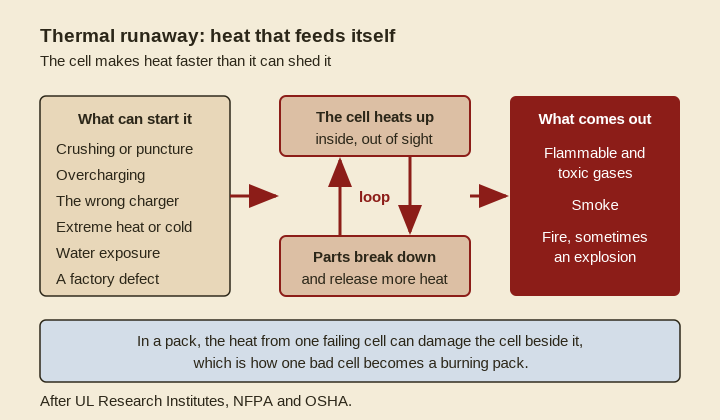 Thermal runaway is a loop: heat causes breakdown, and breakdown makes more heat.
What starts it? The NFPA's list: "physical damage (e.g., the battery is penetrated or crushed or exposed to water), electrical damage (e.g., overcharging or using charging equipment not designed for the battery), exposure to extreme temperatures, and product defects." In a pack with many cells, OSHA adds, heat from one failing cell "can damage nearby cells, releasing more heat in a chain reaction."
Keep the scale in view. OSHA's bulletin says lithium batteries "are generally safe and unlikely to fail, but only so long as there are no defects and the batteries are not damaged." The same bulletin cites a 2018 Consumer Product Safety Commission report of "over 25,000 overheating or fire incidents" across more than 400 types of products in five years. Failure is unlikely, in OSHA's word. The harm when it happens is not small.
Watch out
A swollen battery is a damaged battery. The Environmental Protection Agency says: "The swelling indicates damage to the battery and is a potential fire hazard." The NFPA's list of warning signs is "an unusual odor, excessive heat, popping sounds, swelling, or change in color," and its instruction is to stop using the device.
What do the safety bodies tell owners to do?
These are the NFPA's words for devices such as phones, laptops and tools.
- "Purchase batteries that are only listed by a nationally recognized testing laboratory and labeled accordingly."
- "Stop charging a battery once it is full."
- "To be safe, use only the charging equipment that is supplied with your device."
- "Have all repairs performed by a qualified professional."
For e-bikes and e-scooters, the NFPA says not to charge "when either the charger or the battery is damaged" and not to store batteries "in an area that blocks the only exit" from a room.
Tip
When a battery reaches the end of its life, it does not go in the trash or the curbside bin. "The Speaker Battery Recall and How to Dispose of a Recalled Lithium Battery" walks through where it does go, and why a recalled battery follows a stricter path.
What do people get wrong?
"You have to run it flat before recharging." That advice comes from the memory effect, in which repeated partial charges make a battery "remember" a lower capacity. The Clean Energy Institute says lithium-ion batteries "have no memory effect."
"There is lithium metal inside." Not in a healthy lithium-ion cell. Removing pure lithium was the 1985 breakthrough. The lithium is present as ions.
"Water makes a lithium-ion fire worse." The NFPA addresses this in its guidance to fire crews: "Firefighters should use water to fight a lithium-ion battery fire." It traces the confusion to pure lithium metal, which does react with water. That is a statement about what firefighters do. It is not an invitation to fight a battery fire yourself.
"A battery that sits unused stays full." It drains slowly. The Clean Energy Institute puts self-discharge at around 1.5 to 2 percent a month.
"If it still works, it is fine." Damage inside a cell may not show. Swelling, heat, odor and noise are the outward signs, and the official guidance for each of them is to stop.
What to remember
- A cell has an anode, a cathode, an electrolyte and a separator. Lithium ions cross inside, and electrons go around through your device.
- Charging pushes the lithium into the graphite anode. Using the battery lets it return to the cathode.
- Watt hours equal volts times amp hours, and watt hours are the measure of stored energy.
- Batteries age because a little lithium is trapped or lost with each cycle. Heat, charging in the cold and fast charging speed that up.
- Thermal runaway is heat feeding on itself. Damage, the wrong charger, extreme temperatures and defects are the triggers the NFPA names.
- Swelling, odor, heat, popping or a color change mean stop using it.
Cells like these, wired together into large packs, also drive electric cars, and "How Electric and Hybrid Cars Work" follows the energy from the pack to the wheels.
Sources (11)
- U.S. Department of Energy, Office of Science, "DOE Explains...Batteries", last updated 11 December 2023
- The Royal Swedish Academy of Sciences, "Press release: The Nobel Prize in Chemistry 2019", 9 October 2019
- The Royal Swedish Academy of Sciences, "They developed the world's most powerful battery", popular science background, 2019
- University of Washington Clean Energy Institute, "Lithium-Ion Battery", read 15 November 2026
- O'Kane and others, "Lithium-ion battery degradation: how to model it", Physical Chemistry Chemical Physics, 2022, author version on arXiv
- Occupational Safety and Health Administration, "Preventing Fire and/or Explosion Injury from Small and Wearable Lithium Battery Powered Devices", Safety and Health Information Bulletin, 20 June 2019
- UL Research Institutes, "What Is Thermal Runaway?", read 15 November 2026
- National Fire Protection Association, "Lithium-Ion Battery Safety", read 15 November 2026
- Federal Aviation Administration, "PackSafe: Lithium Batteries", last updated 11 August 2026
- Federal Aviation Administration, "Lithium Battery Resources", read 15 November 2026
- U.S. Environmental Protection Agency, "Frequent Questions on Lithium-Ion Batteries", last updated 14 April 2026